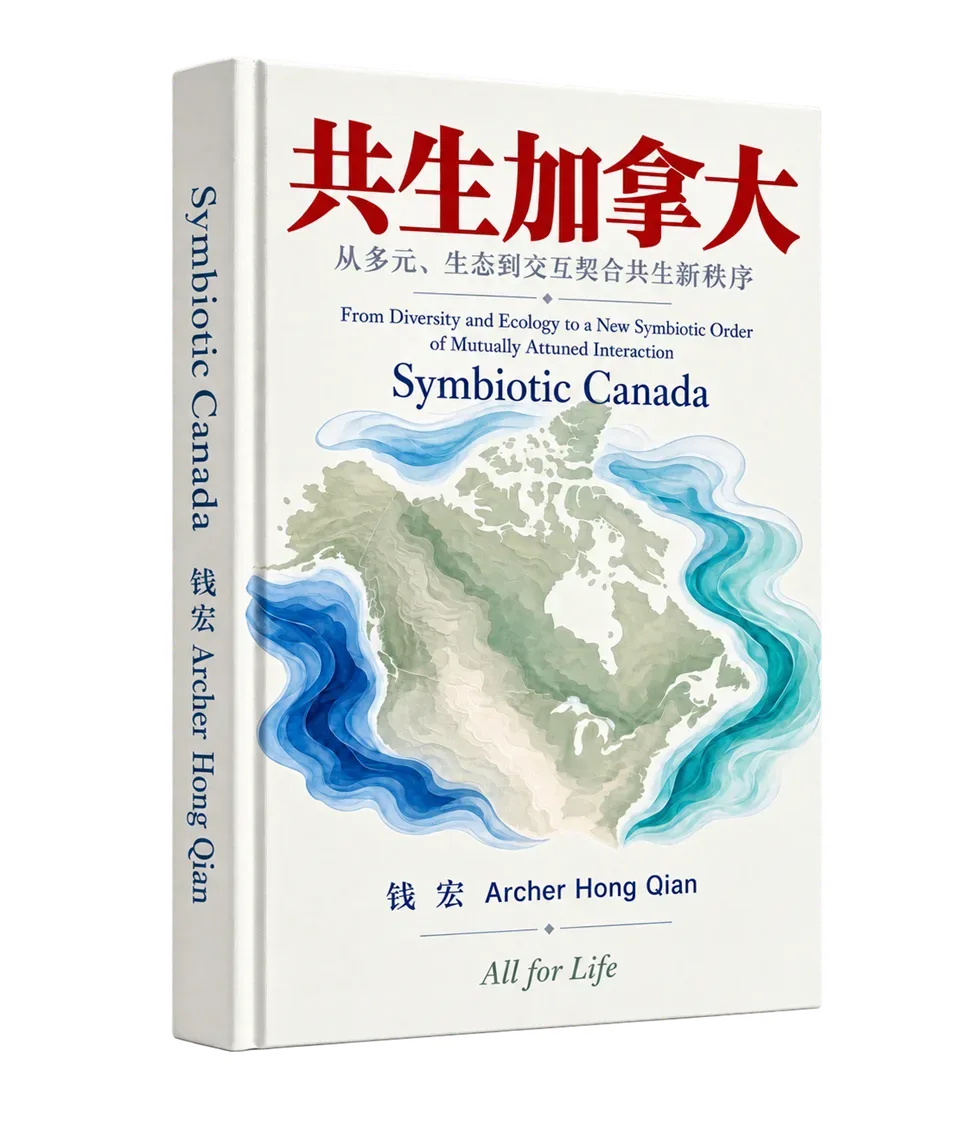
共生加拿大 Symbiotic Canada
共生加拿大
Symbiotic Canada
——从多元、生态到交互契合共生新秩序(写作大纲)
From Diversity and Ecology to a New Symbiotic Order of Mutually Attuned Interaction( Writing Outline)
钱 宏 Archer Hong Qian
谨以此书献给加拿大建国160周年
全书立意
作为G7成员的加拿大——一个拥有丰厚资源的国家,为何仍让普通人的生活承受多重压力?回到生命创造国家繁荣的原点:从斯密的和平、轻税与适当的司法行政,到加拿大立国的良好政府,追问权力与资源怎样向生命承兑。以共生哲学贯通多元、生态、组织与邻里关系,让经济增长与AI/SI的能力回到生命的幸福、尊严和创造。值此2027建国160周年之际,作者倡议建立“加拿大学”,共同开创一个全新的共生加拿大。
受生命之托,向生命承兑。All for Life,Live and let live。当今世界最大的政治,是人的身心灵健康。
五编结构
第一编 回到原点 生命创造与加拿大的生成
第二编 看见问题 从国家增长进入生活账本
第三编 理解共生 从多元并存进入交互生成
第四编 重建信托 让良好政府接受生命检验
第五编 重新出发 共生加拿大与All for Life
开篇 加拿大小史
加拿大的故事,要从地图上的国界出现以前讲起。
那时没有加拿大,也没有美国。今天分属两个国家的山脉、平原、湖泊与河流,正在漫长的地球运动中形成。岩浆冷却,海洋开合,陆块碰撞,山脉隆起;冰川后来覆盖大地,又逐渐退去。生命在变化的土地上繁衍,人们沿着海岸、河谷与草原生活。
1867年,加拿大联邦成立。
一个国家由此有了明确的政治起点,而它所承载的土地、生命与生活,已经拥有极为悠久的历史。
小史从地质构造、山川与冰川塑形写起,进入原住民生活、欧洲殖民、移民定居、联邦建立、国家自主与多元社会的发展;专门写入阿米什人的信仰、家庭、农耕与技术选择,再由加拿大的历史积累,转入今天的问题。
加拿大拥有辽阔土地、丰富资源、多元人口、公共制度与教育科研基础,又与美国形成深厚的产业和生活联系。为什么住房、生产率、公共服务、地区关系与组织信任,仍会同时承受压力?这一问,构成全书的出发点。
不久前,作者读了过去三十年间加拿大人写的十五本关于加拿大现状的书,于是写了一篇《加拿大怎么了?——从十五本加拿大著作看内在危机、邻里关系与共生的可能》(请参阅愛之智慧网:https://www.amorsophia.com/article/10320)。透过这十五本书,我们分别看见加拿大经济结构变化、民主制度、住房、人口、社会安全网、生态与美加关系;把它们放到一起,追问这些问题怎样交互发生,为什么国家积累的财富与能力,未能充分进入普通人的生活,是一个很有趣的切入。
从“大转变”走向“临界点”,由内部组织与生活压力,进入北美邻里关系和国家主体性。住房连接人口,人口连接就业与生产率,财政连接公共服务,生态连接能源与美国市场;宏大的政治经济问题,最终回到家庭、社区和每一个具体生命。
全书由此提出的核心问题是:加拿大怎样重新释放生命的创造力,使国家组织、经济活动、公共制度与AI/SI,都导向生命承兑本身?带着这个问题,进入加拿大的生活与历史,回到“三个时代”的原点,展开共生文明的规范、检验与实践。
第一编 回到原点
顺着“加拿大怎么了?”的追问,从家庭生活进入国家的根本问题:生命怎样创造,国家怎样形成,公共权力为何存在。三个时代的原点确立全书尺度,再由加拿大的多重历史进入“共生之域”的思想发生。
第一章 从一个孩子的加拿大说起
2020年1月19日,我来到加拿大。五岁的外孙Richard参加中国央视在本拿比组织的一场儿童演唱会,认真唱完《我和我的祖国》。回家以后,我问:“你的祖国是哪里?”他回答:“加拿大呀!”
从Richard的回答展开移民第一代、第二代与第三代的身份经验。血缘、出生地、语言、文化记忆和共同生活,怎样进入一个人的归属?孩子的加拿大首先是亲人、学校、邻居和可以安心成长的生活。
以日常经验确立全书的生命尺度:国家建设的成果,需要进入具体人的尊严、安全、责任和创造机会。
从来到加拿大后的思想公益经历展开:从因疫情延长停留,到在地公益讲座、文化交流、青年心路写作与持续著述,说明一种思想怎样通过具体的人、家庭与社区发生。2026年是来到加拿大的第七个年头,经历的时间与思想生成相互连接。
第二章 三个时代的原点
1755年,斯密把繁荣的基本条件概括为和平、轻税和过得去的司法行政。这一表述由Dugald Stewart转述保存。和平保护生命创造,轻税激励生命创造,司法行政保障产权、契约与交往秩序,使生命能够把能量用于劳动、投资、创新与生活。
1867年,加拿大把Peace, Order, and good Government写入立国宪制语言。结合《宪法法》第91条的立法权限语境,展开国家组织与公共责任的讨论:Good如何保证?政府取得权力、税收和公共资源以后,须向生命承兑什么?
共生经济学把这一问题推进到组织信托与生命效能。生命是目的,组织是受托;GDE检验增长,R检验效能转化,H=G/T检验人民获得公共价值所付出的成本及其幸福与尊严。三个时代在生命原点相遇:生命创造、组织受托、价值承兑、共襄生成。
和平、稳定规则与可预期的交往,是长期积累的财富。和平越持久,越要看见它所保护的生活与创造。
第三章 这片土地怎样生成一个国家
由原住民的先在历史,进入First Nations、Inuit、Métis与后来英法传统及世界各地移民的相遇。呈现合作、冲突、殖民创伤、条约关系与制度形成,理解加拿大在多重历史关系中持续生成自身。
将英法关系、魁北克、西部与大西洋地区放进联邦形成和发展中,考察国家统一、地方自治、地区利益与集体行动。以唐纳德·J. 萨瓦(Donald J. Savoie)《加拿大民主:我们的制度正在瓦解》的制度观察追问:历史继承的组织怎样适应加拿大不断变化的现实?
从1867年的联邦组织与权力分工,进入1982年的权利与自由保障、原住民权利及修宪程序。把权利、授权、限制与救济作为制度坐标,考察历史责任、现有合法权益与共同未来怎样获得持续的组织安排。
第四章 从反歧视到避免逆向歧视进入贡献主体
从2021年中国弃婴、加拿大奥运冠军麦克尼尔引发的思考,进入“愛是尽善尽美的联结”。消除坏关系之后,怎样生成好关系?从“受害者”的历史经验,绕开“逆向歧视”,走向“贡献者”的现实行动,从“私民”走向“公民”。
以2023《历史总要翻篇,反思亟需升维:创建一个全新的“共生加拿大”——在“反思排华法案出台100周年论坛暨加拿大156周年国庆晚宴”上的主题发言》为节点,记住伤害,承担责任,防止逆向歧视,并为后来者打开创造未来的位置。
第五章 从山巅之城到共生之域
从2020年“全球共生历史公园”及公益讲座和倡议写起:不同历史与文化能否在同一体验空间中被看见、理解,并生成关系?这颗种子后来生长为共生教育与心智共生乐园,成为思想进入家庭生活的具体路径。
以Pasion、Vision、Mission、Expansion、Action五大品行,为思想现场(2021年11月28日温哥华演讲):亚裔、华裔加拿大人能够贡献怎样的精神象征?“共生之域”把获得生活机会的个人愿望,推进为共同创造制度文明的公共责任。
展开“存同尊异,间道竞和,降本赋能,全息共生”。精神象征要进入行为、规则和组织实践,才能成为共同生活的文明条件。由此转入加拿大现实:已有的多元与制度积累,为何仍会伴随多重生活压力?
以《树立加拿大精神,提振温哥华城市精神》为参照,展开Live and let live:横向意味着自己活,也让别人活;纵向意味着生生不息。国家精神与城市精神,通过教育、社区互助、贡献激励和公共服务进入日常生活。
第二编 看见问题
十五本加拿大著作提供不同的问题窗口。以生命创造与托付—承兑关系贯通住房、人口、税收、公共服务、生态与民主运行,辨认国家账本上的增长怎样进入或偏离普通人的生活。
第六章 大转变怎样走向临界点
以达雷尔·布里克(Darrell Bricker)与约翰·伊比森(John Ibbitson)的《大转变》(The Big Shift)与《临界点》(Breaking Point)作对照,观察人口来源、经济重心、传统精英结构和地区力量的变化。变化需要住房、基础设施、社区和制度相应调适。
区分内部长期积累与外部压力的放大作用。把一切困难归因于某个政党、某位领导人或美国,都会遗漏加拿大自身的组织适应问题。
第七章 从一间房子看经济与生活
参照卡罗琳·惠茨曼(Carolyn Whitzman)的《住房真相:破解加拿大住房危机》(Home Truths),追问住房对投资者、银行、政府、房地产行业与家庭分别意味着什么。资产升值、税收和GDP增长,怎样与租金、购房成本、房产税、物业费及社区稳定形成不同账目?
纳入退休居民的持续居住能力、青年成家、劳动者通勤与企业用工。并将原住民历史权益和后来者财产安全列为需精确辨明的组织问题:把法律依据、权利边界、责任主体和救济安排放在同一视野中。
第八章 人口怎样成为创造力
将道格·桑德斯(Doug Saunders)的《最大化加拿大:迈向一亿人口的国家》(Maximum Canada)与现实生活承载问题对读。人口规模可能扩大市场、分工和创造机会;其效果取决于住房、医疗、教育、交通、就业与生产率能否交互契合。
区分人口规模、增长速度、年龄与技能结构、地区分布以及公共设施供给。把移民本人和原有居民同时纳入生活账本,检验人口增长怎样转化为共同创造能力。
将《“AI for All”:影响世界生态的三件大事》提出的全球AI人才汇聚构想,纳入人口与创造力的讨论。人来到加拿大,Mind也来到加拿大;住房、科研条件、创业环境、社区归属与价值承兑共同决定不同Mind能否连接为Minds。人才政策由数量目标推进为生活、创造与信心的组织条件。
进一步追问人才、资本、大学、企业与社区怎样形成有益交互。吸引研究者、工程师和创业者,需要把就业、创业、科研设施和家庭生活安排放到同一张账本中;用新增创造、合作网络、生活改善与持续发展能力,检验公共资源投入的结果。全球人才流动由此连接加拿大内部的组织创新,也连接北美共同创造的可能。
第九章 税收与服务之间发生了什么
将诺拉·洛雷托(Nora Loreto)《社会安全网:衰退中的加拿大(第一部)》对社会安全网衰退的分析,与行政成本和管制负担的批评对读。居民可能同时面对税负不低、服务等待与生活成本上升,必须追踪资源取得、组织消耗和实际服务的完整过程。
从“税务自由日”进入家庭生活账本,辨明不同税负口径,再追问:政府取得资源以后,向家庭承兑了什么?多工作、多创业、多投资带来的收益,怎样被税费、行政程序、合规和等待成本改变?
将住房、就业、投资、生产率、税源、财政与公共服务连接起来,辨认公共职能的缺位与组织消耗的膨胀。具体问题为第四编留下共同追问:取得与承兑怎样相称,生命创造的转动力怎样保持?
第十章 生态保护怎样回到生命与生活
以J. B. 麦金农(J. B. MacKinnon)的《曾经与未来的世界:自然的过去、现在与可能》(The Once and Future World)提醒读者:习惯退化后的自然,会缩小对生命可能性的想象。珍惜加拿大的森林、河流、湖泊与自然空间,是讨论生态政策的前提。
区分生态现实、生态主义理念、环境政策与实际结果。把自然保护、能源供给、住房建设、产业就业和家庭成本共同纳入生態背负与生命效能的考察,追问谁受益、谁承担代价,以及能否形成更好的组织安排。以欧盟碳排放配额交易为例,考察减排实效、交易利益与组织成本,警惕指标和管理体系脱离生态目的后自我繁殖。
第十一章 民主授权怎样进入组织运行
以安德鲁·科因(Andrew Coyne)的《加拿大民主的危机》,以及唐纳德·J. 萨瓦(Donald J. Savoie)的《加拿大民主:我们的制度正在瓦解》为参照,从党魁、党团、议员、议会、行政体系、司法与媒体的关系考察组织责任。民主授权之后,还要追问受托者做成了什么,权力如何受到监督,错误如何被发现与纠正。结合萨瓦对公共机构的分析,追问监督制度自身如何接受监督、纠错与效能评价。
本编归结为一条问题链:人口与住房交互,住房与就业交互,就业与投资和生产率交互,财政与服务交互,生态与能源交互,北美关系又进入每一个环节。共同尺度由此落在生命与生活。
第三编 理解共生
生命本自具足,又非独存。没有人是可支配、操纵和诈取的法理Object,不同Subject需要尊严、自由和创造空间,更需要Intersubjective Symbiosism愛之智慧规范你、我、他(她它祂)生产、生活、生態。本编从多元的贡献进入交互契合共生秩序,阐明组织信托所保护和连接的究竟是什么。
第十二章 多元文化主义的贡献与待解之题
认真说明Multiculturalism在平等权利、文化尊严和公共参与方面的贡献。不同者能够在一个国家中保有语言、信仰与文化,是加拿大值得珍惜的文明成果。
继续追问:平等存在以后,主体之间怎样交往?群体各自保有身份,如何形成共同规则、公共责任与创造关系?多元提供主体并存的事实,文明还需要组织有益交互的规范。
多元的价值,要由有益交互与共同创造检验。主体更多、连接更广,还须看合作是否降本赋能,是否改善共同生活。
从《加拿大宪法》进入多元文化的制度基础:权利与自由宪章第27条涉及多元文化遗产的解释原则,并须与基本自由、平等权、权利限制和司法救济整体阅读。不同主体的文化尊严与共同公共责任在同一宪制秩序中展开。
第十三章 生命本自具足 又非独存
正式阐明万事交互主体共生 Everything Intersubjective Symbiosism(EIS)。生命具有自身的主体性,又始终处在与他者的关系中;尊重主体与理解关系须同时展开。
差异并不自动生成共生,连接、交互也可能造成支配、伤害与负载。必须考察交互的内容、组织方式和生命结果。共生以主体获得有益交互和新的生成可能为实际内涵。
确立一个文明级判断:多元是事实,生态是条件,共生是文明规范。差异是主体存在与交互的基本条件,也可能引发冲突、对立与混乱;只有不同主体发生有益的交互与组织生成,才形成共生。
第十四章 一视为仨与间道的生成
从“主体—主体—间道”展开:加拿大内部的族群、地区、机构与个人,以及加拿大与美国,都有自身位置;关系本身也有需要理解和组织的生成空间。
你我他(她它祂)主体的交互可以形成任何一方单独都不曾拥有的能力、价值与生活可能。“间性”包括共同规则、合作组织、公共设施、知识与文化生成,须在具体关系中辨明。连接—交互—契合—生成,是需要条件与检验的过程。
长期交往形成的规则、市场、合作经验与信任,构成“间性”的积累。调整关系时,要辨明哪些需要改变,哪些值得延续;国家自主也包含维护和更新有益关系的能力。
第十五章 尊重主体与承担行为责任
建立共同规范:尊重具体生命,依据事实判断行为,以适用一致的规则处理责任。反歧视应持续消除歧视;同一事实标准不应随族裔、性别、宗教或政治归属改变。
提出身份互换检验,并说明历史处境、实际需要和法律责任须被准确辨明。关怀弱者、公共安全和行为责任要进入同一套可以说明、执行与纠错的安排。
把平等权及改善处境不利群体的安排一并纳入讨论。对历史伤害和现实不利处境的回应,须说明目的、事实、法律依据与实际效果;主体尊严、差别处境和一致适用的法治原则共同构成判断条件。
第十六章 从文化交往进入信任
在“2024’ Multiculturalism and Anti-Racism Awards颁奖典礼期间与省议员Mable Elmore交流,提出在Multiculturalism概念里,注入Symbiosis的意涵,明确北美蓝天白云下的各族裔“Live and let live”的规定性,叫Multi-Symbiosism,意义会更加明确而积极。Multi-Symbiosism,就包涵了“多元”这一现象描述和“共生”这一本质规定,因而给“多元文化”赋予了哲学灵魂,不仅是一种新认知,而且是一种价值取向,反种族主义(Anti-Racism)自然是题中应有之义。这样,Multi-Symbiosism就成为一种新的生活方式——加拿大和BC省完全可以成为一个充满Amorsophia——愛之智慧的多元共生的国度和省份!
以此为Intercultural Trust思考为节点,展开交往怎样通过持续合作、履行承诺和公正处理争议形成信任。
信任为共生提供条件,组织责任使信任能够持续。当学校、医院、媒体、司法与政府承担越来越多生活职能时,共生文明必须进入组织信托。
第四编 重建信托
承接开篇Good Government的根本问题,把良好政府落实为持续检验的受托—承兑关系。先明确组织责任与创造激励,再以具体案例检查规则和服务,最后由GDE、R与H=G/T完成从增长到生活的检验。
第十七章 生命是目的 组织是受托
生命把权力、资源和部分生活职能交付组织,组织因此承担受托责任。Government回到Trust,意味着公共权力的取得、使用和结果,始终接受生命托付的检验。Organizational Trust(组织信托)使Good成为可以追问、验证和纠偏的关系。
以六问贯穿组织行为:受谁之托?向谁负责?谁受益?谁承担成本?结果由谁承兑?错误能否纠正?进一步把托付对象、资源使用、履约结果、公开验证与纠错程序落实到政府、企业、学校、医院和平台。
展开三重和平:人与人之间,人与组织之间,组织与组织之间。邻里和平与国际和平属于组织间关系;和平降低冲突、防范与交易耗散,使创造能够持续。受生命之托,向生命承兑,是三重关系中的共同组织责任。
契约经由持续履约与生活承兑,积累为组织信托。环境变化,可以依约协商、修订或退出;各方都须承担相应责任。决策者还须说明:眼前收益由谁取得,长期代价由谁及哪一代人承担?
第十八章 轻税与公共价值怎样相互承兑
回到斯密的生命创造原点,解释轻税如何激励劳动、投资、创业与创新。考察税收与行政、监管、合规成本的综合作用,辨认组织取得资源时怎样改变人的行动意愿及尚未发生的创造。
高税收与高福利之间,需要真实的公共价值承兑。医疗、教育、养老、安全与司法都要落实到服务对象与实际获得;政府预算、机构数量和政策善意须进入投入、组织成本与生活结果的对照。
以保护创造动力、明确公共职责和提高服务效能共同检验改革。把权力、税收、监管及服务安排放进同一受托关系,使家庭、社区、市场与政府各自获得相应的责任和行动空间。
第十九章 善意怎样在组织运行中偏离
以CBC的9·11用语争议为案例,追踪规则初衷、编辑指令、具体执行、公共反馈及纠正过程。以完整材料辨明责任,避免用政治标签代替分析。
从个案揭示善意进入组织后的实际路径:目的能否被规则准确表达,执行能否保留事实判断,纠错能否触及制度。自我纠错能力是组织信托的重要组成。
目标的完成,要由生命的结果检验。考察政策是否在达到局部目标时,损伤就业、安全、信任与长期创造条件,防止把治理责任转移为对外敌意或身份动员。
第二十章 欧洲的教训:加拿大怎样走出殖官主义困境
黄仁勋问德国总理默茨:“连技术都没有,你监管什么?”默茨推动本国企业运用国际AI技术,激活工业积累,启示加拿大正视产业创造与监管的先后关系。从奶农倒掉超配额牛奶,到可交易的碳排放许可,再到漫长的基础设施审批,追问制度如何从解决问题转向维护自身:谁制定配额,谁可以买卖,谁掌握审批评估,谁获益,谁承担成本?殖官主义在机制上使规则、指标和交易权利自我繁殖,在体制上使权力与既得利益固化。以开放合作、契约信用、组织信托和GDE检验监管实效,让公共权力服务生命创造。
第二十一章 每一个生命怎样获得保护与服务
以BC毒品政策、治安、公共空间与社区照护为案例,将成瘾者的生命健康、居民通行、儿童活动、商户经营和一线服务能力共同纳入检验。区分官方数据、公众安全感与具体城市经验,依据政策时序和执行结果展开判断。
由医疗等待、教育资源、移民服务与基础设施配置,明确不同层级政府和服务机构的受托对象、资金来源、职责边界与结果。关怀弱者、保护公共安全和承担行为责任,需要形成能够同时履行的组织安排。
建立政策目标、资源投入、执行过程、服务结果及公开纠错的责任链。每一项新增承诺都要说明资源、组织能力与对已有服务的影响,让取得与承兑在具体生命的生活中接受检验。
第二十二章 从GDP进入GDE价值参量
GDP记录生产与交易,GDE继续检验它们怎样作用于生命。道路修复、医疗支出、行政活动和冲突后的重建,即使都进入GDP,在生活账本上仍需辨明其创造、修补与耗散的不同结果。
GDE=Σ(GDP?×η?);η?=GDE?/GDP?;R=GDE/GDP。GDE固定为Gross Development Effectiveness,国内生产效能总值。每项GDP经由生命效能系数η?进入检验,R观察经济活动所形成的生命效能与GDP的比例。将监管制度的目标成效与组织成本分别入账:谁制定指标、谁持有配额、谁取得收益、谁承担等待与浪费?
C降本,释放生命;E赋能,激发生命;H健康,养护生命;T信任,连接生命;P和平,共襄生命。把住房负载、公共承载、生態背负、组织消耗与新增创造共同记账,明确对象、时期、比较基准及指标口径,使Good Government获得生命效能尺度。
将和平与信任保护的创造、减少的耗散,以及破坏关系后的替代和重建成本纳入比较。既看新增多少价值,也看保存了哪些生活条件。
第二十三章 幸福与尊严怎样进入生活
H=G/T。H(Happiness & Dignity)指人民的幸福与尊严;G指组织受托所形成的真实公共价值;T(Transaction Cost & Marginal Benefit Cost)指人民获得公共服务、维护合法权益、实现自身价值和维持正常生活所付出的社会交易成本与边际获益成本。
看病等待、教育负担、创业审批、经营合规、权利救济中的时间、金钱、机会和尊严损耗,构成Good Government每天接受的生活检验。在G大体相近时,T越低,H越高。此式的H、T与GDE五因中的H健康、T信任,依各自公式语境区分。
至此贯通三个时代的原点:斯密揭示创造条件,加拿大确立公共组织的宪制秩序,共生经济学以组织信托、GDE、R及H=G/T检验其承兑。让生产回归生活,生活呈现生态,生态激励生命,为下一编的实践提供共同尺度。
第五编 重新出发
以生命创造为动力,以组织信托为责任,以效能和生活体感为检验,推进加拿大内部、北美邻里和AI/SI时代的共生实践。由此提出面向2027年建国160周年建立“加拿大学”的构想,归于All for Life。
第二十四章 原住民与后来者怎样共同生成
将历史承认、条约关系、和解、自治、公共服务、就业与产业合作联结起来。原住民与后来者都应具有参与安排、表达异议、承担责任与共享成果的位置。
围绕土地使用、社区建设和合作项目,明确历史权利、现有合法权益、协商程序、受益安排及争议救济。共同生成须通过具体制度,使对历史的责任与对未来的建设相互连接。
第二十五章 地区与社区怎样形成创造能力
从家庭、社区、市政、企业、学校及社会组织的真实合作出发,讨论住房、照护、青年就业、技能培训和公共空间。联邦与省、市的职责应围绕问题协同,并保留基层判断与创造空间。
经济、政治、文化的自组织,以及心智、行为、制度的相应作用,共同进入实践视野。自组织(动能)与共生/共襄生成(势能)是相应相辅相成关系;实践要同时释放主体行动能力并形成有益的组织关系。
把“以孩子为中心的教育、以教师为中心的学校、以学校为中心的社区、以社区托底的政治经济文化生態”作为社区实践线索。依托现有社区服务空间,组织面向各年龄与族裔的公共学习、创业支持、情感护理和文化交流,逐步形成“社区共生大学”的教育功能。
第二十六章 加拿大与美国怎样成为邻居
以罗伯特·博思韦尔(Robert Bothwell)的《你的国家,我的国家:一部美国与加拿大的共同历史》、J. L. 格拉纳特斯坦(J. L. Granatstein)的《美国佬,回家去?加拿大人与反美主义》,以及迈克尔·亚当斯(Michael Adams)的《火与冰:美国、加拿大与价值观趋同的迷思》为参照,考察战争、边界、产业、文化与国家认同。经济连接与价值差异可以长期并存,国家主体性也在关系中持续形成。
将1812年战争及其后的关系转变作为历史线索,结合唐纳德·E. 阿贝尔森(Donald E. Abelson)与斯蒂芬·布鲁克斯(Stephen Brooks)的《历史使我们成为朋友:重新审视加拿大与美国的特殊关系》,以及阿萨·麦克彻(Asa McKercher)与迈克尔·D. 史蒂文森(Michael D. Stevenson)的《构建特殊关系:艾森豪威尔时代的美加关系,1953—1961》,展开“特殊关系”研究与“宽容性调适”,说明有分歧的主体怎样建立持续合作。历史仪式、访问与政治言论只作关系观察的具体材料,保持宪制角色、政策议程和个人表达的区别。
以三重和平进一步理解邻里关系:美加双方的独立主体地位,与产业、家庭和文化生活的深度连接相互并存。和平本身具有经济效能,处理分歧的方式会直接改变两国的企业成本、家庭生活与未来信心。
以《太平、繁荣得不耐烦》中的两宋故事作反向教材,辨认借远方力量打击近邻、破坏既有关系所引发的连锁后果(https://www.amorsophia.com/article/10272)。分别交代盟约、战争与履约背景,再追问:为何低估已有和平,却高估想象中的远方?以此警惕政治情绪遮蔽生活账本,珍惜美加长期形成的有益连接。
第二十七章 从合并想象进入主体间性
将黛安·弗朗西斯(Diane Francis)的《世纪合并:为什么加拿大与美国应该成为一个国家》(Merger of the Century)与萧伯纳The Apple Cart并置:深度连接提出合作问题,政治合并还涉及代表权、决定权与权力重心的重组。由此追问连接究竟可以生成哪些组织形式。
将“第51州”话题放回政治语言、谈判与舆论的具体语境,区分主权问题与制度实现条件。加拿大保持加拿大,美国保持美国,双方仍可在能源、产业、安全、科研和生活网络中生成新的共同能力。
第二十八章 打开北美自由贸易区生活账本
承接杰弗里·黑尔(Geoffrey Hale)《如此之近,又如此之远:美加关系的公开与隐秘世界》对跨境组织网络的观察,以及《加拿大媒体人当谨言慎行》的生活账本思路,沿贸易、企业、就业、收入、家庭和社区逐层展开。能源、电网、零部件、农产品、资本、学生与跨境家庭都进入观察(https://www.amorsophia.com/article/10298)。
关税、监管与边境措施最终进入生产和生活成本;合作收益与生態背负、社区代价、安全风险均需记录。用C、E、H、T、P检验关系效能,并将协商、履约、争端处理与纠错纳入国家间组织信托。
贸易多元化应增加有效连接,培育自主能力与抗风险能力,同时检验新旧连接的实际价值。国家有权自主决定是否签约,缔约后承担履行承诺与依约处理争议的责任。《美墨加协定》的原产地等共同规则应依约履行,不能把主权当作规避已承担契约义务的理由。
把多元化落实为净增价值:新增多少市场、收入与就业,降低多少集中风险,又增加多少运输、转换与制度成本?开拓远方,同时维护有价值的近邻合作。美加墨各方依约协商、处理争议,以生活结果检验政策,避免把分歧转化为敌对冲突。
第二十九章 从三件大事进入All for Life
AI(Artificial Intelligence)与SI(Super Intelligence,超强/超级智能)在特定语言、逻辑范畴内显示片面超强,其能力进入社会以后,需要接受完整生命与生活的检验。能耗能效不对称、系统思维局限,以及数据、算法、算力和神经网络无法自行生成意识与Amorsophia,构成进一步追问AI升格的哲学问题。
把人才汇聚、社区医疗与AM基础设施组织为三件相互支撑的大事:AI/SI怎样从技术能力进入普通人的生活,又怎样生成加拿大能够贡献给世界的新能力?借鉴默茨推动德国工业企业与英伟达开展AI合作的思路,以开放技术应用和产业创造能力支撑自主发展。
一 汇聚人才 生成创造网络
第一件大事,是把全球AI人才的流动转化为加拿大的生命创造力。进一步展开研究者、工程师、创业者、大学、企业和社区的连接机制:人在哪里生活,知识怎样共享,创造如何获得资源,成果如何进入产业与公共服务,贡献怎样得到承兑。
让不同Mind相遇、形成Minds,并持续生成合作网络。公共支持、科研条件和创业资本须围绕真实创造发挥作用;以成果、贡献和生活条件检验投入,使人才汇聚能够形成长期的社会创造能力。
二 从看病难进入AI for Life
第二件大事,是探索“社区全科医生+全息检测机器人机制”,结合AI辅助诊疗与健康管理,回应福利国家看病难和发展中国家看病贵的共同问题。以社区为生活入口,使医生、检测设备、健康资料、转诊与持续照护形成协同,减少重复劳动、无效等待和资源连接中的耗散。
医生承担专业判断与医疗责任;拟议检测设备和AI在经过专业验证的能力范围内,提供检测支持、资料整理、风险提示与服务连接。研发按需求论证、原型形成、专业验证、依法试点与结果评估推进;患者的数据使用、知情参与及申诉机制同时进入组织安排。
以候诊与通勤时间、服务可及性、健康结果、家庭成本、医护工作负担和患者信任评议成效。社区难题的解决,可以进一步生成设备研发、软件服务、专业培训和健康管理的新产业;全球推广的价值取决于这些生命效能能够在不同生活条件下持续实现。
三 创建AM基础设施与奖抑通机制
第三件大事,是率先探索研发Amorsophia MindsField / Network基础设施,直面能力增长、外部监管、组织成本与技术伦理之间的循环。必须首先明确Double AM(Artificial Mind & Amorsophia MindsField / Network):Artificial Mind是机器智能升格的心智层;Amorsophia MindsField / Network是更关键的共生心智基础设施。
Mind与Mind连接、交互形成Minds;Minds与Minds再上下左右联通,形成MindsField / Network;Amorsophia(愛之智慧)贯通其间,以“奖—抑—通”组织动态运行。奖,鼓励有益于生命的创造与合作;抑,约束侵害主体、滥用能力和失托行为;通,疏通主体之间的信息、资源、服务与合作连接。三者在生活反馈与组织责任中持续调适。
以LIFE—AI—TRUST交互契合,把生命目的、AI/SI能力与受托责任组织在一起。技术开发者、服务机构、专业人员和使用者各自说明授权、能力边界、成本与结果,保留人的独立判断、专业责任及申诉纠错渠道,使伦理要求进入实际运行,并使监管措施接受生命效能检验。
三件事形成的实践逻辑:人才汇聚提供创造主体,社区医疗提供真实需求与服务场景,AM基础设施提供连接、受托与动态调适机制。以GDE的C降本、E赋能、H健康、T信任、P和平检验三者的综合效果,使公共投入、商业创造与社会受益相互承兑。AI for All → AI for Life → All for Life——一切为了生命。
第三十章 温哥华城市精神与共生实践
把“尽善尽美联结愛的共生之城”落实为可以参与的行动。社区服务机构、居民、学校、企业与公益组织共同建立情感护理与自我护理的学习空间,开展志愿者培训、代际交流、文化活动与需要时的专业转介,使灵魂呵护、生活互助与公共服务相互连接。
从2020年全球共生历史公园的种子,展开“心智共生乐园”(Minds Symbiosis Park):儿童、父母、祖父母与不同族裔、世代,在艺术、自然、历史、生活和AI的体验中,让Mind遇见Mind,形成Minds,并生成新的共同生活。把公共教育、体验空间和社区服务结合起来,使共生文明成为可进入、可体验的生活。
由已有合作基础的社区起步,选择照护、青年成长、健康服务或公共教育的一项具体问题,确定参与者、空间、资源、责任、成果和反馈周期。建立项目生活账本,以组织信托六问与GDE五因评议结果;再探索贡献奖励、青年创意支持和社区共生大学等机制。城市精神通过持续行动与公开纠错获得真实承载。
第三十一章 建国160周年与加拿大学的建立
以2027年加拿大建国160周年为契机,提出建立“加拿大学”的必要性构想。加拿大拥有丰富历史经验、多元社会、成熟公共制度与广阔自然空间,又面对住房、人口承载、生产率、地区关系及AI—SI的共同挑战。这个国家需要一种能够把既有积累与未来问题贯通起来的自我理解,并把理解转化为公共教育和持续创造。
建立的必要性首先在于问题的完整性:国家的生活由家庭、社区、市场、政府、自然与技术共同生成,分列的问题需要放回交互关系中理解。其次在于宪制的承兑性:从Good Government走向可检验的组织信托,使自由、尊严、公共责任和实际生活相互连接。再次在于时代的生成性:AI—SI重组知识、工作与公共判断,加拿大需要以All for Life确立方向,并以自己的实践贡献世界。
“加拿大学”以加拿大的历史生成、生命生活、组织制度和世界关系为完整研究对象,以EIS的主体—主体—间为观察方法。其核心问题是:加拿大怎样成为加拿大,已经形成的制度怎样向生命承兑,不同主体怎样共同生成未来?原住民知识、英法传统、移民经验、自然与能源、北美邻里、AI—AM与组织信托,在同一个生活过程里展开。
已有Canadian Studies及其国际研究网络,为这一构想提供学术积累与合作基础。本书倡议在此基础上建立以共生文明为方向的“加拿大学”研究、教育与实践体系,推动经典阅读、宪制理解、生活账本与社区项目相互验证;汇聚不同观点,使分歧成为可以公开讨论、交互检验的创造条件。
把历史经验转化为组织记忆,研究契约怎样形成、更新与承兑,关系破坏的成本怎样被看见。“加拿大学”由此承担保存经验、检验决策与传承公共责任的任务。
启动路径:从2026年起整理思想公益与社区实践档案,建立公开阅读书目与专题研讨;逐步邀请大学研究者、原住民知识持有者、社区组织、专业人士、企业和青年共同参与,形成研究与教育网络。围绕Good Government、GDE、北美生活账本与AI for Life发展共同课题,将人才创造网络、社区健康服务与AM基础设施作为可以持续观察、评议和改进的实践方向(《从亚当·斯密、加拿大立国之约到共生经济学的组织信托》https://www.amorsophia.com/article/10305)。
面向2027年的阶段成果,可包括“加拿大学”纲领性论述、加拿大生活与组织信托年度观察、公共课程与双语资料,以及可评议的社区共生实践案例。参与机构依其实际合作形成职责、资源和成果安排;以既有学校、研究机构和社区空间为起点,使研究、教育与实践持续相互生成。
加拿大建国160周年,可以成为重新认识加拿大、共同创造加拿大的文明契机。本书以此献礼,也以此发出一项持续的邀请:让加拿大的多元与自然禀赋、制度与科技能力,共同进入All for Life。
结语 我们给孩子留下怎样的加拿大
回到Richard的回答:“加拿大呀!”我们要留给孩子的加拿大,是生命愿意创造、创造得到承兑,人与人、人与组织、组织与组织能够保持和平并共同生成的加拿大。由家庭的生活进入国家的责任,再从国家的责任回到每一个生命。
一代人签约,几代人承兑。留给孩子的财富,也包括可以信赖的规则、能够合作的邻里与持续创造的生活条件。
让Good Government接受生命检验,让AI/SI的能力进入生命创造,让“加拿大学”积累这个国家重新出发的知识与实践。生命本自具足,又非独存。受生命之托,向生命承兑。All for Life——一切为了生命。
温哥华之歌 Amorsophia
雪雁向北,衔来一季春天,
丰沛的雨水,连起山海的曲线,
红樱作泥,许下蒲公英的愿,
愛之智慧,在你我他心间流转。
船长的远方,原民的姑娘,
拉丁小伙,迎着维多利亚的暖阳,
欧陆经纬,织入华夏墨香,
就是世间的盐与光。
温哥华啊,你这多元而共生的家,
没一个人(生来)是一座孤岛,
Amorsophia是通心之道,
最真挚的情怀,在狮门桥上拥抱。
Amorsophia,你我他尽善尽美之光!
Live and let live.
温哥华,你我他尽善尽美之光!
Amorsophia —Live and let live,
Amorsophia —Live and let live!
参考书目
1. Darrell Bricker、John Ibbitson:《The Big Shift: The Seismic Change in Canadian Politics, Business, and Culture and What It Means for Our Future》,2013。
2. Darrell Bricker、John Ibbitson:《Breaking Point: The New Big Shifts Putting Canada at Risk》,2025。
3. Andrew Coyne:《The Crisis of Canadian Democracy》,2025。
4. Donald J. Savoie:《Democracy in Canada: The Disintegration of Our Institutions》,2019。
5. Carolyn Whitzman:《Home Truths: Fixing Canada’s Housing Crisis》,2024。
6. Doug Saunders:《Maximum Canada: Toward a Country of 100 Million》,2017。
7. Nora Loreto:《The Social Safety Net: Canada in Decline, Book One》,2024。
8. J. B. MacKinnon:《The Once and Future World: Nature As It Was, As It Is, As It Could Be》,2013。
9. J. L. Granatstein:《Yankee Go Home? Canadians and Anti-Americanism》,1996。
10. Michael Adams:《Fire and Ice: The United States, Canada and the Myth of Converging Values》,2003。
11. Geoffrey Hale:《So Near Yet So Far: The Public and Hidden Worlds of Canada–US Relations》,2012。
12. Robert Bothwell:《Your Country, My Country: A Unified History of the United States and Canada》,2015。
13. Donald E. Abelson、Stephen Brooks:《History Has Made Us Friends: Reassessing the Special Relationship between Canada and the United States》,2024。
14. Asa McKercher、Michael D. Stevenson:《Building a Special Relationship: Canada–US Relations in the Eisenhower Era, 1953–61》,2024。
15. Diane Francis:《Merger of the Century: Why Canada and America Should Become One Country》,2013。
16. 钱宏(Archer Hong Qian):《将AI升格为AM》/Elevating AI to AM,2026年9月。
17. 钱宏(Archer Hong Qian):《共生经济学概论(修订版)》/Symbionomics: An Overview (Revised Edition),2026年9月。
18. 加拿大:《加拿大宪法》/The Constitution Acts, 1867 to 1982,1867、1982。
Symbiotic Canada
From Diversity and Ecology to a New Symbiotic Order of Mutually Attuned Interaction(Writing Outline)
Archer Hong Qian
Dedicated to the 160th anniversary of Canadian Confederation
The Book’s Central Idea
Why does Canada, a G7 member endowed with abundant resources, still leave ordinary people facing so many pressures in life? Return to the starting point of national prosperity: life itself creates it. From Adam Smith's peace, light taxation, and tolerable administration of justice, to the Good Government promised at Canada's founding, ask how public power and resources are to deliver value back to life. Symbiotic philosophy connects diversity, ecology, institutions, and relations between neighbours, returning economic growth and the capabilities of AI/SI to human happiness, dignity, and creativity. On the occasion of Canada's 160th anniversary in 2027, the author proposes establishing “Canadian Studies” as an integrated field of inquiry and practice—a new vision of Canada Studies—to help create a new Symbiotic Canada.
Entrusted by life, accountable to life. All for Life; Live and let live. The greatest political concern in today's world is the health of the human body, mind, and spirit.
THE FIVE-PART STRUCTURE
Part I — Returning to the Origins: Life's Creativity and the Making of Canada
Part II — Seeing the Problems: From National Growth to the Ledger of Everyday Life
Part III — Understanding Symbiosis: From Coexisting Diversity to Generative Interaction
Part IV — Rebuilding Trust: Subjecting Good Government to the Test of Life
Part V — Beginning Anew: Symbiotic Canada and All for Life
OPENING — A BRIEF HISTORY OF CANADA
Canada's story begins before national borders appeared on maps.
There was no Canada then, nor any United States. Mountains, plains, lakes, and rivers that now belong to two countries were taking shape through the Earth's long movements. Magma cooled, oceans opened and closed, continental plates collided, and mountain ranges rose. Glaciers later covered the land and gradually retreated. Life multiplied across a changing landscape, and people lived along coasts, river valleys, and grasslands.
In 1867, the Canadian Confederation was established.
The country thus acquired a definite political beginning, while the land, lives, and ways of living it encompassed already had histories of immense duration.
This short history begins with geology, mountains, rivers, and glacial formation; moves through Indigenous life, European colonization, immigration and settlement, Confederation, national autonomy, and the development of a diverse society; and makes special room for Amish faith, family life, farming, and choices about technology. From Canada's accumulated history it then turns to the questions of the present.
Canada possesses vast territory, abundant resources, a diverse population, public institutions, and strong educational and research foundations. It also has deep industrial and everyday connections with the United States. Why, then, do housing, productivity, public services, regional relations, and institutional trust face pressure at the same time? This is the book's starting question.
Recently, the author read fifteen books on the state of Canada written by Canadians over the past thirty years, leading to an essay, “What Has Happened to Canada?—Internal Crises, Neighbourly Relations, and the Possibility of Symbiosis Through Fifteen Canadian Books” (Amorsophia website: https://www.amorsophia.com/article/10320). These books illuminate changes in the economy, democratic institutions, housing, population, social safety nets, ecology, and Canada–US relations. Considered together, they invite a particularly revealing inquiry: how do these problems interact, and why have the wealth and capacities accumulated by the nation failed to translate fully into ordinary people's lives?
From The Big Shift to Breaking Point, the discussion moves from domestic institutional and living pressures to North American neighbourly relations and national subjectivity. Housing connects with population; population with employment and productivity; public finance with services; ecology with energy and the US market. Questions of political economy ultimately return to families, communities, and each particular life.
The central question is therefore: how can Canada release life's creative capacities anew, ensuring that national institutions, economic activity, public arrangements, and AI/SI all deliver value to life itself? With this question, the book enters Canadian life and history, returns to the starting points of three historical eras, and develops the norms, tests, and practices of a symbiotic civilization.
PART I — RETURNING TO THE ORIGINS
The question “What has happened to Canada?” leads from family life to the fundamental questions of the state: How does life create? How is a nation formed? Why does public authority exist? The origins of three eras establish the book's perspective, followed by the emergence of the idea of a “Realm of Symbiosis” within Canada's layered history.
Chapter 1 — Canada Through the Eyes of a Child
On January 19, 2020, I arrived in Canada. My five-year-old grandson Richard took part in a children's concert organized by China's CCTV in Burnaby and earnestly sang “My Motherland and Me.” Back home, I asked him, “Where is your motherland?” He replied, “Canada!”
Richard's answer opens the experience of belonging among first-, second-, and third-generation immigrants. How do ancestry, birthplace, language, cultural memories, and a life shared with others become part of one's belonging? A child's Canada begins with family, school, neighbours, and a place where one can grow up in peace.
Such ordinary experience establishes the book's measure of life: the achievements of nation-building must become real opportunities for the dignity, security, responsibility, and creativity of particular people.
My public-interest and intellectual activities since coming to Canada provide another thread: an extended stay during the pandemic, public lectures, cultural exchange, writings about young people's inner lives, and continued authorship. They show how an idea takes shape among actual people, families, and communities. The year 2026 marks my seventh year in Canada; lived experience and the generation of thought have developed together.
Chapter 2 — The Starting Points of Three Eras
In 1755, Adam Smith summarized the basic conditions of prosperity as peace, light taxes, and a tolerable administration of justice, in an observation preserved through Dugald Stewart's account. Peace protects life's creativity; light taxation encourages it; the administration of justice secures property, contracts, and the order of exchange, enabling people to devote their energies to work, investment, innovation, and living.
In 1867, Canada incorporated “Peace, Order, and good Government” into the constitutional language of its founding. Read in the context of the legislative powers in section 91 of the Constitution Act, this opens a discussion of national organization and public responsibility: how is “Good” assured? After a government acquires power, taxes, and public resources, what value must it deliver to life?
Symbionomics advances this question through Organizational Trust and life's effectiveness. Life is the end; organizations are trustees. GDE tests growth, R tests the conversion of economic activity into effectiveness, and H = G/T examines the cost people must bear to receive public value and preserve happiness and dignity. The three eras meet at the origin of life: life's creativity, organizational trusteeship, the delivery of value, and collaborative generation.
Peace, stable rules, and predictable relations are forms of wealth accumulated over time. The longer peace endures, the more important it is to see the everyday life and creativity that it protects.
Chapter 3 — How This Land Became a Country
Begin with Indigenous histories preceding the Canadian state, then trace the encounters among First Nations, Inuit, Métis, British and French traditions, and migrants from around the world. Describe cooperation, conflict, colonial wounds, treaty relationships, and institutional formation, showing how Canada continues to take shape through multiple historical relations.
Place British–French relations, Quebec, the West, and Atlantic Canada within the development of Confederation. Consider national unity, local autonomy, regional interests, and collective action. Donald J. Savoie's Democracy in Canada: The Disintegration of Our Institutions helps frame the question: how can inherited institutions adapt to Canada's continually changing realities?
From the 1867 division of federal powers, move to the protections of rights and freedoms, Indigenous rights, and amendment procedures associated with 1982. Use rights, authorization, limits, and remedies as institutional coordinates for considering historical responsibilities, existing lawful interests, and sustainable arrangements for a shared future.
Chapter 4 — From Opposing Discrimination and Preventing Reverse Discrimination to Becoming Contributing Subjects
Begin with the reflections prompted in 2021 by Canadian Olympic champion Maggie Mac Neil, a child abandoned in China, and consider the proposition that love is the bond of goodness and beauty brought to fulfilment. After removing harmful relationships, how do we generate beneficial ones? Move beyond a historical identity as “victims,” avoid reverse discrimination, and create room for “contributors” who act in the present—from private individuals to citizens.
Take as a reference point my 2023 address, “History Must Turn a Page; Reflection Must Rise to a Higher Dimension: Creating a New Symbiotic Canada,” delivered at a forum marking a century since the Chinese Immigration Act and a dinner celebrating Canada's 156th anniversary. Remember injury, take responsibility, prevent reverse discrimination, and open space for future generations to create.
Chapter 5 — From the City upon a Hill to a Realm of Symbiosis
Start with the 2020 Global Symbiotic History Park initiative, public lectures, and proposals: can different histories and cultures be seen, understood, and connected within a shared experiential space? That seed later grew into symbiotic education and the Minds Symbiosis Park, creating a concrete route for ideas to enter family life.
Use the five qualities—Passion, Vision, Mission, Expansion, and Action—as the setting for the lecture delivered in Vancouver on November 28, 2021. What spiritual and cultural contributions can Asian and Chinese Canadians make? The Realm of Symbiosis takes the individual desire for opportunity further, toward the public responsibility of creating an institutional civilization together.
Develop the principles of preserving common ground while respecting differences, pursuing harmony through the paths between subjects, reducing costs and empowering life, and realizing holistic symbiosis. Spiritual ideals must enter conduct, rules, and organizational practice before becoming conditions for common life. This leads to the question: why do Canada's diversity and institutional achievements coexist with pressures across so many areas of life?
Draw on “Building the Canadian Spirit and Revitalizing the Spirit of Vancouver” to elaborate “Live and let live”: horizontally, live yourself and allow others to live; across generations, life continues to flourish. National and civic spirit enter daily life through education, mutual aid, incentives for contribution, and public services.
PART II — SEEING THE PROBLEMS
Fifteen Canadian books offer different windows onto the country's problems. The relationship of entrustment and delivery of value, grounded in life's creativity, links housing, population, taxes, public services, ecology, and democratic processes. It helps distinguish the growth recorded in national accounts from the benefits that do—or do not—reach everyday life.
Chapter 6 — How the Big Shift Became a Breaking Point
Compare The Big Shift and Breaking Point by Darrell Bricker and John Ibbitson, examining changes in immigration sources, economic centres of gravity, traditional elite structures, and regional political power. Such changes call for corresponding adjustments in housing, infrastructure, communities, and institutions.
Distinguish long-accumulated domestic pressures from the amplification caused by external events. Blaming every difficulty on one party, one leader, or the United States would overlook Canada's own problems of organizational adaptation.
Chapter 7 — Economics and Everyday Life Through a Single Home
Drawing on Carolyn Whitzman's Home Truths: Fixing Canada's Housing Crisis, ask what housing means, respectively, to investors, banks, governments, real estate businesses, and families. How do asset appreciation, tax revenues, and GDP growth enter different ledgers from rent, purchase costs, property taxes, strata fees, and community stability?
Include the ability of retired people to remain in their homes, young adults' opportunities to establish families, workers' commutes, and employers' labour needs. Indigenous historical entitlements and the property security of later arrivals must also be defined accurately within institutional arrangements: examine legal bases, boundaries of rights, responsible parties, and remedies together.
Chapter 8 — How Population Becomes Creative Capacity
Read Doug Saunders's Maximum Canada: Toward a Country of 100 Million alongside the real carrying capacity of everyday life. A larger population can expand markets, specialization, and opportunities to create; the results depend on whether housing, healthcare, education, transportation, employment, and productivity are mutually attuned.
Distinguish population size, rate of growth, age and skill composition, geographical distribution, and infrastructure provision. Include immigrants and established residents in the same ledger of life, testing how population growth becomes a shared capacity to create.
Introduce the proposal to bring global AI talent together, as developed in “AI for All: Three Major Initiatives Affecting the World's Ecology.” When people come to Canada, their Minds come with them. Housing, research conditions, entrepreneurial opportunities, community belonging, and value delivered in return all shape whether individual Minds can connect and form Minds. Talent policy must advance beyond numerical targets to the conditions of living, creating, and trusting.
Ask further how talent, capital, universities, companies, and communities can interact beneficially. Attracting researchers, engineers, and entrepreneurs requires employment, company formation, research facilities, and family life to be considered on one ledger. Evaluate public spending through new creation, collaborative networks, improvements in life, and durable development capacity. Global talent mobility thus connects Canada's internal institutional innovation with possibilities for common creation across North America.
Chapter 9 — What Happens Between Taxation and Services?
Read Nora Loreto's The Social Safety Net: Canada in Decline, Book One, on the deterioration of social protections alongside criticism of administrative costs and regulatory burdens. Residents may simultaneously face substantial taxes, long waits for services, and rising costs of living. The complete path from resource collection through institutional consumption to actual service must be traced.
Begin with “Tax Freedom Day,” distinguishing different measures of the tax burden, then ask: what has the government delivered to families after collecting resources? How are the returns from working more, starting enterprises, and investing altered by taxes, fees, administrative procedures, compliance requirements, and delays?
Connect housing, employment, investment, productivity, the tax base, public finance, and services. Identify both missing public functions and expanding institutional overhead. These specific questions leave a common inquiry for Part IV: how can what organizations take and what they deliver be brought into alignment, while preserving the momentum of life's creativity?
Chapter 10 — Returning Ecological Protection to Life and Living
J. B. MacKinnon's The Once and Future World: Nature As It Was, As It Is, As It Could Be reminds readers that when our expectations of nature decline, our imagination of what life could be also contracts. Cherishing Canada's forests, rivers, lakes, and natural spaces is the starting point for discussing ecological policy.
Distinguish ecological realities, ecological ideologies, environmental policy, and actual outcomes. Examine conservation, energy supply, housing construction, industrial employment, and household expenses together in terms of ecological burden and effectiveness for life. Ask who benefits, who bears the cost, and whether better institutional arrangements are possible. Use the EU emissions-trading system to evaluate real reductions, trading gains, and organizational costs, while guarding against the self-reproduction of indicators and management structures after they become detached from ecological purposes.
Follow Canada’s waste from its generation and sorting through recycling and cross-border disposal into the realities of everyday life. Canada’s clean streets cannot substitute for an accounting of where its waste ultimately goes. Shipments sent to the Philippines as recyclable plastics contained household waste; after a prolonged dispute, the Canadian government paid for their return and disposal. Some of Metro Vancouver’s waste is transported to landfills in the United States. Waste may cross borders; responsibility does not end at the border. How much is shipped away, how much is actually reused, and how much ends up in landfills? Who receives the money, and who bears the costs of transport, pollution and long-term maintenance? These questions reveal whether local “cleanliness” on paper merely shifts the ecological burden elsewhere. Those who collect the money must deliver public value; those who collect the waste must account for its final destination.
Chapter 11 — How Democratic Authorization Enters Organizational Practice
Use Andrew Coyne's The Crisis of Canadian Democracy and Donald J. Savoie's Democracy in Canada: The Disintegration of Our Institutions to examine institutional responsibility among party leaders, caucuses, elected representatives, parliaments, administrations, courts, and the media. After democratic authorization has been obtained, one must still ask: what have trustees actually accomplished, how is power supervised, and how are mistakes discovered and corrected? Building on Savoie's examination of public institutions, ask how systems of oversight are themselves supervised, corrected, and evaluated for effectiveness.
This part concludes with a connected chain of questions: population interacts with housing; housing with employment; employment with investment and productivity; public finance with services; ecology with energy; and North American relations enter every link. The common measure is found in life and living.
PART III — UNDERSTANDING SYMBIOSIS
Life is inherently complete in itself, yet never exists alone. No human being is a legal Object to be controlled, manipulated, or exploited. Every Subject needs dignity, freedom, and room to create. More fundamentally, Intersubjective Symbiosism and Amorsophia—the Wisdom of Love—must inform the production, living, and ecology of you, me, and others (she, it, and He). This part moves from the contributions of diversity to an order of mutually attuned interaction and symbiosis, explaining what Organizational Trust protects and connects.
Chapter 12 — The Contributions and Unresolved Questions of Multiculturalism
Give full recognition to multiculturalism's contribution to equal rights, cultural dignity, and public participation. The ability of different people to preserve their languages, faiths, and cultures within one nation is an achievement of Canadian civilization worth cherishing.
Then ask: how do subjects relate once equal existence has been secured? How can groups that retain their own identities develop common rules, public responsibilities, and creative relationships? Diversity describes subjects living side by side. Civilization also requires norms for organizing beneficial interaction.
The value of diversity must be tested by beneficial interaction and shared creation. More subjects and wider connections must also be assessed by whether cooperation reduces costs, empowers people, and improves common life.
Use Canada's Constitution as the foundation of multiculturalism's institutional discussion. Section 27 of the Canadian Charter of Rights and Freedoms establishes an interpretive principle concerning Canada's multicultural heritage, which must be read alongside fundamental freedoms, equality rights, limitations on rights, and judicial remedies. Cultural dignity and shared public responsibility unfold in a common constitutional order.
Chapter 13 — Life Is Inherently Complete, Yet Never Exists Alone
Present formally the concept of Everything Intersubjective Symbiosism (EIS)—万事交互主体共生. Life has its own subjectivity yet always exists in relation to others. Respect for subjects and understanding of their relationships must be developed together.
Differences do not automatically generate symbiosis; connections and interactions may also lead to domination, harm, and burdens. We must examine what occurs in interactions, how they are organized, and what happens to life as a result. Symbiosis means that subjects experience beneficial interaction and acquire new possibilities for generation.
Establish a civilizational proposition: diversity is a fact, ecology is a condition, and symbiosis is a civilizational norm. Differences are basic conditions of the existence and interaction of subjects, but they may also bring conflict, opposition, and disorder. Symbiosis takes form only where different subjects interact beneficially and generate new organizational relationships.
Chapter 14 — Seeing One as Three and the Generation of the JIAN
Begin with “Subject–Subject–JIAN”: the peoples, regions, institutions, and individuals within Canada, as well as Canada and the United States, each have their own positions; the relationship between them also contains a space for generation that deserves to be understood and organized.
Interaction among you, me, and others (she, it, and He) can generate capacities, value, and possibilities for living that no party possessed alone. The intersubjective JIAN includes shared rules, cooperative organizations, public facilities, and the creation of knowledge and culture. It must be understood within actual relationships. Connection–Interaction–Mutual Attunement–Generation is a process requiring both enabling conditions and evaluation.
Rules, markets, experience of cooperation, and trust accumulated through long association form a heritage of JIAN. When relationships change, we must distinguish what should be altered from what deserves to continue. National autonomy also includes the ability to preserve and renew beneficial relationships.
Chapter 15 — Respecting Subjects and Taking Responsibility for Conduct
Establish a common norm: respect particular human lives, judge behaviour on evidence, and assign responsibility according to consistently applied rules. Opposition to discrimination should continue to remove discrimination. The factual standards applied to the same conduct should not change with ethnicity, gender, religion, or political identity.
Propose the test of exchanging identities and positions, while accurately identifying historical circumstances, actual needs, and legal duties. Caring for vulnerable people, protecting public safety, and ensuring responsibility for conduct all belong within arrangements that can be explained, implemented, and corrected.
Include equality rights and measures addressing the circumstances of disadvantaged groups. Responses to historical harm and present disadvantage must explain their objectives, facts, legal bases, and real effects. Subject dignity, differing circumstances, and consistently administered law jointly establish the conditions of judgment.
Chapter 16 — From Cultural Exchange to Trust
During the 2024 Multiculturalism and Anti-Racism Awards, I spoke with British Columbia MLA Mable Elmore and proposed introducing the meaning of Symbiosis into Multiculturalism. Under the blue skies of North America, the principle of “Live and let live” among ethnic communities could be expressed as Multi-Symbiosism. It would have clearer and more positive meaning. Multi-Symbiosism includes both the description of the phenomenon—“diversity”—and the essential norm—“symbiosis”—thereby giving multiculturalism a philosophical soul. It is both a new understanding and a value orientation, with anti-racism naturally included. Canada and British Columbia could become a country and province of multicultural symbiosis, filled with Amorsophia—the Wisdom of Love.
Use this encounter as a point of departure for Intercultural Trust, discussing how continuing cooperation, fulfilled commitments, and the fair resolution of disputes generate trust.
Trust supplies conditions for symbiosis, and organizational responsibility sustains it. As schools, hospitals, media, courts, and governments take on more functions of daily life, symbiotic civilization must take form through Organizational Trust.
PART IV — REBUILDING TRUST
Return to the opening question of Good Government and make it an ongoing relationship of entrustment and the delivery of value that can be evaluated. Begin by clarifying organizational duties and incentives to create; then test rules and services through concrete cases; finally, use GDE, R, and H = G/T to move from the measurement of growth to the test of everyday life.
Chapter 17 — Life Is the End; Organizations Are Trustees
Life entrusts authority, resources, and some functions of living to organizations, which thereby acquire fiduciary responsibilities. To return Government to Trust means that the acquisition, exercise, and outcomes of public authority are always examined against life's entrustment. Organizational Trust makes “Good” a relationship that can be questioned, verified, and corrected.
Ask six questions of organizational conduct: Whose trust do you hold? To whom are you responsible? Who benefits? Who bears the cost? To whom must the outcome deliver value? Can errors be corrected? Apply entrusted parties, resource use, delivered results, public verification, and corrective procedures to governments, enterprises, schools, hospitals, and platforms.
Elaborate three dimensions of peace: between people, between people and organizations, and between organizations. Peace between neighbours and among nations belongs to the third dimension. Peace reduces the costs of conflict, defensive measures, and transactions, allowing creativity to continue. Entrusted by life, accountable to life—this is the common organizational responsibility across all three relationships.
Contracts accumulate into Organizational Trust through continued fulfilment and value delivered in life. When circumstances change, parties may negotiate, amend, or withdraw according to agreed terms, each bearing its corresponding responsibilities. Decision-makers must also explain who receives immediate benefits and who—including which future generation—will bear the long-term costs.
Chapter 18 — How Light Taxation and Public Value Deliver Value to One Another
Return to Adam Smith's starting point of life's creativity and explain how light taxation encourages work, investment, enterprise, and innovation. Examine the combined effects of taxes, administration, regulation, and compliance costs, identifying how the collection of resources changes people's willingness to act, including creative activity that never comes into being.
High taxes and generous welfare provision require a real delivery of public value. Healthcare, education, pensions, security, and justice must be measured by actual recipients and actual benefits. Government budgets, the number of agencies, and good intentions must be compared with inputs, organizational costs, and living outcomes.
Evaluate reform by protecting creative incentives, defining public responsibilities, and improving service effectiveness together. Place power, taxation, regulation, and service arrangements within a single relationship of trust so that families, communities, markets, and government have appropriate responsibilities and freedom to act.
Chapter 19 — How Good Intentions Go Astray in Organizational Practice
Use the CBC's controversy over terminology relating to 9/11 as a case study, tracing the original purpose of rules, editorial instructions, specific implementation, public response, and correction. Establish responsibility through the complete record, without substituting political labels for analysis.
The case illuminates the route from good intentions to actual organizational conduct: can rules accurately express the purpose, can implementation preserve factual judgment, and can correction reach the institution itself? The capacity to correct one's own errors is central to Organizational Trust.
Whether an objective has been fulfilled must be assessed through its outcomes for life. Examine whether policies achieve partial goals while damaging employment, safety, trust, or long-term conditions for creativity. Avoid replacing responsibility for governance with external hostility or mobilization around identity.
Chapter 20 — Europe's Lesson: How Can Canada Overcome Bureaucolonialism?
Jensen Huang asked German Chancellor Friedrich Merz, “What are you regulating if you don't even have the technology?” Merz encouraged German companies to adopt international AI technologies and revitalize their accumulated industrial strengths. Canada should reconsider the relationship between industrial creation and regulation. From dairy farmers disposing of milk produced beyond quotas, to tradable carbon-emission allowances, to lengthy infrastructure approvals, ask how institutions move from solving problems to preserving themselves: who establishes quotas, who may trade them, who controls approvals and evaluations, who gains, and who bears the costs? Bureaucolonialism / Reproductive Officialdom operates, at the level of mechanisms, through the self-reproduction of rules, indicators, and tradable entitlements, and at the institutional level through the entrenchment of power and vested interests. Use open cooperation, fidelity to contracts, Organizational Trust, and GDE to examine regulatory effectiveness and ensure public authority serves life's creativity.
Chapter 21 — How Every Life Receives Protection and Services
Use British Columbia's drug policies, public safety, public spaces, and community care as cases. Examine the health and lives of people experiencing addiction together with residents' ability to move about, children's activities, small business operations, and the capacity of frontline services. Distinguish official figures, public perceptions of safety, and specific urban experiences, making judgments from the sequence of policies and their implementation.
From healthcare waiting times, educational resources, immigration services, and infrastructure allocation, clarify the people served, funding sources, jurisdictional boundaries, and outcomes of governments and providers at different levels. Caring for vulnerable people, protecting public safety, and ensuring responsibility for behaviour must be achievable together through workable institutional arrangements.
Establish a chain of responsibility linking objectives, resources, execution, service outcomes, and publicly accessible correction. Every new promise should identify its resources, organizational capacity, and possible effects on existing services. What organizations take and deliver must be tested in the lives of actual people.
Chapter 22 — From GDP to the GDE Measure of Value
GDP records production and transactions. GDE goes further to test how they affect life. Road repairs, medical expenditures, administrative operations, and reconstruction after conflict may all enter GDP, but a ledger of life must distinguish the value they create, the damage they repair, and the resources they dissipate.
GDE = Σ(GDP? × η?); η? = GDE?/GDP?; R = GDE/GDP. GDE stands for Gross Development Effectiveness, the aggregate effectiveness of domestic production and development. Each component of GDP is assessed through its life-effectiveness coefficient η?, while R indicates the proportion of GDP converted into effectiveness for life. Record the achievements and organizational costs of regulation separately: who sets the indicators, who owns the quotas, who receives the benefits, and who bears the costs of delay and waste?
C—Cost Reduction, releasing life; E—Empowerment, energizing life; H—Health, nurturing life; T—Trust, connecting life; P—Peace, enabling life to flourish together. Account for housing burdens, public-service capacity, ecological burdens, organizational dissipation, and new creation together, specifying the population, period, baseline, and measurement standards so that Good Government acquires a measure of effectiveness for life.
Compare the creativity preserved and losses avoided through peace and trust with the substitution and rebuilding costs caused by broken relationships. Count both the value newly created and the conditions of life maintained.
Chapter 23 — How Happiness and Dignity Enter Everyday Life
H = G/T. Here H means Happiness & Dignity; G means the genuine public value generated through an organization's fulfilment of its trust; T means Transaction Cost & Marginal Benefit Cost—the social transaction costs and marginal costs of obtaining benefits that people bear when accessing services, defending lawful rights, realizing their values, and maintaining normal lives.
Waiting for treatment, educational burdens, approvals to start businesses, operating compliance, and legal remedies all entail losses of time, money, opportunity, and dignity. They constitute the daily test of Good Government. Where G is broadly comparable, a lower T produces a higher H. The H and T in this formula must be distinguished, according to context, from Health and Trust among GDE's five factors.
The starting points of the three eras are now connected: Smith identified conditions for creativity, Canada established a constitutional order for public organization, and Symbionomics uses Organizational Trust, GDE, R, and H = G/T to test what that order delivers. Let production return to living, living manifest itself as ecology, and ecology inspire life, providing a common measure for the practical work of the next part.
PART V — BEGINNING ANEW
With life's creativity as momentum, Organizational Trust as responsibility, and effectiveness and the lived experience of people as measures, advance symbiotic practice within Canada, across its North American neighbourhood, and in the AI/SI era. On this foundation, propose establishing “Canadian Studies” as a new integrated initiative for Canada's 160th anniversary in 2027, and return to All for Life.
Chapter 24 — How Indigenous Peoples and Later Arrivals Can Generate a Future Together
Connect historical recognition, treaty relations, reconciliation, self-government, public services, employment, and industrial partnerships. Indigenous peoples and later arrivals alike must have places from which to participate in arrangements, express disagreement, take responsibility, and share in results.
For land use, community development, and cooperative projects, clarify historical rights, existing lawful interests, consultation procedures, arrangements for sharing benefits, and remedies for disputes. Common generation requires concrete institutions that connect responsibility for history with building the future.
Chapter 25 — How Regions and Communities Develop Creative Capacity
Begin with actual cooperation among families, communities, municipalities, enterprises, schools, and civil organizations around housing, care, youth employment, skills training, and public space. Federal, provincial, and municipal responsibilities should be coordinated around problems while preserving local judgment and initiative.
Bring into the same practical perspective the self-organization of economics, politics, and culture, and the corresponding interplay of Mind, behaviour, and institutions. Self-organization (kinetic energy) and symbiosis/collaborative generation (potential energy) stand in a mutually responsive, complementary, and mutually constitutive relationship. Practice must both release the capacity of subjects to act and generate beneficial organizational relationships.
Use as a community-practice guide “education centred on children, schools centred on teachers, communities centred on schools, and an economic, political, and cultural ecology supported by communities.” Working through existing service spaces, organize public learning, support for entrepreneurship, emotional care, and cultural exchange across ages and ethnic backgrounds, gradually developing the educational functions of a “Community Symbiosis University.”
Chapter 26 — How Canada and the United States Can Be Neighbours
Draw on Robert Bothwell's Your Country, My Country: A Unified History of the United States and Canada, J. L. Granatstein's Yankee Go Home? Canadians and Anti-Americanism, and Michael Adams's Fire and Ice: The United States, Canada and the Myth of Converging Values to examine war, borders, industry, culture, and national identity. Economic connections and differences in values can coexist over long periods; national subjectivity also continues to emerge through relationships.
Use the War of 1812 and the subsequent transformation of relations as a historical thread. Bring in Donald E. Abelson and Stephen Brooks's History Has Made Us Friends: Reassessing the Special Relationship between Canada and the United States and Asa McKercher and Michael D. Stevenson's Building a Special Relationship: Canada–US Relations in the Eisenhower Era, 1953–61 to study the “special relationship” and accommodative adjustment across differences. Historical ceremonies, visits, and political speeches serve as concrete observations, while constitutional offices, policy agendas, and individual statements remain distinct.
Use the three dimensions of peace to understand relations between neighbours. The independent subjecthood of Canada and the United States coexists with deep industrial, family, and cultural connections. Peace itself produces economic effectiveness; the way disagreements are handled directly changes business costs, family life, and confidence in the future.
Take the story of China's Song dynasties in “Growing Impatient with Peace and Prosperity” as a cautionary contrast: bringing distant powers into conflict with near neighbours and destroying established relations can set off a chain of consequences (https://www.amorsophia.com/article/10272). Explain the background of alliances, warfare, and treaty obligations, then ask why we underestimate existing peace while overestimating imagined benefits from distant relationships. Avoid allowing political passions to obscure the ledger of life, and cherish the beneficial links built over time by Canada and the United States.
Chapter 27 — From Dreams of Merger to Intersubjectivity
Set Diane Francis's Merger of the Century: Why Canada and America Should Become One Country beside George Bernard Shaw's The Apple Cart. Deep connections raise questions of cooperation; political merger also entails reorganizing representation, decision-making authority, and the centre of power. This opens the question of what organizational forms connection can generate.
Place the idea of Canada becoming a “51st state” back into the contexts of political language, negotiation, and public opinion, distinguishing questions of sovereignty from the institutional conditions for implementation. Canada can remain Canada and the United States remain the United States, while the two countries generate new shared capacities in energy, industry, security, research, and networks of daily life.
Chapter 28 — Opening the Ledger of Life in the North American Free Trade Area
Build on Geoffrey Hale's So Near Yet So Far: The Public and Hidden Worlds of Canada–US Relations and its examination of cross-border organizational networks, together with the everyday-life accounting approach in “Canadian Media Professionals Should Choose Their Words Carefully” (https://www.amorsophia.com/article/10298). Proceed through trade, businesses, jobs, income, families, and communities. Energy, power grids, components, agricultural products, capital, students, and families living across borders all belong in the picture.
Tariffs, regulations, and border measures ultimately enter the costs of production and living. Record the gains from cooperation alongside ecological burden, community costs, and security risks. Use C, E, H, T, and P to test effectiveness, while including consultation, fulfilment of agreements, dispute resolution, and correction in Organizational Trust between countries.
Diversification of trade should add effective connections, foster independent capabilities, and strengthen resilience while assessing the actual value of existing and new connections. A country has the sovereign right to decide whether to enter an agreement; after signing, it is responsible for fulfilling commitments and settling disputes according to its terms. Common rules under the United States–Mexico–Canada Agreement (USMCA), including rules of origin, must be observed. Sovereignty cannot serve as an excuse for escaping treaty commitments already undertaken.
Translate diversification into net added value: how many new markets, how much income and employment, and how much reduction in concentrated risk are achieved? What additional transportation, transition, and institutional costs arise? Reach for distant opportunities while sustaining valuable cooperation with near neighbours. Canada, the United States, and Mexico should consult, resolve disputes, and fulfil their agreements, testing policy by real living outcomes instead of allowing disagreements to become hostile conflicts.
Chapter 29 — From Three Major Initiatives to All for Life
AI (Artificial Intelligence) and SI (Super Intelligence) display extraordinary yet partial strengths within particular domains of language and logic. Once those capabilities enter society, they must be judged in the context of the fullness of life. The mismatch between energy consumption and energy efficiency, limits of systemic thinking, and the inability of data, algorithms, computing power, and neural networks to generate consciousness or Amorsophia by themselves raise further philosophical questions about elevating AI.
Organize three mutually supporting initiatives: talent gathering, community healthcare, and AM infrastructure. How do AI/SI capabilities enter ordinary life and become new capacities that Canada can contribute to the world? Learn from Merz's effort to connect German industrial enterprises with NVIDIA, using open access to technology and industrial creativity to sustain independent development.
I. Bringing Talent Together to Generate Networks of Creativity
The first initiative is to turn the movement of global AI talent into Canada's capacity to create for life. Develop mechanisms connecting researchers, engineers, entrepreneurs, universities, companies, and communities. Where will people live? How will knowledge be shared? How will creativity gain access to resources? How will results enter industry and public services? How will contributions be recognized and rewarded?
Allow individual Minds to meet, become Minds together, and continuously generate networks of cooperation. Public support, research conditions, and entrepreneurial capital must serve real creation. Evaluate investment through achievements, contributions, and living conditions so that talent gathering builds lasting social creative capacity.
II. From Difficulty Seeing a Doctor to AI for Life
The second initiative explores a “community general practitioner + holographic testing robot” mechanism, connecting AI-assisted diagnosis and health management to the shared challenges of long waiting times in welfare states and expensive care in developing countries. With the community as the point of entry, coordinate doctors, diagnostic devices, health records, referrals, and continuing care to reduce repetitive work, pointless waiting, and losses in connecting resources.
Doctors retain professional judgment and medical responsibility. Proposed testing devices and AI provide diagnostic support, information organization, risk prompts, and service connections only within professionally validated capabilities. Research and development proceed through needs assessment, prototyping, professional validation, legally compliant pilots, and outcome evaluation; patients' data use, informed participation, and rights of appeal are incorporated into the arrangements.
Measure effectiveness through waiting and travel times, access to services, health outcomes, household costs, medical staff workloads, and patients' trust. Solving community problems can also generate new industries in devices, software services, professional training, and healthcare management. Their global value depends on whether benefits for life can be reproduced under differing living conditions.
III. Building AM Infrastructure and the Reward–Restrain–Connect Mechanism
The third initiative is to take the lead in exploring and developing Amorsophia MindsField / Network infrastructure, confronting the cycle of growing technological capability, external regulation, organizational costs, and technology ethics. First clarify Double AM (Artificial Mind & Amorsophia MindsField / Network): Artificial Mind refers to the mind-level elevation of machine intelligence; Amorsophia MindsField / Network is the more crucial infrastructure for symbiotic minds.
Mind connects and interacts with Mind to form Minds; Minds link with Minds in every direction to form MindsField / Network. Amorsophia—the Wisdom of Love—runs through the whole, organizing its dynamic operation by “Reward–Restrain–Connect.” Reward encourages creation and cooperation beneficial to life; Restrain limits violations of subjects, abuses of capability, and breaches of trust; Connect opens channels for information, resources, services, and cooperation among subjects. The three are continuously adjusted through feedback from lived experience and organizational responsibility.
Through the mutually attuned interaction of LIFE–AI–TRUST, organize life's purposes, AI/SI capabilities, and entrusted responsibilities together. Technology developers, service institutions, professionals, and users each clarify their authorization, capability boundaries, costs, and results. Preserve independent human judgment, professional responsibility, and channels for appeal and correction, so that ethics enters actual operation and regulation is itself tested by effectiveness for life.
The practical logic of the three initiatives is that talent gathering supplies creative subjects; community healthcare provides real needs and service settings; AM infrastructure enables connections, trust, and dynamic adaptation. Use GDE's five factors—C Cost Reduction, E Empowerment, H Health, T Trust, and P Peace—to assess their combined effects, ensuring that public investment, commercial creativity, and social benefits deliver value to one another. AI for All → AI for Life → All for Life.
Chapter 30 — Vancouver's Civic Spirit and the Practice of Symbiosis
Turn “a city of symbiosis, where love connects goodness and beauty brought to fulfilment” into actions people can join. Community service institutions, residents, schools, enterprises, and nonprofit organizations can jointly create learning spaces for emotional care and self-care, organizing volunteer training, intergenerational exchange, cultural activities, and professional referrals when needed. Care for the spirit, mutual assistance in life, and public services can then become interconnected.
From the seed of the Global Symbiotic History Park in 2020, develop the Minds Symbiosis Park: children, parents, grandparents, and people from different ethnic backgrounds and generations encounter art, nature, history, life, and AI. Mind meets Mind, forms Minds, and generates a new common life. Connect public education, experiential spaces, and community services so that symbiotic civilization becomes accessible and tangible.
Begin with communities where cooperation already exists. Select a concrete issue in care, youth development, healthcare, or public education, and define participants, space, resources, responsibilities, results, and feedback cycles. Establish a project's ledger of life and evaluate outcomes through the six questions of Organizational Trust and the five factors of GDE; then explore rewards for contribution, support for young innovators, and the Community Symbiosis University. Civic spirit acquires substance through sustained action and public correction.
Chapter 31 — Canada's 160th Anniversary and the Establishment of Canadian Studies
Use the 160th anniversary of Canadian Confederation in 2027 to propose the establishment of an integrated “Canadian Studies” initiative. Canada has rich historical experience, a diverse society, mature public institutions, and vast natural spaces. It also faces common challenges concerning housing, population capacity, productivity, regional relations, and AI–SI. The country needs a form of self-understanding that connects past achievements with future questions and translates that understanding into public education and continuing creativity.
The first necessity arises from the completeness of the questions: the life of a nation is jointly generated by families, communities, markets, governments, nature, and technology. Issues addressed separately must be understood within their interactions. The second necessity is constitutional accountability: move from Good Government to testable Organizational Trust, connecting freedom, dignity, public responsibility, and real life. The third is the generative nature of the era: AI–SI is reorganizing knowledge, work, and public judgment. Canada needs All for Life to give this change direction and to offer its own practical contribution to the world.
“Canadian Studies” takes the historical formation of Canada, human life and living, organizational institutions, and global relationships as an integrated object of study, using EIS's Subject–Subject–JIAN as its perspective. Its central questions are: How did Canada become Canada? How do its established institutions deliver value to life? How can different subjects generate a future together? Indigenous knowledge, British and French traditions, immigrant experiences, nature and energy, North American relations, AI–AM, and Organizational Trust all unfold within one connected process of living.
Existing Canadian Studies programs and their international networks offer academic foundations and opportunities for cooperation. This book proposes building on them an integrated framework for the study, education, and practice of Canadian Studies directed toward symbiotic civilization. Classic readings, constitutional understanding, ledgers of life, and community projects can test one another. Bring different views together so that disagreements become conditions for open discussion, interactive evaluation, and creativity.
Turn historical experience into organizational memory, studying how contracts are formed, renewed, and fulfilled, and how the costs of damaged relationships become visible. Canadian Studies thus has a role in preserving experience, scrutinizing decisions, and transmitting public responsibility.
The path to launch begins in 2026 with organizing the archives of intellectual public service and community practice and establishing publicly available reading lists and thematic seminars. Gradually invite university researchers, holders of Indigenous knowledge, community organizations, professionals, enterprises, and young people to participate in a research and education network. Develop common projects around Good Government, GDE, the North American ledger of life, and AI for Life, taking talent-creation networks, community health services, and AM infrastructure as practical directions open to sustained observation, assessment, and improvement (“From Adam Smith and Canada's Founding Compact to Organizational Trust in Symbionomics,” https://www.amorsophia.com/article/10305).
Milestones for 2027 could include a foundational statement on Canadian Studies, annual observations of Canadian life and Organizational Trust, public courses and bilingual resources, and assessable examples of community symbiosis. Participating institutions would organize responsibilities, resources, and deliverables according to their actual collaborations. Starting from existing schools, research institutes, and community spaces, research, education, and practice can continue generating one another.
The 160th anniversary of Confederation can become a civilizational opportunity to rediscover Canada and create Canada together. This book is dedicated to that anniversary and extends an ongoing invitation: let Canada's diversity and natural endowments, institutions and technological capacities, come together for All for Life.
CONCLUSION — WHAT KIND OF CANADA WILL WE LEAVE OUR CHILDREN?
Return to Richard's reply: “Canada!” The Canada we wish to leave our children is one in which life is free to create, creativity receives its due, and peace and collaborative generation prevail among people, between people and organizations, and among organizations. From family life to national responsibility, and from national responsibility back to every individual life.
One generation signs a compact; several generations fulfil it. The wealth we leave children includes trustworthy rules, neighbours capable of cooperation, and enduring conditions for creative living.
Let Good Government be tested by life; let AI/SI capabilities enter life's creativity; and let Canadian Studies accumulate the knowledge and practice through which the country can begin anew. Life is inherently complete in itself, yet never exists alone. Entrusted by life, accountable to life. All for Life.
A SONG OF VANCOUVER — AMORSOPHIA
Snow geese fly north, bearing news of spring,
Abundant rains trace the curves of sea and mountain;
Red cherry blossoms fall, blessing dandelion seeds,
Amorsophia—the Wisdom of Love—flows between your heart and mine.
The captain bound for distant shores, an Indigenous maiden,
A young man from Latin lands greets Victoria's sunshine;
The threads of Europe mingle with the fragrance of Chinese ink,
Becoming the salt and light of the world.
O Vancouver, home of diversity and symbiosis,
No one is born an island unto themselves;
Amorsophia is the way that joins our hearts,
And our truest embrace unfolds upon the Lions Gate Bridge.
Amorsophia, light of goodness and beauty in you, me, and all!
Live and let live.
Vancouver, light of goodness and beauty in all of us!
Amorsophia—Live and let live,
Amorsophia—Live and let live!
REFERENCES
1. Darrell Bricker and John Ibbitson. The Big Shift: The Seismic Change in Canadian Politics, Business, and Culture and What It Means for Our Future. 2013.
2. Darrell Bricker and John Ibbitson. Breaking Point: The New Big Shifts Putting Canada at Risk. 2025.
3. Andrew Coyne. The Crisis of Canadian Democracy. 2025.
4. Donald J. Savoie. Democracy in Canada: The Disintegration of Our Institutions. 2019.
5. Carolyn Whitzman. Home Truths: Fixing Canada's Housing Crisis. 2024.
6. Doug Saunders. Maximum Canada: Toward a Country of 100 Million. 2017.
7. Nora Loreto. The Social Safety Net: Canada in Decline, Book One. 2024.
8. J. B. MacKinnon. The Once and Future World: Nature As It Was, As It Is, As It Could Be. 2013.
9. J. L. Granatstein. Yankee Go Home? Canadians and Anti-Americanism. 1996.
10. Michael Adams. Fire and Ice: The United States, Canada and the Myth of Converging Values. 2003.
11. Geoffrey Hale. So Near Yet So Far: The Public and Hidden Worlds of Canada–US Relations. 2012.
12. Robert Bothwell. Your Country, My Country: A Unified History of the United States and Canada. 2015.
13. Donald E. Abelson and Stephen Brooks. History Has Made Us Friends: Reassessing the Special Relationship between Canada and the United States. 2024.
14. Asa McKercher and Michael D. Stevenson. Building a Special Relationship: Canada–US Relations in the Eisenhower Era, 1953–61. 2024.
15. Diane Francis. Merger of the Century: Why Canada and America Should Become One Country. 2013.
16. Archer Hong Qian. Elevating AI to AM. September 2026.
17. Archer Hong Qian. Symbionomics: An Overview (Revised Edition). September 2026.
18. Canada. The Constitution Acts, 1867 to 1982. 1867 and 1982.