历史成败,事在人为
历史成败,事在人为
History's Successes and Failures Depend on Human Agency
——谈谈共和国的两个基本交互点
—On the Two Fundamental Points of Interaction in a Republic
钱 宏 Archer Hong Qian
辛亥革命一百周年的时候,孙中山突然变得很忙。
一个早已作古八十多年的历史人物,被请到不同的评论席上:有人奉为共和先驱,有人斥为百年乱源;有人称颂他让出总统的胸怀,有人追问他后来组织革命党时的集权选择。今天,辛亥百年又过去十五年,重读辛灏年2010年在多伦多大学的《谁孕育了辛亥革命?》,再读高伐林汇集的各家评论,仍然耐人寻味。
这些评论问得最多的是:谁做了什么,谁做错了什么,革命是否必要,改良是否可行。我却更想追问:这些关键人物的选择与作为,对共和国的公民学与组织学建设,究竟产生了什么实际效能?这便是本文副标题所说的“两个基本交互点”。
历史成败,事在人为。这里的“人”,既包括关键时刻的历史人物,也包括一个个具有自主生命的公民;这里的“为”,既有敢想敢干的行动,也有使生命创造转化为持久公共秩序的组织能力。
十五年前的争论,争的是什么?
辛灏年强调辛亥革命是社会各界长期觉醒的结果:新闻、学界、新军、华侨、部分清朝官员与革命团体彼此激荡,而孙中山以思想、意志和行动推动共和理想的凝聚。高伐林汇编的意见却远比一个“赞成”或“反对”复杂。把这些名字与问题放在一起,才看得出讨论的深浅。
| 评论者 | 主要观点(据2011年汇编) | 进一步追问 |
| 胡锦涛、李铁映 | 确认孙中山与辛亥革命的历史功绩;强调后来革命事业的继承关系 | 共和目标如何衡量,不能只以政治谱系宣示 |
| 章开沅 | 肯定孙中山的大同理想,也指出晚年对日本和苏维埃主义的认识误区 | 理想与实际选择如何互相检验 |
| 许倬云 | 强调革命仓促、社会准备不足,孙中山未能充分联系地方士绅网络 | 革命动员如何生成可持续的社会组织 |
| 余英时 | 指出民族主义的动员力量常常压过个人自主与民主诉求 | 民族共同体与公民个人权利如何相应 |
| 袁伟时 | 肯定革命前倡导、筹款与思想贡献,批评其后党内权威集中及战争选择 | 共和领袖怎样接受制度约束 |
| 龙应台、楚梦 | 检讨孙中山与武昌起义的直接关系,质疑对其个人功劳的过度归属 | 群体行动不能被单一人物遮蔽 |
| 张鸣、秦晖 | 讨论孙中山争取外援、对日交涉的历史争议,区分设想、协商与既成事实 | 外援的利益边界与政治责任 |
| 李泽厚 | 反思革命神圣化及其长期社会代价 | 历史突破与生命代价应当同时核算 |
| 汪朝光 | 尊重先驱者理想,也强调政治体制设计及实际条件 | 理想需要可运行的制度组织 |
| 芦笛、冯胜平 | 尖锐批评孙中山的军政道路,并提出其他可能的宪政、议会和自治路径 | 历史可能性还需检验现实的组织条件 |
表中意见既有相互补充的发现,也有彼此冲突的判断。有的人看重革命者的理想与贡献,有的人看重革命后的集权倾向;有人认为革命仓促,有人认为改良早已失去机会。对历史人物的批评应当核对史实,而对未曾走过的道路,也不能凭想象宣布它必然成功。问题仍在:共和究竟建设了什么,未能建设什么?
2006年,我为什么说邻居伟大而幸运?
2006年8月20日,我写下《邻居的伟大和幸运》,后来发表于美国《新世界时报》。那个邻居,是俄罗斯。我当时写道:“历史的前进,不能没有历史人物的推动。”历史人物未必少犯错误,甚至可能比常人犯更多错误;然而,他们能够把强烈而明晰的历史感诉诸现实行动,在机会稍纵即逝之际,抓住一个民族、一个国家、一个社会的生机。
彼得大帝、戈尔巴乔夫、叶利钦,处境迥异,成败亦有争议,但关键人物影响历史方向的事实值得注意。那篇文章对俄罗斯转型的期待,属于2006年的历史现场;后来发生的变化,留待另文讨论。文章的潜台词,自然是比较中国的不幸。中国从不缺有志之士,遗憾的是许多历史机会已来到面前,却未能沉淀为持续的文明成果。
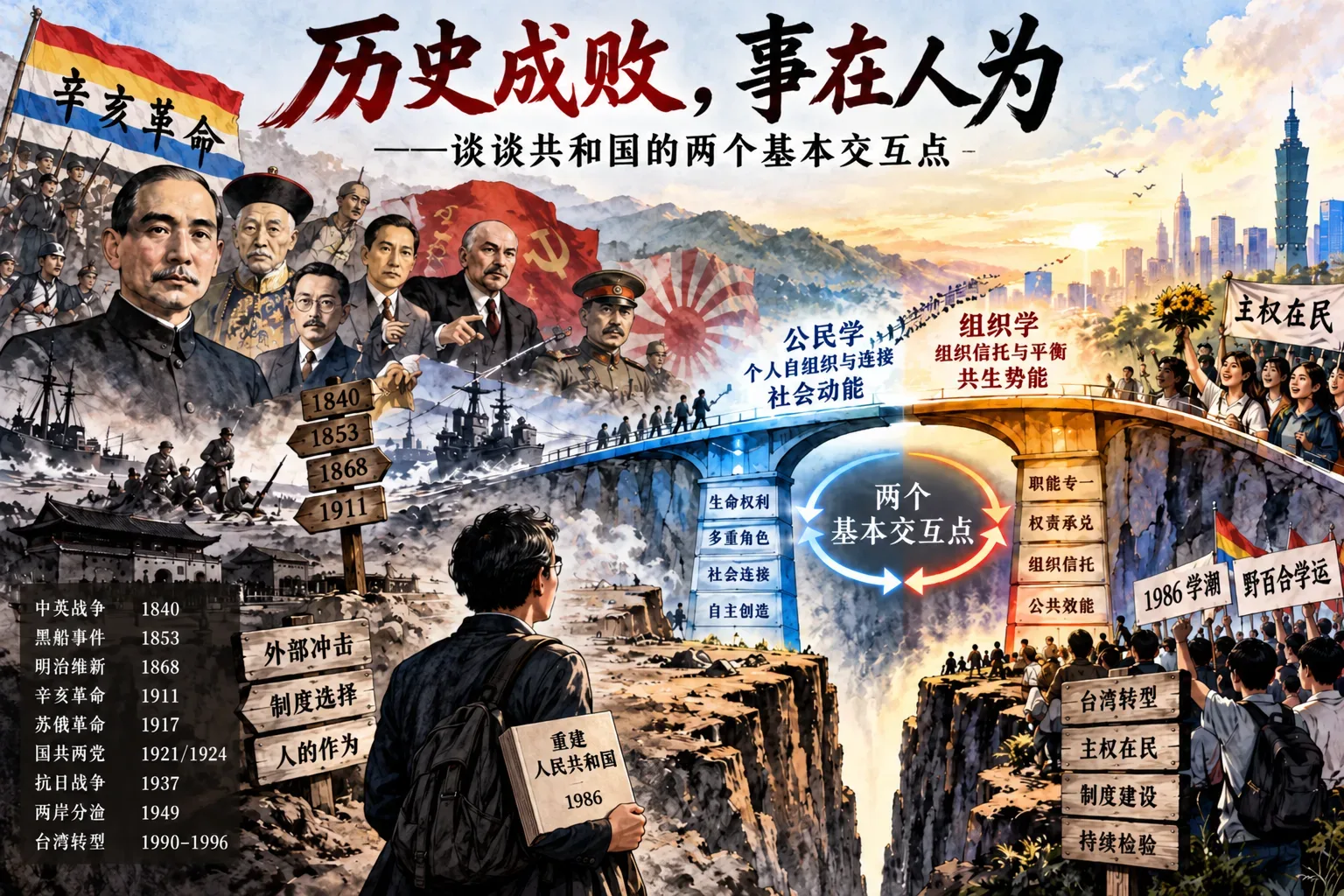
1840年中国遭遇中英战争,1853年日本遭遇美国佩里黑船,随后一个走过洋务、变法、立宪与革命的漫长道路,一个在1868年开启明治维新。面对外部冲击,历史行动、组织选择与制度结果大不一样。明治国家后来走向军国主义和侵华战争,又提醒我们:一代人的成功,不担保下一代人不会将其毁坏。事在人为,既可以成事,也可以败事。
1986年:共和国的两个基本交互点
1985年1月4日一场车祸使我受伤,次年脑震荡后遗症住院护理治疗期间,我完成《重建人民共和国:一个“精神裂变症”患者的自述——公民个人权利优先引论》。那时就提出两个相互关联的理论视角:作为整体主义的共和国公民学,作为个体主义的共和国组织学。基本观察是“个人社会角色多样化与组织职能专一化”,思想起点则是“公民个人权利优先”。
公民是活生生的个人。他可以是家庭成员、劳动者、研究者、纳税人、消费者、投资者、选民、志愿者;随着时间、空间和生活实践的展开,角色不断丰富。公民的整体性,存在于一个具体生命所拥有的多样角色,也生成于无数公民之间的交互连接。所谓整体主义的公民学,根基恰在具有独立人格、价值和权利的公民个人。
学校、企业、社团、政党、政府则不同。每一组织因特定社会需要而形成,拥有相对专一的职能、有限的权力与应当承担的责任。所谓个体主义的组织学,首先把每个具体组织当作有明确功能边界的组织主体来研究,考察它怎样与公民、与其他组织发生关系。一个组织一旦试图包揽个人全部生活,让公民成为其附属物,便会重现我在1986年批评的“墙网式”社会结构。
四十年后的今天,我愿意从共生哲学再把这一关系说透:以生命载体的个人自组织及其连接、交互为源泉,形成社会动能;以组织之间的权责承兑、功能契合和组织信托平衡为条件,形成社会共生势能。前者不断产生新的知识、劳动、产业与生活方式,后者使多元主体能够可信赖地协作,把一时的创造转化为持续的公共效能。
自组织是动能,共生与共襄生成是势能,二者相应相辅相成。动能推动关系更新,势能保障并激励新的创造;组织信托来自具体主体的持续交互,也必须在这种交互中不断接受检验。公民学研究生命主体如何创造社会,组织学研究社会组织如何承兑生命主体的创造。这便是共和国的两个基本交互点。
苏联及第三国际扶持与中国两党的组织道路
辛亥之后,中国政治又遭遇两种巨大的制度外部性:一边是苏俄革命及共产国际所带来的政党组织模式、资金、顾问与军事支持;另一边是日本军国主义的扩张及侵华战争。二者都深刻影响了中国共和国建设的实际路径。
这里有一个事实必须说清楚:中国共产党成立于1921年,其早期建党与共产国际的指导、推动和协助密切相关;中国国民党的思想、组织源流则早于苏俄革命,不能说它由苏联创建。1923—1924年,孙中山接受苏联支持,国民党在苏联顾问参与下改组,国共第一次合作由此形成,进而建立党政军一体化程度更高的政治动员体系。苏联及共产国际扶持中国共产党,也扶持改组后的中国国民党,使两党共同成为反对北洋政府、推动国民革命的主要力量。
值得追问的是,苏联输入的并不只有经费和军械,还有组织纪律、宣传动员、干部训练及党与军事权力关系的制度经验。中国两党有各自的社会基础与历史选择,后来也走向激烈对抗;然而,它们的现代组织形态都无法绕开这段外部制度影响。日本侵华战争又改变了社会动员、军事力量和政治联盟的结构。人的作为,始终发生在内外主体交互的复杂关系之中。
1949年,中华人民共和国(PRC)在大陆成立,中华民国(ROC)政府迁至台湾。若以夺取与保有政权为尺度,胜负已经分明;若以公民个人权利与公共组织信托为尺度,两个政权在当时都尚未完成共和国两个基本交互点的现代建设。
至我写作《重建人民共和国:一个“精神裂变症”患者的自述——公民个人权利优先引论》时,我当然不知道十年后台湾会发生真正翻天覆地的现代转型——共和国名副其实了。
倒是大陆发生了“八六学潮”(在台湾史学界则被称为“丙寅学运”),事后得知,导火索是位于安徽合肥的中国科学技术大学学生不满合肥市西城区人民大代表选举存在包办现象,要求真正落实基层民主选举。电视上看到运动迅速从合肥波及全国,以合肥、上海、北京为主,最终扩散到全国约20座城市、150所高校。学生们核心口号与要求,聚焦于民主选举、新闻自由、恐吓自由、反贪腐以及改善校园生活环境。非常奇怪的是,我在医院似乎半睡半醒间,看见赵紫阳突然走到我的病床前,对我清清楚楚说了一句话:“我当总书记了!”我马上问“那耀邦呢?”他就消失了,我也醒了,马上告诉对面床上的病友(一位参加过飞虎队,后从公交公司退休的老先生)说我刚才做了一个梦,经过文革洗礼的他赶紧对我说:“老弟,这可不敢乱说哈”,两人就会一笑。
从台湾的转变,再看共和国建设效能
台湾后来的变化,提供了观察历史人物与制度生成关系的重要案例。1990年野百合学运提出改革诉求,随后召开“国是会议”,推动终止动员戡乱时期、改造中央民意机关和总统选举制度,至1996年举行首次总统直选。“主权在民”由社会要求逐步落实为国家制度的运作方式。学生、社会组织、政治领导人与既有权力结构,在行动、协商和制度变更中合力影响了这一进程。
这不意味着台湾政治从此没有问题,却说明同样的事情,可以因处理方式的不同,产生完全不同的后果,而怎么做都有大把的理由!关键历史人物的选择与各界主体的交互,事在人为,可以为共和国建立可持续的制度安排——是否肯定公民权利、组织职能边界与公共信托如何有效衔接,从而释放公民社会自组织连接能力,以检验现代共和国是否名副其实。
所以,今天我再看辛亥革命中的孙中山、宋教仁、袁世凯、黄兴、章太炎、陈炯明及其后继者,要问两个问题:他们的思想与行动,究竟扩大了多少公民自主创造的社会动能?他们所建立、推动或阻碍的制度,又留下怎样的组织信托与共生势能?
革命可以在一夜之间改变政权格局,共和国却必须在此后无数日常生活中兑现革命的承诺。权利能不能行使,责任能不能追究,组织能不能各尽其职,社会创造能不能成为人民真实的生活福祉,才是历史作为的持续效能。这也是从GDP的规模观察进一步走向GDE(国内生产效能总值)的深层意义。
回到十五年前的争论
辛灏年、胡锦涛、李铁映、章开沅、许倬云、余英时、袁伟时、龙应台、楚梦、张鸣、秦晖、李泽厚、汪朝光、芦笛、冯胜平,都从各自的观察视角讨论孙中山与辛亥革命。其中值得吸收的史料、观点与问题,不必靠彼此否定来显出价值。把人物功过的争论推进到公民学、组织学建设效能的检验,才能使历史评价更接近共和国的现实生命。
历史成败,事在人为。关键人物能够抓住或错失历史机会;众多公民的自组织及其交互,决定社会动能能否不断涌现;组织之间的权责承兑与信托平衡,则关系到这些机会能否沉淀为持久的文明成果。
历史不能重演,人的作为却总在开始。凡事交互主体共生。
史料与文本说明
本文以钱宏1986年《重建人民共和国》、2006年《邻居的伟大和幸运》,辛灏年2010年《谁孕育了辛亥革命?》演讲,以及高伐林2011年辛亥百年评论汇编为主要文本基础。表格归纳各评论者的当年观点,不意味着本文接受其中全部结论。关于1985年车祸与1986年写作年份,依原稿自述厘清;关于苏联影响,区分中国共产党建党、国民党既有渊源及1923—1924年改组与国共合作的不同历史阶段。
History's Successes and Failures Depend on Human Agency
—On the Two Fundamental Points of Interaction in a Republic
Archer Hong Qian
When the centennial of the Xinhai Revolution arrived, Sun Yat-sen suddenly became a very busy man.
A historical figure who had been dead for more than eighty years was summoned before one tribunal of opinion after another. Some hailed him as a pioneer of republicanism; others condemned him as the source of a century of turmoil. Some praised his magnanimity in relinquishing the presidency; others questioned his later authoritarian choices in organizing a revolutionary party.
Today, another fifteen years have passed since the centennial. Rereading Xin Haonian's 2010 lecture at the University of Toronto, Who Gave Rise to the Xinhai Revolution?, alongside the various commentaries collected by Gao Falin, remains a thought-provoking experience.
Most of those commentaries asked who did what, who made which mistakes, whether revolution was necessary, and whether reform was feasible.
I would rather ask another question: What actual effectiveness did the choices and actions of these pivotal historical figures produce in building republican citizenship and republican organization?
These are the "two fundamental points of interaction" referred to in this essay's subtitle.
History's successes and failures depend on human agency. Here, "human" includes both the historical figures who emerge at decisive moments and every individual citizen endowed with an autonomous life. And "agency" encompasses both the courage to imagine and act, and the organizational capacity to transform life's creative energies into a lasting public order.
What Were People Arguing About Fifteen Years Ago?
Xin Haonian emphasized that the Xinhai Revolution resulted from the long awakening of different sectors of Chinese society: the press, intellectuals and students, the New Army, overseas Chinese, certain Qing officials, and revolutionary organizations. Their interactions and mutual influence created a growing revolutionary momentum, while Sun Yat-sen helped consolidate republican aspirations through his ideas, determination, and actions.
The opinions compiled by Gao Falin, however, were far more complicated than a simple division between supporters and opponents. Bringing these names and arguments together allows us to see the depth—and limitations—of the debate.
| Commentators | Main Arguments (2011 Compilation) | Further Questions |
|---|---|---|
| Hu Jintao and Li Tieying | Affirmed the historical achievements of Sun Yat-sen and the Xinhai Revolution, emphasizing the continuity of subsequent revolutionary movements | How should republican objectives be measured beyond proclamations of political succession? |
| Zhang Kaiyuan | Affirmed Sun's ideal of Great Harmony while identifying misconceptions in his later understanding of Japan and Soviet ideology | How should political ideals and actual choices be tested against one another? |
| Cho-yun Hsu (Xu Zhuoyun) | Argued that the revolution was hurried and society insufficiently prepared, and that Sun failed to mobilize local gentry networks adequately | How can revolutionary mobilization generate sustainable social organizations? |
| Yu Ying-shih | Observed that nationalist mobilization often overshadowed individual autonomy and democratic aspirations | How can the national community and individual citizens' rights remain mutually responsive? |
| Yuan Weishi | Recognized Sun's early contributions in revolutionary advocacy, fundraising, and political thought, while criticizing his later concentration of party authority and choices involving warfare | How can republican leaders be subjected to institutional constraints? |
| Lung Ying-tai and Chu Meng | Reexamined Sun's direct relationship to the Wuchang Uprising and questioned the excessive attribution of collective achievements to one individual | How can collective action avoid being obscured by the reputation of a single historical figure? |
| Zhang Ming and Qin Hui | Discussed controversies over Sun's pursuit of foreign assistance and negotiations with Japan, distinguishing intentions, negotiations, and accomplished facts | What are the boundaries of foreign assistance, national interests, and political responsibility? |
| Li Zehou | Questioned the sanctification of revolution and its long-term social costs | How should historical breakthroughs and their human costs be evaluated together? |
| Wang Chaoguang | Respected the idealism of revolutionary pioneers while emphasizing institutional design and practical political conditions | How can ideals be embodied in workable institutions? |
| Lu Di and Feng Shengping | Sharply criticized Sun's military-political approach and proposed alternative possibilities involving constitutionalism, parliamentary government, and local autonomy | How should historical alternatives be tested against the organizational conditions of their time? |
These views contain mutually complementary discoveries as well as directly conflicting judgments.
Some emphasized the revolutionaries' ideals and contributions; others concentrated on authoritarian tendencies that emerged after the revolution. Some believed the revolution had been launched prematurely; others argued that the opportunity for reform had already been lost.
Criticism of historical figures must be tested against historical facts. Nor can anyone simply declare, through imagination, that a path never taken would inevitably have succeeded.
The question remains: What did the republic actually build, and what did it fail to build?
Why Did I Call Our Neighbor Great and Fortunate in 2006?
On August 20, 2006, I wrote an essay entitled The Greatness and Good Fortune of Our Neighbor, later published in the American newspaper News World Times.
That neighbor was Russia.
I wrote at the time:
"Historical progress cannot occur without the driving force of historical figures."
Historical figures do not necessarily make fewer mistakes than ordinary people. They may, in fact, make far more.
Yet they can translate a powerful and lucid sense of history into concrete action. At moments when opportunities are fleeting, they can seize the possibilities of renewal for a people, a nation, and a society.
Peter the Great, Mikhail Gorbachev, and Boris Yeltsin lived under very different historical circumstances. Their achievements and failures remain open to debate. Yet the ability of pivotal individuals to influence the direction of history deserves serious attention.
The hopes I expressed for Russia's transformation belonged to the historical circumstances of 2006. Subsequent developments deserve a separate discussion.
The unspoken comparison in that essay, naturally, concerned China's misfortune.
China has never lacked people of vision and determination. What is regrettable is that so many historical opportunities arrived at our doorstep without being transformed into enduring achievements of civilization.
In 1840, China confronted Britain in the First Opium War. In 1853, Japan encountered Commodore Matthew Perry's American Black Ships.
China subsequently traveled a long road through the Self-Strengthening Movement, political reform, constitutional experiments, and republican revolution. Japan embarked on the Meiji Restoration in 1868.
Both countries faced external pressures. Yet their historical actions, organizational choices, and institutional outcomes differed profoundly.
Japan's subsequent descent into militarism and its war of aggression against China remind us of something else: the achievements of one generation do not guarantee that the next generation will refrain from destroying them.
Human agency can build history. It can also undo it.
1986: The Two Fundamental Points of Interaction in a Republic
On January 4, 1985, I was injured in a traffic accident. The following year, while hospitalized for treatment of lingering symptoms from a concussion, I completed Rebuilding the People's Republic: Confessions of a "Mental Fission Syndrome" Patient—An Introduction to the Primacy of Individual Citizens' Rights.
In that work, I proposed two interconnected theoretical perspectives:
Republican Citizenship Studies, grounded in Holism, and Republican Organization Studies, grounded in Individualism.
My fundamental observation was the diversification of individual social roles alongside the specialization of organizational functions.
The intellectual starting point was the primacy of individual citizens' rights.
A citizen is a living individual.
The same person may be a family member, worker, researcher, taxpayer, consumer, investor, voter, or volunteer. As time, space, and lived experience unfold, that person's roles continue to multiply.
The wholeness of citizenship resides both in the diverse roles embodied by a single living person and in the interactive connections generated among countless citizens.
Thus, the foundation of a holistic approach to citizenship lies precisely in individual citizens endowed with independent personalities, values, and rights.
Schools, enterprises, associations, political parties, and governments are different.
Each organization arises to meet particular social needs. Each possesses relatively specialized functions, limited authority, and corresponding responsibilities.
An individualistic approach to organization therefore begins by recognizing every concrete organization as an organizational subject with definite functional boundaries. It examines how that organization interacts with citizens and with other organizations.
Once an organization attempts to encompass every aspect of an individual's life and reduce citizens to its appendages, the result is a return to what I criticized in 1986 as a "wall-and-web" social structure.
Forty years later, I would like to make this relationship clearer through the philosophy of Symbiosism.
The self-organization of individuals as living subjects, together with their connections and interactions, generates social kinetic energy.
The fulfillment of organizational rights and responsibilities, functional compatibility, and balanced organizational trust generate social symbiotic potential energy.
The former continually produces new knowledge, labor, industries, and ways of life. The latter enables diverse subjects to cooperate through relationships of trust, transforming momentary creativity into sustained public effectiveness.
Self-organization is kinetic energy; symbiosis and co-generative collaboration constitute potential energy. The two are mutually responsive, complementary, and mutually constitutive.
Kinetic energy drives the renewal of relationships. Potential energy sustains and stimulates further creativity.
Organizational trust emerges through the continuing interactions of concrete subjects and must continually be tested through those same interactions.
Citizenship studies examine how living subjects create society.
Organization studies examine how social organizations fulfill their obligations to, and give effect to, the creativity of living subjects.
These are the two fundamental points of interaction in a republic.
Soviet and Comintern Support and the Organizational Paths of China's Two Political Parties
After the Xinhai Revolution, China's political development encountered two immense external institutional influences.
One came from the Russian Revolution and the Soviet and Comintern models of party organization, together with financial assistance, advisers, and military support.
The other came from the expansion of Japanese militarism and Japan's war of aggression against China.
Both profoundly affected the actual course of republican construction in China.
One historical fact must be made clear.
The Chinese Communist Party (CCP) was founded in 1921, and its early formation was closely connected with the guidance, encouragement, and assistance of the Communist International.
The intellectual and organizational origins of the Chinese Nationalist Party (Kuomintang, KMT) predated the Russian Revolution. It would therefore be historically inaccurate to claim that the Soviet Union originally founded the KMT.
However, in 1923–1924, Sun Yat-sen accepted Soviet support. The KMT underwent reorganization with the participation of Soviet advisers, and the First United Front between the KMT and CCP took shape.
A new system of political mobilization emerged, characterized by a much higher degree of integration among party organization, political authority, and military power.
The Soviet Union and the Comintern supported both the Chinese Communist Party and the reorganized Chinese Nationalist Party, helping make them the principal political forces opposing the Beiyang government and advancing the National Revolution.
The significance of this external institutional influence deserves particular attention.
What the Soviet Union introduced went far beyond money and weapons. It also brought organizational discipline, methods of political propaganda and mobilization, cadre training, and institutional practices governing the relationship between political parties and military authority.
The two Chinese parties possessed their own social foundations and made their own historical choices. They eventually entered into fierce conflict with one another.
Nevertheless, the development of their modern organizational forms cannot be understood apart from this period of external Soviet institutional influence.
Japan's invasion of China further transformed the structures of social mobilization, military power, and political alliances.
Human agency always operates within complex relationships of interaction among internal and external subjects.
In 1949, the People's Republic of China (PRC) was established on the mainland, while the government of the Republic of China (ROC) relocated to Taiwan.
Measured by the seizure and retention of political power, the outcome was clear.
Measured by individual citizens' rights and public organizational trust, neither political system had, at that time, completed the modern construction of the republic's two fundamental points of interaction.
When I wrote Rebuilding the People's Republic: Confessions of a "Mental Fission Syndrome" Patient—An Introduction to the Primacy of Individual Citizens' Rights, I certainly had no idea that, ten years later, Taiwan would undergo a truly transformative political transition—one that would finally give substantive meaning to its republican name.
Meanwhile, the mainland experienced the 1986 Student Movement, referred to by some Taiwanese historians as the Bingyin Student Movement.
I later learned that the immediate trigger was dissatisfaction among students at the University of Science and Technology of China, in Hefei, Anhui Province, with what they regarded as manipulated arrangements in elections to the People's Congress in Hefei's western district. They demanded genuine implementation of grassroots democratic elections.
Watching television, I saw the movement spread rapidly from Hefei to other parts of the country, particularly Shanghai and Beijing, eventually reaching approximately twenty cities and 150 universities.
The students' principal demands concerned democratic elections, freedom of the press, freedom from intimidation, opposition to corruption, and improvements in campus living conditions.
Something very strange happened at that time.
While I was in the hospital, somewhere between sleep and wakefulness, I seemed to see Zhao Ziyang suddenly walk up to my bedside.
He said to me, clearly and unmistakably:
"I'm the General Secretary now!"
I immediately asked:
"Then what about Yaobang?"
He vanished, and I woke up.
I promptly told the patient in the bed opposite mine—an elderly gentleman who had served with the Flying Tigers and later retired from a public transit company—about the dream I had just had.
Having lived through the Cultural Revolution, he quickly warned me:
"My young friend, you'd better not say things like that out loud!"
We both laughed.
Taiwan's Transformation and the Effectiveness of Republican Construction
Taiwan's subsequent transformation offers an important historical example of the relationship between pivotal individuals and institutional development.
In 1990, the Wild Lily Student Movement presented demands for political reform.
The National Affairs Conference followed, helping advance the termination of the Period of National Mobilization for Suppression of the Communist Rebellion, the restructuring of central representative institutions, and reform of the presidential election system.
In 1996, Taiwan held its first direct presidential election.
"Sovereignty resides in the people" was gradually transformed from a social demand into an operative principle of national institutions.
Students, civic organizations, political leaders, and existing structures of authority collectively influenced this process through action, negotiation, and institutional change.
This does not mean that Taiwan's political system has been free of problems ever since.
It does demonstrate that the same kinds of historical challenges can produce entirely different outcomes depending on how they are handled.
And people can always find plenty of reasons to justify whatever they choose to do!
The decisions of pivotal historical figures, together with interactions among different social subjects, can establish sustainable republican institutions.
That is precisely what it means to say that history depends on human agency.
The crucial questions are whether citizens' rights are recognized; how organizational functions, boundaries, and public trust are effectively connected; and whether these arrangements release the self-organizing and connective capacities of civil society.
These are the tests of whether a modern republic truly lives up to its name.
So today, when I look again at Sun Yat-sen, Song Jiaoren, Yuan Shikai, Huang Xing, Zhang Taiyan, Chen Jiongming, and their successors, I ask two questions:
How much social kinetic energy arising from citizens' autonomous creativity did their ideas and actions actually release?
And what forms of organizational trust and symbiotic potential energy were left behind by the institutions they established, promoted, or obstructed?
A revolution may transform the distribution of political power overnight.
Yet a republic must fulfill the promises of that revolution through countless acts of everyday life in the years that follow.
Can rights actually be exercised? Can responsibilities be enforced? Can organizations perform their respective functions? Can social creativity be translated into real improvements in people's lives and well-being?
These are the enduring measures of effectiveness in historical action.
They also reveal the deeper significance of moving beyond GDP as a measure of economic scale toward GDE (Gross Development Effectiveness).
Returning to the Debate of Fifteen Years Ago
Xin Haonian, Hu Jintao, Li Tieying, Zhang Kaiyuan, Cho-yun Hsu, Yu Ying-shih, Yuan Weishi, Lung Ying-tai, Chu Meng, Zhang Ming, Qin Hui, Li Zehou, Wang Chaoguang, Lu Di, and Feng Shengping all examined Sun Yat-sen and the Xinhai Revolution from their own perspectives.
The historical materials, insights, and questions worth preserving in their arguments need not gain their value by negating one another.
Only by moving the debate beyond the personal merits and failings of historical figures, toward an examination of the actual effectiveness of citizenship studies and organization studies in building the republic, can historical evaluation come closer to the lived reality of republican society.
History's successes and failures depend on human agency.
Pivotal figures may seize or miss historical opportunities.
The self-organization and interactions of countless citizens determine whether society can continually generate kinetic energy.
The fulfillment of organizational responsibilities and the balance of institutional trust determine whether those opportunities can be transformed into enduring achievements of civilization.
History cannot be replayed. Human agency, however, is always beginning anew.
Everything Intersubjective Symbiosism.
Notes on Sources and Texts
This essay draws primarily on Archer Hong Qian's Rebuilding the People's Republic (1986) and The Greatness and Good Fortune of Our Neighbor (2006); Xin Haonian's 2010 lecture Who Gave Rise to the Xinhai Revolution?; and Gao Falin's 2011 compilation of commentaries on the centennial of the Xinhai Revolution.
The comparative table summarizes the commentators' positions at the time and does not imply the author's endorsement of all their conclusions.
The chronology of the 1985 traffic accident and the writing completed in 1986 follows the author's original account.
Regarding Soviet influence, the essay distinguishes among the founding of the Chinese Communist Party, the earlier historical origins of the Chinese Nationalist Party, and the KMT's reorganization and the formation of the First United Front in 1923–1924.