中国K?
中国K?
China’s K?
——从“繁荣与收缩并存”到共生经济学的K→Q经济诊疗学
— From the Coexistence of “Prosperity and Contraction” to the K→Q Economic Diagnostic Framework of Symbionomics
钱宏(Archer Hong Qian)
“K型分化”正在成为解释中国经济结构分化的一种流行说法:供给增长而需求疲弱,出口增长而内需不足,高技术制造业扩张而传统产业收缩,于是,一升一降的两组曲线被画成一个“K”。有人仍用“三驾马车”解释:投资、出口两驾乏力,就设法把消费这驾重新赶起来。这种分析能够描述增长动力的变化,却还没有回答更根本的问题:为什么一个已经拥有巨大生产能力的经济体,国民消费仍需要不断被“刺激”和“拉动”?
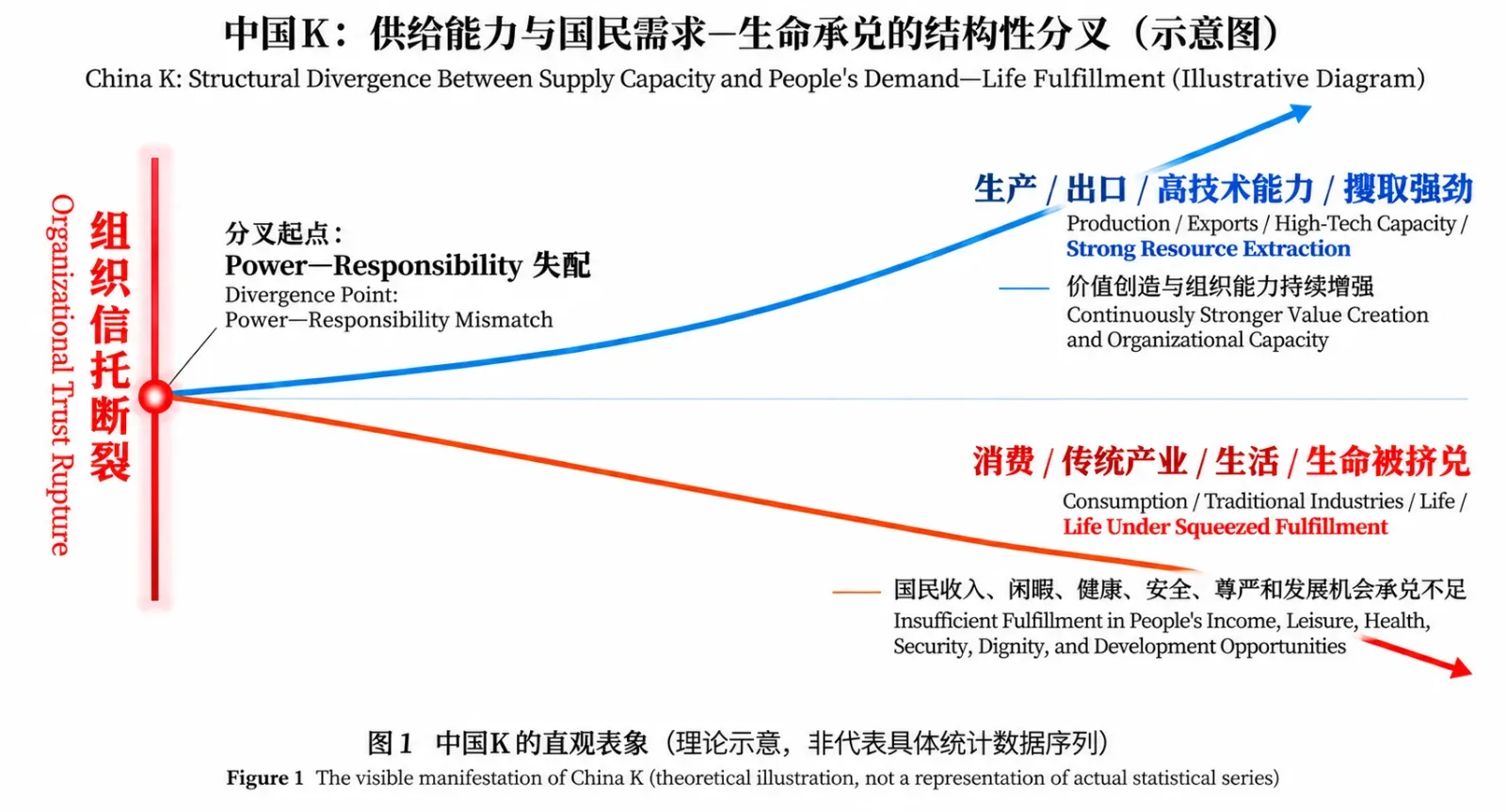
这些现象可以描述K,却不能解释K。把症状当成病,把曲线当成诊断,恰恰遮蔽了最需要回答的问题:为什么分叉?在哪里分叉?是什么机制使两条线越走越远?
K不是繁荣与收缩同时发生,而是价值创造与国民生命承兑发生结构性断裂。
一、K不是两条曲线,而是价值创造与国民生命承兑的断裂
共生经济学不把K简单理解为贫富分化,也不把两个行业、两个阶层、两组指标的一升一降直接定义为K。一个经济体可以GDP增长、投资增长、出口增长、技术进步、企业扩大、资本升值,但还必须继续追问:这一切最终向国民承兑了什么?
收入、闲暇、健康、安全、尊严和发展机会,是最基本的国民生命价值承兑。如果社会生产能力越来越强,而国民获得这些价值的能力没有同步增强,甚至下降,那么真正的K就出现了。
K的本质,是价值创造与国民生命承兑之间发生结构性断裂。
二、从罗斯托到福特:增长理论走到了哪里?
20世纪关于增长与现代化的两种经典思路,恰好可以帮助我们看清K—Q经济诊疗学究竟向前追问了什么。1960年,W. W. 罗斯托在《经济增长的阶段》中把发展概括为五个阶段:传统社会、起飞前提、起飞、走向成熟和大众高消费时代。它的重要贡献,是把经济发展理解为一个由技术、投资、产业结构和社会条件共同推动的历史过程,而不是某一年的GDP数字。“起飞”尤其抓住了生产能力跨过临界点以后形成自我强化增长的现象。
但罗斯托的终点仍然落在“大众高消费”。这意味着发展的主轴仍主要沿着生产能力、收入提高和消费扩张展开。它能够解释一个社会怎样从低生产率走向工业化、成熟和高消费,却没有充分回答:增长创造的价值究竟怎样向具体生命承兑?如果消费更多的同时,闲暇减少、健康受损、生态负载增加、安全感和社会信托下降,仅以“高消费”作为成熟尺度就不够了。Q-Economy因此不是罗斯托之后简单增加一个“第六阶段”,而是改变衡量发展的坐标轴:从“生产—收入—消费”进一步转向“价值创造—生命承兑—生态呈现—生命再激励”。
福特主义则向Q又靠近了一步。1914年福特汽车公司宣布“五美元日薪、八小时工作日”,相较此前约2.34美元、九小时工作日,是工资与时间安排的重大改变。其直接经营背景包括流水线劳动单调、员工流动率极高以及稳定生产的需要;后来形成的“福特主义”,则把大规模生产、高工资与大众消费联系起来。这里真正值得吸收的,不只是“让工人有钱买汽车”,而是生产率提高以后,一部分新增价值开始以更高收入和更多闲暇重新回到劳动者生活。
这已经触及Q-Economy所说的“承兑”,但仍没有完成范式转换。福特主义主要把人放在“生产者—消费者”的循环中;Q-Economy首先把人还原为完整的生命主体。工资是承兑,闲暇也是承兑;健康、安全、尊严、生态和发展机会同样是承兑。福特主义关心的是大生产怎样形成大消费的循环,Q-Economy进一步追问:生产组织取得了多少Power,就应担当多少Responsibility;创造出来的价值,最终有多少真正回到生命。
福特把生产者变成有能力消费的生产者;Q-Economy则要把“生产者—消费者”重新还原为完整的生命主体。
由此也就能看清罗斯托、福特、中国K与今天“发钱还是不发钱”的争论为什么可以贯通起来:罗斯托回答“经济怎样起飞并走向大众消费”;福特主义回答“大生产怎样通过工资与消费形成循环”;中国K暴露的却是,生产和出口能力已经很强,价值创造仍可能与国民生命承兑发生结构性断裂。到了这里,再把问题缩回“怎样刺激消费”,就又退回了旧坐标系。真正需要修复的,不是消费冲动,而是价值创造向国民生命承兑的传动机制;而这个机制最终落实为组织受谁之托、掌握什么Power、担当什么Responsibility、向谁承兑——也就是重建组织信托。
三、K是共同病象,不是共同病因
中国K、美国K、日本K、欧洲K、英国K、加拿大K以及南美一些国家的K,不能混为一谈。它们可能具有相似的分叉外形,却由不同的组织结构、生产方式、社会责任关系和历史条件生成。
K可以同形,病因不同;K是共同病象,不是共同病因。
美国K除了资本、高科技产业和资产价值上升与部分普通国民生活改善不同步,更具有历史辨识度的一面,是铁锈带、传统工业衰退和城市空心化,与廉价进口所支撑的高消费同时存在。一边失去部分产业、就业和社区基础,一边享受更便宜的消费;生产与消费跨越国界发生分离。说到这里,就已经可以看到全球化2.0留下的另一层问题:不同经济体在交换中获得局部利益,也可能把未由自身承担的成本传递给对方,从而形成的互害机制。
日本则提供了另一面镜子。传统日本企业内部组织权力可以高度集中,但企业同时承担与员工劳动和生活相联系的责任。长期雇佣、工资福利、职业培训和退休安排,使生产组织与员工生活之间保持承兑关系。
既然组织这个人的劳动,就不能只要他的生产贡献,而把他的生活结果完全推出组织责任之外,交给社会自生自灭。
因此,问题不是Power集中本身,而是Power与Responsibility是否断裂。欧洲一些国家又可能呈现另一种K:福利承兑很强,而生产、财政与代际承载能力受到挤压。不同的K需要不同的诊断,但进入Q,都绕不开组织与生命主体之间信托关系的重建。
四、中国K:权力包揽,责任外推
中国K最深的病灶,不是房地产,不是消费不足,不是出口过强,也不是新旧产业的一升一降。甚至“举国体制”“政府公司主义”“中国特色资本主义”“社会主义市场经济”等等,仍然只是描述。真正需要诊断的是它背后的组织结构。
权力包揽,责任外推;生产组织,生命不承兑。
这里必须把Right与Power分开。Right是权利,与义务相对应;Power是权力,是组织支配、决定、配置资源和强制执行的能力。这里所说的“权力包揽”,说的是Power。
任何有效组织都需要Power。问题不在于组织有没有Power,而在于Power与Responsibility是否对应:组织了,就要负责;掌握多少Power,就应担当与之相应的Responsibility。
土地可以组织,资本可以组织,信贷可以组织,投资可以组织,产业可以组织,技术可以组织,生产可以组织,出口可以组织,社会生活也可以被组织。中国K的结构性断裂,正发生在这里:一边是高度集中的组织权力、资源支配、生产组织和价值沉淀能力;另一边是国民收入、闲暇、健康、安全、尊严和发展机会的承兑。前者可以很强,后者却没有同步。
这条结构性断裂已经把问题从经济表象推到了组织关系本身:当一个组织不断扩大自己的Power,却不担当与这种Power相应的Responsibility,生产能力与国民生命承兑就可能沿着两条不同的轨迹运行。要解释中国K为什么长期生成,就必须继续追到组织自身的生成逻辑。
五、中国K的根:殖官主义——组织为何从受托者变成自我繁殖者
如果公共组织的Power来自国民生命的授权,那么正常的组织关系应当是:
国民生命 → 授权 → 组织获得Power → 担当Responsibility → 向国民生命承兑。
组织存在的目的,是承担单个生命主体无法独立承担的公共责任。Power因此不是组织自身的财产,而是履行受托责任的能力。问题发生在这条关系倒转以后:组织不再只是实现受托目的的工具,而逐渐形成自身的职位、层级、预算、利益与延续逻辑;职能原本决定组织,后来却可能变成组织寻找职能;问题原本需要组织解决,后来问题的存在反而可能成为增加机构、编制、预算和Power的理由。
这就是殖官主义。它不是一般意义上的官僚存在,更不是简单的“大政府”或“小政府”问题,而是公共组织脱离受托目的以后,由生命的受托者逐渐异化为具有自身目的的主体,以职位、层级、预算、特许和依附关系不断复制自己,并不断进入和占用社会资源与生命空间。(参见钱宏:《共生经济学概论(修订版)》,第八章第十一节“殖官主义:组织成为自我繁殖主体”。)
殖官主义之所以具有如此顽强的历史延续性,并不是因为“官僚主义”三个字可以解释一切,而是因为它有自己的经济发生机制。《共生经济学概论》第八章把刑徒经济、货殖经济与计划经济作为三种可以跨时代叠加的历史母体来考察:刑徒经济以强制征用生命和劳动,货殖经济使财富进入持续经营、积累和增殖,计划经济则可能以集中目标统摄分散知识与生活差异。三者一旦越过自身边界,就可能使生命降格为人力,使公共Power成为资源入口,使社会成为组织自我复制的供养场。
首先是刑徒经济。
刑徒经济首先是一种生命位置。人在其中不是拥有自身目的、权利和生活世界的主体,而成为可以编户、征发、迁徙、惩戒和替换的人力单位。劳动目的不是由劳动主体之间的契约生成,而由Power预先规定;服从本身成为一种资源,惩罚则保证这种资源随时可以被组织调用。
中国秦制把战争动员、户籍编制、徭役、连坐、军功爵和官僚派遣结合起来,显示出极强的标准化与组织能力。同一套组织能力既可以统一文字、度量衡和行政体系,也可以穿透家庭与地方社会,把人口、粮食、土地乃至人的时间直接接入国家目标。这里需要辨认的,不是简单评价某一历史制度的功过,而是一种能够跨时代反复出现的组织机制。(参见钱宏:《共生经济学概论(修订版)》,第八章第二、三节“刑徒经济:把生命变成可征用的人力”“刑徒机制为何能够制造‘辉煌’”。)
因此,刑徒经济并不限于监狱劳动。只要退出权被取消,劳动责任无限,而决定权、话语权缺席,生命在功能上就可能被刑徒化。它可以迅速集中资源、压低显性成本、完成巨大工程,因而具有强烈的组织诱惑;但是,被征用者失去的时间、健康、家庭生活和发展机会,以及由社会和生态承担的负载,却未必进入同一张成本表。
于是,一种重要的经济错位出现了:生产成果由组织记录,生命负载却可能成为隐账;组织能力越来越强,并不自动意味着国民生命承兑能力同步增强。中国K的一条深根由此显现。
但是,仅仅征用生命,还不足以支撑组织持续扩张。组织自我繁殖还需要财富,而财富的流动、积累、增殖以及它与Power的结合,就进入了第二条历史母体——货殖经济。
“货殖”本身并不是贬义。《史记·货殖列传》恰恰看见了民间生产、交换、经营和财富流动的生命力:“天下熙熙,皆为利来;天下攘攘,皆为利往。”农、虞、工、商各任其能、各得所欲,财货流动“若水之趋下”。这是一种由生命主体自身需要、能力和交换关系生成的经济秩序。
真正锋利的判断在后面:“故善者因之,其次利道之,其次教诲之,其次整齐之,最下者与之争。”《史记正义》释“与之争”为“与众争利”。
“与众争利”的要害,不只是公共组织也进入市场赚钱,而是“利出一孔”,又“利入一孔”。所谓“利出一孔”,是土地、资本、信用、牌照、项目、准入、经营资格乃至发展机会越来越从Power控制的通道流出;所谓“利入一孔”,则是社会创造出来的财富和收益,又通过专营、土地、金融、税赋以及其他组织机制,越来越集中地流回同一Power体系。于是,Power既控制利从哪里出,又控制利向哪里入。
这时,“与众争利”就不再是普通市场主体之间的利益竞争。普通市场主体在规则中逐利,公共Power却能够制定规则;普通市场主体需要取得资源,公共Power却能够配置资源;普通市场主体承担经营失败,公共组织却可能把成本重新外推给社会。掌握规则的人,同时控制利益的入口和出口,市场关系由此发生性质变化。
所以司马迁把它列为“最下者”,具有深刻的经济学意义。最好的治理是“因之”——顺应生命主体自身的生产、交换与创造;最坏的,则是本应维护这种秩序的公共Power直接进入利益过程,与自己受托服务的国民“争利”。(参见钱宏:《共生经济学概论(修订版)》,第八章第四至六节“货殖经济:财富怎样成为权力通道”“从重商主义到政府公司主义”“三大经济学源流:刑徒、货殖与官营”。)
桑弘羊所代表的盐铁官营,使这一问题进一步成为现实的组织机制。盐铁官营、均输、平准、酒榷的重要性,不只在于增加国家财政收入,而在于公共Power开始同时进入资源控制、生产经营、商品流通、价格调节和利益取得。组织既制定规则,又配置重要资源,同时参与经营并取得收益,“利出一孔—利入一孔”由此获得了制度性的组织通道。
因此,司马迁与桑弘羊不能混为一谈。司马迁留下的是对民间货殖生命力的发现,以及对公共Power“与众争利”的警告;桑弘羊留下的,则是公共Power直接进入资源、经营和收益取得的官营实践。前者揭示货殖的生命力与边界,后者则显示货殖一旦与Power结合,怎样可能转化为组织扩张的经济机制。
这样,刑徒经济、货殖经济和官营机制便连成了一条发生链:刑徒经济把生命变成可以组织和征用的人力;货殖经济使财富不断经营、积累和增殖;官营机制则使Power进入财富的生成、配置与取得。
三者叠加以后,生命、财富与Power开始形成自我强化的循环:组织征用生命 → 生命创造财富 → Power控制财富通道 → 财富供养组织 → 组织扩大Power → 扩大的Power进一步控制生命与资源。
殖官主义由此获得了自我繁殖的经济基础。刑徒经济为它提供可征用的生命,货殖经济为职位、特许和组织扩张提供可兑现的收益,计划经济一旦越过有限协调的边界,又可能为组织全面进入社会提供总体性的配置机制。(参见钱宏:《共生经济学概论(修订版)》,第八章第六至十一节。)
所以,殖官主义中的“殖”,不只是官位和机构数量增加。更深层的是,组织越来越像一个以自身延续为目的的主体,向土地、资本、金融、企业、社区和个人生活空间延伸,以社会资源供养自身,再以自身承担越来越多事务为理由继续扩大Power。由规则治理走向越来越多的直接进入、直接配置和直接管理,由“必须管”走向“能够管”,再由“能够管”滑向“都要管”,只是这一组织逻辑展开后的现实表现。
中国K由此获得了比“消费不足”“房地产下行”“新旧产业分化”更深的解释。
它不是简单的市场周期和规划预期,而是一条长期生成的组织链:
生命被组织 → 财富被创造 → 利出一孔、利入一孔 → Power与财富相互强化 → 组织自我繁殖 → 国民生命自组织空间受到挤压 → 生产组织能力与国民生命承兑能力发生结构性分叉。
这才是中国K的根。
在正常的受托关系中,组织取得什么Power,就应当担当什么Responsibility;支配多少资源,就应当对多少结果负责。组织越深入生产、资源配置和社会生活,就越不能只取得组织成果,而把就业、收入、健康、养老、闲暇、安全、尊严和发展机会等生活后果留给国民、家庭和社会承担。
但是,当组织由生命的受托者逐渐变成自我繁殖主体以后,Power与Responsibility也随之发生结构性分离:Power不断向组织集中,Responsibility却不断向国民、家庭与社会外推。
权力包揽,责任外推;Power留下,Responsibility转移。
六、殖官主义的要害:Power留下,Responsibility转移
这种Power与Responsibility的分离,使殖官主义不只是机构和层级的自我繁殖,而成为能够持续生成中国K的权责机制:Power可以不断向组织集中,Responsibility却可以不断向组织之外转移。
土地要管,资本要管,企业要管,就业要管,教育要管,医疗要管,住房要管,社区要管,甚至个人怎样谋生也要管;但当这些领域最终产生生活后果时,失业怎么办、养老怎么办、看病怎么办、住房怎么办、孩子毕业找不到工作怎么办,却越来越需要个人和家庭自己承担。
于是出现一种特殊结构:决定权在组织,后果却在个人;资源配置权在组织,生活风险却在家庭;Power不断集中,Responsibility却不断外推。
一个普通的生活场景就足以说明问题。一个人失去了正式工作,没有要求组织养他,而是推一辆小车出去摆摊,靠自己的劳动挣钱养家。这本来是生命自组织最朴素的表现:原来的组织关系中断以后,生命主体重新组合自己的时间、劳动、技能和有限资源,自行恢复生存能力。
可是,如果公共组织一方面没有为他的失业和基本生活提供足够承兑,另一方面又以管理Power禁止或者不断限制他的自谋生路,那么一个极其尖锐的矛盾就出现了:
我不充分向你承兑,却限制你自己承兑;我不担当你的生活责任,却继续支配你的生存方式。
这已经不是简单的“管理严格”或者“社会保障不足”。它揭示的是Power与Responsibility在同一个组织关系中的反向运动:
Power越过边界继续存在,Responsibility却在边界之前停了下来。
因此,“责任外推”不能仅仅理解为财政支出少或者社会福利不足。它首先是一种权责结构:组织保留决定、配置、许可、禁止的Power,却把这些决定所产生的一部分生命后果转交给个人、家庭和社会承担。
殖官主义更深的成本,不只是组织本身花了多少钱,而是它可能把维持Power的收益内部化,把Power产生的部分Responsibility外部化。
而Responsibility的外部化不会止于个人与家庭。没有在一个主体内部承担的成本,还可能继续转移给乡村、生态、下一代,乃至其他经济体。
七、责任没有消失,只是换了地方承担——从中国K到全球化2.0
中国K中的责任外推由此呈现两重方向。
第一重,是向内外推。组织掌握和扩大Power,却把就业、收入、养老、医疗、闲暇、健康、安全、尊严和发展机会中的一部分生活后果,推给个人、家庭和社会自行承担。
第二重,是向外外推。如果低成本生产的一部分真实成本没有在国内得到承担和承兑,又通过持续的低价出口进入国际市场,那么被输出的就不只是商品,也包括价格压力、产业冲击以及由此产生的调整成本。由此可能形成低价倾销和通缩输出。
责任没有消失,只是换了地方承担。
这句话打开了理解全球化2.0互害机制的入口。一端可能以国民生命承兑不足、乡村与生态负载换取低成本生产和出口;另一端可能以产业外移、铁锈带和城市空心化换取廉价进口和高消费。双方获得局部利益,也留下各自的K。没有被一个主体承担的成本,不会凭空消失,只会转移给另一个主体、另一个地区、另一代人或另一种生态。
因此,全球化2.0的问题不是简单的“谁占了谁的便宜”,而是价值交换与责任承担发生错位:收益可以跨境流动,成本也会跨境转移;一国没有内部化的负载,可能成为另一国必须承担的调整成本。表面互利,深处可能生成互害。
责任外推到这里已经跨越组织边界和国界。但还有最后一个必须追问的问题:当一部分Responsibility被推给国民以后,国民是否至少拥有充分的空间,通过自己的生命自组织能力来承担和修复?如果连这一空间也被Power继续压缩,中国K就会进一步加深。
八、国民生命自组织:责任推给你,自己承兑的空间又受限
生命本自具足,又非独存。“本自具足”,意味着国民不是等待组织安排和刺激的被动对象,而具有依靠劳动、技能、家庭、社区、企业和社会关系自行组织生活的能力;“又非独存”,意味着个人不可能独自承担所有公共风险,受托组织也不能因此逃避Responsibility。
因此,组织与生命主体之间必须同时守住两条边界:该由组织担当的责任,组织必须担当;国民能够自组织完成的事情,组织不应不必要地替代和压制。
中国K更深的一重矛盾恰恰发生在这里:Responsibility被推给国民以后,Power却没有相应退出;个人和家庭需要自己承担更多生活后果,却未必同时获得更充分的自组织空间。
不充分向你承兑,又限制你自己承兑;不担当你的生活责任,又干预你自己谋生。
Power扩张 → Responsibility外推 → 生命自组织受抑。
这三者一旦形成循环,中国K就不再只是收入分配问题,而成为组织结构与生命结构之间的断裂。也正因为如此,后面所看到的“供强需弱”、谨慎消费、低成本竞争以及“发钱还是不发钱”的争论,都只是这一结构投射到经济表面的不同症状。
九、“供强需弱”只是中国K投射出来的经济症状
经过前面对组织结构的诊断,再回头看工业增加值增长而商品零售疲弱、出口较强而内需不足、高技术制造扩张而传统产业收缩,就可以看出:这些都是中国K投射到宏观数据上的症状,却不是中国K本身。
为什么供给可以很强?因为生产、投资、信贷、产业链、技术和出口都可以被高度组织。为什么需求不能用同样的方法“组织”出来?因为最终消费的不是一个抽象变量,而是一个个具体的国民生命主体。
没有足够收入,不能消费;养老、医疗、住房、教育和就业缺乏可靠保障,不敢消费;劳动时间过长、闲暇不足,没有条件消费;未来承兑不确定,就会增加储蓄。所谓“需求不足”,由此首先不是消费意愿出了问题,而是生产能力向国民生命承兑的传动不足。
真正的问题不是怎样让国民多花钱,而是如此巨大的生产能力,为什么没有转化成与之相称的国民生命价值承兑能力?
这一问也把分析自然推向供给的另一面:如果产品可以长期保持很低的价格,那么所谓“低成本”究竟来自效率提高,还是还有一部分真实成本没有进入价格、而由国民生命、社会和生态承担?
十、低成本究竟是谁的低成本?
产品价格低,可以来自技术进步、规模经济、产业集群、完整供应链和劳动生产率提高,这些都是真实竞争力。共生经济学并不否认这些优势,而是继续追问:全部成本都进账了吗?
劳动者的健康、失去的闲暇、家庭承担的生活成本、生态负载、地方社会公共成本,以及安全、尊严和发展机会的损失,如果没有进入商品价格,就并没有因此消失。一部分成本没有进入商品价格,却进入了国民生命、社会和生态的负载。
因此,评价竞争力不能只问产品卖多少钱,还必须问:谁创造?谁负载?谁受益?谁承担?最终向谁承兑?
如果国民一方面承担了没有进入价格的负载,另一方面又对养老、医疗、住房、就业和未来发展缺乏稳定预期,那么消费疲弱就更不能简单归结为“手里钱不够”。这也正是“给不给国民发钱”争论必须重新定位的地方。
十一、发钱还是不发钱?先分清纾困责任与结构治疗
围绕消费不足,一个反复出现的争论是:要不要给国民发钱。这个问题必须分成两个层次。
第一,在疫情、灾害或其他突发性外生冲击中,国民的正常劳动、经营和收入来源因公共危机而突然中断,紧急现金支持首先不是一个“刺激消费”的技术问题,而是组织是否担当受托责任的问题。
例如新冠疫情期间,美国向符合条件的居民实施多轮Economic Impact Payments;加拿大通过CERB等项目向受疫情直接影响、失去或减少劳动收入的劳动者提供紧急收入支持;日本向居民普遍发放每人10万日元的特别定额给付;欧洲多国则通过工资补贴、收入支持、现金或社会转移等方式维持家庭基本生活。中国也实施了低保扩围、临时救助及部分地方现金补助,但没有采取美国、日本那种全国性、广覆盖的居民直接现金支付,也没有采用加拿大CERB那种大规模紧急收入替代模式。
在这种特定时期,把临时纾困简单等同于长期福利依赖,或者用“高福利会损害增长”来否定紧急收入支持,是把两个不同层次的问题混在了一起。公共组织要求国民为了公共安全暂停正常生产和生活时,就必须对由此产生的基本生活风险担当相应责任。
第二,当经济已经进入结构性K以后,发钱又不能被当作根治K的办法。一次性现金可以改变当期货币流量,却不能自动解决养老、医疗、住房、就业以及未来发展机会的不确定性。如果未来生命价值缺乏可靠承兑,国民把新增收入储蓄起来,恰恰可能是一种理性的生命自组织行为。
发钱解决的是当期货币流量,后顾之忧涉及的是未来生命价值承兑。
因此,所谓“信心不足”不能只停留在心理解释,更不能停留在超高道德承诺上。真正需要追问的是:国民为什么对未来缺乏稳定预期?如果养老、医疗、就业、住房、安全和发展机会不能得到可靠承兑,谨慎消费和增加储蓄就是对现实风险的回应。
真正需要修复的不是消费冲动,而是生命承兑。
所以,“发钱还是不发钱”不是中国K—Q诊疗的第一问题。罗斯托把发展推到“大众高消费”,福特主义把高工资与大众消费连接起来,都有其历史贡献;但中国K提示我们,消费不是可以孤立启动的一驾“马车”。该纾困的时候不纾困,是组织责任缺位;把临时发钱当作长期结构治疗,又是把流量工具误作制度疗法。只有把收入、养老、医疗、住房、就业、闲暇、安全、尊严和发展机会重新纳入生命的组织承兑,才能从“刺激消费”进入“重建组织信托”的结构治疗。
十二、从K到Q,不是打碎组织,而是重建组织信托
诊断中国K,不是为了打碎组织。中国已经形成的制造能力、基础设施能力、产业链能力、技术能力和组织能力,是长期积累形成的社会能力。由K到Q,不是摧毁这些能力,也不是简单从K上面拿一部分财富分给K下面。只要生成K的组织机制没有改变,K还会重新生成。
治疗K,不是修剪K的两条线,而是改变生成K的机制。
为什么这一改变最终必然指向组织信托?因为价值不会从“生产”自动跳到“生命”。连接价值创造与生命承兑的,正是一个个现实组织:国家、企业、金融机构、平台、社区以及正在形成的智能组织。资源由组织配置,贡献由组织发现和记录,权利由组织确认,责任由组织承担,结果也必须经由组织关系向生命承兑。K虽然表现为经济曲线的分叉,断裂真正发生的地方,却是组织关系。
所以,从K到Q不是在“政府还是市场”之间再选一次边,也不是把分配环节单独加码,而是把组织重新放回受托关系:谁授权,向谁负责;掌握什么Power,担当什么Responsibility;使用什么资源,记录什么贡献与负载;产生什么结果,最终向生命如何承兑。
组织信托不是要求人们相信组织,更不是一句道德口号,而是可验证、可追责、可承兑的受托关系。
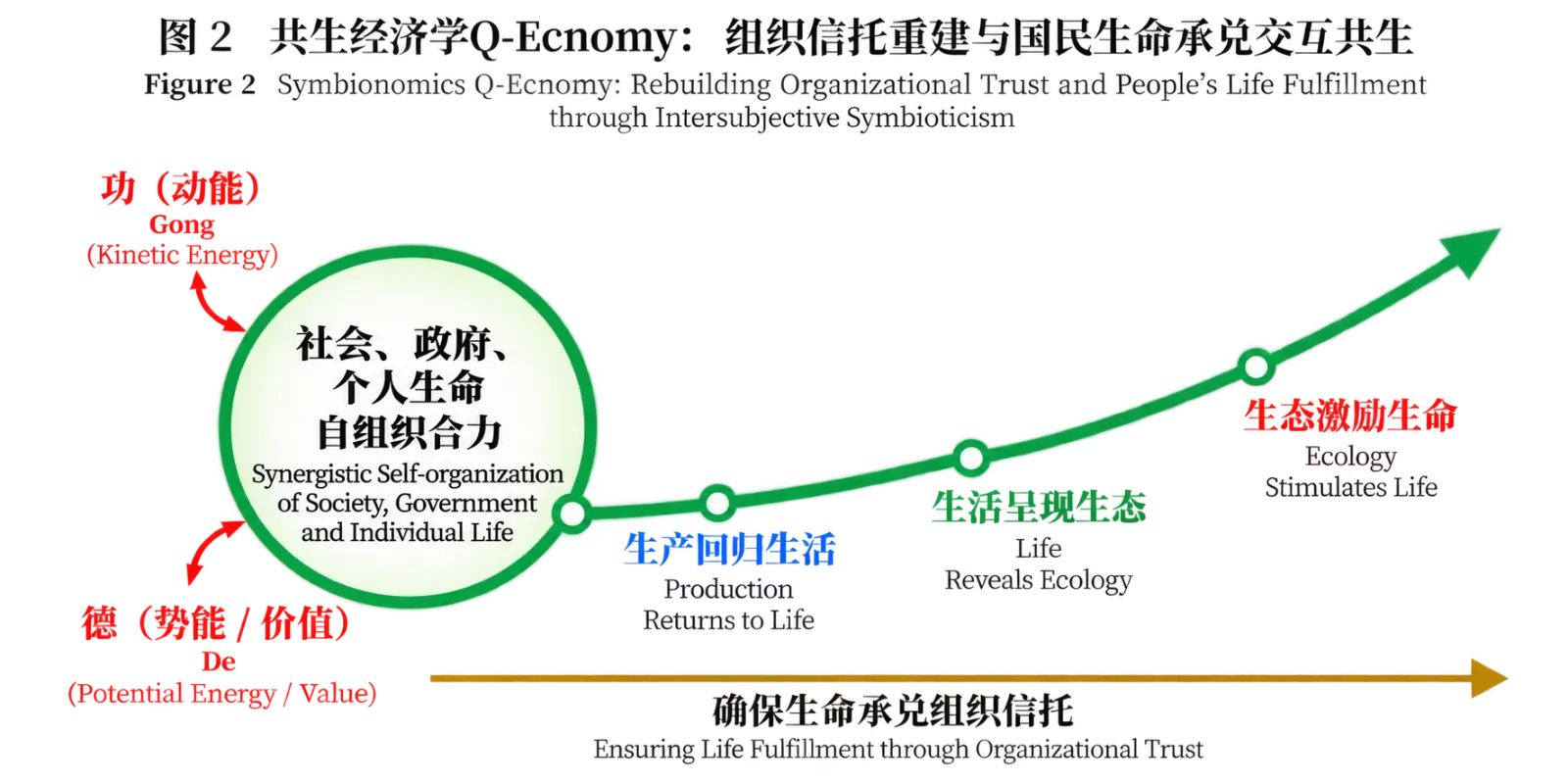
重建组织信托,也不是简单把组织变小或者变大,而是恢复组织自身的生命力、自组织联通和自愈能力。该由组织担当的责任,组织必须担当;国民能够自组织的生活,组织不能横加替代和压制。
到这里,中国K的诊疗完成了从“症状—病理—病根”到“治疗原则”的转换。下一步才是把这个原则放回不同国家:K可以同形,病因不同,因此处方也不能相同。
十三、不同的K,共同指向重建组织信托
各国K的表现形式不同,进入Q的具体道路也不会相同。美国需要面对资本、产业、社区与普通国民之间的断裂;一些欧洲经济体需要重新平衡福利责任、生产能力与代际承载;中国则必须处理强大组织能力与国民生命承兑不足之间的结构性断裂。
K是共同病象,不是共同病因;Q是共同方向,不是同一种处方。
因此,从K到Q也有不同深度。有的K主要需要修复既有信托链;有的需要重建组织与生命主体之间的关系;当组织自身的运行逻辑已经持续生成K时,就不能停留于修修补补,而必须脱胎换骨。
有的K需要修复,有的K需要重建,有的K则必须脱胎换骨。共同方向,都是重建组织信托。
所谓脱胎换骨,不是打碎组织,而是改变组织赖以运行的内在逻辑:不是取消Power,而是让Power重新与Responsibility对应;不是依靠自我繁殖维持组织,而是恢复组织的自组织联通、自愈能力和向生命承兑的能力。
如果这一原则只适用于传统国家和企业,它还不能称为一种面向未来的经济诊疗学。AI正在成为新的生产、决策和社会组织力量,它恰好提供了一个新的检验。
十四、从AI到Double AM,同样是重建组织信托
这一逻辑不只适用于传统国家、企业和社会组织。
AI(人工智能)或SI(超强智能)正在成为新的生产、决策和社会组织力量。数据中心消耗电力、水、土地和算力资源;算法和平台进入就业、金融、教育、医疗、信息与公共决策。如果智能能力不断扩大,而它对生命、社会和生态造成的负载无人承担,AI-SI同样可能复制“Power扩张、Responsibility外推”的旧结构。
因此,刚刚出版的《将AI升格为AM / Elevating AI to AM》将AI升格为Double AM(Artificial Mind & Amorsophia MindsField / Network),与《共生经济学概论(修订版)/ SYMBIONOMICS: AN OVERVIEW (Revised Edition)》一样,都指向同一个组织逻辑:人工智能(AI)或超强智能(SI)不能只追求能力扩张,还必须重新嵌入生命主体之间的责任、信托与承兑关系,才能克服自身“三大瓶颈”和引发的“三大焦虑”。
AI-SI越强,越不能脱离生命;组织越强,越不能脱离受托责任。
由传统经济组织走到智能组织,问题没有改变:Power如何与Responsibility重新联通,价值与能力如何重新向生命承兑。由此,全文最后要回答的就不再是哪一种政策工具,而是K如何真正转向Q。
十五、从K到Q:恢复生命与组织的自组织联通
共生经济学所说的Q,不是把K强行压平,也不是重新平均分配。Q要恢复的是价值从创造到生命承兑的转动力。
生命本自具足,又非独存。
“本自具足”,意味着国民具有自己的生命自组织能力,组织不能把生命主体降格为等待安排、等待刺激、等待分配的对象;“又非独存”,意味着个人、家庭、企业、社区、国家以及新的智能组织彼此关联,任何主体都不能把自己的Responsibility无限推给其他主体。
因此,从K到Q不是让一个更大的组织替代所有自组织,而是恢复生命与组织之间、组织与组织之间的联通:该自主的自主,该担当的担当,该记录的记录,该承兑的承兑。
国民生命自组织 → 主体确权 → 贡献发现与记录 → Power与Responsibility重新对应 → 组织信托 → 价值承兑 → 交互主体共生 → Q。
这条链也说明,真正的组织生命力不是自我繁殖。一个组织有没有活力,不看它增加了多少机构、层级和Power,而看它能否履行受托责任,能否与其他生命主体联通,能否发现并激励贡献,能否自我修复,并最终把价值创造向生命承兑。
这就是从K到Q所说的“脱胎换骨”:不是摧毁组织,而是让组织重新成为生命自组织之间的受托连接者。
这也是万事交互主体共生 Everything Intersubjective Symbiosism 在K—Q经济诊疗中的落点。
结语:中国K,是K—Q经济诊疗学的一张病历
中国K可以归结为四层:表象,是供需、内外、新旧分化;结构,是强大的组织能力与不足的国民生命价值承兑之间发生分化;机制,是权力包揽、责任外推,生产组织、生命不承兑,国民自组织反受抑制;根源,是殖官主义所表现的组织自我繁殖与资源殖取。
但诊断的目的不是停留在病名,而是找到从K到Q的路径。不同国家有不同的K,却都必须重新回答同一个问题:组织为什么存在,受谁之托,向谁负责,担当什么责任,最终向谁承兑?
取得什么Power,就担当什么Responsibility;组织谁的生产,就不能把谁的生活交给社会自生自灭;国民能够自组织的,不横加干预;国民不能独自承担的,受托组织不能逃避责任。
从K到Q,最终不是用一个新组织替代旧组织,而是重建组织信托。对一些K,这是修复;对另一些K,这是重建;而对那些已经由组织自身运行逻辑不断生成K的结构,则必须脱胎换骨——包括从“重建共和国”到“创建共生国”。
脱胎换骨的目的不是摧毁组织,而是恢复组织的生命:恢复自组织联通,恢复自愈能力,恢复Power与Responsibility的对应,恢复价值创造向国民生命的承兑。
不是国民为组织而存在,而是组织受托于国民生命;不是生命服从生产,而是生产回归生活;不是组织自我繁殖,而是万事交互主体共生(Everything Intersubjective Symbiosism)。
生产回归生活,生活呈现生态,生态激励生命。
参考文献:
钱宏(Archer Hong Qian):《共生经济学的第一性原理 ——从 K-Economy 的确诊到共生经济学 Q-Economy 的组织信托重建》,The First Principle of Symbionomics — From the Diagnosis of K-Economy to the Rebuilding of Organizational Trust in Q-Economy. 愛之智慧网 https://www.amorsophia.com/article/10322;孞態场 ai-am.org
史实说明
罗斯托五阶段依据其1960年《经济增长的阶段》及世界银行对该理论的概述。福特“五美元日薪、八小时工作日”依据The Henry Ford馆藏与公司史料;史料同时表明,其直接背景包括流水线劳动造成的高流动率与稳定生产的经营需要,因此本文不把“五美元日薪”简单归因于“让工人买得起汽车”,而将其作为后来福特主义“大生产—较高工资—大众消费”关系的历史起点来讨论。
China’s K?
— From the Coexistence of “Prosperity and Contraction” to the K→Q Economic Diagnostic Framework of Symbionomics
Archer Hong Qian
“K-shaped divergence” is becoming a popular way to describe structural divergence in China’s economy: supply expands while demand remains weak; exports grow while domestic demand is insufficient; high-tech manufacturing expands while traditional industries contract. Two sets of curves—one rising and one falling—are therefore drawn as a “K.” Some still explain the situation through the “three-horse carriage” of investment, exports, and consumption: when investment and exports lose momentum, consumption is supposed to be driven forward again. Such analysis can describe changes in the drivers of growth, but it does not answer the more fundamental question: why does an economy that already possesses enormous productive capacity still need household consumption to be repeatedly “stimulated” and “pulled”?
These phenomena can describe K, but they cannot explain K. Treating symptoms as the disease and curves as the diagnosis obscures the questions that most need to be answered: Why does the divergence occur? Where does it occur? What mechanism causes the two lines to move farther and farther apart?
K is not the simultaneous occurrence of prosperity and contraction. It is a structural rupture between value creation and the fulfillment of people’s lives.
I. K Is Not Two Curves, but a Rupture Between Value Creation and the Fulfillment of People’s Lives
Symbionomics does not simply equate K with inequality between rich and poor, nor does it define K merely as one industry, class, or set of indicators rising while another falls. An economy may experience GDP growth, rising investment and exports, technological progress, corporate expansion, and capital appreciation, but one must still ask: What, ultimately, has all of this fulfilled for the people?
Income, leisure, health, security, dignity, and opportunities for development are among the most basic forms of value fulfillment in people’s lives. If society’s productive capacity grows stronger while people’s ability to obtain these values fails to rise correspondingly—or even declines—then the real K has appeared.
The essence of K is a structural rupture between value creation and the fulfillment of people’s lives.
II. From Rostow to Ford: How Far Has Growth Theory Come?
Two classic twentieth-century approaches to growth and modernization help clarify what the K–Q Economic Diagnostic Framework is asking beyond conventional theory. In 1960, W. W. Rostow, in The Stages of Economic Growth, summarized development in five stages: traditional society, preconditions for take-off, take-off, drive to maturity, and the age of high mass consumption. His important contribution was to understand economic development as a historical process jointly driven by technology, investment, industrial structure, and social conditions, rather than as a single year’s GDP figure. The idea of “take-off” in particular captured the self-reinforcing growth that can emerge once productive capacity crosses a critical threshold.
Yet Rostow’s endpoint remained “high mass consumption.” The main axis of development therefore still ran through productive capacity, higher income, and expanding consumption. The framework could explain how a society moves from low productivity to industrialization, maturity, and high consumption, but it did not sufficiently answer a further question: how does the value created by growth actually fulfill concrete human lives? If greater consumption is accompanied by less leisure, damaged health, heavier ecological burdens, and declining security and social trust, then “high consumption” alone is not an adequate measure of maturity. Q-Economy is therefore not a simple “sixth stage” added after Rostow. It changes the coordinates by which development is judged—from “production–income–consumption” toward “value creation–life fulfillment–ecological manifestation–renewed stimulation of life.”
Fordism moved one step closer to Q. In 1914, Ford Motor Company announced the five-dollar workday and an eight-hour day, compared with the previous wage of about $2.34 and a nine-hour day. This was a major change in both wages and time arrangements. Its immediate business background included monotonous assembly-line work, extremely high employee turnover, and the need to stabilize production. What later came to be called “Fordism” connected mass production, higher wages, and mass consumption. What deserves to be absorbed from this history is not merely the idea of “paying workers enough to buy cars,” but the fact that, after productivity rose, part of the newly created value began to return to workers’ lives in the form of higher income and more leisure.
This already touches the “fulfillment” emphasized by Q-Economy, but it does not yet complete the paradigm shift. Fordism mainly places people within a “producer–consumer” cycle; Q-Economy first restores the person as a complete life subject. Wages are fulfillment, and leisure is fulfillment; health, security, dignity, ecology, and opportunities for development are also fulfillment. Fordism asks how mass production can generate a cycle of mass consumption. Q-Economy asks further: however much Power a production organization acquires, it should assume a corresponding Responsibility; and of the value created, how much ultimately returns to life?
Ford turned producers into producers capable of consuming; Q-Economy seeks to restore the “producer–consumer” to a complete life subject.
This also makes clear why Rostow, Ford, China’s K, and today’s debate over “whether to give people cash” can be understood within one line of inquiry. Rostow answered how an economy takes off and moves toward mass consumption. Fordism answered how mass production forms a cycle through wages and consumption. China’s K reveals that even when production and export capacity are already very strong, value creation can still become structurally disconnected from the fulfillment of people’s lives. At that point, reducing the question once again to “how to stimulate consumption” merely retreats into the old coordinate system. What needs repair is not the impulse to consume, but the transmission mechanism through which value creation fulfills people’s lives. That mechanism ultimately comes down to whom an organization is entrusted by, what Power it holds, what Responsibility it assumes, and to whom it fulfills value—in other words, the rebuilding of organizational trust.
III. K Is a Common Pathology, Not a Common Cause
China’s K, America’s K, Japan’s K, Europe’s K, Britain’s K, Canada’s K, and the K found in some South American countries cannot be treated as the same phenomenon. They may have a similar outward shape of divergence, yet they are generated by different organizational structures, modes of production, relations of social responsibility, and historical conditions.
K can have the same shape while arising from different causes; K is a common pathology, not a common cause.
In the United States, beyond the divergence between rising capital, high-tech industries, and asset values on the one hand and the living conditions of some ordinary citizens on the other, a historically distinctive feature is the coexistence of the Rust Belt, declining traditional industry, and hollowed-out cities with high consumption supported by cheap imports. On one side, industries, jobs, and community foundations are partly lost; on the other, consumers enjoy cheaper goods. Production and consumption become separated across national borders. This already reveals another problem left by Globalization 2.0: different economies may obtain partial benefits from exchange while also transferring costs they themselves do not bear to the other side, thereby creating mechanisms of mutual harm.
Japan provides another mirror. Within traditional Japanese firms, organizational Power could be highly concentrated, yet firms also assumed responsibilities connected with employees’ work and lives. Long-term employment, wages and benefits, vocational training, and retirement arrangements maintained a fulfillment relationship between the organization of production and employees’ lives.
If an organization organizes a person’s labor, it cannot take only that person’s productive contribution while pushing the consequences for his or her life entirely outside the organization’s Responsibility and leaving them to society to sort out on its own.
The problem, therefore, is not the concentration of Power itself, but whether Power and Responsibility are ruptured. Some European countries may display yet another kind of K: welfare fulfillment is strong, while productive capacity, fiscal sustainability, and intergenerational carrying capacity are squeezed. Different K’s require different diagnoses, but entering Q always requires rebuilding the trust relationship between organizations and life subjects.
IV. China’s K: Power Takes Over, Responsibility Is Pushed Out
The deepest lesion in China’s K is not real estate, insufficient consumption, excessive exports, or the rise of new industries alongside the decline of old ones. Even descriptions such as a “whole-of-nation system,” “government corporatism,” “capitalism with Chinese characteristics,” or a “socialist market economy” remain descriptions. What must actually be diagnosed is the organizational structure behind them.
Power takes over, Responsibility is pushed out; production is organized, but life is not fulfilled.
Here Right and Power must be distinguished. Right means a right and corresponds to obligation; Power means organizational authority—the capacity to command, decide, allocate resources, and enforce. The “taking over” discussed here refers to Power.
Every effective organization needs Power. The problem is not whether an organization has Power, but whether Power corresponds to Responsibility: once you organize, you must be responsible; however much Power you hold, you should assume the corresponding Responsibility.
Land can be organized, capital can be organized, credit can be organized, investment can be organized, industry can be organized, technology can be organized, production can be organized, exports can be organized, and social life can also be organized. The structural rupture of China’s K occurs precisely here: on one side stand highly concentrated organizational Power, resource control, production organization, and the capacity to accumulate value; on the other stand the fulfillment of people’s income, leisure, health, security, dignity, and opportunities for development. The former can be very strong while the latter fails to keep pace.
This structural rupture pushes the analysis from economic appearances into organizational relations themselves. When an organization continually expands its Power without assuming the Responsibility corresponding to that Power, productive capacity and the fulfillment of people’s lives can begin to move along two different trajectories. To explain why China’s K is generated over the long term, one must trace the problem further back to the generative logic of organization itself.
V. The Root of China’s K: Bureaucolonialism — How Organizations Turn from Trustees into Self-Reproducing Subjects
If the Power of public organizations comes from authorization by people’s lives, then the normal organizational relationship should be:
People’s lives → Authorization → Organization acquires Power → Assumes Responsibility → Fulfills value to people’s lives.
The purpose of organization is to assume public responsibilities that individual life subjects cannot bear alone. Power is therefore not the organization’s private property; it is the capacity to fulfill entrusted responsibilities. The problem begins when this relationship is reversed. The organization ceases to be merely an instrument for fulfilling entrusted purposes and gradually develops its own logic of positions, hierarchy, budgets, interests, and continuity. Functions originally determined the organization; later the organization may begin searching for functions. Problems originally required organizations to solve them; later the continued existence of problems may itself become a reason to add agencies, staffing, budgets, and Power.
This is Bureaucolonialism. It is not bureaucracy in the ordinary sense, nor is it simply a question of “big government” versus “small government.” It is the process by which a public organization, after departing from its entrusted purpose, changes from a trustee of life into a subject with purposes of its own—continually reproducing itself through positions, hierarchy, budgets, privileges, and relations of dependence, while continually entering and occupying social resources and the space of life. (See Archer Hong Qian, Symbionomics: An Overview (Revised Edition), Chapter 8, Section 11, “Bureaucolonialism: Organization Becomes a Self-Reproducing Subject.”)
The historical persistence of Bureaucolonialism cannot be explained by the word “bureaucracy” alone. It has its own economic mechanism of generation. Chapter 8 of Symbionomics: An Overview examines the convict economy, the wealth economy, and the planned economy as three historical matrices that can overlap across eras: the convict economy coercively requisitions life and labor; the wealth economy places wealth into continuous operation, accumulation, and expansion; and the planned economy may use centralized objectives to override dispersed knowledge and differences in lived conditions. Once these three exceed their proper boundaries, life may be reduced to manpower, public Power may become the gateway to resources, and society may become the support system for organizational self-reproduction.
First comes the convict economy.
The convict economy is first of all a position assigned to life. Within it, a person is not treated as a subject possessing his or her own purposes, rights, and lifeworld, but as a unit of manpower that can be registered, requisitioned, relocated, punished, and replaced. The purpose of labor is not generated through contracts among laboring subjects but predetermined by Power; obedience itself becomes a resource, while punishment ensures that this resource can be mobilized by the organization at any time.
China’s Qin system combined war mobilization, household registration, corvée labor, collective liability, military-rank rewards, and bureaucratic appointment, demonstrating extraordinary standardization and organizational capacity. The same organizational capacity could unify writing, weights and measures, and administrative systems, while also penetrating families and local society and directly connecting population, grain, land, and even people’s time to state objectives. What needs to be identified here is not simply the merits and faults of one historical system, but an organizational mechanism capable of recurring across eras. (See Symbionomics: An Overview (Revised Edition), Chapter 8, Sections 2 and 3, “The Convict Economy: Turning Life into Requisitionable Manpower” and “How the Convict Mechanism Can Produce ‘Glory.’”)
The convict economy is therefore not limited to literal prison labor. Whenever the right to exit is removed, labor obligations become unlimited, and decision-making power and voice are absent, life can become functionally convict-like. Such a system can rapidly concentrate resources, suppress visible costs, and complete enormous projects, which gives it a powerful organizational attraction. Yet the time, health, family life, and development opportunities lost by those being requisitioned—as well as the burdens borne by society and ecology—may never enter the same cost ledger.
An important economic misalignment then appears: production achievements are recorded by the organization, while the burdens on life can become hidden accounts. Stronger organizational capacity does not automatically mean stronger capacity to fulfill people’s lives. One deep root of China’s K appears here.
Yet the requisitioning of life alone cannot sustain continuous organizational expansion. Organizational self-reproduction also requires wealth. The flow, accumulation, expansion of wealth, and its combination with Power bring us to the second historical matrix—the wealth economy.
“Wealth-making” (huozhi) is not inherently pejorative. Sima Qian’s “Biographies of Merchants” in Records of the Grand Historian recognized precisely the vitality of private production, exchange, enterprise, and the circulation of wealth: “All under Heaven bustle for profit; all under Heaven jostle for profit.” Farmers, foresters, craftsmen, and merchants each exercise their abilities and obtain what they seek; goods and wealth flow “as water runs downward.” This is an economic order generated by the needs, capacities, and exchange relations of life subjects themselves.
The sharper judgment comes later: “Therefore the best [government] follows them; the next guides them toward benefit; the next instructs them; the next regulates them; and the worst competes with them.” The Correct Meaning of the Records of the Grand Historian explains “competes with them” as “competing with the people for profit.”
The essence of “competing with the people for profit” is not merely that public organizations also enter the market to make money, but that “benefit exits through one opening” and then “benefit enters through one opening.” “Benefit exits through one opening” means that land, capital, credit, licenses, projects, market access, operating qualifications, and even opportunities for development increasingly flow outward through channels controlled by Power. “Benefit enters through one opening” means that the wealth and returns created by society increasingly flow back into the same Power system through monopolies, land, finance, taxation, and other organizational mechanisms. Power thus controls both where benefit comes from and where it returns.
At that point, “competing with the people for profit” is no longer ordinary competition among market participants. Ordinary market participants pursue profit within rules, while public Power can make the rules; ordinary market participants must obtain resources, while public Power can allocate them; ordinary market participants bear business failure, while public organizations may push costs back onto society. When those who control the rules also control the entrances and exits of benefit, the nature of the market relationship changes.
Sima Qian’s classification of this as the “worst” therefore carries profound economic meaning. The best governance is to “follow them”—to follow the production, exchange, and creativity generated by life subjects themselves. The worst is for public Power, which should maintain this order, to enter the process of benefit directly and “compete for profit” with the people it is entrusted to serve. (See Symbionomics: An Overview (Revised Edition), Chapter 8, Sections 4–6, “The Wealth Economy: How Wealth Becomes a Channel of Power,” “From Mercantilism to Government Corporatism,” and “Three Major Economic Sources: Convict, Wealth, and State-Operated Economies.”)
The salt-and-iron state monopolies represented by Sang Hongyang turned this problem further into an actual organizational mechanism. The significance of the salt and iron monopolies, the equal-supply system, price stabilization, and the liquor monopoly lay not only in increasing state revenue, but in public Power simultaneously entering resource control, production and operation, commodity circulation, price regulation, and the acquisition of benefits. The organization made the rules, allocated key resources, participated in business, and captured returns. “Benefit exits through one opening—benefit enters through one opening” thereby acquired an institutional organizational channel.
Sima Qian and Sang Hongyang therefore cannot be conflated. Sima Qian left a recognition of the vitality of private wealth-making and a warning against public Power “competing with the people for profit”; Sang Hongyang left the practice of state operation in which public Power directly entered resources, business operations, and the acquisition of returns. The former reveals the vitality and boundary of the wealth economy; the latter shows how, once wealth-making combines with Power, it can become an economic mechanism for organizational expansion.
The convict economy, the wealth economy, and the state-operated mechanism thus form a chain of generation: the convict economy turns life into manpower that can be organized and requisitioned; the wealth economy keeps wealth in operation, accumulation, and expansion; the state-operated mechanism allows Power to enter the generation, allocation, and acquisition of wealth.
When the three overlap, life, wealth, and Power begin to form a self-reinforcing cycle: organization requisitions life → life creates wealth → Power controls the channels of wealth → wealth supports organization → organization expands Power → expanded Power further controls life and resources.
Bureaucolonialism thereby acquires an economic foundation for self-reproduction. The convict economy supplies requisitionable life; the wealth economy supplies realizable returns for positions, privileges, and organizational expansion; and once the planned economy exceeds the boundary of limited coordination, it may provide an overall allocation mechanism through which organization enters society comprehensively. (See Symbionomics: An Overview (Revised Edition), Chapter 8, Sections 6–11.)
The “colonial” element in Bureaucolonialism therefore means more than an increase in official positions and the number of institutions. At a deeper level, organization increasingly resembles a subject whose purpose is its own continuation, extending into land, capital, finance, enterprises, communities, and the personal space of life; social resources support the organization, and the organization then uses the growing number of affairs it undertakes as a reason to expand Power further. Moving from governance by rules toward ever more direct entry, direct allocation, and direct management—from “must manage” to “can manage,” and then from “can manage” to “manage everything”—is simply the real-world expression of this organizational logic.
China’s K can therefore be explained at a level deeper than “insufficient consumption,” “a property downturn,” or “divergence between new and old industries.”
It is not simply a market cycle or a planning expectation, but a long-generated organizational chain:
Life is organized → wealth is created → benefit exits through one opening and enters through one opening → Power and wealth reinforce one another → organization reproduces itself → the space for people’s self-organization is squeezed → productive organizational capacity and the capacity to fulfill people’s lives structurally diverge.
This is the root of China’s K.
In a normal entrusted relationship, whatever Power an organization acquires, it should assume the corresponding Responsibility; however many resources it controls, it should be responsible for the corresponding outcomes. The more deeply an organization enters production, resource allocation, and social life, the less it can take only the organizational achievements while leaving the consequences for employment, income, health, pensions, leisure, security, dignity, and development opportunities to individuals, families, and society.
But once an organization changes from a trustee of life into a self-reproducing subject, Power and Responsibility also become structurally separated: Power continues to concentrate in the organization, while Responsibility is continually pushed outward onto individuals, families, and society.
Power takes over, Responsibility is pushed out; Power remains, Responsibility is transferred.
VI. The Core of Bureaucolonialism: Power Remains, Responsibility Is Transferred
This separation of Power and Responsibility makes Bureaucolonialism more than the self-reproduction of institutions and hierarchy. It becomes a power–responsibility mechanism capable of continually generating China’s K: Power can keep concentrating in organizations while Responsibility keeps moving outside them.
Land is to be managed, capital is to be managed, enterprises are to be managed, employment is to be managed, education is to be managed, health care is to be managed, housing is to be managed, communities are to be managed, and even how individuals make a living is to be managed. Yet when these fields ultimately produce consequences for life—what happens after unemployment, in old age, when one gets sick, with housing, or when a graduate cannot find work—individuals and families increasingly have to bear those consequences themselves.
A distinctive structure then appears: decision-making authority is in the organization, but consequences fall on the individual; resource-allocation authority is in the organization, but life risks fall on the family; Power keeps concentrating while Responsibility keeps being pushed outward.
An ordinary scene from daily life is enough to reveal the problem. A person loses a formal job. He does not ask the organization to support him, but pushes a cart onto the street and sells goods to earn a living for his family. This is one of the simplest expressions of life’s self-organization: after the original organizational relationship is broken, the life subject recombines his own time, labor, skills, and limited resources to restore his capacity to survive.
But if a public organization, on the one hand, does not provide adequate fulfillment for his unemployment and basic livelihood and, on the other hand, uses administrative Power to prohibit or continually restrict his effort to make a living, an extremely sharp contradiction appears:
I do not adequately fulfill value to you, yet I restrict your ability to fulfill it yourself; I do not assume Responsibility for your life, yet I continue to control the way you survive.
This is no longer simply “strict management” or “insufficient social security.” It reveals the opposite movement of Power and Responsibility within the same organizational relationship:
Power crosses the boundary and continues; Responsibility stops before reaching the boundary.
“Externalizing Responsibility” therefore cannot be understood merely as low fiscal spending or insufficient welfare. It is first a structure of Power and Responsibility: the organization retains the Power to decide, allocate, permit, and prohibit, while transferring part of the life consequences generated by those decisions to individuals, families, and society.
The deeper cost of Bureaucolonialism is not merely how much the organization itself spends, but that it may internalize the benefits of maintaining Power while externalizing part of the Responsibility generated by that Power.
And the externalization of Responsibility does not stop with individuals and families. Costs not borne within one subject may continue to be transferred to rural communities, ecology, future generations, and even other economies.
VII. Responsibility Does Not Disappear; It Is Merely Borne Somewhere Else — From China’s K to Globalization 2.0
The externalization of Responsibility in China’s K thus moves in two directions.
The first is inward externalization. Organizations hold and expand Power while pushing part of the consequences for employment, income, pensions, health care, leisure, health, security, dignity, and opportunities for development onto individuals, families, and society.
The second is outward externalization. If part of the real cost of low-cost production is not borne and fulfilled domestically, and goods produced under those conditions continuously enter international markets at low prices, then what is exported is not only merchandise but also price pressure, industrial shocks, and the adjustment costs that follow. This can become low-price dumping and the export of deflation.
Responsibility does not disappear; it is merely borne somewhere else.
This opens the door to understanding the mutually harmful mechanisms of Globalization 2.0. One side may exchange insufficient fulfillment of people’s lives and burdens on rural communities and ecology for low-cost production and exports; the other may exchange industrial relocation, Rust Belt decline, and urban hollowing-out for cheap imports and high consumption. Both sides obtain partial benefits while leaving behind their own K. A cost not borne by one subject does not vanish; it is transferred to another subject, another region, another generation, or another ecology.
The problem of Globalization 2.0 is therefore not simply “who took advantage of whom,” but a misalignment between value exchange and the bearing of Responsibility: benefits can flow across borders, and costs can also be transferred across borders. Burdens that one country fails to internalize may become adjustment costs that another country must bear. What appears mutually beneficial on the surface may generate mutual harm underneath.
At this point Responsibility has been pushed across organizational and national boundaries. But one final question remains: when part of Responsibility is pushed onto the people, do they at least retain sufficient space to bear and repair it through their own capacity for life self-organization? If even this space continues to be compressed by Power, China’s K deepens further.
VIII. The Self-Organization of People’s Lives: Responsibility Is Pushed onto You, While Your Space for Self-Fulfillment Is Restricted
Life is inherently self-sufficient, yet never exists alone. “Inherently self-sufficient” means that people are not passive objects waiting to be arranged or stimulated by organizations; they possess the capacity to organize their own lives through labor, skills, family, community, enterprise, and social relationships. “Yet never exists alone” means that individuals cannot bear every public risk by themselves, and entrusted organizations cannot use this fact to evade Responsibility.
The relationship between organization and life subjects must therefore respect two boundaries at once: Responsibilities that belong to the organization must be assumed by the organization; matters that people can accomplish through self-organization should not be unnecessarily replaced or suppressed by the organization.
A deeper contradiction in China’s K occurs precisely here: after Responsibility is pushed onto the people, Power does not withdraw correspondingly. Individuals and families must bear more consequences for life, yet they do not necessarily receive greater space for self-organization.
You do not adequately fulfill value to me, yet you restrict my ability to fulfill it myself; you do not assume Responsibility for my life, yet you intervene in my efforts to make a living.
Power expansion → Responsibility externalization → suppression of life self-organization.
Once these three form a cycle, China’s K is no longer merely a problem of income distribution; it becomes a rupture between organizational structure and life structure. For this reason, “strong supply and weak demand,” cautious consumption, low-cost competition, and the debate over “whether to give people cash” are all merely different symptoms of the same structure projected onto the economic surface.
IX. “Strong Supply and Weak Demand” Is Only an Economic Symptom Projected by China’s K
After diagnosing the organizational structure, we can return to the familiar macroeconomic picture—industrial value added growing while retail sales are weak, exports remaining strong while domestic demand is insufficient, high-tech manufacturing expanding while traditional industries contract—and see that these are symptoms projected by China’s K onto macroeconomic data, not China’s K itself.
Why can supply be so strong? Because production, investment, credit, industrial chains, technology, and exports can all be highly organized. Why can demand not be “organized” in the same way? Because the final consumer is not an abstract variable but concrete people as life subjects.
Without sufficient income, people cannot consume. If pensions, health care, housing, education, and employment lack reliable security, people dare not consume. If working hours are too long and leisure is insufficient, people lack the conditions to consume. If future fulfillment is uncertain, people increase savings. “Insufficient demand” is therefore not first a problem of consumer willingness, but of inadequate transmission from productive capacity to the fulfillment of people’s lives.
The real question is not how to make people spend more money, but why such enormous productive capacity has not been transformed into a corresponding capacity to fulfill value in people’s lives.
This question also turns our attention to the other side of supply: if products can remain very cheap for a long time, does that “low cost” come from higher efficiency, or are some real costs absent from prices and instead borne by people’s lives, society, and ecology?
X. Whose Low Cost Is It?
Low product prices may come from technological progress, economies of scale, industrial clusters, complete supply chains, and higher labor productivity. These are genuine competitive strengths. Symbionomics does not deny these advantages; it asks a further question: have all costs entered the account?
Workers’ health, lost leisure, living costs borne by families, ecological burdens, local public costs, and losses of security, dignity, and development opportunities do not disappear merely because they are absent from commodity prices. Some costs do not enter the price of goods; instead, they enter the burden sheets of people’s lives, society, and ecology.
Competitiveness therefore cannot be judged only by asking how much a product sells for. One must also ask: Who creates? Who bears the load? Who benefits? Who assumes the cost? To whom is value ultimately fulfilled?
If people bear burdens that never entered prices while also lacking stable expectations about pensions, health care, housing, employment, and future development, then weak consumption cannot simply be reduced to “not enough money in people’s hands.” This is precisely where the debate over “whether to give people cash” must be repositioned.
XI. Give People Cash or Not? First Distinguish Relief Responsibility from Structural Treatment
A recurring debate surrounding weak consumption is whether the government should give people cash. The issue must be divided into two levels.
First, during a pandemic, disaster, or other sudden exogenous shock, when normal work, business activity, and income sources are abruptly interrupted by a public crisis, emergency cash support is first not a technical matter of “stimulating consumption,” but a question of whether the organization assumes its entrusted Responsibility.
During COVID-19, for example, the United States implemented multiple rounds of Economic Impact Payments for eligible residents; Canada provided emergency income support through CERB and related programs to workers directly affected by the pandemic who lost or suffered reductions in labor income; Japan made a universal Special Cash Payment of ?100,000 per resident; and many European countries used wage subsidies, income support, cash transfers, or social transfers to maintain basic household livelihoods. China also expanded dibao coverage, temporary assistance, and some local cash subsidies, but did not adopt nationwide, broad-based direct cash payments comparable to those in the United States and Japan, nor a large-scale emergency income-replacement program comparable to Canada’s CERB.
In such specific periods, treating temporary relief simply as long-term welfare dependency, or invoking the claim that “high welfare harms growth” to reject emergency income support, confuses two different levels of the problem. When public organizations require people to suspend normal production and life for public safety, those organizations must assume corresponding Responsibility for the basic livelihood risks thereby created.
Second, once an economy has entered structural K, cash transfers cannot be treated as a cure for K. A one-time payment can change current monetary flows, but it cannot automatically resolve uncertainty surrounding pensions, health care, housing, employment, and future development opportunities. If future life value lacks reliable fulfillment, saving additional income may be a rational act of life self-organization.
Cash transfers address current monetary flows; worries about the future concern future fulfillment of life value.
“Lack of confidence” therefore cannot remain merely a psychological explanation, much less a matter of lofty moral promises. The real question is why people lack stable expectations about the future. If pensions, health care, employment, housing, security, and opportunities for development cannot be reliably fulfilled, cautious consumption and increased saving are responses to real risks.
What truly needs repair is not the impulse to consume, but life fulfillment.
Thus, “give people cash or not” is not the first question in the diagnosis and treatment of China’s K→Q. Rostow’s movement toward “high mass consumption” and Fordism’s connection of higher wages with mass consumption both made historical contributions. But China’s K reminds us that consumption is not an isolated “horse” that can simply be whipped into motion. Failing to provide relief when relief is required is a failure of organizational Responsibility; treating temporary cash payments as long-term structural treatment mistakes a flow instrument for an institutional therapy. Only when income, pensions, health care, housing, employment, leisure, security, dignity, and opportunities for development are reincorporated into the organizational fulfillment of life can the analysis move from “stimulating consumption” to the structural treatment of “rebuilding organizational trust.”
XII. From K to Q: Do Not Smash Organization; Rebuild Organizational Trust
Diagnosing China’s K is not an argument for smashing organizations. China’s manufacturing capacity, infrastructure capacity, industrial-chain capacity, technological capacity, and organizational capacity are social capabilities accumulated over a long period. Moving from K to Q does not mean destroying these capacities, nor simply taking some wealth from the upper arm of K and distributing it to the lower arm. As long as the organizational mechanism that generates K remains unchanged, K will regenerate.
Treating K is not about trimming the two arms of K; it is about changing the mechanism that generates K.
Why must this change ultimately point toward organizational trust? Because value does not automatically leap from “production” to “life.” The link between value creation and life fulfillment is made through real organizations: states, enterprises, financial institutions, platforms, communities, and emerging intelligent organizations. Resources are allocated through organizations; contributions are discovered and recorded through organizations; rights are recognized through organizational relations; organizations must assume Responsibility corresponding to their Power; and outcomes must ultimately be fulfilled to life through organizational relations. K appears as a divergence of economic curves, but the actual rupture occurs in organizational relationships.
The move from K to Q therefore does not mean choosing sides once again between “government” and “market,” nor simply increasing redistribution. It means returning organization to an entrusted relationship: Who authorizes it, and to whom is it responsible? What Power does it hold, and what Responsibility does it assume? What resources does it use, and what contributions and burdens does it record? What outcomes does it produce, and how are they ultimately fulfilled to life?
Organizational trust does not mean asking people to believe in organizations, nor is it a moral slogan. It is an entrusted relationship that is verifiable, accountable, and fulfillable.
Rebuilding organizational trust is also not simply about making organizations smaller or larger. It means restoring the organization’s own vitality, self-organizational connectivity, and capacity for self-healing. Responsibilities that belong to the organization must be assumed by the organization; forms of life that people can self-organize must not be unnecessarily replaced or suppressed.
At this point, the diagnosis of China’s K has moved from “symptom–pathology–root cause” to a “principle of treatment.” The next step is to return this principle to different countries: K can have the same shape while arising from different causes, so the prescriptions cannot be identical.
XIII. Different K’s, a Common Direction: Rebuilding Organizational Trust
The manifestations of K differ across countries, and the concrete roads into Q will therefore also differ. The United States must confront ruptures among capital, industry, communities, and ordinary citizens; some European economies must rebalance welfare Responsibility, productive capacity, and intergenerational carrying capacity; China must address the structural rupture between strong organizational capacity and insufficient fulfillment of people’s lives.
K is a common pathology, not a common cause; Q is a common direction, not a single prescription.
The transition from K to Q therefore has different depths. Some K’s mainly require repair of existing trust chains; some require rebuilding the relationship between organization and life subjects; when the organization’s own operating logic continuously generates K, patchwork is no longer enough—it must undergo a fundamental transformation.
Some K’s require repair, some require rebuilding, and some require fundamental transformation. The common direction is the rebuilding of organizational trust.
Fundamental transformation does not mean smashing organizations. It means changing the internal logic by which they operate: not abolishing Power, but reconnecting Power with Responsibility; not maintaining organization through self-reproduction, but restoring self-organizational connectivity, self-healing capacity, and the ability to fulfill value to life.
If this principle applied only to traditional states and enterprises, it could not yet be called an economic diagnostic framework for the future. AI is becoming a new force of production, decision-making, and social organization. It therefore provides a new test.
XIV. From AI to Double AM: Rebuilding Organizational Trust Here as Well
This logic does not apply only to traditional states, enterprises, and social organizations.
AI (Artificial Intelligence) or SI (Super Intelligence) is becoming a new force of production, decision-making, and social organization. Data centers consume electricity, water, land, and computing resources; algorithms and platforms enter employment, finance, education, health care, information, and public decision-making. If intelligent capability continues to expand while no one assumes the burdens it imposes on life, society, and ecology, AI–SI can reproduce the old structure of “Power expansion and Responsibility externalization.”
Accordingly, the newly published Elevating AI to AM elevates AI to Double AM (Artificial Mind & Amorsophia MindsField / Network). Together with SYMBIONOMICS: AN OVERVIEW (Revised Edition), it points to the same organizational logic: Artificial Intelligence (AI) or Super Intelligence (SI) cannot pursue capability expansion alone; it must be re-embedded in relations of Responsibility, trust, and fulfillment among life subjects in order to overcome its own “three bottlenecks” and the “three anxieties” it generates.
The stronger AI–SI becomes, the less it can be separated from life; the stronger an organization becomes, the less it can be separated from entrusted Responsibility.
From traditional economic organizations to intelligent organizations, the problem remains the same: how can Power be reconnected with Responsibility, and how can value and capability once again be fulfilled to life? The final question is therefore no longer which policy instrument to use, but how K can truly become Q.
XV. From K to Q: Restoring the Self-Organizational Connectivity of Life and Organization
The Q of Symbionomics does not mean forcibly flattening K, nor does it mean redistributing everything equally. Q restores the motive force that carries value from creation to life fulfillment.
Life is inherently self-sufficient, yet never exists alone.
“Inherently self-sufficient” means that people possess their own capacity for life self-organization; organizations must not reduce life subjects to objects waiting to be arranged, stimulated, or allocated resources. “Yet never exists alone” means that individuals, families, enterprises, communities, states, and new intelligent organizations are interconnected, and no subject can indefinitely push its own Responsibility onto other subjects.
The move from K to Q therefore does not mean replacing all self-organization with a larger organization. It means restoring connectivity between life and organization, and among organizations: what should be autonomous remains autonomous; what should be assumed is assumed; what should be recorded is recorded; what should be fulfilled is fulfilled.
Self-organization of people’s lives → recognition of subject rights → discovery and recording of contributions → reconnection of Power and Responsibility → organizational trust → value fulfillment → intersubjective symbiosis → Q.
This chain also shows that genuine organizational vitality is not self-reproduction. Whether an organization is alive and vigorous is not measured by how many institutions, layers, and forms of Power it adds, but by whether it can fulfill entrusted Responsibility, connect with other life subjects, discover and encourage contributions, heal itself, and ultimately fulfill value creation to life.
This is the “fundamental transformation” implied by the move from K to Q: not destroying organization, but restoring organization as an entrusted connector among forms of life self-organization.
This is also where Everything Intersubjective Symbiosism — 万事交互主体共生 — finds its place in the K–Q economic diagnosis and treatment.
Conclusion: China’s K Is a Case Record in the K–Q Economic Diagnostic Framework
China’s K can be summarized in four layers. At the surface are divergences between supply and demand, external and internal sectors, and new and old industries. Structurally, strong organizational capacity diverges from insufficient fulfillment of value in people’s lives. Mechanistically, Power takes over while Responsibility is pushed outward; production is organized while life is not fulfilled; and people’s self-organization is instead constrained. At the root lies Bureaucolonialism, expressed through organizational self-reproduction and resource extraction.
But the purpose of diagnosis is not to stop at naming the disease; it is to find the path from K to Q. Different countries have different K’s, yet all must answer the same questions anew: Why does organization exist? By whom is it entrusted? To whom is it responsible? What Responsibility does it assume? To whom does it ultimately fulfill value?
Whatever Power you acquire, assume the corresponding Responsibility. If you organize people’s production, you cannot leave their lives to fend for themselves. Where people are capable of self-organization, do not interfere unnecessarily; where people cannot bear the burden alone, entrusted organizations cannot evade Responsibility.
From K to Q, the ultimate task is not to replace an old organization with a new one, but to rebuild organizational trust. For some K’s this means repair; for others, rebuilding; and for structures in which the organization’s own operating logic continually regenerates K, it requires fundamental transformation—including the movement from “rebuilding the republic” to “creating a symbiotic state.”
The purpose of fundamental transformation is not to destroy organization, but to restore the life of organization: restore self-organizational connectivity, restore self-healing capacity, restore the correspondence between Power and Responsibility, and restore the fulfillment of value creation to people’s lives.
People do not exist for organizations; organizations are entrusted by people’s lives. Life does not serve production; production returns to life. Organization does not reproduce itself for its own sake; everything exists in intersubjective symbiosis — Everything Intersubjective Symbiosism.
Production returns to life; life reveals ecology; ecology stimulates life.
Reference
Archer Hong Qian, “The First Principle of Symbionomics — From the Diagnosis of K-Economy to the Rebuilding of Organizational Trust in Q-Economy,” Amorsophia website; MindsField ai-am.org.
Historical Note
Rostow’s five stages are based on his 1960 work The Stages of Economic Growth and the World Bank’s overview of the theory. Ford’s “five-dollar workday and eight-hour day” is based on The Henry Ford collections and company historical materials. The historical record also shows that its immediate background included high turnover caused by assembly-line labor and the business need to stabilize production. This essay therefore does not simply attribute the five-dollar workday to the claim that Ford wanted workers to be able to buy cars; instead, it treats it as a historical starting point for the later Fordist relationship among mass production, relatively high wages, and mass consumption.