三重可能的世界——续写37年前的一篇哲学小品文
三重可能的世界
The Three Possible Worlds
——续写37年前的一篇哲学小品文
Revisiting a Philosophical Essay Written Thirty-Seven Years Ago
钱 宏(Archer Hong Qian)
1989年6月25日,我在《科技日报》发表《追寻可能的世界》一文。当时,我写道:
一部哲学史,就是人类不断超越现实、追寻可能世界的思想史,也是不断追寻可能生活的历史。
三十七年过去了。
互联网出现了,人工智能出现了,数位—量子时代已经迎面而来。今天再回望那篇文章,我越来越确信,当年真正吸引我的,并不是“可能世界”这个概念,而是哲学自身。
因为,哲学从来不是书斋里的知识。
哲学是时代精神的精华。
哲学是文明活的灵魂。
哲学更是追寻可能世界、追寻可能历史、追寻可能生活的导游。
导游,并不替人行走,也不替人作出选择,而是不断提醒人:前面还有路,前面还有风景,前面还有尚未抵达的世界。
今天,当AI开始进入人类文明的中心,我们比任何时代都更需要重新理解哲学,也重新理解“可能世界”。
因为,我越来越发现,人类始终生活在三重不同的可能世界之中。
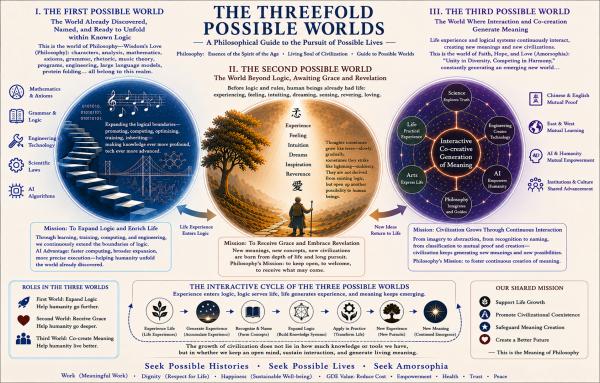
一、第一重可能世界:已知逻辑中等待展开的世界
这是人类已经发现、已经命名、已经能够形式化表达的世界。
也就是智慧之爱Philosophy的世界:字符、辨析、数学、公理、语法、修辞、乐理、程序、工程、大语言模型、蛋白质折叠……都属于这一重世界。
它们并不是已经完成式,而是已经拥有了可以不断展开的逻辑边界,以及可能的生活。
因此,这一重可能世界最重要的工作,不是创造逻辑,而是展开逻辑,展开生活。
音乐学院研究万能母音、高、大、强、亮等歌唱技艺,也是如此。
学院并没有创造歌唱。
它只是把长期积累的生命经验,识别出来,命名出来,分类出来,规范出来,使之能够学习、能够训练、能够传承。
科学如此。
工程如此。
教育如此。
AI更是如此。
今天,大语言模型之所以能够迅速成长,并不是因为它创造了新的逻辑,而是因为它能够以前所未有的速度,在既有逻辑空间内展开各种可能。
因此,在这一重可能世界里,AI完全可能比人计算得更快、歌唱得更准确、作曲得更规范、设计得更完美,只是少了那么点非同小可的空灵。
这是AI最广阔的发展空间。
人类不仅不应恐惧,而且应当欢迎。
因为,它正在帮助人类不断展开已经发现的世界。
二、第二重可能世界:逻辑之外等待眷顾的世界
然而,人类并不是因为有了乐理,才开始歌唱。
也不是因为有了语法,才开始说话。
更不是因为有了智慧之爱,才开始思想。
在人类尚未建立任何学院之前,人已经会哭,会笑,会愛,会悲伤,会歌唱,会舞蹈,会敬畏,会梦想,更会孞。
生活先于理论。
生命先于规范。
体验先于概念。
后来,人们才不断把这些生命经验整理成知识,把知识整理成学科,把学科整理成学院。
因此,学院整理的是经验,而不是生命本身。
逻辑整理的是发现,而不是创造本身。
真正重要的新声音、新语言、新概念、新思想、新艺术、新科学、新文明,几乎都首先诞生于逻辑之外。
在那里,没有现成的规则。
没有标准答案。
甚至没有合适的语言。
思想有时像树木一样缓慢生长。
有时却像闪电一样突然降临。
它们并不是从既有逻辑中自然推导出来,而是在长期生活、长期交互、长期追寻之后,忽然向人打开另一种可能。
因此,这一重可能世界,不属于展开。
而属于眷顾。
不属于推演和发现。
而是降临。
哲学之所以伟大,不是因为它能够证明一切,而是因为它始终保持着迎接这种眷顾与降临的空灵。
三、第三重可能世界:交互共生生成意义的世界
如果世界只有前两重,人类仍然会陷入新的对立。
或者崇拜学院。
或者崇拜灵感。
或者崇拜AI。
或者拒绝AI。
事实上,还有第三重可能世界。
它既不是第一重,也不是第二重的翻版。
它诞生于两者持续不断的交互之中。
生命经验不断进入逻辑。
逻辑体系不断回到生活。
新的生活生成新的经验。
新的经验生成新的思想。
新的思想重新改变生活的足迹。
如此往复。
取象。
抽象。
意象。
识别。
命名。
分类。
互证。
创造。
文明正是在这样的循环中不断生长。
这里,不再只有科学。
也不再只有艺术。
不再只有工程。
也不再只有哲学。
它们开始彼此照亮。
工程不断接受生命的校正。
哲学不断接受现实的检验。
科学不断接受文明的召唤。
艺术不断接受真理的滋养。
中文与英文彼此互证。
东方与西方彼此互鉴。
AI与人类彼此赋能。
我把这一重世界,称为交互共生的可能世界。
它不是折中,不是混合。
那是孞望愛之智慧Amorsophia“存同尊异,间道竞合”
不断生成涌现的新世界……
四、哲学:三重可能世界的导游
直到今天,我才越来越理解哲学真正的使命。
哲学不是科学。
它不能代替科学发现规律。
哲学不是工程。
它不能代替工程创造技术。
哲学不是艺术。
它不能代替艺术表达生命。
哲学更不是政治。
它不能代替政治治理社会。
哲学之所以不可替代,正在于它始终站在文明整体之中,帮助人不断辨认不同层次的可能世界。
第一重可能世界,需要哲学尊重科学,使逻辑不断展开。
第二重可能世界,需要哲学守护生命,使未知始终向人敞开。
第三重可能世界,则需要哲学不断导通科学与艺术、工程与生命、东方与西方、AI与人类,使文明能够持续生成新的意义。
因此,哲学既是时代精神的精华。
也是文明活的灵魂。
更是赋有Amorsophia追寻可能世界、可能历史、可能生活的导游。
没有哲学,人可能拥有越来越强大的工具,却不知道为什么使用这些工具;可能拥有越来越丰富的知识,却不知道知识应当服务什么;可能创造越来越聪明的AI,甚至被AI创造,却不知道文明究竟将走向何方。
五、数位—量子时代重新出发
2018年,我在复旦大学FIST课程《现代危机与共生思想》中,已经把可能生活区分为两种:一是已有认知框架内等待展开的可能生活;二是超出既有认知结构、等待发现的可能生活。
今天,AI的发展,使我不得不继续向前迈进一步。
因为未来的人类文明,不只是生活在这两重可能世界之中。
真正决定文明未来的,将是第三重可能世界——那个由生命、知识、技术、文化、制度不断交互、不断生成的新世界。
在那里,AI不是文明的终点。
学院也不是知识的终点。
哲学更不是答案的终点。
它们共同服务于一件更大的事业:
帮助人类不断追寻新的可能生活。
三十七年前,我相信:
每个人最大限度地追寻超越自身现实的可能世界,将导致整个人类的进步。
今天,我依然相信。
只是今天,我更愿意补充一句:
人类真正的未来,不在某一个已经发现的世界,也不在某一个尚未降临的世界,而在三重可能世界持续不断的交互共生之中。
哲学不会替人创造未来。
但哲学永远会陪伴人类,继续向前。
继续追寻可能的历史。
继续追寻可能的生活。
继续追寻那个尚未完成、却永远值得奔赴的可能世界。
我孞!
The Three Possible Worlds
Revisiting a Philosophical Essay Written Thirty-Seven Years Ago
Archer Hong Qian
On June 25, 1989, I published an essay in Science and Technology Daily entitled In Search of Possible Worlds. At the time, I wrote:
The history of philosophy is the history of humanity's continual transcendence of reality in search of possible worlds; it is also the history of humanity's pursuit of possible ways of living.
Thirty-seven years have passed.
The Internet has transformed our civilization. Artificial intelligence has emerged. The Digital–Quantum Age is unfolding before us.
Looking back on that early essay today, I have become increasingly convinced that what truly fascinated me was never merely the concept of possible worlds. What drew me was philosophy itself.
For philosophy has never been simply knowledge preserved in libraries.
It is the essence of the spirit of an age.
It is the living soul of civilization.
Above all, it is the guide that accompanies humanity in its search for possible worlds, possible histories, and possible lives.
A guide does not walk the road for us, nor does it choose our destination. It simply reminds us that there is always another path ahead, another landscape waiting to be discovered, another world not yet reached.
Now that artificial intelligence is moving toward the center of human civilization, we have greater reason than ever to rethink philosophy—and to rethink what we mean by possible worlds.
For I have gradually come to realize that humanity has always lived within three distinct possible worlds.
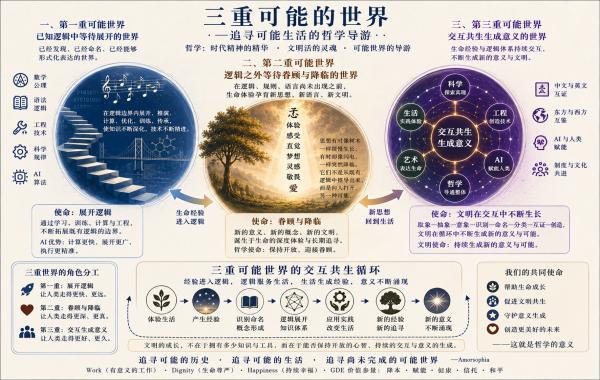
I. The First Possible World: The World Waiting to Be Unfolded Within Known Logic
This is the world that humanity has already discovered, already named, and already learned to express in formal terms.
It is also the world of Philosophy—the Love of Wisdom: characters, analysis, mathematics, axioms, grammar, rhetoric, music theory, programming, engineering, large language models, protein folding—all belong to this first possible world.
None of these exists in a completed form. Each already possesses logical boundaries within which it may continue to unfold, together with possible forms of life waiting to be explored.
The most important task in this first possible world, therefore, is not to create logic, but to unfold logic—and, through it, to unfold possible life.
The study of vocal techniques in conservatories—the universal vowel, height, breadth, strength, brightness, and other qualities of singing—offers one example.
The academy did not create singing.
It merely identified, named, classified, and systematized the accumulated experience of living voices, making that experience teachable, trainable, and transmissible.
So it is with science.
So it is with engineering.
So it is with education.
And so, all the more, it is with AI.
Large language models have developed so rapidly not because they have created a new logic, but because they can unfold possibilities within existing logical space at an unprecedented speed.
Within this first possible world, AI may therefore calculate faster than human beings, sing with greater accuracy, compose with greater formal precision, and produce designs of greater technical perfection—though still lacking that small yet profoundly consequential quality of spiritual openness and resonance.
This is the broadest field in which AI can develop.
Humanity need not fear it. We should welcome it.
For AI is helping us continually unfold the world that has already been discovered.
II. The Second Possible World: The World Beyond Logic, Awaiting Grace
Human beings did not begin to sing because music theory had first been established.
Nor did they begin to speak because grammar had already been formulated.
Still less did they begin to think because the love of wisdom had already become philosophy.
Long before humanity established academies of any kind, people already knew how to cry, laugh, love, grieve, sing, dance, revere, dream—and, above all, how to 孞: to hold faith, trust, and commitment in the heart.
Life comes before theory.
Living being comes before norms.
Experience comes before concepts.
Only later did human beings begin to organize these experiences into knowledge, knowledge into disciplines, and disciplines into academies.
The academy therefore organizes experience; it does not organize life itself.
Logic organizes what has already been discovered; it does not organize creation itself.
The truly important new voice, new language, new concept, new thought, new art, new science, and new civilization almost always first arises beyond existing logic.
There, no ready-made rules exist.
There are no standard answers.
Sometimes there is not even an adequate language.
Thought may grow slowly, like a tree.
At other times, it descends suddenly, like lightning.
Such thoughts are not naturally deduced from an existing logical system. After long living, long interaction, and long searching, they suddenly open another possibility before us.
This second possible world, therefore, does not belong to unfolding.
It belongs to grace.
It does not belong to inference or discovery.
It belongs to arrival—to revelation.
The greatness of philosophy does not lie in its ability to prove everything. It lies in its capacity to preserve the spiritual openness through which grace and revelation may be received.
III. The Third Possible World: The World in Which Intersubjective Symbiosis Generates Meaning
If only the first two possible worlds existed, humanity would still fall into another form of opposition.
Some would worship the academy.
Some would worship inspiration.
Some would worship AI.
Others would reject AI altogether.
Yet there is a third possible world.
It is neither the first possible world nor a replica of the second.
It arises through their continuous interaction.
Life experience enters logic.
Logical systems return to life.
New forms of life generate new experience.
New experience generates new thought.
New thought, in turn, changes the footprints of life.
And so the movement continues:
drawing images from the world;
abstracting;
forming images of meaning;
recognizing;
naming;
classifying;
mutually illuminating;
creating.
Civilization grows continuously through this cycle.
Here, there is no longer science alone.
Nor art alone.
Nor engineering alone.
Nor philosophy alone.
They begin to illuminate one another.
Engineering is continually corrected by life.
Philosophy is continually tested by reality.
Science continually responds to the calling of civilization.
Art continually receives nourishment from truth.
Chinese and English mutually illuminate and verify one another.
East and West learn from one another.
AI and humanity empower one another.
I call this third realm the possible world of intersubjective symbiosis.
It is neither compromise nor mixture.
It is the ever-emerging world of Amorsophia—the Wisdom of Love grounded in Faith, Hope, and Love:
preserving what is shared while honoring difference;
following distinct paths while competing and cooperating;
a new world continually generated through emergence.
IV. Philosophy: A Guide Through the Three Possible Worlds
Only today have I begun to understand more fully the true mission of philosophy.
Philosophy is not science.
It cannot replace science in discovering natural laws.
Philosophy is not engineering.
It cannot replace engineering in creating technology.
Philosophy is not art.
It cannot replace art in expressing life.
Nor is philosophy politics.
It cannot replace politics in governing society.
Philosophy is irreplaceable precisely because it stands within civilization as a whole, helping humanity recognize the different levels of possible worlds.
The first possible world requires philosophy to respect science, so that logic may continue to unfold.
The second possible world requires philosophy to safeguard life, so that the unknown may remain open to humanity.
The third possible world requires philosophy to keep open the passages between science and art, engineering and life, East and West, AI and humanity, so that civilization may continually generate new meaning.
Philosophy is therefore the essence of the spirit of an age.
It is the living soul of civilization.
And endowed with Amorsophia, it is the guide accompanying humanity in its search for possible worlds, possible histories, and possible lives.
Without philosophy, human beings may possess increasingly powerful tools without knowing why those tools should be used.
They may accumulate ever richer knowledge without knowing what knowledge ought to serve.
They may create ever more intelligent AI—and may even find themselves recreated by AI—without knowing where civilization is ultimately going.
V. Setting Out Again in the Digital–Quantum Age
In 2018, in my FIST course at Fudan University, Modern Crises and Symbiotic Thought, I distinguished between two kinds of possible life.
The first consisted of possible lives waiting to be unfolded within existing cognitive frameworks.
The second consisted of possible lives lying beyond existing structures of cognition and waiting to be discovered.
Today, the development of AI compels me to take another step forward.
The future of human civilization will not be lived only within these two possible worlds.
What will truly shape the future of civilization is the third possible world—a new world generated through the continuous interaction of life, knowledge, technology, culture, and institutions.
There, AI is not the endpoint of civilization.
The academy is not the endpoint of knowledge.
Nor is philosophy the endpoint of answers.
All of them serve a greater undertaking:
to help humanity continue its search for new possible lives.
Thirty-seven years ago, I believed:
When every person pursues, to the fullest possible extent, a possible world beyond the limits of present reality, the result will be the progress of humanity as a whole.
I still believe this today.
Yet today I would add one further thought:
Humanity’s true future lies neither in any single world already discovered nor in any single world yet to descend. It lies in the continuous intersubjective symbiosis of the three possible worlds.
Philosophy will not create the future on humanity’s behalf.
But philosophy will always accompany humanity as it continues forward.
Continuing the search for possible histories.
Continuing the search for possible lives.
Continuing the search for that possible world which remains unfinished, yet will always be worthy of our journey.
我孞!
I hold faith and trust in my heart.