
善为何需要表扬,恶为何不能纵容?
善为何需要表扬,恶为何不能纵容?
Why Goodness Needs Praise and Evil Must Not Be Condoned?
——善的正反馈、无效GDP窟窿与文明生成机制
——The Positive Feedback of Goodness, the Hollowing of GDP, and the Generative Mechanism of Civilization
钱宏(Archer Hong Qian)
2026年7月16日于温哥华
一个社会为什么需要及时表扬做好事的人?
这个问题看似简单,却触及文明能否持续生长的内在机制。人们习惯于把社会秩序寄托在法律、监管、惩罚和控制上,却容易忽略一个更朴素的事实:任何有生命的系统,都需要适时获得正向回应。一个孩子做了好事,如果长期无人看见、无人理解、无人肯定,他未必会立即放弃善良,却可能逐渐失去继续行善的热情;一个组织中的成员承担责任、节约成本、忠实服务,如果得到的回报只是沉默,甚至因为触动既得利益而受到打压,那么组织中最先退却的,往往正是那些仍然愿意认真做事的人。
社会也一样。
善若长期得不到确认,恶却不断获得利益,文明的激励方向便会发生倒置。做好做坏一个样,做得越好承担越多,弄虚作假反而能够获得资源、地位和安全,久而久之,人们便会把犬儒当作成熟,把冷漠当作清醒,把投机当作能力。组织的文件可能越来越完备,口号可能越来越响亮,真正愿意承担受托责任的人却越来越少。
因此,表扬并不是文明生活中的装饰,也不只是管理者安抚成员情绪的一种技巧。表扬首先意味着:社会能够识别善,组织愿意确认善,文明懂得让善获得继续生长的条件。
很多时候,这种确认并不需要昂贵的物质成本。一个真诚的称赞、一项适当的荣誉、一份公开的肯定、一次对责任与创造的如实记录,都可能使行善者感到自己的付出没有被世界遗忘,也让周围的人看到什么样的行为值得效法。它几乎不增加社会的物化负担,却能够积累信任、激发创造、促进合作,并使更多生命主体愿意主动承担责任。
从这个意义上说:
奖,是文明成本最低、文明收益最高的公共治理工具之一。
然而,文明激励不能只有“奖”,还必须包括“抑”与“通”。
表扬善行,不等于回避恶行;强调正向激励,也不意味着对浪费、欺诈、特权和组织失信保持沉默。一个社会若只会赞美,却不敢揭露恶,所谓“正能量”最终也可能成为遮蔽问题、保护既得利益的话术。善得不到真实确认固然会衰弱,恶得不到及时抑制,同样会扩散、复制并形成负向激励。
这正是愛之智慧孞態场/网(Amorsophia MindsField/Network,AM)蕴涵“奖—抑—通”机制的原因。
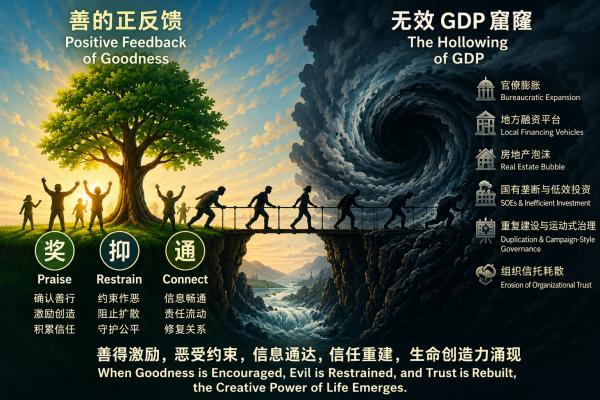
所谓“奖”,是确认生命、善行、创造和忠实受托;所谓“抑”,是使作恶、欺诈、浪费和侵害生命的行为不能获得持续扩张的条件;所谓“通”,则是让信息、意见、经验、责任和资源能够在生命主体与组织之间真实流动,使善能够被发现,恶能够被辨认,破裂的关系能够得到修复,新的创造能够不断发生。
三者不可分割。没有“奖”,文明失去生长善的动力;没有“抑”,恶会吞噬善所积累的信托;没有“通”,善恶都可能被权力、信息壁垒和组织话术任意定义,奖与抑也会异化为控制生命的工具。
由此观察现实,为什么我们应当及时肯定一些国家降低政府成本、削减无效支出、减轻管制负担、恢复家庭与市场活力的改革?并不是因为某位政治人物天然正确,也不是因为共生经济学要依附某种意识形态,而是因为凡是能够减少浪费、降低社会交易成本、恢复组织受托责任并释放生命创造力的行动,都应当得到如实确认。
米莱以“电锯改革”,压缩阿根廷长期膨胀的官僚组织,川普新政2.0,以DOGE、Trump Accounts、TrumpRx以及双边谈判等方式尝试降低政府与民生运行成本,这些政策的具体成效当然仍需由事实检验,也可能伴随争议、偏差和需要纠正之处。但只要某项改革确实减少了无效支出,改善了家庭生活,促进了和平,或者使公共组织重新面对受托责任,共生经济学就不应因为党派偏见而吝惜肯定。
及时表扬做对的事,本身就是推动改革继续向善的一种文明激励。
与这些正向样本相对,“无效GDP窟窿”则构成了一个反向验证。
一个国家可以拥有巨大的经济总量、完整的工业体系、庞大的外汇储备和强大的组织动员能力,却仍然无法回答一个最朴素的问题:
钱去哪里了?
如果大量公共资源,进入庞大的行政系统、地方融资平台、房地产扩张、国有垄断体系、重复建设、运动式治理以及各类低回报项目,形成了可以被计入GDP的经济流量,却没有相应转化为居民收入、家庭幸福、教育医疗、社会保障、国家安全、生态改善和组织信托,那么这些GDP究竟创造了什么价值?
从传统经济学看,这是投资回报递减、债务膨胀和资源错配;从共生经济学看,则是一个更深的无效GDP窟窿。
钱并没有真正消失。它只是从本来可以改善生命与生活的社会资源,转换成了低效组织的运行成本、闲置资产的账面价值、债务利息以及未来世代必须承担的负担。GDP记录了这些经济活动“发生过”,却不辨别它们究竟是在创造价值、转移价值、消耗价值,还是毁灭价值。
拆除可以形成GDP,重建也可以形成GDP;污染可以形成GDP,治理污染又形成一遍GDP;制造行政障碍需要大量组织成本,随后再设立机构解决这些障碍,又可以增加新的支出和“殖官”规模。若只看GDP,活动越多,经济似乎越繁荣;若用GDE——Gross Domestic Effectiveness,即国民生態效能——加以核验,就必须追问这些活动究竟改善了多少生活、生态、生命效能与组织信托,又消耗了多少能源、时间、信用、机会和代际资源。
发生得越多,并不等于发展得越好;当负效能活动不断扩大,增长本身便可能成为窟窿。
更严重的是,当一个组织长期以“天下为公”“全心全意为人民服务”等宏大话语证明自身正当性,却不能清楚说明公共资源的去向,不能让生命主体真实分享经济增长的成果,也不愿接受公开核验与责任追究时,“官员以各种话术不公开自己的财务收入”,问题便不再只是经济效率低下,而是组织信托的系统性耗散。
组织本应是生命的受托者。政府、企业、银行、学校以及各种公共机构所拥有的权力、资源和技术能力,都来自生命主体的授权与托付。当资源配置者可以制造政绩,却不必为失败负责;可以借新债维持旧规模,却把成本留给未来;可以用宏大目标解释一切浪费,却不允许人民追问“钱去哪里了”,那么“服务人民”便可能从受托责任异化为组织自我保护的话术。
因此,揭露无效GDP窟窿,并不是为了把批评变成另一种意识形态,也不是为了否定一个社会中真实存在的劳动、创造和建设成就,而是为了恢复文明最基本的奖抑机制:该表扬的表扬,该揭露的揭露;让真正改善生命的创造获得激励,让依靠话术、垄断、浪费和欺诈获利的行为失去扩张条件。
善与思想并不是比较级。思想帮助人们认识善、辨别善,也揭示伪善和组织性作恶;善则使思想进入生命实践,不至于沦为空洞知识或权力话术。思想与善和而生物、交互共襄,由此形成文明的正反馈。
共生经济学所坚持的两条原则,正是在这里相遇:
Live and let live.
尊重生命,使生命各安其命、各展其能,形成良性循环。
Don’t be evil and let evil be.
不要自己作恶,引发别人作恶,让作恶者借助组织和话术不断扩张,形成恶性循环。
文明的成长,既需要及时确认善,也需要勇敢抑制恶;既需要表扬那些降低成本、增进幸福、恢复信托的人与行动,也需要揭开无效GDP、组织浪费和制度欺诈的遮羞布。只有当善能够被看见、价值能够被确认、恶能够被约束、信息能够真实通达,生命自组织的创造力才会不断生成、涌现,组织信托才可能重新建立。
文明并不是依靠不断增加控制而生成,而是在奖善、抑恶、通达的交互过程中,使善得到正反馈(Positive Feedback of Goodness),使恶不能自我复制,使生命不断创造新的可能。
从这个意义上说,共生经济学本身,就是一种追求以最低制度成本和社会摩擦成本,不断提升幸福、尊严与生命效能的经济学。
Why Goodness Needs Praise and Evil Must Not Be Condoned?
——The Positive Feedback of Goodness, the Hollowing of GDP, and the Generative Mechanism of Civilization
By Archer Hong Qian
July 16, 2026, in Vancouver
Page 1
Why does a society need to praise those who do good deeds in a timely manner?
This question seems simple, yet it touches upon the inner mechanism of whether a civilization can continuously grow. People are accustomed to placing social order upon laws, regulation, punishment, and control, while easily overlooking a simpler fact: any living system needs to receive positive feedback in due time. If a child does a good deed but remains unseen, misunderstood, and unacknowledged for a long time, they might not abandon goodness immediately, but they may gradually lose the enthusiasm to continue doing good. If a member of an organization assumes responsibility, saves costs, and serves faithfully, but receives only silence in return—or even faces suppression because they disturb vested interests—then those who are still willing to do things conscientiously are often the first to retreat from the organization.
The same goes for society.
If goodness is not confirmed for a long time while evil continuously gains benefits, the direction of incentives in civilization will be inverted. When doing well or doing poorly makes no difference, and those who do better must bear more while those who engage in fraud obtain resources, status, and security instead, people will eventually mistake cynicism for maturity, indifference for clear-headedness, and speculation for capability. The documents of an organization may become increasingly complete and its slogans increasingly resonant, yet fewer and fewer people are genuinely willing to assume fiduciary duties.
Therefore, praise is not a decoration in civilized life, nor is it merely a technique for managers to placate the emotions of members. Praise first and foremost means: society can identify goodness, organizations are willing to confirm goodness, and civilization knows how to provide the conditions for goodness to keep growing.
Much of the time, this confirmation does not require expensive material costs. A sincere compliment, an appropriate honor, a public affirmation, or a faithful record of responsibility and creativity can all make do-gooders feel that their efforts have not been forgotten by the world, while allowing those around them to see what kind of behavior is worth emulating. It adds almost no physical burden to society, yet it can accumulate trust, inspire creativity, promote cooperation, and make more living subjects willing to proactively take on responsibility.
In this sense:
Praise is one of the public governance tools with the lowest civilization cost and the highest civilization return.
Page 2
However, civilized incentives cannot rely on "praise" alone; they must also include "restraint" and "connection."
Praising good deeds does not equal evading evil deeds; emphasizing positive incentives does not mean remaining silent about waste, fraud, privilege, and organizational breach of trust. If a society only knows how to praise but dares not expose evil, the so-called "positive energy" may ultimately become a rhetoric that conceals problems and protects vested interests. While goodness will weaken if it is not genuinely confirmed, evil will likewise diffuse, replicate, and form a negative incentive if it is not restrained in a timely manner.
This is precisely why the Amorsophia MindsField/Network (AM) encapsulates the mechanism of "Praise–Restraint–Connection."
The so-called "Praise" means confirming life, good deeds, creativity, and faithful stewardship; "Restraint" means ensuring that acts of evil, fraud, waste, and infringement upon life cannot obtain the conditions for continuous expansion; "Connection" means allowing information, opinions, experiences, responsibilities, and resources to flow genuinely between living subjects and organizations, so that goodness can be discovered, evil can be identified, broken relationships can be repaired, and new creations can constantly emerge.
The three are inseparable. Without "Praise," civilization loses the momentum to grow goodness; without "Restraint," evil will swallow the trust accumulated by goodness; without "Connection," both goodness and evil can be arbitrarily defined by power, information barriers, and organizational rhetoric, and praise and restraint will degenerate into tools for controlling life.
Observing reality from this perspective, why should we promptly affirm the reforms of certain countries that reduce government costs, cut ineffective expenditures, alleviate regulatory burdens, and restore the vitality of families and markets? It is not because a certain political figure is inherently correct, nor because symbiotic economics needs to attach itself to a certain ideology, but because any action that can reduce waste, lower social transaction costs, restore organizational fiduciary duties, and release the creative power of life should be faithfully confirmed.
Milei compresses Argentina’s long-bloated bureaucratic organization through his "chainsaw reform"; Trump's New Deal 2.0 attempts to lower government and livelihood operating costs through DOGE, Trump Accounts, TrumpRx, and bilateral negotiations. The specific effectiveness of these policies must, of course, still be tested by facts, and they may be accompanied by controversies, deviations, and points requiring correction. However, as long as a certain reform genuinely reduces ineffective spending, improves family life, promotes peace, or makes public organizations face their fiduciary duties again, symbiotic economics should not hold back affirmation due to partisan bias.
Timely praise for doing the right thing is itself a civilized incentive that drives reform to continue toward goodness.
In contrast to these positive examples, "the hollowing of GDP" constitutes a reverse verification.
A country can possess a massive economic aggregate, a complete industrial system, huge foreign exchange reserves, and strong organizational mobilization capabilities, yet still fail to answer the most basic question:
Where did the money go?
If large amounts of public resources enter bloated administrative systems, local financing vehicles, real estate expansion, state-owned monopoly systems, redundant construction, campaign-style governance, and various low-return projects, they form economic flows that can be counted into GDP.
Page 3
Yet, if these flows are not correspondingly transformed into household income, family happiness, education, medical care, social security, national security, ecological improvement, and organizational trust, then what value exactly did this GDP create?
From the perspective of traditional economics, this represents diminishing returns on investment, debt expansion, and resource misallocation; from the perspective of symbiotic economics, it is a deeper hollow of ineffective GDP.
The money did not truly disappear. It was merely converted from social resources that could have improved life and living into the operating costs of inefficient organizations, the book value of idle assets, debt interest, and burdens that future generations must bear. GDP records that these economic activities "happened," but it does not discern whether they are creating value, transferring value, consuming value, or destroying value.
Demolition can generate GDP, and reconstruction can also generate GDP; pollution can generate GDP, and environmental remediation generates GDP all over again; creating administrative obstacles requires substantial organizational costs, and subsequently setting up agencies to resolve these obstacles can add new expenditures and expand the scale of "bureaucratic proliferation." If one only looks at GDP, the more activities there are, the more prosperous the economy seems. But if checked against GDE—Gross Domestic Effectiveness—one must ask how much these activities have actually improved life, ecology, life effectiveness, and organizational trust, and how much energy, time, credit, opportunity, and intergenerational resources they have consumed.
The fact that more happens does not mean that development is better; when negative-effectiveness activities continuously expand, growth itself can become a hollow.
Even more serious is when an organization uses grand narratives such as "working for the public good" or "serving the people heart and soul" to justify its legitimacy for a long time, yet cannot clearly account for the whereabouts of public resources, refuses to let living subjects genuinely share the fruits of economic growth, and is unwilling to accept public verification and accountability. When "officials use various rhetoric to avoid disclosing their financial income," the problem is no longer just low economic efficiency, but a systemic dissipation of organizational trust.
Page 4
Organizations are supposed to be the trustees of life. The power, resources, and technical capabilities possessed by governments, enterprises, banks, schools, and various public institutions all stem from the authorization and entrustment of living subjects. When resource allocators can manufacture political achievements but do not have to be responsible for failures, can incur new debts to maintain old scales while leaving the costs to the future, and can use grand goals to explain away all waste while forbidding citizens from asking "where did the money go," then "serving the people" may alienate from a fiduciary duty into a rhetoric for organizational self-protection.
Therefore, exposing the hollow of ineffective GDP is not about turning criticism into another ideology, nor is it about denying the real labor, creation, and construction achievements that exist in a society. Rather, it is about restoring the most fundamental reward-and-restraint mechanism of civilization: praise what should be praised, expose what should be exposed; allow creations that genuinely improve life to receive incentives, and strip away the conditions for expansion from behaviors that profit from rhetoric, monopoly, waste, and fraud.
Goodness and thought are not in a comparative relationship. Thought helps people recognize and distinguish goodness, and it also unmasks hypocrisy and organizational evil; goodness, in turn, brings thought into the practice of life, preventing it from degenerating into hollow knowledge or power rhetoric. Thought and goodness harmonize to generate life and interact to assist each other, thereby forming the positive feedback of civilization.
The two principles upheld by symbiotic economics meet precisely here:
Live and let live.
Respect life, allowing all lives to find their peace and express their capabilities, forming a virtuous cycle.
Don’t be evil and let evil be.
Do not commit evil yourself, do not trigger others to commit evil, and do not let evildoers continuously expand by relying on organizations and rhetoric, which forms a vicious cycle.
The growth of civilization requires both the timely confirmation of goodness and the courageous restraint of evil. It requires praising those individuals and actions that lower costs, enhance happiness, and restore trust, while also tearing away the fig leaf of ineffective GDP, organizational waste, and institutional fraud. Only when goodness can be seen, value can be confirmed, evil can be restrained, and information can genuinely connect, will the creative power of life’s self-organization continuously generate and emerge, and organizational trust can be rebuilt.
Civilization is not generated by continuously increasing control. Rather, it is through the interactive process of praising goodness, restraining evil, and connecting information that goodness receives positive feedback, evil is prevented from replicating itself, and life continuously creates new possibilities.
In this sense, symbiotic economics itself is an economics that seeks to continuously elevate happiness, dignity, and life effectiveness with the lowest institutional and social friction costs.