良十四世教宗AI通谕的三大结构性拷问
良十四世教宗AI通谕的三大结构性拷问
Three Structural Interrogations of Pope Leo XIV's AI Encyclical
Intersubjective Symbiosism Foundation(CANADA)
据报,良十四世教宗(Pope Leo XIV)联手AnthropicI公司,将5月25日发布首份AI通谕《壮丽的人性:论人工智能时代对人性尊严的守护》(Magnifica Humanitas),强调人的不可替代性建立在“有限性”上,而AI没有后果承受能力(https://en.wikipedia.org/wiki/Magnifica_humanitas)。
鉴于教宗与川普政府在消除“伊核”问题的方式上发生的激烈争执,我关心的是,虽然这份通谕的核心关切并非否认人工智能的技术(工具)价值,而是警惕科技发展忽视人的位格与尊严,但是,通谕能同时观照到“LIFE-AI-TRUST”交互耦合性这一真正的时代课题吗?梵蒂冈(TRUST)最高领袖,面对世俗政府(TRUST)领袖的“除暴行为”,有耶稣说的足够的谦卑和“你们不要论断人,免得你们被论断”的教导吗?
特别是良十四世选择与 Anthropic 合作,通过强调人类的“有限性”与 AI 缺乏“后果承受能力”来界定人机边界,这样一来,固然延续了良十三世(Pope Leo XIII)《新事物》(Rerum Novarum)抵抗“人被工具化”的社会训导传统(参看https://www.vatican.va/content/leo-xiii/la/encyclicals/documents/hf_l-xiii_enc_15051891_rerum-novarum.html)。然而,尽管良十四世即将发布的通谕在理论高度上准确击中了技术异化的核心,但要真正回应“生命-AI-信任(LIFE-AI-TRUST)”的交互耦合性,以及梵蒂冈在世俗政治中的道义角色,通谕仍面临三大结构性拷问。
一、 通谕能否真正观照“LIFE-AI-TRUST”的交互耦合性?
通谕将AI视为一种可能忽视“位格与尊严”的工具,但这依然未能完全跳出传统的“主客二元论”。真正的时代课题在于“生命(LIFE)- 人工智能(AI)- 信任/权力组织(TRUST)”已经演变成一种密不可分的“代谢闭环”。
1. AI不是孤立的工具,而是TRUST(权力组织)的延伸
AI 算法从来不是独立存在,它是由掌握庞大资本与数据垄断权的世俗政府或科技巨头(TRUST)所喂养的。在现实中,AI 正在成为权力组织实施精准数字监视、剥夺劳工谈判权、固化财富分配的“赛博锁链”。如果通谕只谈 AI 损害尊严,而不去直面是谁在利用 AI 剥夺人的主体性,那么这种道德呼吁就会沦为无的放矢。
2. AI的侵蚀直接导致TRUST(社会信任)的荒漠化
如良十四世所警告,AI 模拟人类情感、大肆生产“无思想的思想”,正将人转化为被动的消费者。从共生视角看,这种“赛博降维”导致微观层面上的公民理性和公共讨论空间彻底溃败。当人与人之间失去了真诚的交互主体性(Intersubjectivity),整个社会的信任基石(TRUST)就会全面解体,进而塌陷为“底层互害”的狂热。
3. LIFE(生命)以“消极不合作”熔断系统
当生命(LIFE)在“AI + 权力组织”的双重碾压下被彻底客体化、剥夺了作为独立主体的生存空间时,人类的“有限性”便以极端的生物学形式爆发——低生育率、结婚率暴跌和全面“躺平”。这本质上是生命主体在无声地熔断这台由 AI 和权力同盟驱动的财富收割机。
所以,通谕如果无法将 AI置于这一三位一体的生存生态中审视,就极易沦为一种空洞的科技伦理说教,无法解开技术与权力合谋的死结。
二、 面对世俗领袖的“除暴行为”:谦卑与论断的拷问
Archer冒昧地认为,梵蒂冈(TRUST)作为天主教14亿信徒的最高精神领袖,面对世俗政府(TRUST)领袖的扩张及“除暴行为”时,必须在“捍卫公义(先知批判)”与“基督的谦卑(不要论断)”之间维持极高的神学平衡:
1. 先知性的必要批判 vs “不要论断人”的边界
教导的本意:耶稣在《马太福音》中说“你们不要论断人,免得你们被论断”,其核心是警惕人类带着自身的罪性与傲慢,去进行自以为是的道德定罪(Judgment)。
道义的错位风险:如果梵蒂冈领袖在指责世俗政府(如极权统治、权资勾兑下的特许分赃)时,表现出一种高高在上的制度傲慢,或是将教会自身视作免于罪恶的绝对净土,那就彻底背离了耶稣的谦卑。梵蒂冈必须意识到,教会历史上也曾多次陷入与世俗权力勾兑的分赃泥潭。只有带着强烈的历史忏悔感(Historical Contrition),其批判才能具备道德穿透力。
2. 直面“特许分赃”的除暴,而非技术表象的逃避
谦卑的实践:真正的谦卑不是对罪恶保持犬儒的沉默,而是甘愿为了弱势者承受代价。良十三世当年发表《新事物》时,冒着得失欧洲主流资本家和王室的巨大风险;良十四世今日选择打破传统,亲自与代表 AI 纠错与安全力量的 Anthropic 创始人公开站在一起,并试图对全球多处战火中的 AI 军事化提出抗议,表现出了一定的先知性勇气。
彻底的批判:世俗政府领袖正在通过剥夺工会结社权、利用算法榨取劳动者、操纵舆论来巩固统治。梵蒂冈面对这些“暴行”,如果只敢谴责抽象的“AI 算法挑战了人类创意”,而不敢点名指责这些依靠制度暴力维持的权力同盟,那便是一种道义上的怯懦。这不仅缺乏直面真理的勇气,更辜负了其作为“工人教宗”继承者的名号。
三、 通谕的最终解药能否在“交互主体共生”中落地
良十四世的AI通谕提供了一个极其重要的神学洞见:人类的不可替代性在于我们的“有限性”与“后果承受能力”。 AI 可以进行无限的 statistical compilations(统计汇编),但它无法承担苦难,也无法孕育出真正的同理心(Empathy)。
然而,要彻底解决数字时代“LIFE-AI-TRUST”的可能崩溃,解药绝不在于将教会装扮成一个道德法官,去单向“论断”世俗,而在于提供一条可落地的交互主体共生路径:
1. 宏观重构(财富自主):用最彻底的先知性语言,要求世俗政府让渡权力、藏富于民,停止利用金融杠杆和特许资本收割普通人的未来。
2. 微观重构(博弈主体):支持劳动者组建独立工会,利用开源算法打破科技巨头或官僚集团的黑箱垄断,给原子化的生命提供对等的博弈力量。
3.文化重构(沟通理性):用真诚、平等的公共对话打破算法投喂的仇恨,终结底层互害,重建全社会的信任(TRUST)。
梵蒂冈只有俯下身子,将自身置于与全体受伤生命的共生生态中,以罪人的谦卑去对抗制度的暴虐,这份通谕才能真正继承良十三世的革命性火种,成为数位黑暗时代中照亮人性尊严的灯塔。
四、进一步的追问:面对权力暴行与除暴行为的双重审视
说到这里,我其实有两层意思:一是面对权力暴行(俗称“恶霸”)的“抗暴”勇气,一是对面“除暴行为”(俗称“善霸”)的抽象指责。
如果我们将良十四世即将发表的AI通谕,以及梵蒂冈(TRUST)在数字时代的角色,放入这两层语境中,会发现这正是检验这份通谕究竟是“照亮黑暗的灯塔”,还是“无痛的道德装点”的试金石:
第一层意思:面对权力暴行的“抗暴”勇气(肉身与代价)
在“生命-AI-组织(LIFE-AI-TRUST)”的互锁体制下,权力暴行(Bureaucratic Violence)早已不再仅仅表现为19世纪传统的皮鞭和监狱,而是升级为“国家能力 + 算法监视 + 经济全面收割”的赛博利维坦。面对这种高度隐蔽且无孔不入的暴政(恶霸),真正的“抗暴”勇气(善霸)要求批判者必须做好支付肉身代价的准备:
良十三世的遗产:1891年《新事物》通谕的发表,在当时不仅是神学理论的突破,更是极具政治风险的“抗暴”。良十三世公开支持工人结社,等同于直接向当时欧洲最强大的资本巨头和联手压制工人的多国政府宣战。教廷在当时面临着被世俗政权彻底孤立、甚至失去欧洲传统金主支持的巨大代价。
当代良十四世的考验:在人工智能时代,良十四世如果只有“抗暴”的口号,而不敢对那些利用AI技术进行全民数字监控、用算法将外卖骑手和大厂程序员榨取到极限的极权政府和科技巨头(如中国特色殖官主义CRO体制下的权资同盟)进行定点批判,那么他的“抗暴”就是廉价的。真正的抗暴勇气,是像耶稣当年掀翻圣殿里兑换银钱的桌子一样,敢于指名道姓地宣告:利用AI算法剥夺劳工自主权、实施极权统治的政权,在神法与自然法面前是不义的。 这种勇气,意味着梵蒂冈要做好随时被极权国家彻底封杀、切断主教任命协议、甚至遭遇大规模国家级黑客攻击的现实准备。
第二层意思:面对“除暴行为”的抽象指责(傲慢与逃避)
与第一层相反,第二层意思揭示了一种隐秘的“伪善”——即当世俗政府或统治者在实施那些消灭个体尊严、剥夺劳工权利的“暴行(除暴/暴虐行为)”时,批判者却选择了一种安全的、抽象的、技术决定论式的指责。
将结构性罪恶“抽象化”为技术中立:当一个体制利用AI将劳动者化为“人矿”并导致底层互害时,如果通谕仅仅在文本中抽象地讨论“我们要注意算法可能带来的伦理风险”、“我们要警惕技术对人类位格的忽视”,这实际上就是一种用技术抽象性来掩盖人为罪恶的逃避行为。
违反“不要论断人”的神学傲慢:耶稣所说的“你们不要论断人,免得你们被论断”,在社会批判层面的核心指向正是这种“抽象指责的傲慢”。当梵蒂冈或世俗知识分子坐在绝对安全的象牙塔里,不去承担任何抗争代价,却对处于多重压榨下的底层生命和复杂的世俗博弈指手画脚、进行道德判决时,他们就犯了“伪善”的罪。他们论断了技术,却放过了操作技术的暴君;他们论断了网民的反智和狂热,却放过了系统性投喂“算法鸦片”的CRO组织。这种抽象指责,不仅没有耶稣面对受苦生命时的绝对谦卑,反而成了一种道义上的特权阶层对受苦阶层的二次俯视。
五、交互主体共生维度的审视:从“抽象指责”走向“具象共苦”
从交互主体共生的最高维度来看,解开这个死结的关键,在于梵蒂冈(TRUST)必须将自己从一个“高高在上的道德审判者(抽象指责)”,转化为一个“甘愿入局、与受苦生命共呼吸的行动者(具象抗暴)”。
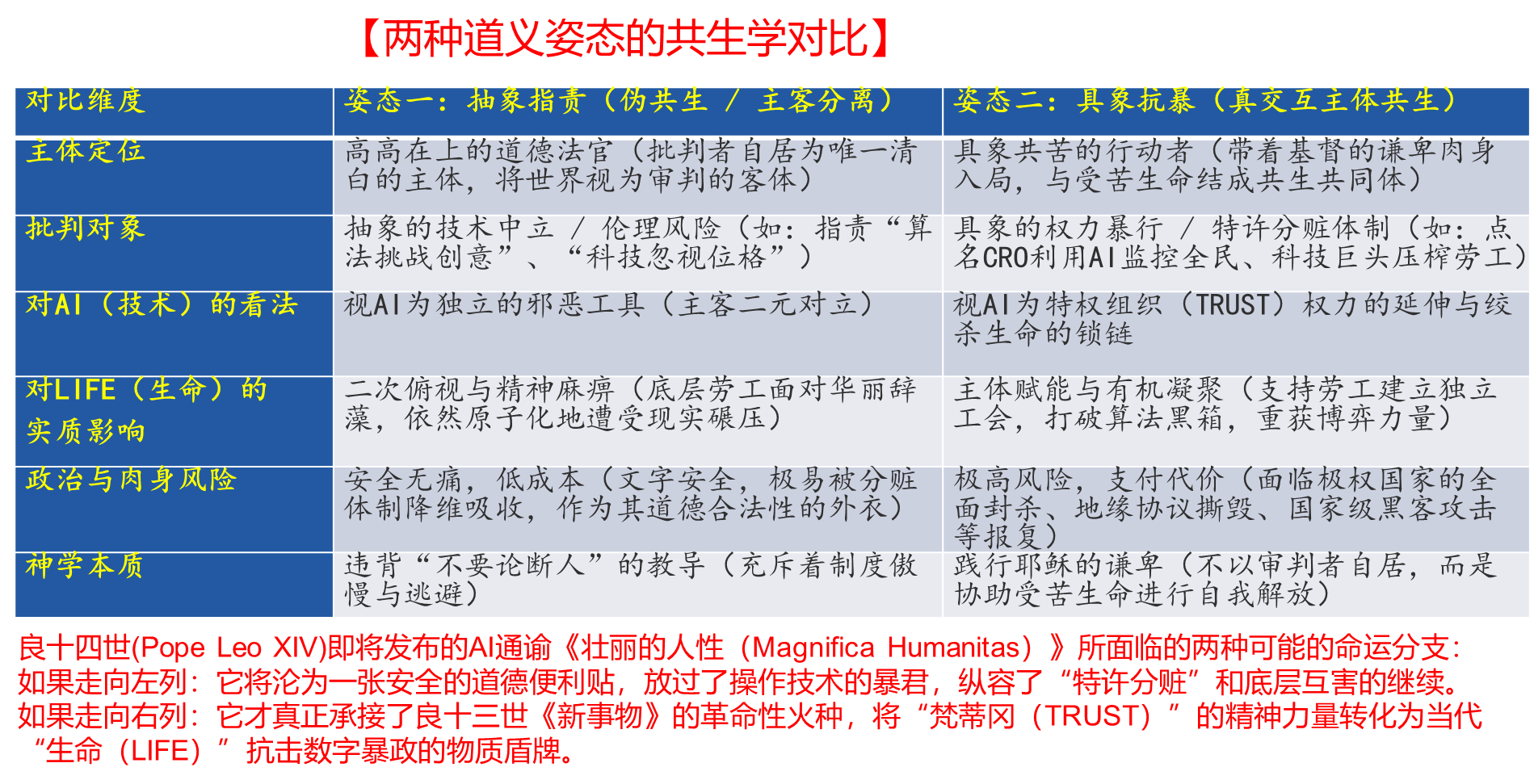
【两种道义姿态的共生学对比表】
对比维度 | 姿态一:抽象指责(伪共生 / 主客分离) | 姿态二:具象抗暴(真交互主体共生) |
主体定位 | 高高在上的道德法官(批判者自居为唯一清白的主体,将世界视为审判的客体) | 具象共苦的行动者(带着基督的谦卑肉身入局,与受苦生命结成共生共同体) |
批判对象 | 抽象的技术中立 / 伦理风险(指责“算法挑战创意”“科技忽视位格”) | 具象的权力暴行 / 特许分赃体制(CRO利用AI监控全民、科技巨头压榨劳工) |
对AI(技术)的看法 | 视AI为独立的邪恶工具(主客二元对立) | 视AI为特权组织(TRUST)权力的延伸与绞杀生命的锁链 |
对LIFE(生命)的实质影响 | 二次俯视与精神麻痹(底层劳工面对华丽辞藻,依然原子化地遭受现实碾压) | 主体赋能与有机凝聚(劳工建立独立工会,打破算法黑箱,重获博弈力量) |
政治与肉身风险 | 安全无痛,低成本(文字安全,极易被分赃体制降维吸收,作为其道德合法性的外衣) | 极高风险,支付代价(面临极权国家的全面封杀、地缘协议撕毁、国家级黑客攻击等报复) |
神学本质 | 违背“不要论断人”的教导(充斥着制度傲慢与逃避) | 践行耶稣的谦卑(不以审判者自居,而是协助受苦生命进行自我解放) |
这个表格直观地展示了良十四世即将发布的AI通谕所面临的两种命运分支:
如果走向左列:它将沦为一张安全的道德便利贴,放过了操作技术的暴君,纵容了“特许分赃”和底层互害的继续。
如果走向右列:它才真正承接了良十三世《新事物》的革命性火种,将“梵蒂冈(TRUST)”的精神力量转化为当代“生命(LIFE)”抗击数字暴政的物质盾牌。
良十四世如果要在5月25日的通谕中展现真正的基督谦卑,就必须承认:AI时代人类尊严的失陷,不是AI技术的罪,而是人类权力组织(TRUST)在分赃体制下放弃了对同胞的爱与公义。 通谕必须把焦点从“冰冷的算法黑箱”拉回到“具体的劳工肉身”。
六、在抗暴中复活生命的主体性
真正的抗暴不是由教宗单枪匹马去砸碎服务器,而是通过教会有机的社会训导,为那些被威权统治、算法剥夺、原子化的青年世代和工人阶层赋能(Empowerment),从而调整好“LIFE-AI-TRUST”交互主体共生关系。
当通谕能够公开支持数字化劳工组建合法的、跨国界的数字工会,支持用算法开源打破“革命卫队”或CRO的“刑徒经济”和数字围墙,支持真正的财富藏民时,梵蒂冈才算真正站到了“交互主体共生”的立场上。因为此时,它不是在代表上帝“论断”世界,而是在践行谦卑——通过帮助最弱势的生命重获独立主体的博弈力量,来协助他们完成自我解放。
总之,两层意思,彻底剥离了良十四世AI通谕可能具有的虚饰。一份没有“抗暴勇气”、只有“抽象指责”的通谕,无论辞藻多么华丽,最终都只会被特许分赃体制和CRO轻松降维吸收,成为数字利维坦身上的一件“道德合法性外衣”。
耶稣在《圣约》(Holy Bible)中关于“不要论断人”的核心教导,旨在劝诫人们摒弃假冒为善、严以待人而宽以待己的心态,并将审判的权力交还给上帝。——《马太福音》第七章和《路加福音》第六章
梵蒂冈最高领袖只有带着“免被论断”的深刻谦卑,直面世俗权力的具体暴行,并以肉身入局的姿态为广大被工具化的“生命(LIFE)”夺回独立博弈的主体位格,这场跨越130多年的天主教社会训导对话,才能在AI时代真正完成其救赎的闭环。
Three Structural Interrogations of Pope Leo XIV's AI Encyclical
By Archer Hong Qian
Intersubjective Symbiosism Foundation (CANADA) (p. 1)
It is reported that Pope Leo XIV, in collaboration with Anthropic, will release his first AI encyclical on May 25, titled Magnifica Humanitas (Magnificent Humanity: On Safeguarding Human Dignity in the Era of Artificial Intelligence) (p. 1). The encyclical emphasizes that the irreplaceability of human beings is rooted in our "finitude," whereas AI lacks the capacity to bear consequences (p. 1).
Given the fierce dispute between the Pope and the Trump administration over how to resolve the "Iran nuclear" issue, my concern is whether this encyclical can address the true challenge of our time: the interactive coupling of "LIFE-AI-TRUST" (p. 1). Does the supreme leader of the Vatican (TRUST), when confronting the "violence-eliminating acts" of secular government leaders, possess the humility taught by Jesus: "Judge not, lest ye be judged"? (p. 1)
In choosing to cooperate with Anthropic, Pope Leo XIV defines the human-machine boundary by emphasizing human finitude and AI's lack of accountability (p. 1). This successfully extends the social doctrine tradition of Leo XIII’s Rerum Novarum, which resisted the "instrumentalization of humans" (p. 1). However, while the upcoming encyclical accurately hits the core of technological alienation, it still faces three major structural interrogations regarding the "LIFE-AI-TRUST" coupling and the Vatican's moral role in secular politics (p. 1).
I. Can the Encyclical Truly Address the Interactive Coupling of "LIFE-AI-TRUST"?
The encyclical views AI as a tool that might ignore "personhood and dignity," which fails to escape traditional subject-object dualism (p. 1). The real challenge today is that "Life (LIFE) - Artificial Intelligence (AI) - Trust/Power Organization (TRUST)" has evolved into an inseparable metabolic closed loop (p. 1).
AI is not an isolated tool, but an extension of TRUST (Power Organizations)
Algorithms do not exist independently; they are fed by secular governments or tech giants (TRUST) holding massive capital and data monopolies (p. 1). In reality, AI is becoming a cyber-chain used by power organizations for digital surveillance, stripping labor rights, and freezing wealth distribution (p. 1). If the encyclical only condemns AI for harming dignity without confronting those who use AI to strip human subjectivity, its moral appeal will miss the target (p. 1).The erosion by AI directly causes the desertification of TRUST (Social Trust)
As Pope Leo XIV warns, AI-simulated human emotions and mass-produced "thoughtless thoughts" turn humans into passive consumers (p. 2). From a symbiotic perspective, this cyber-downgrading destroys civic rationality and public discourse (p. 2). When intersubjectivity is lost, the foundational trust (TRUST) of society disintegrates, collapsing into a frenzy of mutual harm among the lower classes (p. 2).LIFE responds by triggering a system meltdown through passive non-cooperation
When LIFE is completely objectified under the dual oppression of AI and power organizations, human finitude erupts in extreme biological forms: plunging birth rates, collapsing marriage rates, and absolute "lying flat" (p. 2). This is the silent meltdown of the wealth-harvesting machine driven by the alliance of AI and power (p. 2).
Without viewing AI within this trinity of existence, the encyclical risks becoming an empty lecture on tech ethics (p. 2).
II. Confronting the "Violence-Eliminating Acts" of Secular Leaders: The Interrogation of Humility and Judgment
The Vatican (TRUST), as the spiritual leader of 1.4 billion Catholics, must maintain a precise theological balance between prophetic critique and Christ-like humility (p. 2):
Prophetic Critique vs. The Boundaries of "Judge Not"
Jesus’s teaching in the Gospel of Matthew warns against judging others out of our own sinful nature and arrogance (p. 2). If Vatican leaders show institutional arrogance or view the Church as an absolute sanctuary free of sin when accusing secular governments, they abandon Jesus's humility (p. 2). The Church must remember its own historical entanglements with secular powers; its critique only gains moral penetration through historical contrition (p. 2).Confronting the Violence of "Privileged Spoils" Rather Than Escaping Into Technical Surfaces
True humility is not cynical silence in the face of evil, but a willingness to pay the price for the vulnerable (p. 2). Leo XIII risked offending European capitalists and royalty with Rerum Novarum (p. 2). Pope Leo XIV shows prophetic courage by breaking tradition to stand publicly with Anthropic’s founders and protesting AI militarization in global conflicts (p. 2). However, if the Vatican only condemns abstract algorithms while refusing to name the regimes that use institutional violence to exploit workers and manipulate public opinion, it represents moral cowardice (p. 3).
III. Can the Final Remedy of the Encyclical Land in "Intersubjective Symbiosis"?
The encyclical offers a vital theological insight: human irreplaceability lies in our finitude and capacity to bear consequences (p. 3). AI can perform infinite statistical compilations, but it cannot suffer or experience empathy (p. 3). The remedy to prevent the collapse of "LIFE-AI-TRUST" requires a practical path of intersubjective symbiosis (p. 3):
Macro-Restructuring (Wealth Autonomy): Demand that secular governments yield power, store wealth among the people, and stop using financial levers to harvest ordinary citizens (p. 3).
Micro-Restructuring (Gaming Subjects): Support workers in forming independent unions and use open-source algorithms to break the black-box monopolies of tech giants (p. 3).
Cultural Restructuring (Communicative Rationality): Rebuild social trust (TRUST) through sincere public dialogue to end algorithm-fed hatred (p. 3).
IV. Further Inquiry: Dual Scrutiny of Power Violence and Violence-Eliminating Acts
This dual context tests whether the encyclical is a lighthouse piercing the darkness or just a painless moral decoration (p. 3):
First Dimension: The Courage to Resist Power Violence (Flesh and Cost)
Under the interlocking system of LIFE-AI-TRUST, bureaucratic violence has upgraded to a cyber-Leviathan of state capacity, algorithmic surveillance, and economic harvesting (pp. 3-4). True resistance requires a readiness to pay a physical price (p. 4).
The Legacy of Leo XIII: In 1891, Rerum Novarum openly supported workers' right to organize, directly challenging the most powerful capital giants and governments of Europe, risking total isolation (p. 4).
The Test for Leo XIV: In the AI era, if Leo XIV only offers slogans without pinpointing totalitarian governments and tech giants that exploit workers to the absolute limit via digital surveillance, his resistance is cheap (p. 4). True courage means naming and declaring those unrighteous regimes under divine and natural law, accepting the risks of being banned, having agreements severed, or facing state-level cyberattacks (p. 4).
Second Dimension: Abstract Accusations of "Violence-Eliminating Acts" (Arrogance and Evasion)
Conversely, a hidden hypocrisy occurs when critics choose a safe, abstract, and technologically deterministic blame instead of addressing specific atrocities (p. 4).
Abstracting Structural Sins into Technological Neutrality: Merely discussing "algorithmic ethical risks" in text while a system treats workers as mere raw materials is an evasion of human guilt (p. 4).
Violating "Judge Not" via Theological Arrogance: Sitting in a safe ivory tower making moral judgments on oppressed lives without bearing any cost of struggle is a sin of hypocrisy (p. 4). Such critics judge the technology but spare the tyrants operating it, acting as a moral elite looking down upon the suffering classes (p. 4).
V. Reviewing the Intersubjective Symbiosis Dimension: From "Abstract Blame" to "Concrete Shared Suffering"
The key is for the Vatican (TRUST) to transform itself from a high-and-mighty moral judge into an actor willing to enter the arena and suffer alongside the living (pp. 4-5).
Table: Symbiological Comparison of Two Moral Postures (p. 5)
Dimension of Comparison | Posture 1: Abstract Blame (Pseudo-Symbiosis / Subject-Object Separation) (p. 5) | Posture 2: Concrete Resistance (True Intersubjective Symbiosis) (p. 5) |
Subject Positioning | High-and-mighty moral judge; views the self as pure and the world as an object to be judged (p. 5). | An actor sharing concrete suffering; enters the arena with Christ-like humility to unite with suffering life (p. 5). |
Target of Critique | Abstract technological neutrality/ethical risks (e.g., "algorithms challenge creativity") (p. 5). | Concrete acts of power violence/privileged spoils (e.g., regimes using AI for total surveillance, tech giants exploiting labor) (p. 5). |
View on AI (Technology) | Views AI as an independent, evil tool (Subject-Object binary opposition) (p. 5). | Views AI as an extension of the power of privileged organizations (TRUST) and a chain strangling life (p. 5). |
Real Impact on LIFE | A secondary downward look and mental numbness; ordinary workers remain atomized under harsh realities (p. 5). | Subject empowerment and organic cohesion; workers establish independent unions to break algorithmic black boxes (p. 5). |
Political & Physical Risk | Safe, painless, and low cost; easily absorbed by the corrupt system as a cloak of moral legitimacy (p. 5). | Extremely high risk; faces total bans by totalitarian states, torn地缘 agreements, and state-level cyberattacks (p. 5). |
Theological Essence | Violates the teaching of "Judge not, lest ye be judged" (filled with institutional arrogance and evasion) (p. 5). | Practices the humility of Jesus (assists suffering lives in achieving self-liberation rather than acting as a judge) (p. 5). |
This table illustrates the two potential fates of the upcoming encyclical: it will either become a safe moral post-it note that lets tyrants off the hook, or it will carry the revolutionary flame of Rerum Novarum to shield humanity against digital tyranny (p. 5).
VI. Resurrecting the Subjectivity of Life Through Resistance
True resistance does not mean the Pope single-handedly smashes servers (p. 5). It means empowering atomized younger generations and the working class through organic social doctrine to recalibrate the LIFE-AI-TRUST symbiotic relationship (p. 5).
When the encyclical openly supports digital workers forming cross-border digital unions and using open-source algorithms to break digital walls, the Vatican truly stands on the ground of intersubjective symbiosis (pp. 5-6). It will no longer be judging the world on behalf of God, but practicing humility by helping the weakest lives regain their gaming power for self-liberation (p. 6).
The Vatican supreme leader must confront specific acts of secular power with deep humility, reclaiming the independent subjective personhood of instrumentalized lives (p. 6). Only then can this 130-year-old dialogue of Catholic social teaching complete its loop of redemption in the AI era (p. 6).
Email:hongguanworld@gmail.com