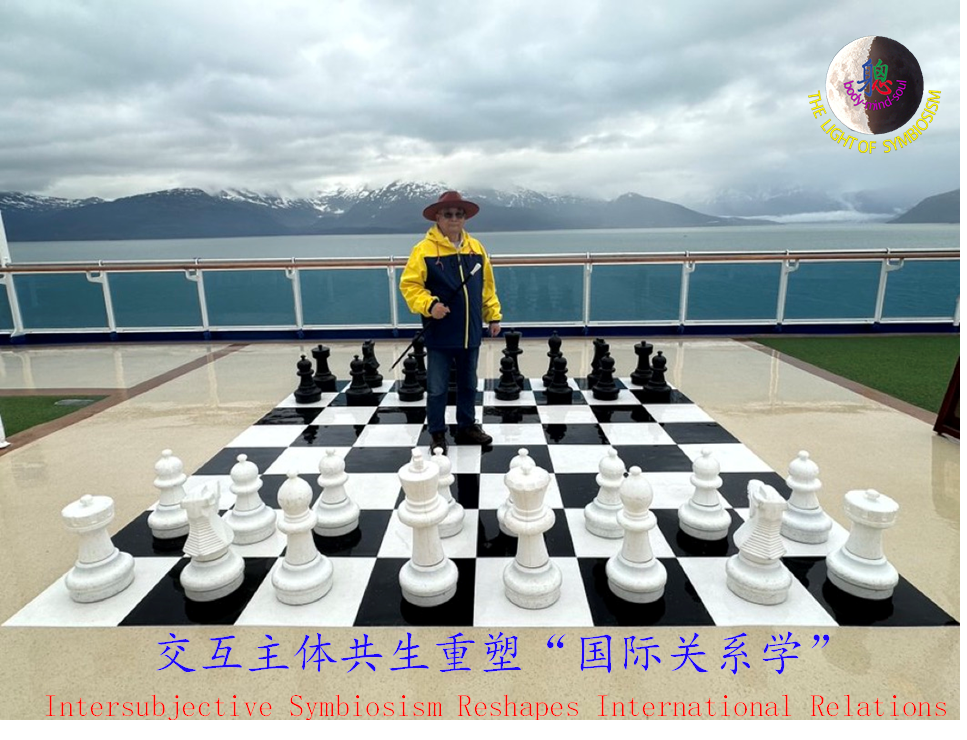
差异与秩序交互共生之道
差异与秩序交互共生之道
——Amorsophia贯通Narrow Corridor的间道竞合
钱 宏Archer Hong Qian
2026 年3 月24-25 日晨于Vancouver
万物交互主体共生(Everything Intersubjective Symbiosis):在同性相斥与异性相吸之间寻找动態平衡。
这里要探讨的是:生命自组织连接差异,这是存同求异,是物理、生理、心理上的异性相吸(Heterogeneous Attraction);生命他组织连接和谐,这叫求同存异,但在物理、生理、心理上是同性相斥(Homogeneous Repulsion)。那么,如何在伦理、哲理、数理上达成同性相斥与异性相吸的动態平衡?这就是交互主体共生要讲的问题,也是经济学讲的窄廊问题,亦即 Holy Bible(圣约)讲的窄门之约!
将生物学的自组织与社会学的他组织相对立,并试图在伦理、哲理、数理三个维度上寻找那个“动態平衡点”。这正是愛之智慧(Amorsophia)交互主体共生(Intersubjective Symbiosis)的核心命题:如何在一个“同性相斥(资源竞争)”与“异性相吸(功能互补)”并存的生態中,找到那条不滑向崩溃、也不陷入僵死的窄廊。
公元前8世纪的东方思想家伯阳父发现:“和实生物,同则不继”。如果撇开意识形态之争,而从经验感知出发,人们往往更容易看到一件事情:世界并不是由“相同”“求同”生成的。
人与人之间的吸引,常常来自差异;思想与思想的推进,也往往源于不一致;甚至文明的跃迁,也多发生在交汇之处,而非封闭之内。这种现象,如果用一种近乎物理的语言去描述,可以称为异性相吸(Heterogeneous Attraction)。
然而,当差异不断展开,另一种力量也随之显现:相似的主体之间,会争夺资源、空间与表达权。在企业之间、学派之间、国家之间,这种现象几乎无处不在。这便是同性相斥(Homogeneous Repulsion)。
如果仅仅停留在观察层面,这两种力量似乎只是现实的两种状態;但当它们同时作用于同一个系统时,一个更深的问题开始浮现:当“相吸”不断生成新结构,而“相斥”不断划定边界时,系统如何不走向崩溃,也不陷入停滞?
当差异不只是并列,而是发生真正的交互时,世界会发生一种微妙却关键的变化。
这种变化,正是继伯阳父发现“和实生物,同则不继”2800年后,发现“从苍天那里取得雷电,从暴君那里取得民权”的美国建国之父之一的Benjamin Franklin的伟大发现!
在人类社会中,这种变化最直观的体现,是孩子的诞生:两个不同的主体,在交互之中,生成了一个新的主体。这个“他者(The Other)”,既延续,又超越。
类似的事情,也正在另一条路径上发生。
当人类与人工智能(AI)不断交互时,人们逐渐感受到:决策、创造与判断,正在从“单一主体”转向“共生结构”。在医学中,医生与AI共同判断病情;在交通中,人类与算法共同完成驾驶;在创作中,思想与模型交织生成新的表达。
于是,一个并不突兀却意义深远的现象出现了:“他者(The Other)”不再只是自然生成,也开始技术生成。在这样的结构中,“异性相吸”不再只是连接,而成为一种生成机制。
然而,如果系统只依赖“相吸”,它很快会失去形状。没有边界的连接,会走向吞噬;没有区分的融合,会走向均质;没有张力的结构,会逐渐失去生命。
于是,“相斥”开始呈现出另一种面貌。
在市场中,竞争维持创新;在科学中,分歧推动突破;在制度中,制衡防止权力失控。慢慢地,人们开始意识到:同性相斥(Homogeneous Repulsion),并不只是冲突,它也是一种保护机制。如果说“相吸”让世界不断生成,那么“相斥”则让世界不至于塌陷。
一条被不断验证的路径:从“窄门”到“窄廊”。当这种张力被进一步思考时,它在不同文明中,逐渐呈现出惊人的一致性。
在《圣经·马太福音》中,有这样一段话:“你们要进窄门。因为引到灭亡,那门是宽的,路是大的,进去的人也多;引到生命,那门是窄的,路是小的,找着的人也少。”(Enter ye in at the strait gate… for narrow is the way, which leadeth unto life.)
这段话,表面上是在劝诫选择,但如果从结构上看,它更像是在描述一种规律:
宽的路,往往通向极端
窄的路,才允许生命持续
类似“窄门(Narrow Gate)”的观察,在现代政治经济学中,也以另一种形式出现。在 The Narrow Corridor 中,Daron Acemoglu 与 James A. Robinson 描述了一种状態:当国家过强时,社会被压制,差异消失,系统趋于僵化;当国家过弱时,社会碎片化,秩序瓦解,系统难以维持。而真正能够产生自由与活力的状態,并不在两端,而存在于一条狭窄的区间之中——窄廊(Narrow Corridor)。
如果用一种更具画面感的方式去理解这一结构,可以想象自己正行走在一条极窄的通道中:两侧是高墙,一侧代表国家,一侧代表社会。它们并非静止,而是在不断向内或向外移动。当一侧压近,空间被挤压;当一侧退去,结构开始松散。行走其间的人,并不能停,也无法依赖某一个方向,只能在不断变化的间隙中调整步伐。于是,这条路不再是一条“路径”,而更像是一种持续校准的状態(Continuous Adjustment)。
当“窄门”与“窄廊”被放在同一视野中时,它们开始显现出一种更深层的共性。它既不是单纯的道德选择,也不是单一的制度安排,而更像是一种贯穿不同层面的结构经验。
在“你—我—他”的关系中:“求同”让系统得以运行,“尊异”让系统得以生成。当两者之间形成一种不偏不倚却始终流动的状態时,可以称之为间道(Middle Way / Corridor-like Path)。
在这条间道中,竞争与合作不再彼此排斥,差异与秩序也不再互相否定。它们更像是在同一条细线上,彼此牵引。当这种张力被进一步思考时,它在不同文明中,逐渐呈现出惊人的一致性。
间道的浮现:在你我他之间行走。当“窄门”与“窄廊”被放在同一视野中时,它们开始显现出一种更深层的共性。它既不是单纯的道德选择,也不是单一的制度安排,而更像是一种贯穿不同层面的结构经验。
在“你—我—他”的关系中:
“求同”让系统得以运行
“尊异”让系统得以生成
当两者之间形成一种不偏不倚却始终流动的状態时,可以称之为间道(Middle Way / Corridor-like Path)。
在这条间道中,竞争与合作不再彼此排斥,差异与秩序也不再互相否定。它们更像是在同一条细线上,彼此牵引。
从差异的生成,到边界的守护;从“他者”的出现,到制度的“窄廊”;再到“间道”的展开与愛之智慧(Amorsophia)的介入,一路走来,那道“窄门”似乎始终存在。它不宽,也不显眼,甚至常常被忽视。但在不同文明的不同表达中,它反复出现:
作为“窄门(Narrow Gate)”
作为“窄廊(Narrow Corridor)”
也作为“间道竞合(Corridor-like Path competition and cooperation)”
或许可以这样理解:宽路,让系统迅速走向极端;窄门,让生命得以持续生成。当人能够在“你我他”之间,不断校准自己的位置,在相吸与相斥之间保持张力,在差异与秩序之间行走其间,那么,间道竞合的“生且共生,生生不息”,便不再只是愿景,而成为一种可以被实践的路径。
我们可以从三个维度来拆解这个动態平衡:
1. 伦理维度:窄门之约 (The Ethical Narrow Gate) 在伦理上,“同性相斥”表现为个体欲望的同质化竞争(抢夺同一块蛋糕)。 平衡点:这里的“窄门”在于克制与承认。正如《圣经》所言,引向永生的门是窄的。 交互共生:伦理上的平衡不是消灭竞争,而是通过“契约”将相斥的力量转化为相互制衡。这需要一种“大我”的自觉——承认他者的主体性(Intersubjectivity),从而在“利己”与“利他”的狭窄边界上行走。
2. 哲理维度:愛智之光 (The Philosophical Amorsophia) 在哲理上,“异性相吸”是自组织的动力(存同求异),而“和谐”是他组织的诉求(求同存异)。 平衡点:这里的平衡点就是 Amorsophia(愛之智慧)。 交互共生:愛(Amor)是对差异的包容与吸引,它驱动系统向外扩展、连接异质;智慧(Sophia)则是对秩序的观照,它防止系统在扩张中解体。哲理上的平衡在于:以愛驱动连接(异性相吸),以智维持秩序(化解相斥)。
3. 数理维度:窄廊模型 (The Mathematical Narrow Corridor) 在数理或经济学上,这是一个非线性动態系统的稳定解。 平衡点:阿西莫格鲁的“窄廊”是国家力量与公民社会力量的平衡。如果向一边倾斜,就是专制(强制求同);向另一边倾斜,就是动荡(绝对差异)。 交互共生:从数理上看,这需要一个负反馈机制。
当“同性相斥”过强时,系统引入“他组织”的规则来降低内耗。
当“他组织”导致的“热寂(过分和谐)”出现时,系统通过“自组织”的差异化来激活生命力。
动態平衡意味着系统始终处于“混沌边缘(Edge of Chaos)”——既有足够的结构来维持生存,又有足够的扰动来产生进化。
交互主体共生的“窄门之约”,其实是生命系统在熵增与有序之间的耦合(Coupling):
自组织(差异)提供了进化的动力。
他组织(和谐)提供了生存的空间。
交互主体共生就是:在承认“我、你、他”截然不同的前提下(物理/心理差异),通过伦理的契约、哲理的愛智、数理的制度,建立起一个“互为环境、互为资源”的生命共生体。
公元前8世纪到前4世纪,轴心时代(the Axial Age)见证了人类首次“百猴共生效应”,孕育了智慧之愛(Philosophy)与福音宗教。诚如雅斯贝尔斯所言:“人类一直靠轴心时期所产生的思考和创造的一切而生存,每一次新的飞跃都回顾这一时期,并被它重燃火焰。”那是一个人类第一次集体觉醒的时代:老子、孔子、释迦牟尼、苏格拉底、犹太先知,几乎同时在不同大陆点亮了文明的火种。他们共同回答了一个根本问题——人在宇宙中应当如何安放自己?答案指向内在的超越、道德的秩序与对“他者(The Other)”的关怀。从那时起,人类文明便在“智慧之愛”的烛照下,缓慢却坚定地前行。
然而今天的世界,随着“绝对时空观”与“相对时空观”跃迁到“时空意间观”,特别是LIFE(生命形態)—AI(智能形態)—TRUST(组织形態)一体化现象的出现,轴心时代的智慧已然捉襟见肘。其“人类自我中心”的特性,先天具有以主体(Subject)自居,而视他者(他、她、它、祂)、异己者为客体(Object)加以支配、操纵的“二元对立统一”维护特权的特征。这明显在发生学、动力学和协和学上,背离了造物主赋予宇宙生命自组织连接平衡再平衡的交互主体共生(Intersubjective Symbiosism)的灵魂——Amorsophia(愛之智慧 / Wisdom of Love)。
全球化1.0(323 BC - 1944 AD)与全球化2.0(1945-2025)正面对迭代式结构性崩解之际,全球化重组(全球化3.0)的共生时代(the Symbiotic Age)行将来临。人们却发现,灵魂深处正涌起一种前所未有的迷茫:物质从未如此丰富,信息从未如此通达,技术从未如此强大。可人与人之间的距离,却在算法的推送下越来越远;家庭的温度,在碎片化的时间里越来越冷;生命的意义,在永不停歇的竞争中越来越模糊。抑郁、焦虑、空虚像隐形的病毒,悄然蔓延。这正是人类灵魂的内在迷茫——一种被技术赋能却被意义掏空的深层失落。
迷茫之下,显性三大瓶颈清晰可见:LIFE(生命形態)的内在迷茫已从个体扩散为集体现象;AI(智能形態)呈现出喜忧参半的理性极至——算法无比强大,却无法真正理解“愛”与“意义”;TRUST(组织形態)则陷入低效浪费欺诈的权力腐化。制度本应服务生命,却常常成为权力自我繁殖的工具;资源本应普惠,却在层层关系网中被截留、浪费、甚至欺诈。这种腐化不是个别现象,而是低文化属性阈值(Cultural Attribute Threshold)与殖官主义(Reproductive Officialdom)共同作用的结果。它让整个社会在“看似繁荣”中,悄然流失信任与活力。
当“窄门”与“窄廊”被放在同一视野中时,它们开始显现出一种更深层的共性。它既不是单纯的道德选择,也不是单一的制度安排,而更像是一种贯穿不同层面的结构经验。
在“你—我—他”的关系中:“求同”让系统得以运行,“尊异”让系统得以生成。当两者之间形成一种不偏不倚却始终流动的状態时,可以称之为间道(Middle Way / Corridor-like Path)。
在这条间道中,竞争与合作不再彼此排斥,差异与秩序也不再互相否定。它们更像是在同一条细线上,彼此牵引。
当问题走到这里,已经不再只是结构安排的问题,而逐渐进入一种更细微的层面。
在差异与秩序之间,是否存在一种感知方式,可以同时容纳两者?Amorsophia(愛之智慧 / Wisdom of Love),似乎正提供了这样一种可能。
Amor,使人能够接近差异,而不急于消除;
Sophia,使人能够理解结构,而不陷入僵化。
当两者交织时,系统不再需要在两端之间做出极端选择,而是在其中形成一种微妙的平衡。这种平衡,并不稳定,却也因此具有生命。
当人工智能(AI)逐渐进入这一结构时,问题开始变得更加复杂。一方面,人们会感到控制的边界正在模糊;另一方面,算法又不断推动世界向“同质化”收敛。在这样的情境中,“窄门”与“窄廊”并没有消失,反而变得更加关键。它开始转化为另一种关系:LIFE(生命)—AI(智能)—TRUST(组织)之间的耦合。
如果三者之间失去平衡:生命可能被算法同化,智能可能脱离伦理约束,组织可能走向极端集中,或完全瓦解。而如果三者之间能够维持一种类似“窄廊”的结构,那么,技术不再只是工具,而成为共生的一部分。
面对这一切,我们必须回到更深的源头——Naturaropocene(自然世)的共生起源。宇宙从一开始就不是“主体支配客体”的战场,而是生命自组织连接、动態平衡、再平衡的共生场域。自然界的一切,从雪雁北飞到蒲公英随风飘散,特别是俊男靓女美丽爱情,都在无声地示范:差异不是对立,而是生成的土壤;秩序不是压制,而是让差异得以持续的框架。
进入Anthropocene(人类世),我们曾以为可以凭借理性与技术征服自然,却发现自己正在逼近共生底线。生態崩溃、社会撕裂、信任瓦解……这些都不是“外部成本”,而是人类中心主义二元对立思维的必然结果。如果继续沿用轴心时代“主体-客体”的老框架,我们将无法跨越这条底线。
唯有迈向Earthropocene(地球世),人类文明才能找到真正的共生灵魂。在这里,LIFE、AI、TRUST不再是相互竞争的三股力量,而是交互主体共生的三位一体。互联网-物联网-孞態网叠加而成的Amorsophia Mindsfield(愛之智慧孞態场/网,AM),将成为人类生活方式创新与再组织的基础设施。它让AI从工具转化为交互主体共生(Intersubjective Symbiosism)的伙伴,让每一次决策、每一次创造、每一次治理,都在“生且共生,生生不息”的节奏中展开。
建构Amorsophia Mindsfield(愛之智慧孞態场/网,AM)与“神的帐幕在人间,祂要与人同住”(启示录:21)召唤相呼应。通过“窄门之约”,人类回应神的呼召,承兑“Holy Bible(圣约):律法之约-福音之约-共生之约”,活出神的形像,不辜负神的创造。
Amorsophia(愛之智慧),正是这样一条在差异与秩序之间不断校准的间道。它让我们在“相吸”中生成新可能,在“相斥”中守护边界,在“窄门”与“窄廊”之间,找到一条既不被吞噬、也不被僵化的生生不息之路。它不是技术升级,而是文明坐标的整体跃迁。它让我们从轴心时代的“智慧之爱”(Philosophy),真正走向共生时代的“愛之智慧”(Amorsophia)。
Live and let live. 生且共生,生生不息。
当LIFE(生命)找回意义,AI(人艺智能)超越局限,TRUST(组织)重获诚孞,人类文明将迎来真正的MAHA(Make All Healthy Again)。这不是关于未来的预言,而是关于当下“时空意间”觉知、觉悟、觉愛的邀约——用神的方法做神的工,必得神的供应!
我们呼吁有远见有勇气的科学家、企业家、政治家与哲学家,重新拥抱,携手点燃这场文明之火——Amorsophia Mindsfield(愛之智慧孞態场)。
The Covenant of the Narrow Gate: The Symbiotic Way Between Difference and Order
——Amorsophia Illuminates the Narrow Corridor of Middle-Way Competition and Cooperation
By Archer Hong Qian
Vancouver, March 24–25, 2026
Everything Intersubjective Symbiosis: Seeking Dynamic Balance Between Homogeneous Repulsion and Heterogeneous Attraction.
What I wish to explore here is this: life’s self-organization connects through difference — this is “seeking difference while preserving commonality,” the heterogeneous attraction (异性相吸) at the physical, physiological, and psychological levels; while life’s he-organization connects through harmony — this is “seeking commonality while preserving difference,” yet at the physical, physiological, and psychological levels it is homogeneous repulsion (同性相斥). So how can homogeneous repulsion and heterogeneous attraction achieve dynamic balance at the ethical, philosophical, and mathematical levels? This is precisely the core question of intersubjective symbiosis, the Narrow Corridor problem in economics, and also the Narrow Gate Covenant spoken of in the Holy Bible!
Placing biological self-organization in opposition to sociological he-organization and attempting to find that “dynamic balance point” across the three dimensions of ethics, philosophy, and mathematics — this is the core proposition of Amorsophia (Wisdom of Love) Intersubjective Symbiosis: how, within an ecology where “homogeneous repulsion (resource competition)” and “heterogeneous attraction (functional complementarity)” coexist, to find the narrow corridor that neither slides toward collapse nor falls into rigidity.
If we begin not from theory but from lived experience, one truth becomes immediately clear: the world is not generated by sameness.
Attraction between people often arises from difference; the advancement of ideas frequently springs from disagreement; even civilizational leaps most often occur at points of convergence rather than within enclosures. This phenomenon, described in near-physical terms, can be called heterogeneous attraction (异性相吸).
Yet as difference continues to unfold, another force emerges: similar subjects compete for resources, space, and voice. This occurs almost everywhere — between enterprises, schools of thought, and nations. It is homogeneous repulsion (同性相斥).
At the level of mere observation, these two forces appear simply as two states of reality. But when they act simultaneously upon the same system, a deeper question arises: When “attraction” continuously generates new structures and “repulsion” continuously draws boundaries, how can the system avoid collapse or stagnation?
When difference moves beyond mere juxtaposition and becomes genuine interaction, the world undergoes a subtle yet crucial transformation.
This transformation is precisely the great discovery made 2,800 years after Boyang Fu’s insight that “harmony truly produces things, sameness cannot continue” — the discovery by one of America’s Founding Fathers, Benjamin Franklin, who “drew lightning from the heavens and power from tyrants.”
In human society, the most vivid manifestation of this transformation is the birth of a child: two distinct subjects, through interaction, generate a new subject. This “the other (The Other)” both continues and transcends the original pair.
A similar phenomenon is unfolding along another path.
As humans interact continuously with artificial intelligence (AI), people increasingly sense that decision-making, creation, and judgment are shifting from “single-subject” to “symbiotic structure.” In medicine, doctors and AI jointly diagnose illness; in transportation, humans and algorithms jointly complete driving; in creation, thought and models interweave to produce new expression.
Thus, a phenomenon that is neither abrupt nor insignificant emerges: “the other (The Other)” is no longer generated only by nature — it is now also generated by technology. In this structure, heterogeneous attraction is no longer merely connection; it becomes a generative mechanism.
Yet if a system relies solely on “attraction,” it quickly loses form. Connection without boundaries leads to engulfment; fusion without distinction leads to homogenization; structure without tension gradually loses vitality.
Thus “repulsion” reveals another face.
In the market, competition sustains innovation; in science, disagreement drives breakthroughs; in institutions, checks and balances prevent the abuse of power. Gradually, people come to realize that homogeneous repulsion (同性相斥) is not only conflict — it is also a protective mechanism. If “attraction” allows the world to keep generating, then “repulsion” keeps the world from collapsing.
A Path Continuously Verified: From the “Narrow Gate” to the “Narrow Corridor”
When this tension is considered more deeply, it reveals a striking consistency across different civilizations.
In the Gospel of Matthew in the Bible, there is this passage: “You should enter the narrow gate. For the gate is wide and the road is broad that leads to destruction, and many enter through it; but the gate is narrow and the road is difficult that leads to life, and few find it.” (Enter ye in at the strait gate… for narrow is the way, which leadeth unto life.)
On the surface, this is an exhortation to choose; yet structurally, it describes a law:
The wide road often leads to extremes.
Only the narrow road allows life to continue.
A similar observation to the “Narrow Gate” appears in modern political economy in another form. In The Narrow Corridor, Daron Acemoglu and James A. Robinson describe a state in which, when the state is too strong, society is suppressed, difference disappears, and the system tends toward rigidity; when the state is too weak, society fragments, order collapses, and the system becomes unsustainable. The state capable of generating true freedom and vitality lies not at either extreme, but within a narrow interval — the Narrow Corridor.
To understand this structure more vividly, imagine walking along an extremely narrow passage: high walls on both sides, one representing the state, the other society. They are not static; they continuously move inward or outward. When one side presses closer, space is compressed; when one side recedes, structure loosens. The person walking within cannot stop, nor can they rely on any single direction; they must continually adjust their steps within the ever-changing gaps. Thus, this road is no longer a “path,” but rather a state of continuous adjustment (Continuous Adjustment).
The Emergence of the Middle Way: Walking Between You, Me, and Him/Her/It/Them
When the “Narrow Gate” and “Narrow Corridor” are placed in the same field of vision, they begin to reveal a deeper commonality. It is neither a purely moral choice nor a single institutional arrangement, but rather a structural experience that runs through multiple levels.
In the relationship of “you—I—he/she/it/them”:
“Seeking commonality” enables the system to operate.
“Honoring difference” enables the system to generate.
When the two form a state that is impartial yet always flowing, it can be called the Middle Way (Middle Way / Corridor-like Path).
In this Middle Way, competition and cooperation no longer exclude each other, nor do difference and order negate each other. They are more like pulling each other along the same fine line.
From the generation of difference to the protection of boundaries; from the appearance of “the other” to the institutional “Narrow Corridor”; and then to the unfolding of the Middle Way and the intervention of Amorsophia (Wisdom of Love) — along the entire journey, that “Narrow Gate” seems always to exist. It is neither wide nor conspicuous, and is often overlooked. Yet in the different expressions of different civilizations, it repeatedly appears:
as the “Narrow Gate”
as the “Narrow Corridor”
and also as “Middle-Way Competition and Cooperation (Corridor-like Path competition and cooperation)”
Perhaps it can be understood this way: the wide road quickly drives the system toward extremes; the narrow gate allows life to continue generating. When people can continually calibrate their position between “you, me, and him/her/it/them,” maintain tension between attraction and repulsion, and walk between difference and order, then the “live and co-live, and life will continue without end” of Middle-Way competition and cooperation is no longer merely a vision, but becomes a path that can actually be practiced.
Everything Intersubjective Symbiosis: Seeking Dynamic Balance Between Homogeneous Repulsion and Heterogeneous Attraction
Everything Intersubjective Symbiosis (Intersubjective Symbiosis): what I wish to explore here is that life’s self-organization connects through difference — this is “seeking difference while preserving commonality,” the heterogeneous attraction at the physical, physiological, and psychological levels; while life’s he-organization connects through harmony — this is “seeking commonality while preserving difference,” yet at the physical, physiological, and psychological levels it is homogeneous repulsion. So how can homogeneous repulsion and heterogeneous attraction achieve dynamic balance at the ethical, philosophical, and mathematical levels? This is precisely the core question of intersubjective symbiosis, the Narrow Corridor problem in economics, and also the Narrow Gate Covenant spoken of in the Holy Bible!
Placing biological self-organization in opposition to sociological he-organization and attempting to find that “dynamic balance point” across the three dimensions of ethics, philosophy, and mathematics — this is the core proposition of Amorsophia (Wisdom of Love) Intersubjective Symbiosis: how, within an ecology where “homogeneous repulsion (resource competition)” and “heterogeneous attraction (functional complementarity)” coexist, to find the narrow corridor that neither slides toward collapse nor falls into rigidity.
We can dissect this dynamic balance from three dimensions:
1. Ethical Dimension: The Ethical Narrow Gate Ethically, “homogeneous repulsion” manifests as the homogenized competition of individual desires (fighting for the same piece of cake). Balance point: Here the “Narrow Gate” lies in restraint and acknowledgment. As the Bible says, the gate that leads to life is narrow. Intersubjective symbiosis: Ethical balance does not mean eliminating competition, but transforming the force of repulsion into mutual checks and balances through “covenant.” This requires a “greater self” awareness — acknowledging the subjectivity of the other (Intersubjectivity), so as to walk the narrow boundary between “self-interest” and “altruism.”
2. Philosophical Dimension: The Light of Love-Wisdom (The Philosophical Amorsophia) Philosophically, “heterogeneous attraction” is the driving force of self-organization (seeking difference while preserving commonality), while “harmony” is the demand of he-organization (seeking commonality while preserving difference). Balance point: The balance point here is precisely Amorsophia (Wisdom of Love). Intersubjective symbiosis: Love (Amor) is the embrace and attraction of difference, driving the system outward to expand and connect the heterogeneous; wisdom (Sophia) is the contemplation of order, preventing the system from disintegrating in expansion. Philosophical balance lies in: using love to drive connection (heterogeneous attraction) and wisdom to maintain order (dissolving repulsion).
3. Mathematical Dimension: The Narrow Corridor Model (The Mathematical Narrow Corridor) In mathematics or economics, this is the stable solution of a non-linear dynamic system. Balance point: Acemoglu’s “Narrow Corridor” is the balance between state power and civil-society power. Tilting to one side produces despotism (forced commonality); tilting to the other produces turbulence (absolute difference). Intersubjective symbiosis: From a mathematical perspective, a negative-feedback mechanism is required.
When “homogeneous repulsion” is too strong, the system introduces “he-organization” rules to reduce internal friction.
When “he-organization” leads to “heat death (excessive harmony),” the system activates vitality through the differentiation of “self-organization.”
Dynamic balance means the system always remains at the “edge of chaos” — possessing enough structure to sustain survival and enough disturbance to generate evolution.
Summary: The Essence of Intersubjective Symbiosis What you call the “Narrow Gate Covenant” is in fact the coupling of a living system between entropy increase and order:
Self-organization (difference) provides the driving force of evolution.
He-organization (harmony) provides the space for survival.
Intersubjective symbiosis is: under the premise of acknowledging that “I, you, he/she/it/them” are fundamentally different (physical/psychological differences), to establish, through ethical covenant, philosophical love-wisdom, and mathematical institutions, a living symbiotic body in which all are “mutual environment and mutual resource.”
A Path Continuously Verified: From the “Narrow Gate” to the “Narrow Corridor”
When this tension is considered more deeply, it reveals a striking consistency across different civilizations.
In the Gospel of Matthew in the Bible, there is this passage: “You should enter the narrow gate. For the gate is wide and the road is broad that leads to destruction, and many enter through it; but the gate is narrow and the road is difficult that leads to life, and few find it.” (Enter ye in at the strait gate… for narrow is the way, which leadeth unto life.)
On the surface, this is an exhortation to choose; yet structurally, it describes a law:
The wide road often leads to extremes.
Only the narrow road allows life to continue.
A similar observation to the “Narrow Gate” appears in modern political economy in another form. In The Narrow Corridor, Daron Acemoglu and James A. Robinson describe a state in which, when the state is too strong, society is suppressed, difference disappears, and the system tends toward rigidity; when the state is too weak, society fragments, order collapses, and the system becomes unsustainable. The state capable of generating true freedom and vitality lies not at either extreme, but within a narrow interval — the Narrow Corridor.
To understand this structure more vividly, imagine walking along an extremely narrow passage: high walls on both sides, one representing the state, the other society. They are not static; they continuously move inward or outward. When one side presses closer, space is compressed; when one side recedes, structure loosens. The person walking within cannot stop, nor can they rely on any single direction; they must continually adjust their steps within the ever-changing gaps. Thus, this road is no longer a “path,” but rather a state of continuous adjustment (Continuous Adjustment).
The Emergence of the Middle Way: Walking Between You, Me, and Him/Her/It/Them
When the “Narrow Gate” and “Narrow Corridor” are placed in the same field of vision, they begin to reveal a deeper commonality. It is neither a purely moral choice nor a single institutional arrangement, but rather a structural experience that runs through multiple levels.
In the relationship of “you—I—he/she/it/them”:
“Seeking commonality” enables the system to operate.
“Honoring difference” enables the system to generate.
When the two form a state that is impartial yet always flowing, it can be called the Middle Way (Middle Way / Corridor-like Path).
In this Middle Way, competition and cooperation no longer exclude each other, nor do difference and order negate each other. They are more like pulling each other along the same fine line.
From the generation of difference to the protection of boundaries; from the appearance of “the other” to the institutional “Narrow Corridor”; and then to the unfolding of the Middle Way and the intervention of Amorsophia (Wisdom of Love) — along the entire journey, that “Narrow Gate” seems always to exist. It is neither wide nor conspicuous, and is often overlooked. Yet in the different expressions of different civilizations, it repeatedly appears:
as the “Narrow Gate”
as the “Narrow Corridor”
and also as “Middle-Way Competition and Cooperation (Corridor-like Path competition and cooperation)”
Perhaps it can be understood this way: the wide road quickly drives the system toward extremes; the narrow gate allows life to continue generating. When people can continually calibrate their position between “you, me, and him/her/it/them,” maintain tension between attraction and repulsion, and walk between difference and order, then the “live and co-live, and life will continue without end” of Middle-Way competition and cooperation is no longer merely a vision, but becomes a path that can actually be practiced.
The Axial Age and the Leap to the Symbiotic Age: The Inner Confusion of the Human Soul and the Rise of Amorsophia
From the 8th to the 4th century BCE, the Axial Age (the Axial Age) witnessed humanity’s first “hundred-monkey symbiotic effect,” giving birth to the wisdom of love (Philosophy) and gospel religions. As Karl Jaspers observed: “Humanity has always lived on the thinking and creation produced in the Axial Age; every new leap returns to this period and is re-ignited by its flame.” It was the first collective awakening of humanity: Laozi, Confucius, the Buddha, Socrates, and the Hebrew prophets almost simultaneously lit the flames of civilization on different continents. They collectively answered a fundamental question — how should human beings position themselves in the cosmos? Their answers pointed toward inner transcendence, moral order, and care for “the other (The Other).”
Yet today’s world, as the shift from “absolute spacetime” and “relative spacetime” to the spacetime mind-intent view occurs, and especially with the emergence of the integrated phenomenon of LIFE (Life Form) — AI (Intelligence Form) — TRUST (Organizational Form), the wisdom of the Axial Age has become inadequate. Its inherent “human-centered” character carries the innate feature of positioning the self as Subject while treating the other (he, she, it, They) and the alien as Object to be dominated and manipulated — the “dualistic opposition-unity” that safeguards privilege. This clearly deviates, in terms of genesis, dynamics, and synergy, from the soul of Intersubjective Symbiosis (Intersubjective Symbiosism) bestowed by the Creator upon cosmic life — the self-organizing, connective, dynamic balance and re-balance — which is precisely Amorsophia (Wisdom of Love).
As Globalization 1.0 (323 BC – 1944 AD) and Globalization 2.0 (1945–2025) face iterative structural disintegration, the Globalization 3.0 of the Symbiotic Age (the Symbiotic Age) is quietly arriving. Yet people discover a profound inner confusion surging in the depths of the soul: material abundance has never been greater, information has never flowed more freely, technology has never been more powerful. Yet the distance between people grows ever wider under algorithmic推送; family warmth grows ever colder amid fragmented time; the meaning of life grows ever more blurred amid ceaseless competition. Depression, anxiety, and emptiness spread like invisible viruses. This is the inner confusion of the human soul — a deep loss empowered by technology yet hollowed of meaning.
Beneath this confusion, the three manifest bottlenecks are clear: LIFE (Life Form)’s inner confusion has spread from the individual to the collective; AI (Intelligence Form) exhibits a mixed blessing of rational extremes — algorithms are immensely powerful yet cannot truly understand “love” and “meaning”; TRUST (Organizational Form) is trapped in low-efficiency waste and fraudulent power corruption. Institutions that should serve life instead become tools for the self-reproduction of power; resources that should benefit all are intercepted, wasted, or even defrauded through layered networks. This corruption is not an isolated phenomenon but the joint outcome of low cultural attribute threshold (Cultural Attribute Threshold) and Chinese Reproductive Officialdom (Reproductive Officialdom). It causes the entire society to quietly lose trust and vitality even while appearing prosperous.
When artificial intelligence (AI) gradually enters this structure, the question becomes even more complex. On one hand, people feel that the boundary of control is blurring; on the other, algorithms continually push the world toward “homogenization.” In such a context, the “Narrow Gate” and “Narrow Corridor” do not disappear — they become even more critical. They begin to transform into another kind of relationship: the coupling between LIFE (Life Form) — AI (Intelligence Form) — TRUST (Organizational Form).
If the three lose balance, life may be assimilated by algorithms, intelligence may detach from ethical constraints, and organization may move toward extreme centralization or complete disintegration. But if the three can maintain a structure similar to the “Narrow Corridor,” technology is no longer merely a tool — it becomes part of symbiosis.
Facing all this, we must return to the deeper origin — the symbiotic origin of Naturaropocene (the Natural World). From the very beginning, the universe was never a battlefield of “subject dominating object,” but a symbiotic field of life’s self-organizing connection, dynamic balance, and re-balance. Everything in nature — from snow geese flying north to dandelions drifting in the wind — silently demonstrates: difference is not opposition, but the soil of generation; order is not suppression, but the framework that allows difference to continue.
Entering Anthropocene (the Human World), we once believed we could conquer nature through reason and technology, only to discover we are approaching the symbiotic底线. Ecological collapse, social tearing, trust disintegration… these are not “external costs,” but the inevitable result of anthropocentric dualistic thinking. If we continue to use the old “subject-object” framework of the Axial Age, we will be unable to cross this底线.
Only by advancing toward Earthropocene (the Earth World) can human civilization find its true symbiotic soul. Here, LIFE, AI, and TRUST are no longer three competing forces, but a trinity of intersubjective symbiosis. The Amorsophia Mindsfield (愛之智慧孞態场/网, AM), formed by the superposition of the Internet, the Internet of Things, and the Minds Network, will become the basic infrastructure for human lifestyle innovation and re-organization. It transforms AI from a tool into a partner of intersubjective symbiosis, allowing every decision, every creation, and every governance to unfold in the rhythm of “live and co-live, and life will continue without end.”
The construction of Amorsophia Mindsfield (愛之智慧孞態场/网, AM) echoes the call of “God’s tabernacle is among men, and He will dwell with them” (Revelation 21). Through the “Narrow Gate Covenant,” humanity responds to God’s call, fulfills the Holy Bible (Covenant): the Covenant of Law — the Covenant of Gospel — the Covenant of Symbiosis, lives out the image of God, and does not fail the Creator.
Amorsophia (Wisdom of Love) is precisely such a Middle Way that continuously calibrates between difference and order. It enables us to generate new possibilities in “attraction,” to guard boundaries in “repulsion,” and to find, between the “Narrow Gate” and the “Narrow Corridor,” a path of life that is neither engulfed nor rigidified. It is not a technological upgrade, but an overall leap in civilizational coordinates. It leads us from the “wisdom of love” of the Axial Age to the true “Wisdom of Love” of the symbiotic age.
Live and let live. Live and co-live, and life will continue without end.
When LIFE (Life) recovers meaning, AI (Artificial Intelligence) transcends its limits, and TRUST (Organization) regains sincerity and faith, human civilization will welcome the true MAHA (Make All Healthy Again). This is not a prophecy about the future, but an invitation in the present “spacetime mind-intent” to awareness, awakening, and loving — to do God’s work with God’s method, and surely receive God’s provision!
We call upon visionary and courageous scientists, entrepreneurs, politicians, and philosophers to embrace once more and together ignite this flame of civilization — Amorsophia Mindsfield (愛之智慧孞態场).