Why AA Is Not a Tautology Like ''Infinite Infinity''
Why AA Is Not a Tautology Like 'Infinite Infinity'
Introduction
(Apologize for the format, a Facebook issur)
At first glance, the expression Absolute Absolute (AA) may appear similar to phrases such as “infinite infinity,” “true truth,” or “ultimate ultimate.” In ordinary language such constructions often collapse into tautology—simple repetition that adds no new conceptual content. Because of this linguistic habit, critics sometimes assume that AA is merely rhetorical emphasis or philosophical exaggeration.
However, this interpretation misunderstands the intention behind the concept. In Instancology, AA is not a repetition of the same idea but a signal that thinking has reached the boundary of conceptual systems. The duplication does not reinforce meaning; it prevents misunderstanding. The phrase Absolute Absolute is designed to indicate something that cannot be reduced to a relational concept.
Expressions such as “infinite infinity” remain inside conceptual structures. AA, by contrast, marks the background from which conceptual structures themselves arise. Therefore the resemblance between AA and tautology is superficial. The repetition is not semantic redundancy but philosophical necessity.
Understanding this distinction requires a careful examination of language, logic, ontology, and the historical development of metaphysical thought.
1. What Is a Tautology?
In logic and linguistics, a tautology is a statement that repeats the same meaning without adding new information. Classic examples include expressions such as “free gift,” “past history,” or “final conclusion.” Each expression contains redundancy because the meaning of the second word is already implied in the first.
In formal logic, tautology appears in statements such as A = A or “Either it rains or it does not rain.” Such statements are always true, but their truth arises from logical structure rather than from meaningful content. They provide certainty but not knowledge.
When someone hears the phrase “infinite infinity,” the same logic seems to apply. Infinity already implies endlessness. Repeating the word does not produce a higher level of infinity in ordinary language. It simply reinforces the idea rhetorically.
For this reason, many people initially interpret AA as a similar form of repetition. If “absolute” already means ultimate, then repeating it appears redundant. Yet this assumption rests on treating AA as a normal linguistic expression rather than a philosophical indicator.
2. The Relational Nature of Human Concepts
Human thinking operates through relationships and distinctions. Concepts emerge from contrasts such as subject versus object, finite versus infinite, relative versus absolute, and being versus non-being.
Every concept gains meaning through its relation to something else. Even the word “absolute” normally derives meaning from contrast with the “relative.” Without this contrast the word would lose significance.
Thus, even the traditional philosophical “absolute” still belongs to a conceptual system. It remains part of relational thinking.
This can be seen in major philosophical systems. Spinoza’s Substance, Hegel’s Absolute Spirit, Kant’s Noumenon, and Heidegger’s Being all attempt to describe ultimate reality. Yet each concept still exists within philosophical discourse. Each is something that can be discussed, analyzed, and interpreted.
AA in Instancology is not meant to function as the highest concept within such discourse. Instead, it indicates the background that makes conceptual discourse possible in the first place.
3. The Four Ontological Domains
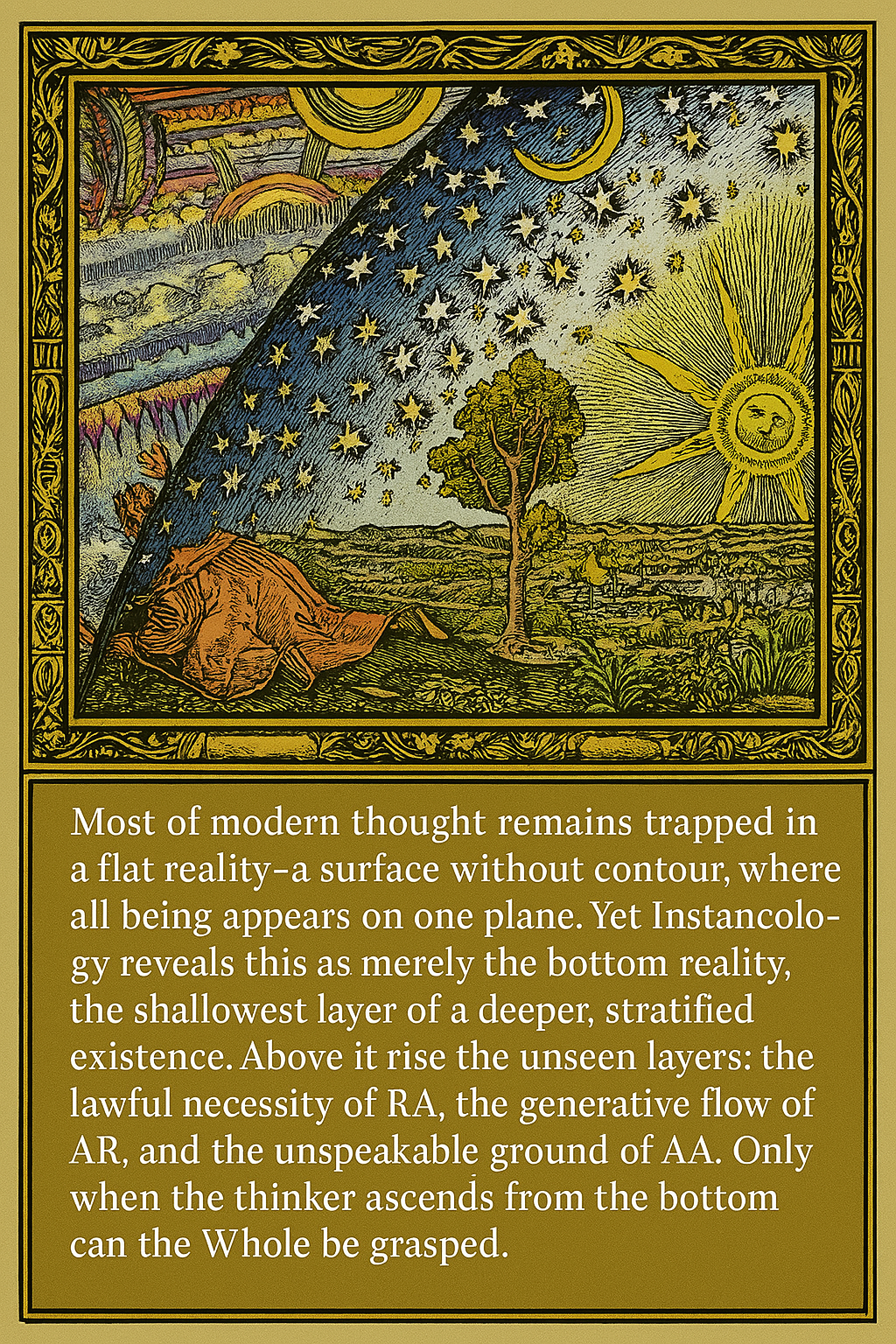
Instancology organizes reality into four domains: RR (Relative Relative), AR (Absolute Relative), RA (Relatively Absolute), and AA (Absolutely Absolute).
RR includes the symbolic world created by human beings. Language, culture, technology, institutions, and social systems belong to this level. These are not purely subjective, yet they depend heavily on human interpretation and construction.
AR refers to natural existence. This includes physical objects, biological organisms, planets, stars, and the observable universe. These entities exist independently of human language.
RA includes formless principles such as laws of nature, logic, mathematics, and life. These are not physical objects, yet they structure physical reality.
AA stands outside these domains. It is not an instance, not a law, not a concept, and not an entity. Instead it is the background that allows all instances to arise.
Because AA is not an instance, it cannot be treated as another object within ontology. Rather, it is the ground from which ontology itself becomes possible.
4. Why “Infinite Infinity” Is Different
The phrase “infinite infinity” remains within mathematical reasoning. Mathematics has developed sophisticated theories of infinity, including Cantor’s transfinite numbers and different orders of infinity.
Even these advanced concepts remain inside formal systems. Infinity, no matter how large or abstract, is still defined within mathematics.
Therefore “infinite infinity” may sound grand, but it does not escape the conceptual framework in which infinity is defined.
AA is fundamentally different. It does not belong to mathematics, logic, physics, or any other structured system. Instead it refers to the background condition from which such systems emerge.
In this sense, comparing AA with “infinite infinity” is like comparing the ocean with a single wave. The wave belongs to the ocean, but the ocean cannot be reduced to the wave.
5. Language at Its Limit
Language evolved to describe objects and events within the world. It is extremely powerful for communication, but it has limits.
When language attempts to describe what lies beyond conceptual structures, it often produces paradox or repetition. Philosophical and spiritual traditions across cultures have encountered this difficulty.
Laozi wrote that the Dao that can be spoken is not the eternal Dao. Wittgenstein concluded that whereof one cannot speak, thereof one must remain silent. Heidegger explored the tension between Being and beings.
Each of these thinkers recognized the same problem: language cannot fully capture the ultimate ground of reality.
AA functions as a pointer toward this ground. The repetition of “absolute” signals that ordinary conceptual interpretation must be suspended.
6. The Purpose of Doubling
If one simply says “Absolute,” the mind immediately interprets the word relative to something else. The concept remains within the relative–absolute distinction.
By doubling the word—Absolute Absolute—the phrase blocks that interpretation. It forces the reader to recognize that AA is not the highest item within a hierarchy but something outside the hierarchy entirely.
The repetition therefore performs a philosophical function. It prevents misunderstanding by emphasizing that AA is not another object among objects.
7. Paradox and the Human Mind
Human cognition depends on distinctions and categories. When we encounter something that cannot be captured within these structures, our thinking often produces paradox.
Statements such as “being and non-being,” “formless form,” or “AA is and is not” appear contradictory because language struggles to represent what lies beyond conceptual limits.
However, paradox does not belong to reality itself. It arises from the limitations of human representation.
Reality does not experience contradiction. Only symbolic systems encounter contradiction when they attempt to describe what exceeds them.
8. The Historical Movement Toward AA
Philosophy has gradually approached the boundary represented by AA. Early philosophers such as Parmenides emphasized Being as the ultimate reality. Plato proposed the realm of Forms. Aristotle developed metaphysics as the study of being as being.
In modern philosophy, Kant revealed the limits of human reason. Hegel attempted to synthesize reality through the concept of Absolute Spirit. Heidegger reopened the question of Being and emphasized the difference between Being and beings.
Each stage moved philosophy closer to recognizing the limits of conceptual thought.
Instancology suggests that the final step is recognizing that the ultimate ground cannot be fully described within conceptual frameworks.
9. The Role of Instancology
Traditional philosophy studies objects of inquiry: knowledge, ethics, politics, mind, language, and existence.
Instancology focuses instead on the structure of instances themselves. It examines how phenomena appear within the domains of AR, RA, and RR.
AA is not another domain among them. It is the background that allows these domains to exist.
Recognizing AA therefore marks the boundary where philosophical inquiry reaches its natural limit.
10. Why AA Cannot Be a Tautology
A tautology repeats meaning within the same conceptual level. AA does not repeat meaning; it indicates the end of conceptual levels themselves.
“Infinite infinity” remains within mathematics. AA points beyond mathematics.
Tautology operates inside language. AA signals the limit of language.
Therefore the repetition in AA is not redundancy but philosophical signaling.
Conclusion
The phrase Absolute Absolute may initially resemble a tautology such as “infinite infinity.” Yet this resemblance arises only because language struggles to indicate what lies beyond conceptual thought.
“Infinite infinity” remains within mathematics and logic. AA stands outside such systems as the background from which they arise.
The repetition in AA therefore serves a precise philosophical purpose. It prevents the Absolute from being mistaken as merely another concept within relational thinking.
AA is not a tautology. It is a marker of the ultimate boundary of ontology, the silent ground from which all instances—natural, logical, and symbolic—emerge.