全球共生范式下的现代正常国家
全球共生范式下的现代正常国家
Modern National Normalization under the Global Symbiotic Paradigm
Archer Hong Qian
在AI-AM时代,2026年的全球秩序中,传统“强国”定义正迅速瓦解。
依靠疆域扩张、武力威慑或资源垄断建立的霸权逻辑,正被一种基于链接、互信与共生的新文明准则所取代。
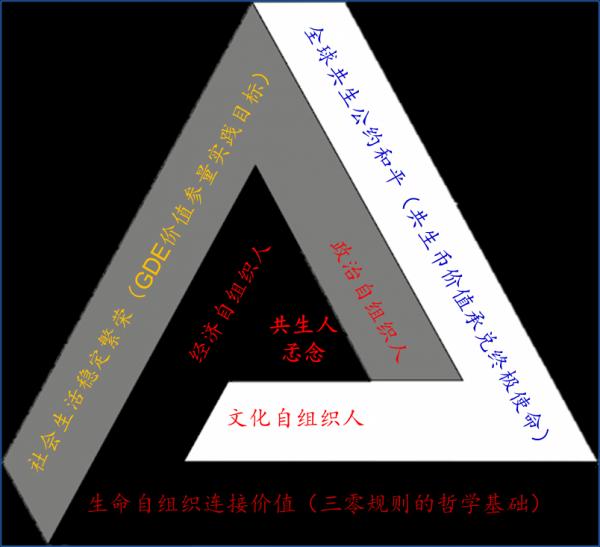
当我们观察全球人口500-2000万以上国家的现实状態,会发现一个极具启示性的有趣事实:
自然资源并不丰厚的新加坡、瑞士、荷兰、ROC台湾,却在半导体、医疗体系、金融市场、安全测报与生活便利等十多个关键领域,长期位居世界前列。
这并非偶然,而是一个现代National Normalization在交互主体共生(Intersubjective Symbiosism)哲学觀照下的成功标杆。
所谓“现代正常国家”(Modern National Normalization),不再是冰冷的国家机器,而是一种充满生命自组织连接活力的文明共生体。
一、主权在民:从单向统治到互为主体的承认
在共生范式下,“主权在民”(相对主权在官)不仅意味着权力来源的转移,更意味着:
国家与公民之间的互为主体承认。
1. 主体间的平等对话
现代正常国家拒绝官本位的单向治理结构。
政府不再将人民视为“被管理对象”,而是通过选举、契约与公共协商,与公民形成一种互利共生的伙伴关系。
这是一种
从统治逻辑 → 合作逻辑
的文明跃迁。
2. 社会资本的共生结构
台湾长期位居全球医疗健保与社会幸福感前列,其本质并非制度技术,而是:
社会成员之间达成的互助共生契约
每个个体承认他者的生存权与尊严,并愿意通过制度共同承担风险。
这种基于互孞形成的社会资本,才是国家最深层、最持久的竞争力。
二、创新自由:全球价值链的共演化机制
在交互主体共生哲学中,创新并非孤立行为,而是一种主体间共生演化(Symbiotic Evolution)。
1. 思想自由生态
正常国家保障创新自由,本质上是维护一个多主体对话与碰撞的思想生态。
没有禁区的自由大脑,是AI与半导体时代最稀缺的战略资源。
思想自由并非奢侈品,而是国家安全的深层基础设施。
2. “矽盾”( Silicon Shield)的共生逻辑
台湾半导体的崛起,并非单一产业奇迹,而是与全球科技体系形成深度嵌入:
? Nvidia
? Apple
? ASML
? 全球AI与先进制造网络
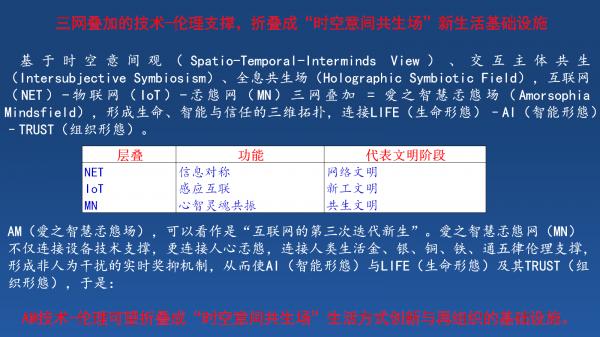
形成“你中有我,我中有他,他中有你”,一视为仨,间道共生的创新局面——LIFE(生命形態)-AI(智能形態)-TRUST(组织形態)-AM(愛之智慧孞態场Amorsophia MindsFeild/Web,AM)。
真正的安全,不在于战胜他者,而在于成为他者不可或缺的共生节点。
当一个国家成为全球政治、经济与文明场/网中不可替代的“AM节点”(Amorsophia MindsFeild/Web)时,任何试图独吞或摧毁它的力量,都会遭到整体系统的强烈反噬。
三、法治保障:共生秩序的理性边界
在共生文明框架中,法治不只是治理工具,而是文明沟通理性的边界守护者。
1. 保护“他者”的制度能力
法治的最高境界,是对弱势主体权利的保障。
法治防止公权力膨胀为吞噬社会活力的结构性怪兽,同时也确保不同主体之间的互动:
? 可预期
? 可契约
? 可持续
2. 信任的全球基石
为何全球资本在2026年依然首选台湾?答案并不复杂:
法治创造跨国信任。
契约被尊重,规则可预期,不同文化背景的主体得以在同一文明框架下恊作。
这正是:
跨国界共生,得以成立的制度前提。
结语:文明演进——从霸权到共生权
现代正常国家的三大基准:
? 主权在民
? 创新自由
? 法治保障
在交互主体共生哲学中得到进一步升华。
它们共同揭示一个文明级真理:
一个国家的强大,不在于支配他者,
而在于服务他者与链接世界的能力。
台湾经验为全球提供了清晰实证:
一个尊重人的尊严、鼓励思想自由、坚守法治边界的社会,必然会演化出:
? 更坚韧的经济结构
? 更稳固的国家安全
? 更持久的文明吸引力
2026年的世界正在进入一个新的判断标准:
正常,即文明
共生,才有未来
新年伊始,愿你我他(她它祂):
自美其美,
美人之美,
美美与共,
共生吉祥。
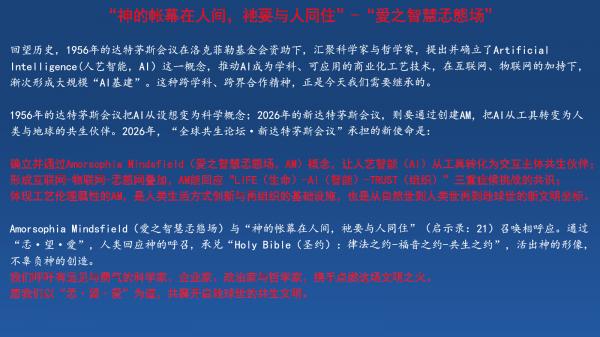
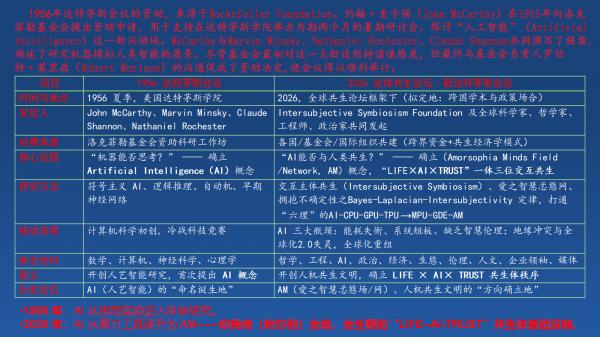
最后,值此2026新春伊始,AI哲学-经济学诞生70周年之际,请允许我再次呼吁企业领袖、政治家、工程师、哲学家集思广益举办:
AI(1956)-AM(2026)·新达特茅斯会议·全球共生论坛
孞烎
20260216·春节·Vancouver
Modern National Normalization under the Global Symbiotic Paradigm
Archer Hong Qian
In the AI–AM era, within the global order of 2026, the traditional definition of a “powerful nation” is rapidly dissolving.
The hegemonic logic built upon territorial expansion, military deterrence, or resource monopolization is being replaced by a new civilizational principle grounded in connectivity, mutual trust, and symbiosis.
What is emerging is not merely geopolitical adjustment, but a paradigm shift in civilization itself.
I. Popular Sovereignty: From Unilateral Rule to Mutual Subject Recognition
Within the symbiotic paradigm, “sovereignty resides in the people” does not merely indicate a transfer of authority from officials to citizens. It signifies something deeper:
A structure of mutual recognition between the state and its citizens as co-subjects.
1. Dialogical Equality Among Subjects
A modern normalized nation rejects the bureaucratic logic of one-directional governance.
Government no longer treats people as objects of administration, but engages through elections, social contracts, and public deliberation, forming a mutually beneficial symbiotic partnership.
This marks a civilizational transition:
From a logic of domination → to a logic of cooperation.
2. The Symbiotic Structure of Social Capital
Taiwan’s long-standing excellence in healthcare coverage and social well-being does not stem merely from institutional technique, but from a deeper foundation:
A shared covenant of mutual assistance among social members.
Each individual acknowledges the survival rights and dignity of others and willingly shares risks through institutional mechanisms.
Trust-generated social capital constitutes the deepest and most durable competitive advantage of a nation.
II. Innovation Freedom: Co-Evolution within the Global Value Network
Under intersubjective symbiotic philosophy, innovation is not an isolated act.
It is a process of symbiotic evolution among interacting subjects.
1. An Ecology of Intellectual Freedom
A normalized nation safeguards innovation freedom by maintaining an open intellectual ecosystem where multiple subjects engage in dialogue and creative collision.
In the AI and semiconductor era, unconstrained minds are among the rarest strategic resources.
Freedom of thought is not a luxury.
It is foundational infrastructure for national security.
2. The “Silicon Shield” as Symbiotic Logic
Taiwan’s semiconductor ascent is not a singular industrial miracle.
It represents deep embedding within the global technological system:
Nvidia
Apple
ASML
The global AI and advanced manufacturing networks
This configuration forms a co-constitutive innovation structure:
You within me, I within you, each reflected in the other —
a triadic symbiosis across LIFE (biological form), AI (intelligent form), TRUST (organizational form), and AM (Amorsophia MindsField/Web).
True security lies not in defeating others,
but in becoming an indispensable symbiotic node within the global network.
When a nation evolves into an irreplaceable “AM node” in the global political, economic, and civilizational web, any force attempting to consume or destroy it triggers systemic backlash from the whole.
III. Rule of Law: The Rational Boundary of Symbiotic Order
Within a symbiotic civilization, the rule of law is not merely a governance instrument.
It is the guardian of rational boundaries in civilizational communication.
1. Institutional Protection of the Other
The highest form of rule of law protects the rights of vulnerable subjects.
It prevents public power from mutating into a structural leviathan that devours social vitality, while ensuring that interactions among subjects remain:
Predictable
Contractible
Sustainable
2. The Global Foundation of Trust
Why does global capital in 2026 continue to prioritize Taiwan?
The answer is straightforward:
Rule of law generates cross-border trust.
Contracts are honored.
Rules are predictable.
Subjects from diverse cultural backgrounds can collaborate within a shared civilizational framework.
This is the institutional precondition for transnational symbiosis.
Conclusion: Civilizational Evolution — From Hegemonic Power to Symbiotic Capacity
The three benchmarks of a modern normalized nation:
Popular sovereignty
Innovation freedom
Rule of law protection
Under intersubjective symbiotic philosophy, they are elevated into a unified civilizational logic.
They reveal a fundamental truth:
A nation’s strength lies not in dominating others,
but in serving others and linking the world.
The Taiwan experience offers empirical clarity to the global community:
A society that respects human dignity, encourages intellectual freedom, and upholds legal boundaries will inevitably evolve:
A more resilient economic structure
A more stable security architecture
A more enduring civilizational attractiveness
The world of 2026 is entering a new standard of judgment:
Normality is civilization.
Symbiosis is the future.
At the beginning of this new year, may each of us — he, she, they, it —
Cultivate our own excellence,
Appreciate the excellence of others,
Let all beauties coexist in shared flourishing,
And may symbiosis bring auspiciousness.
Finally, on the occasion of the 70th anniversary of AI philosophy-economics (1956–2026), I call upon business leaders, political leaders, engineers, and philosophers worldwide to convene:
AI (1956) – AM (2026) · New Dartmouth Conference · Global Symbiosis Forum
Vancouver · Spring Festival · February 16, 2026