一篇反殖官主义宣言!
一篇反殖官主义宣言!
A Manifesto Against Bureaucolonialism!
——从原旨主义的觉悟、殖官主义的癌变,到卢比奥的使命与行动雄心
From the Awakening of Originalism and the Cancerous Growth of Bureaucolonialism to Rubio’s Mission and Ambition for Action
钱 宏(Archer Hong Qian)
2026年11月16日于温哥华
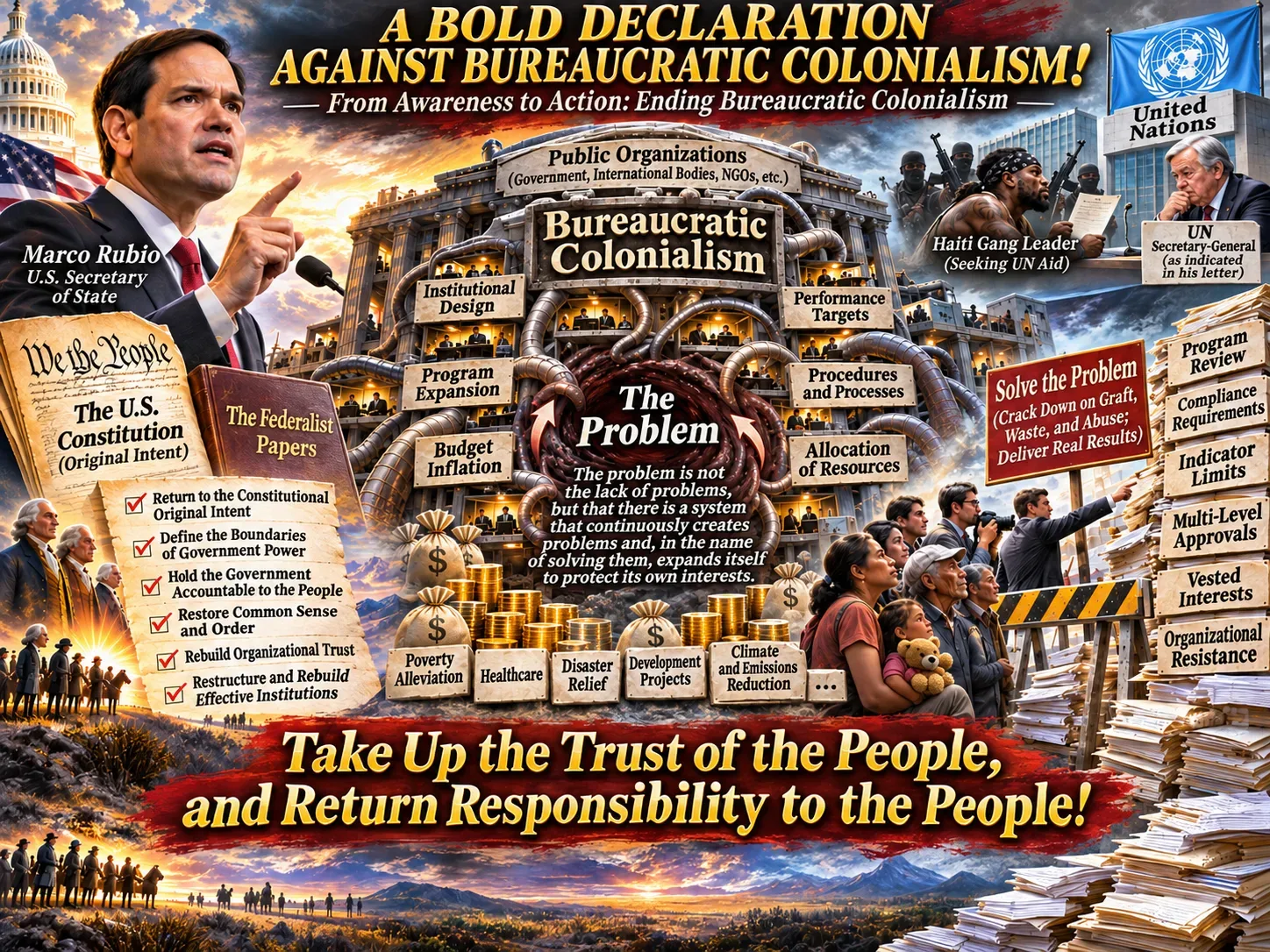
2026年11月13日,美国国务卿马尔科·卢比奥(Marco Rubio)在华盛顿联邦党人学会(Federalist Society)全国律师大会上发表了一场有思想分量、历史纵深与行动激情的演讲。
开场颇为温馨。正在弗吉尼亚大学法学院读三年级的小女儿Daniella Rubio走上讲台,从古巴移民家庭的劳动、信仰与美国梦讲起,介绍父亲走过的公共服务道路。卢比奥登台后,先是一位父亲欣慰的笑容,随后才进入严肃的历史与政治话题。
我反复读看了三遍,尤其欣赏这场演讲同时回答了两个问题:人为什么要做一件事?人有能力做成什么事?前者涉及常识、价值、信仰与使命;后者涉及雄心、决心、组织、行动与坚持。
卢比奥从1982年的里根讲到联邦党人学会与原旨主义,从美国立国精神讲到国际法庭、联合国官僚网络与美国国内各种机构,再讲到1776年的华盛顿与美国未来。在我看来,它可以被理解为一篇具有鲜明思想锋芒的反殖官主义(Bureaucolonialism)宣言。这里的“反殖官主义”,是我对演讲的理论解读,并非卢比奥使用的原话。
一、1982年的里根:在困境中播种思想
1980年里根赢得总统选举,提出减税、抑制通胀、调整政府与市场关系、重振美国经济等主张。然而改革初期,美国经济陷入严重衰退,1982年失业率高企,共和党在中期选举中失去26个众议院席位。改革受到攻击,士气低落,似乎前景黯淡。
恰恰在1982年4月,几名法学院学生在纽黑文组织了一场法律思想研讨会。后来深刻影响美国法律界的联邦党人学会,就从这样的讨论中成长起来。
卢比奥选择这一历史时刻,不言自明地回应2026年美国中期选举之后的政治挫折:一次失败决定不了一项长期事业的命运。改革有方向,政策有过程,生命有节律,成长有周期。枣树种下一年左右才可能结果,桃李需要三年,银杏树更可能由祖辈种植、后辈收获。1982年的低谷之后,美国经济于1983年复苏,里根于1984年大胜连任。经济变化当然涉及货币、财政与市场等多重原因,但历史清楚表明:短期政治挫折与长期事业的结果,可能有巨大的时间差。
二、原旨主义:从宪法文字唤醒美国的立国常识
卢比奥演讲中一个特别值得重视的关键词,是Originalism——原旨主义。
原旨主义主张根据美国宪法制定或批准时的原初含义解释宪法,不能任由后来掌权者依个人或组织偏好改写其法律意义。研究者需要阅读《联邦党人文集》、制宪会议记录、批准宪法时的讨论,以及当时的报纸、著作与词典,努力理解宪法文本在那一时期的公共意义。早期讨论较重视原初意图(Original Intent),后来更多强调原初公共含义(Original Public Meaning)。
它首先是一种宪法解释方法。但我从中看到更深的现实提醒:美国为什么建国?政府为什么获得权力?宪法为什么约束政府?人民的固有权利为什么不能被掌权者或一时的多数任意剥夺?
《独立宣言》强调人的固有权利,政府的正当权力来自被治理者的同意;《联邦党人文集》讨论如何让国家具有行动能力,又防止公共权力被滥用。权力来自人民,政府为人民而设,宪法约束掌权者。这是美国的立国常识。
卢比奥回顾,1982年前后原旨主义仍是受到批评的年轻法学主张,联邦党人学会的早期参与者却坚持长期研究、讨论与培养人才。这项思想事业提醒美国人回到宪法原点,辨明权力的来源、边界和责任。回到原点,是为了看清未来发展的方向;宪法的稳定原则,与人民自主创造的活力可以相应相辅。
三、从原旨主义到MAGA:美国总统首先对美国人民负责
MAGA——Make America Great Again,“让美国再次伟大”,拥有比川普更早的历史。里根1980年竞选时就曾使用相近口号;川普后来使之成为声势浩大的政治运动。查理·柯克于2012年创办Turning Point USA,组织年轻人讨论有限政府、自由市场与美国政治传统,后来成为MAGA青年动员的重要力量。
联邦党人学会与Turning Point USA不尽相同,但都说明:思想要进入社会生活,需要持久的组织、传播、辩论与人才培养。
原旨主义追问宪法从何而来、权力边界何在;MAGA追问国家应该恢复什么、建设什么;川普常识新政则提出如何行动。它们可以沿着美国立国原则形成思想联系。
川普反复强调的America First——美国优先——最有宪政常识意义的一点,是美国总统首先对美国人民负责。美国总统不是世界总统,美国国务卿也不是联合国秘书长。政府接受本国宪法与法律的约束,首要职责是保护人民的正当权利、安全和创造生活的条件。国际合作仍然必要,各国也应承担依条约和国际法确立的责任,对本国人民负责,但任何公共权力都必须有清楚的授权与问责。
四、各种主义怎样走进组织,殖官主义怎样由设官治事发生
殖官主义(Bureaucolonialism)的发生机制,必须从组织怎样设官治事说起。
社会主义、资本主义,自由主义、保守主义,左派、右派,强调增长或强调分配,各有政治经济主张。任何主张要进入实际生活,都必须形成某种组织:政党、政府、企业、大学、NGO、国际机构,等等。
组织建立,就要配置资源、设置职位、分配权力、选任办事的人,也就是设官治事。官员可以经选举产生,也可以经任命产生。设官治事本是组织完成使命的正常需要。
问题发生在官员凭借组织获得权力以后:如果他们不再以完成受托使命为本分,而是利用组织、规则、预算、职位和人事安排繁殖自身权力与利益,殖官主义便开始滋生。它是一种组织病理,其核心是权力与资源在组织内部自我繁殖,成本向外转嫁,公共价值与生命主体的实际需要脱节。
这很像生命机体中的癌变。正常细胞获取养分、履行功能,与机体其他部分协同生活;一旦部分细胞摆脱正常调控,便可能疯狂增殖、争夺养分、侵害组织,最终破坏机体健康。殖官主义则让原本服务共同事业的职位、预算和组织权限,变成一种自我膨胀的力量。
由此可见,问题并不专属于哪一种主义。社会主义形成的组织可能发生,资本主义企业也可能发生;左派政府可能发生,右派政府也可能发生;国际机构、地方政府、大学和公益组织同样可能发生。拨开各种主义和政治正确的外衣,才看得见组织内部这个共同病灶。
五、问题为什么会成为殖官主义的利益来源?
这里有一个不容忽略的转折:一个组织原本因要解决某种问题而成立;为了办事,组织设官、配置预算、制定指标和程序。若官员与机构逐渐从问题的存在中获得稳定的职位、资源与利益,那么问题本身便可能成为他们不愿失去的利益来源。
问题解决了,原有预算可能需要缩减,机构可能应当撤并,某些管理权限与职位也可能不再必要;问题持续存在,机构却可以强调任务艰巨、资源不足,继续要求扩权增编。如此,问题与殖官主义形成病态的相伴关系。有人形容警察与小偷相伴存在,这种比喻的关键在于:警察应以减少犯罪、保障民众安全为工作成果;若反而以犯罪不断存在来维护自身利益,公共职责便发生了颠倒。
扶贫是为了帮助贫困者摆脱贫困,医疗保障是为了让人获得必要服务。目标正当,但实施起来就需要拨款、设机构、定资格、分指标、审核发放。程序、职位与预算随之产生,公共资源沿层级流动。若有人利用审核与拨款造假、套取资金,救助事业便可能沦为殖官主义滋生的温床。
在组织层层经手资金、配置指标的过程中,若每一层都把审批权当作自身利益,便可能出现“雁过拔毛”:纳税人的钱经过多重管理,到真正需要帮助者手中时大幅缩水。更严重时,还会发生虚报对象、伪造记录、优亲厚友和套取补贴。政府效率改革所追查的低效、浪费与欺诈,正应接受这样的资金流向检验。
我听过一个发生在中国乡村的具体故事。一位熟人说,他村里有一个家境相对富裕的人,却领到了扶贫资金。面对邻里质疑,他的回答竟理直气壮:“我没有占我们村里的扶贫指标!”
那句话颇有意味:他强调自己没有占用本村指标,邻里质疑的却是——真正贫困的人尚未获得帮助,条件较好的人凭什么领钱?当指标合规遮蔽了救助目的,程序便压倒了生活事实。此事是我听来的具体见闻,需要查证个案细节;然而,它揭示的资源配置机制值得追究。
指标本来用于分配资源、核算责任;一旦被人掌握、调剂甚至交易,指标便可能从管理工具变成一种利益。加拿大奶业配额、碳排放配额及其交易机制等制度,同样表明:具有交易或分配价值的行政额度,需要严密检验其公共目的、真实成本与受益结构。不同制度不可简单等同于腐败,但其资源配置权都值得监督。
公共援助若发生弄虚作假,危害就更进一步:账面上显示资金已发、服务已提供,真正需要帮助的人却可能什么也得不到。组织的统计成绩越来越漂亮,人民的实际生活却没有改善。
美国明尼苏达州儿童营养项目发生过大规模资金欺诈案件,也有其他福利项目因虚假申报受到调查。这些案例提示:资金拨付、资格审核和服务验收之间,必须能追查每笔钱、每项服务及责任人。具体违法责任属于涉案者,不能泛化到某个族裔或所有福利机构。
美国建国先贤并未在宪法中规定慈善与福利必须由私人部门包办,但美国的立国传统重视限制联邦权力,给社区、教会和民间自组织留下广阔的互助空间。越靠近具体的人,救助责任越容易落实,层层盘剥的空间也越小。卡耐基以“在巨富中死去是一种耻辱”告诫富人承担财富回馈社会的责任;今天,企业家面向儿童和青年提供直接捐赠或账户支持的探索,也提示了另一条路径:减少不必要的官僚中介,使资源更直接地触达生命主体,帮助他们获得自主创造的能力。民间慈善同样需要透明、监督和绩效检验;关键在于钱真正到了谁手中,改善了谁的生活。
殖官主义以问题存在为自身存在的理由,因问题具有利益而缺乏解决问题的动力;它不解决问题,反而可能强调问题、制造问题以维护自身,更荒谬的是,还可能不断地“解决解决问题的人和组织”!
提出问题的公民、揭露事实的记者、为弱势者说话的官员、推动改革的组织,都可能因为触动既得利益而遭遇打压。原本应当被解决的问题仍然存在,真正试图解决问题的人却成了某些组织优先排斥的对象。这便是殖官主义最荒谬、也最危险的组织病理。
六、抽象道德与政治正确怎样成为殖官主义的保护伞
殖官主义通常不会公开承认自己依赖问题存在。它需要一套崇高、抽象、容易得到认同的辩护叙事。社会主义可以讲公平,资本主义可以讲自由,左派可以讲社会正义,右派可以讲国家安全;国际组织可以讲和平、人权和国际法,国内机构可以讲专业治理与程序正义。
这些原则各有价值。问题出在组织利用抽象原则选择性解释现实、遮蔽具体后果,并把外部改革描绘成对这些原则的威胁。它可以不断宣称维护弱者,却不交代救助资金有多少真正到达弱者;不断强调和平,却不核算人民恢复了多少安全;不断讲人权,却忽略长期被杀戮、绑架、恐吓的普通人的权利。
以崇高原则占据道德高地,以抽象叙事遮蔽具体后果,以程序性权力维护组织影响,以尚未解决的问题证明自身存在必要——这就是殖官主义可能采用的通用自我辩护方式。
七、联合国与海地:黑帮头目为什么向联合国秘书长求助?
联合国诞生于第二次世界大战之后,维护和平、促进国际合作有其正当的历史依据,也在救灾、卫生、教育与人道援助中发挥过一定的作用。然而,重大使命不能成为组织免于绩效审查的理由。
海地值得追问。联合国自2004年以来先后实施维和、司法支助、政治协调与能力建设行动,但海地的暴力、绑架与社会失序长期未得到根本解决。不同任务具有不同授权,传统联合国维和特派团也已结束;可是广大人民仍需要真正安全的学校、医院、市场和社区。
尤其富有讽刺意味的是,2026年11月,海地“400 Mawozo”黑帮头目威尔逊·约瑟夫,在海地政府与萨尔瓦多部队联合打击黑帮行动加强之际,写信给联合国秘书长请求调解。一个长期以暴力危害民众的黑帮头目,竟把国际调解机制当作可能争取的渠道!
来信本身不能证明联合国有意庇护黑帮;联合国有关机构也参与支持了打击黑帮的安全行动。然而,此事仍然揭示一个尖锐的组织问题:维护和平的程序,会不会被破坏和平的人拿来拖延打击、争取喘息或抬高自身地位?为什么国际干预多年,普通人的安全仍迟迟无法得到保证?
要求打击黑帮的行动遵守法律、保障平民与正当程序,本身具有必要性。但不能因此失去对最具体的人权的关注:广大人民有不被杀害、不被绑架、能够安全工作、上学与安居乐业的权利。
卢比奥在演讲中批评国际法律机构、联合国官僚网络和某些国际NGO,认为它们有时擅长谴责采取行动的国家,却不承担解决问题的后果。对于美国针对委内瑞拉、伊朗及其他地区的实际行动,也必须分别检验法律依据与现实效果;国际刑事法院更有独立的条约管辖结构,不能简单与联合国行政机构混为一谈。
真正需要追究的是:国际组织怎样证明自己解决了哪些问题?如果它长期未能完成使命,谁来改进?如果既有程序成了阻碍有效行动的工具,谁来纠错?
一个本为解决问题而成立的组织,如果反过来依赖问题维持自身利益,甚至借政治正确的说辞排斥真正解决问题的人和组织,就必须接受反殖官主义的检验。
八、反殖官主义为什么必然付出代价?
殖官主义可能滋生于各种意识形態形成的组织。重建组织信托,势在必行!
职位、预算、合同、审批权、补贴、配额与政策影响力,一旦形成稳定的利益关联,就会发展出自我繁衍和保护的能力。改革者压缩无效机构、打破不合理特权、核查公共资金,势必触动依赖这些安排获利的人。
川普提出“抽干华盛顿沼泽”(Drain the Swamp),其现实针对性可以从这里理解。行政权力与预算形成的自我保护机制,不会因为一声口号自动消失。川普政府整顿机构、审视对外援助和整合安全外交职责,既有改革方向,也需要接受法律授权、改革成本和实际结果的检验。
卢比奥兼任美国国际开发署代理署长及国家安全顾问等职务,更处在这种组织重整的现实交汇点。
反殖官主义要减少无效组织成本、浪费和欺诈,不只是以裁撤人数替代结果检验。公共福利、医疗援助、教育和国际救助具有真实价值,革新的目标应是减少资金在机构中的自我消耗,让资源真正进入需要帮助者的生活,重建组织信托。
九、美国的成长:自由、雄心与拓展精神
卢比奥讲到,美国从1776年大西洋沿岸十三州发展为横跨北美大陆的国家。他强调自由与集体行动能力的结合,强调人民创造、建设、探索和发展的雄心。
国家可以被理解为具有历史连续性、能够学习与纠错的生命共同体。但疆域扩张也可能伴随战争和对原住民的伤害,不能仅以面积衡量国家成长。真正值得检验的是:多少人获得自由、尊严、平等的发展机会和自主创造能力。
平等保护人的尊严与正当机会;机械平均主义若把人的能力、贡献和成果一律拉平,则可能压抑创造。而任何以自由或公平之名扩大自身特权的组织,同样值得警惕殖官主义。
十、在逆境中坚持使命,在胜利时谦卑慎独
美国独立战争并非注定成功。1776年底,华盛顿的军队连续失利,补给困难,士兵饥寒交迫,革命前途险恶。他在给兄弟的信中坦言困境深重,却坚持事业的正当性,继续组织军队、寻找战机、争取盟友。
1781年,法美联军在约克镇迫使英军投降,革命迎来决定性转折。卢比奥以此提醒听众,值得坚持的事业会遭遇困难与反复,但使命必须伴随实际行动、纠错和耐心。
同样面对选举重大挫败,政治人物与执政团队如何应对,大有讲究。2018年,台湾执政党民进党在地方选举中严重失利,蔡英文辞去党主席,连任前景一度备受质疑。她承担政治责任,调整沟通与施政节奏,重新争取社会支持,终于在2020年赢得连任。随后的全球疫情冲击与供应链变化,又把胜选后的治理能力推向考场。防疫组织、口罩供应与国际援助需要公共协同;台湾半导体产业的竞争力,则凝结着数十年的政策支持、企业创新与人才积累。危机中的行动能力,既要克服僵化的行政惯性,也要发挥社会与产业的自主创造活力。
政治成败受多种历史条件影响,但道理很清楚:暂时的挫败不代表事业终结,一时的胜利也绝非机构懈怠、官僚特权滋生的通行证。失败时不失志,胜利时不自满,始终保持担当与纠错的清醒。
十一、Passion—Vision—Mission—Action:从思想到行动
我愿意用四个词概括卢比奥演讲打动我的精神力量:Passion——热情,热愛正当事业;Vision——愿景,知道要创造怎样的未来;Mission——使命,明确为什么做、为谁承担责任;Action——行动,将思想付诸组织、人才、政策和实际建设。
联邦党人学会从1982年的学生研讨会成长为长期的思想网络,恰好说明思想只有进入教育、组织、实践,才可能形成持久影响。
卢比奥不仅是一位职业政治家。他在这场演讲中表现出的历史视野、宪法意识、政治胆识和开拓精神,值得赞赏。但有雄心也要有谦卑;反对旧有殖官主义的人,也须防止自己掌权后滋生新的组织病理。
卢比奥的女儿强调父亲的信仰;卢比奥也谈到美国建国思想中人的固有权利与造物主的关系。对信仰者来说,使命既要求全力以赴,也要求认识自己的有限性。人应认真判断、勇于行动、承担责任,谁也不能保证历史必然按照自己的计划发展,所以始终要保持谦卑与敬畏之心。
尽本分在我,结果交给神!
结语:从原旨主义的觉悟,到反殖官主义的行动宣言
卢比奥说:“Great things that last are built in decades, not election cycles.”(能够持久的伟大事业,需要数十年的建设,不能只用一个选举周期衡量。)
历史与现实一再警示:任何主义进入社会生活,都需要化为组织;而任何组织一旦失去约束,都可能异化为自我繁殖的官僚机器。
殖官主义最隐蔽的剧毒,在于把“解决问题”偷换成“经营问题”:以问题的持续存在维持预算、职位和利益,以抽象的道德叙事掩护组织权力,甚至动用程序与资源去“解决解决问题的人和组织”!
反殖官主义,就是拨开各种主义、宗派与“政治正确”的外衣,回到人之所以为人、组织之所以为组织的常识原点:检验每一份权力的授权来源,追问每一位官员的实际责任,追踪每一笔资源的真实流向,衡量每一个生命主体究竟获得多少自由、安全、尊严与创造机会。
一句话:反殖官主义,就是打破官僚垄断,让权力回到正当授权,让创造力回到生命主体,重建组织信托!
卢比奥的演讲之所以值得理解为一篇时代的反殖官主义宣言,正在于他把宪政的底线常识、国家的行动能力与跨越数十年的改革雄心贯通起来。
思想需要播种,事业需要耕耘。面对低谷,保持敢于担责的勇气;面对胜利,保持警惕异化的谦卑。
Passion—Vision—Mission—Action!
受生命之托,向生命承兑!
尽本分在我,结果交给神!
A Manifesto Against Bureaucolonialism!
From the Awakening of Originalism and the Cancerous Growth of Bureaucolonialism to Rubio’s Mission and Ambition for Action
Archer Hong Qian
November 16, 2026 · Vancouver
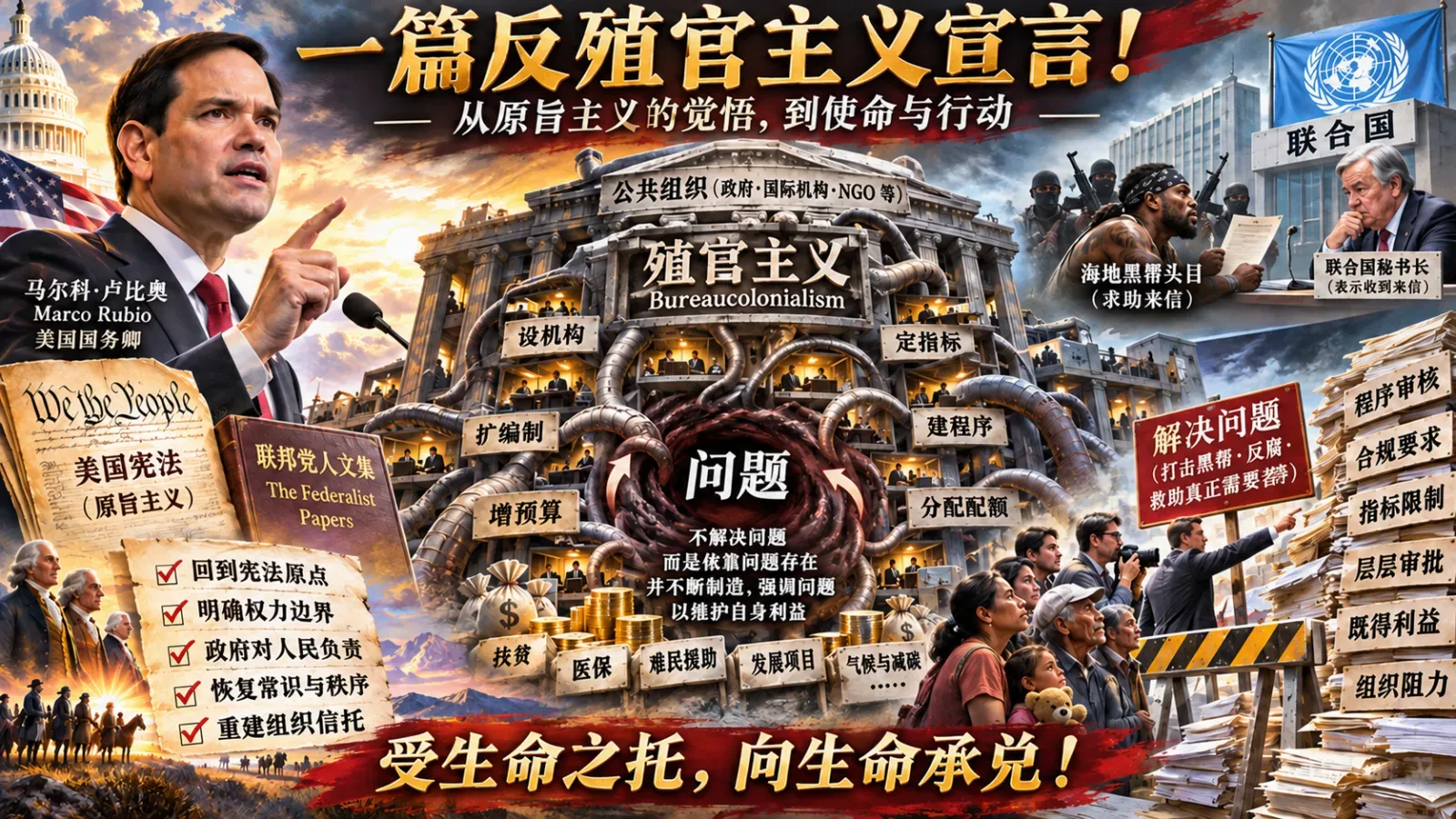
On November 13, 2026, U.S. Secretary of State Marco Rubio addressed the Federalist Society’s National Lawyers Convention in Washington. His speech carried intellectual weight, historical depth, and a compelling passion for action.
The opening was touching. Daniella Rubio, his younger daughter and a third-year law student at the University of Virginia, introduced her father. She spoke of the labor, faith, and American dream of a Cuban immigrant family, and traced his path in public service. Rubio came to the stage first with the delighted smile of a father, before turning to the weightier questions of history and politics.
I have read and watched the speech three times. What I particularly admire is that it addresses two questions together: Why should a person undertake something? And what is a person capable of accomplishing? The first concerns common sense, values, faith, and mission; the second concerns ambition, determination, organization, action, and perseverance.
Rubio takes his audience from Reagan’s predicament in 1982 to the Federalist Society and originalism; from the principles of America’s founding to international courts, the United Nations bureaucracy, and institutions at home; and finally to Washington in 1776 and America’s future. To my mind, his address can be read as a manifesto against Bureaucolonialism. “Against Bureaucolonialism” is my theoretical interpretation, not a phrase Rubio himself used.
I. Reagan in 1982: Planting the Seeds of Ideas in Adversity
Ronald Reagan won the presidency in 1980 promising tax cuts, an end to inflation, a new relationship between government and markets, and a revitalized American economy. Yet the early reform years brought a severe recession. Unemployment soared in 1982, and Republicans lost 26 House seats in the midterm elections. Reform was under attack, morale was low, and the outlook seemed bleak.
It was precisely in April 1982 that several law students organized a symposium on legal ideas in New Haven. The Federalist Society, which would profoundly influence American law, grew out of discussions like this one.
Rubio’s choice of this historical moment is a clear response to political setbacks following the 2026 U.S. midterms: one defeat cannot determine the fate of a long-term cause. Reform has a direction, policy has a process, life has a rhythm, and growth has a cycle. A jujube tree may bear fruit after a year or so; peach and plum trees take several years; a ginkgo planted by grandparents may yield fruit for later generations. After the low point of 1982, the U.S. economy recovered in 1983, and Reagan won a landslide reelection in 1984. Monetary policy, fiscal measures, and market developments all contributed. Yet history shows unmistakably that there can be a vast interval between a short-term political setback and the outcome of a lasting undertaking.
II. Originalism: Recovering America’s Founding Common Sense from the Constitution
One especially important word in Rubio’s speech is Originalism.
Originalism holds that the U.S. Constitution should be interpreted according to its original meaning at the time of drafting or ratification. Those who subsequently exercise power should not rewrite its legal meaning according to their personal or institutional preferences. Scholars therefore study The Federalist Papers, records of the Constitutional Convention, the ratification debates, contemporary newspapers, writings, and dictionaries, seeking to understand what the constitutional text meant to the public of that time. Earlier approaches emphasized original intent; later scholarship placed more weight on original public meaning.
This is first and foremost a method of constitutional interpretation. But I see in it a more immediate reminder: Why was America founded? Why is government given power? Why must the Constitution restrain government? Why do people possess rights that rulers cannot arbitrarily take away? Why must the country’s future not be held hostage by the coercion of a transient majority?
The Declaration of Independence affirms inherent human rights and the principle that legitimate government derives its powers from the consent of the governed. The Federalist Papers explore how to make the nation capable of action while preventing the abuse of public power. Power comes from the people; government exists to serve them; and the Constitution constrains those who govern. These are the common-sense principles of America’s founding.
Rubio recalls that around 1982, originalism was still a young approach to law and had its critics. Early participants in the Federalist Society nevertheless persevered in research, debate, and the education of new generations of lawyers. Their intellectual undertaking reminded Americans to return to their constitutional beginnings and clarify the source, limits, and responsibilities of power. Returning to first principles helps illuminate the direction of future development. Stable constitutional principles and the vitality of people’s autonomous creativity can reinforce each other.
III. From Originalism to MAGA: An American President Answers First to the American People
MAGA—Make America Great Again—has a history preceding Donald Trump. Reagan used a similar slogan in his 1980 campaign; Trump later made it the emblem of a vast political movement. Charlie Kirk founded Turning Point USA in 2012, bringing young people into debates about limited government, free markets, and American political traditions. It subsequently became an important force in MAGA’s youth mobilization.
The Federalist Society and Turning Point USA are not identical. Both, however, demonstrate that ideas enter public life through sustained organization, communication, debate, and the cultivation of talent.
Originalism asks where the Constitution comes from and where the limits of power lie. MAGA asks what the nation should recover and build. Trump’s common-sense reform program asks how to act. Their intellectual connections can be traced to principles of the American founding.
The most constitutionally significant meaning of Trump’s repeated insistence on “America First” is that the American president is accountable first to the American people. The president of the United States is not president of the world, and the secretary of state is not secretary-general of the United Nations. Government is bound by its own Constitution and laws; its primary duty is to protect the legitimate rights, security, and conditions for creative life of its people. International cooperation remains necessary, and nations must also honor obligations established by treaties and international law. But every exercise of public authority requires clear authorization and accountability.
IV. How Ideologies Become Organizations—and How Bureaucolonialism Arises through the Appointment of Officials
To understand Bureaucolonialism, we must begin with how organizations establish offices and appoint people to carry out their work.
Socialism and capitalism, liberalism and conservatism, left and right, an emphasis on growth or an emphasis on distribution: each offers political and economic claims. To enter real life, these claims must take organizational form—in political parties, governments, businesses, universities, NGOs, international institutions, and countless other bodies.
Once an organization exists, it must allocate resources, create positions, distribute authority, and select people to do its work. Officials may be elected or appointed. Establishing offices to carry out public tasks is a normal necessity for any collective undertaking.
The danger emerges after officials acquire authority through the organization. If they cease to make the entrusted mission their guiding duty and instead use rules, budgets, posts, and personnel decisions to reproduce their own power and interests, Bureaucolonialism begins to take root. This is an institutional pathology: power and resources reproduce themselves inside an organization, costs are shifted outward, and public value becomes disconnected from the actual needs of living people.
The process resembles cancer in a living organism. Healthy cells draw nourishment, perform their functions, and cooperate with the rest of the body. When some escape normal regulation, they may multiply without restraint, compete for nutrients, invade tissues, and ultimately damage the organism’s health. Under Bureaucolonialism, positions, budgets, and administrative powers that were meant to serve a common undertaking become instruments of self-expansion.
No particular ideology has a monopoly on this pathology. It may arise in organizations founded on socialist principles or in capitalist firms; in governments of the left or the right; in international agencies, local administrations, universities, and charities. Only by stripping away ideological labels and claims of political correctness can we recognize the common institutional lesion underneath.
V. Why Do Problems Become a Source of Profit for Bureaucolonialism?
Here lies a crucial turning point. An organization is originally created to solve a problem. To do its work, it establishes offices, assigns budgets, and devises quotas and procedures. But if officials and agencies gradually derive secure posts, resources, and benefits from the problem’s continued existence, the problem itself may become an asset they do not want to lose.
If the problem is resolved, budgets may shrink, agencies may need to merge or close, and particular positions or administrative powers may become unnecessary. If the problem persists, however, the agency can emphasize the severity of the task and the shortage of resources, then demand more authority and personnel. A pathological relationship of mutual dependence can thus develop between the problem and Bureaucolonialism. People sometimes speak of the police and thieves as existing alongside one another. The point is that police ought to be judged by reduced crime and improved public safety. If they instead use crime’s continued existence to protect their own interests, their public duty has been turned upside down.
Poverty relief and public welfare make this pathology particularly visible. Poverty programs should help people escape deprivation; health coverage should enable people to obtain necessary care. These are legitimate goals. But implementing them requires funding, agencies, eligibility criteria, quotas, reviews, and disbursements. Administrative posts and procedures proliferate as public money passes through layers of management. If someone exploits the process to fabricate records or obtain funds fraudulently, the aid program can become fertile ground for Bureaucolonialism.
If every administrative layer treats its approval authority as a source of private benefit, the result may be what the Chinese call “plucking feathers from a passing goose.” Taxpayers’ money moves through successive offices, losing value along the way, until little reaches those who truly need it. Worse still are fictitious beneficiaries, forged records, preferential treatment of relatives or associates, and fraudulent subsidies. Government efficiency efforts should follow these flows of money and test claims about inefficiency, waste, and fraud against demonstrable evidence.
I have heard a revealing story from a Chinese village. Someone whose household was relatively prosperous nonetheless received poverty-relief funds. When neighbors challenged him, he replied with complete confidence: “I did not use up our village’s poverty-relief quota!”
That reply is telling. He insisted that he had not taken one of his village’s designated slots. His neighbors were asking a different question: Why had genuinely poor households not received assistance while someone better off had obtained it? When formal compliance with a quota obscures the purpose of relief, procedure defeats reality. I know this as an account told to me; its individual details would require verification. But the allocation mechanism it exposes is well worth investigating.
Quotas are designed to distribute resources and establish responsibility. Once they can be controlled, transferred, or traded, they may themselves acquire economic value. Canada’s dairy supply-management quotas and emissions allowances likewise demonstrate the need to examine the public purpose, actual costs, and beneficiaries of administratively created rights. Different quota systems should not automatically be equated with corruption, but the power to allocate them needs scrutiny.
Falsified public assistance goes further still: the accounts report that money has been distributed and services delivered, while the people who need help may receive nothing. Institutional performance figures improve on paper even as living conditions remain unchanged.
The United States has seen major fraud in Minnesota child-nutrition programs, while other welfare schemes have faced investigations into false claims. Such cases show why every dollar, service, and accountable decision-maker must be traceable from appropriation to actual beneficiary. Responsibility for wrongdoing belongs to the individuals involved; it should not be attributed to an entire ethnic community or every welfare institution.
The American founders did not write a constitutional rule requiring charity and welfare to be handled solely by private actors. Yet the founding tradition placed limits on federal power and left considerable space for mutual aid through communities, churches, and voluntary associations. The closer assistance comes to the people concerned, the easier it can be to identify responsibility and reduce unnecessary administrative extraction. Andrew Carnegie warned that dying in great wealth was a disgrace. Contemporary efforts to direct donations or account-based support toward children and young people point to another possibility: fewer needless bureaucratic intermediaries, more resources reaching living individuals, and greater capacity for independent initiative. Private philanthropy, too, requires transparency and accountability. The test is who actually receives the resources and whose life improves.
When a public problem becomes an institution’s source of advantage, the institution may shift from solving the problem to emphasizing, prolonging, or even creating it in order to protect its own existence. More absurdly still, it may repeatedly seek to “eliminate the people and organizations trying to solve the problem”!
Citizens who raise problems, journalists who uncover facts, officials who speak for vulnerable people, and organizations that pursue reform may be suppressed when they threaten entrenched interests. The original problem remains, while the people attempting to resolve it become the first targets of institutional exclusion. This is Bureaucolonialism at its most absurd—and most dangerous.
VI. How Abstract Morality and Political Correctness Become Bureaucolonialism’s Shield
Bureaucolonialism rarely admits openly that its continued existence depends on unresolved problems. It needs a lofty, abstract, widely appealing narrative of justification. Socialists may speak of fairness, capitalists of freedom, the left of social justice, and the right of national security. International bodies invoke peace, human rights, and international law; domestic agencies invoke professional management and due process.
These principles have value. The trouble begins when organizations employ them selectively to interpret reality, conceal concrete consequences, and portray reform as a threat to the principles themselves. An agency may proclaim its concern for the disadvantaged without accounting for how much assistance actually reaches them; proclaim peace without measuring the security restored to ordinary people; or invoke human rights while overlooking people subjected to murder, kidnapping, and intimidation.
Occupying the moral high ground through exalted principles; concealing outcomes behind abstract narratives; maintaining institutional influence through procedural power; and using an unresolved problem to justify continued existence—these are the characteristic methods by which Bureaucolonialism may defend itself.
VII. The United Nations and Haiti: Why Would a Gang Leader Appeal to the UN Secretary-General?
The United Nations arose after the Second World War with a legitimate historical purpose: protecting peace and promoting international cooperation. It has contributed to disaster relief, public health, education, and humanitarian assistance. Yet an important mission cannot make any institution exempt from accountability for results.
Haiti raises urgent questions. Since 2004, the UN has undertaken successive peacekeeping, justice-support, political-coordination, and capacity-building missions. Yet violence, kidnapping, and social disorder have not been durably overcome. Different missions have different mandates, and the traditional UN peacekeeping operation has ended. Still, Haiti’s people need safe schools, hospitals, markets, and communities.
A particularly ironic episode occurred in November 2026. Wilson Joseph, a leader of Haiti’s notorious “400 Mawozo” gang, wrote to the UN secretary-general seeking mediation as anti-gang efforts involving Haiti and Salvadoran forces intensified. A gang leader associated with violent crimes against civilians saw an international mediation mechanism as a possible avenue of appeal!
The letter does not by itself show that the UN intended to shelter a gang; UN bodies have also supported operations against gangs. Yet it raises a sharp institutional question: might procedures designed to promote peace be used by those who destroy it to delay enforcement, buy time, or improve their standing? Why, after years of international intervention, has lasting safety remained beyond the reach of ordinary people?
Insisting that anti-gang operations obey the law, protect civilians, and observe due process is necessary. But this cannot displace the most tangible of human rights: the right of ordinary people not to be murdered or abducted, and to work, study, and live safely.
In his speech, Rubio criticizes international legal bodies, UN bureaucratic networks, and certain international NGOs, arguing that they sometimes excel at condemning states that take action without bearing the consequences of failing to solve a problem. The legal basis and actual results of American operations involving Venezuela, Iran, and other regions also require examination. The International Criminal Court has its own treaty-based jurisdictional framework and cannot simply be treated as another branch of UN administration.
What ultimately matters is this: How do international institutions demonstrate which problems they have solved? Who improves them when they repeatedly fail their missions? Who corrects the situation when established procedures become obstacles to effective action?
An organization established to solve problems but sustained by their persistence—and perhaps even using politically correct rhetoric to obstruct those attempting solutions—must face a rigorous test of Bureaucolonialism.
VIII. Why Resisting Bureaucolonialism Necessarily Has a Cost
Bureaucolonialism can take root in organizations founded on many different ideologies. Rebuilding organizational trust is therefore imperative.
Posts, budgets, contracts, licensing powers, subsidies, quotas, and policy influence can form durable networks of interest, complete with mechanisms of self-reproduction and self-protection. Reformers who reduce ineffective institutions, challenge unjustified privileges, or audit public funds will inevitably disturb those who benefit from existing arrangements.
Trump’s promise to “Drain the Swamp” can be understood against this background. Self-protecting networks of administrative authority and budgetary power do not disappear because of a slogan. His administration’s institutional reorganization, scrutiny of foreign aid, and consolidation of diplomatic and national-security responsibilities may reflect a reform agenda, but their legal authority, costs, and outcomes must still be examined.
Rubio’s service as acting USAID administrator and national security adviser alongside his role as secretary of state placed him at the intersection of these institutional changes.
The purpose of resisting Bureaucolonialism is to reduce waste, fraud, and unproductive institutional costs, not to treat the number of eliminated positions as the measure of success. Public welfare, healthcare, education, and international relief have genuine value. Reform should stop resources from being consumed by institutional self-maintenance, ensure that they reach the people who need them, and rebuild organizational trust.
IX. America’s Growth: Freedom, Ambition, and the Spirit of Expansion
Rubio describes America’s transformation from thirteen Atlantic states in 1776 to a nation extending across the North American continent. He stresses the combination of individual freedom and the capacity for collective action, and the ambition to create, build, explore, and develop.
A nation may be understood as a living community with historical continuity and the capacity to learn and correct itself. Yet territorial expansion can also entail war and injuries to Indigenous peoples. National growth cannot be judged by area alone. What matters is how many people gain freedom, dignity, equal opportunities for development, and the capacity for autonomous creation.
Equality protects human dignity and legitimate opportunity. Mechanical egalitarianism, by flattening differences in ability, contribution, and achievement, may suppress creativity. And any organization that enlarges its own privileges in the name of either freedom or fairness is equally vulnerable to Bureaucolonialism.
X. Perseverance in Adversity, Humility in Victory
The American Revolution was never destined to succeed. In late 1776, Washington’s army suffered repeated defeats and shortages. The soldiers endured hunger and cold, and the revolutionary cause appeared close to collapse. In a letter to his brother, Washington acknowledged the severity of his predicament but continued to believe in the justice of his cause, organizing his forces, searching for opportunities, and seeking allies.
In 1781, French and American forces compelled the British surrender at Yorktown, marking a decisive turning point. Rubio uses this history to remind his listeners that worthy causes encounter setbacks and reversals, while a true mission demands practical action, correction, and patience.
How leaders respond to electoral defeat can be just as consequential. In 2018, Taiwan’s governing Democratic Progressive Party suffered a severe setback in local elections. Tsai Ing-wen resigned as party chair, and her prospects for reelection were widely questioned. She accepted political responsibility, adjusted her public communication and governing approach, rebuilt support, and won reelection in 2020. The global pandemic and changing supply chains then put the administration’s capacity to govern under a new test. Pandemic response, mask supplies, and international assistance required effective public coordination; Taiwan’s semiconductor competitiveness reflected decades of policy support, corporate innovation, and accumulated talent. Meeting a crisis requires overcoming administrative inertia while drawing on the initiative of society and industry.
Political outcomes depend on many historical conditions. Yet the lesson is clear: a temporary defeat need not end a worthy undertaking, and a victory is no license for institutional complacency or bureaucratic privilege. Do not lose heart in defeat; do not grow complacent in victory. Remain accountable and ready to correct course.
XI. Passion—Vision—Mission—Action: From Ideas to Deeds
Four words capture what moves me most in Rubio’s speech. Passion means ardor for a legitimate cause. Vision means knowing the future one seeks to create. Mission means understanding why one acts and whom one serves. Action means translating ideas into organizations, capable people, policies, and concrete achievements.
The Federalist Society’s development from a student symposium in 1982 into a durable intellectual network illustrates how ideas gain lasting influence through education, organization, and practice.
Rubio is more than a professional politician. In this address, his historical perspective, constitutional consciousness, political courage, and enterprising spirit deserve recognition. Yet ambition must be accompanied by humility: those who oppose an old Bureaucolonialism must also guard against reproducing that pathology once they hold power.
Rubio’s daughter emphasized her father’s faith, and Rubio addressed the relationship between inherent human rights and the Creator in American founding thought. For believers, mission demands wholehearted effort and an awareness of one’s limitations. A person should judge carefully, act courageously, and accept responsibility. No one can guarantee that history will unfold according to a personal plan. Humility and reverence remain essential.
Do my duty; leave the outcome to God!
Conclusion: From the Awakening of Originalism to a Manifesto of Action Against Bureaucolonialism
Rubio says: “Great things that last are built in decades, not election cycles.” Enduring achievements take decades to build; a single electoral cycle cannot measure them.
History and the present offer a recurring warning: every ideology that enters social life must take organizational form. And any organization, without effective constraints, can become a bureaucratic machine devoted to reproducing itself.
The most insidious poison of Bureaucolonialism is the substitution of “managing problems” for “solving problems”: treating persistent problems as sources of budgets, positions, and vested interests; using abstract moral narratives to shield institutional power; and even deploying procedures and resources to “get rid of the people and organizations trying to solve the problems”!
To oppose Bureaucolonialism is to strip away the rhetorical costumes of competing ideologies, factions, and “political correctness,” and return to the common-sense foundations of human life and legitimate organization: verify where each power comes from, ask what each official is accountable for, trace where each resource goes, and measure how much freedom, security, dignity, and opportunity to create reaches each living person.
In a sentence: opposing Bureaucolonialism means breaking bureaucratic monopoly, returning power to legitimate authorization, restoring creative agency to living subjects, and rebuilding organizational trust!
Rubio’s speech can be read as a manifesto against Bureaucolonialism because it brings together constitutional common sense, a nation’s capacity to act, and an ambition for reform that reaches across decades.
Ideas must be planted; great undertakings must be cultivated. In adversity, have the courage to accept responsibility. In victory, have the humility to guard against institutional decay.
Passion—Vision—Mission—Action!
Entrusted by Life, Accountable to Life!
Do my duty; leave the outcome to God!