2026年美国中期选举后的局势再阐释
2026年美国中期选举后的局势再阐释
Rethinking the Political Landscape After the 2026 U.S. Midterm Elections
——维克多·戴维斯·汉森与钱宏的对话
A Dialogue Between Victor Davis Hanson and Archer Hong Qian
交互主体共生基金会
Institute for Global Symbiosism

2026年11月3日美国中期选举落下帷幕,民主党赢得国会参众两院控制权。这一变局迅速引发了全球观察家对川普总统接下来两年任期是否会彻底“跛脚”的激烈辩论。
美国著名历史学家维克多·戴维斯·汉森(Victor Davis Hanson)从权力制衡的先例中寻找攻防战术;而共生经济学(Symbionomics)学者钱宏(Archer Hong Qian)则从系统纠错与生命价值承兑的底层逻辑出发,指出“赢了选举不等于赢得共识,输了席位不等于终结新政”。将两者的视野进行重组与深度重构,能够为我们清晰勾勒出这场变局背后的两重地缘与政治图景。
一、 战略对表:汉森的“战术突围”与钱宏的“系统纠错”
面对共和党失去国会多数的现实,两位学者的视角呈现出一种“战术行动”与“系统规律”的深层共鸣:
1. 府院博弈的常态 vs 制度自组织的动态平衡
汉森的政治现实主义: 汉森回顾了克林顿(1994年)和奥巴马(2010年)在中期选举惨败后反而实现政治翻盘的执政经历。他指出,失去国会意味着川普得以摆脱立法口水战的包袱,而将权力主战场转移至白宫拥有极大自主权的总统行政命令与外交斡旋中,通过“横向博弈”反制国会围剿。
钱宏的共生哲学升华: 钱宏教授直接将这一历史螺旋定义为“一种对某些纠错的纠错”。在共生经济学看来,大选和中期选举绝非单纯的党派分赃,本质上是美国政治“生命自组织连接动态平衡”的自发纠错机制。汉森所看到的历史先例,恰恰证明了该体制在偏离常态时自发的动态校准功能。
2. 外交新赛道 vs 常识新政的“歇脚消化期”
汉森的战术策略: 建议白宫果断换赛道,通过更激进的外交政策、关税及地缘斡旋来重塑川普的历史遗产。
钱宏的系统效能论: 钱宏教授指出,民主党夺回国会,反倒为川普密集推进了一年多的“常识新政”提供了一个“退一步海阔天空”的沉淀与消化期。川普团队恰好可以利用这个缓冲期看清执政盲区,检验产业回流与减税方案中究竟有哪些真正改善了普通人的生活(即校准社会净效能),哪些组织成本仍需修正。
二、 深度解构:权力零和博弈与底层病理诊断的错位
尽管两者在川普的应对策略上达成了某种默契,但在对“民主党本质”及“冲突主战场”的理解上,汉森与钱宏有着本质的理论分叉:
| 剖析维度 | 维克多·戴维斯·汉森 (Hanson) | 钱宏 (Archer Hong Qian) |
| 核心关注点 | 宪政权力博弈: 聚焦于“总统行政权”与“国会立法权”的横向制衡。 | 政党内部生态: 聚焦于纵向的“组织信托”危机与派系利益撕裂。 |
| 民主党的本质 | 视民主党为一个强有力的制度对手,正利用两院优势掣肘行政分支。 | 视民主党为一个“杂牌军”式的表象联盟,缺乏实质性治理共识。 |
| 冲突的主战场 | 府院之争: 发生在川普的白宫与民主党控制的国会之间。 | 党内互搏: 2027年立法季中,民主党内四种组织力量的利益内耗。 |
| 深层理论工具 | 传统的保守派政治现实主义,强调权力的反制与防守反击。 | 共生经济学(Symbionomics):
诊断组织自我繁殖、背离公共信托的“殖官主义”病理。 |
汉森敏锐地看到了白宫与国会的外部对抗;而钱宏则一针见血地指出,民主党的“政治钟摆已经摆进了党内”。民主党能因共同反对川普而赢得多数选票,却无法在进入2027立法环节后,在全民医保、AI就业替代、高开支税收等南辕北辙的议题上达成共识。“身份政治与选举承诺≠宪政格局的现实与不可或缺的治理能力。”
三、 终极追问:如何打破“纠偏之后再纠偏”的循环?
钱宏教授在《如何走出“增长-分配”钟摆纠结?》中,将这场中期选举的宏观图景拉升到了更高维度的文明反思。他强调,无论两党政治标签如何轮换,美国乃至全球经济目前都在承受K型经济(价值创造与生命承兑分叉)的结构性失配。
当AI革命和技术资本未能自发创造惠及普遍家庭的生产率奇迹时,若仅寄希望于汉森式的横向权力斗争,或者民主党式的行政监管扩张,最终都会导致政治组织和依附网络不断膨胀,滑向“殖官主义(Bureaucolonialism)”的自我繁殖病理——即组织逐渐把维护自身职位、预算和特权置于受托公共责任之上。
从“K诊”到“Q疗”的效能校准
共生经济学提出,必须以国内生产效能总值(GDE = Σ(GDPᵢ × ηᵢ))和“五因指数”(降本、赋能、健康、信任、和平)来重新校准未来的公共政策:
货币与财政的生命锚定: 美联储的利率走向与国会的预算博弈,不应只服务于名义资产的数字繁荣,而应优先考虑是否降低了普通家庭的真实生活脆弱性。
产业与关税的边界检验: 川普新政的制造业回流,其保留或修正的依据,在于是否提升了主体的自主创造能力。
AI革命的AM升格: 评估AI科技的成败,不仅要看企业利润,更要算全社会在转岗过渡、能源消耗与社会信托损耗上的总账,推动AI向更具生命价值承兑的“认知心灵(AM)”演进。 [1]
结语
汉森的建议是一份高超的美式政治战术生存指南,指明了白宫放开手脚、以退为进的现实路径。而钱宏教授的共生理论则是一剂制度信任重建的战略药方:选票可以形成多数,未必能形成共识;赢得了官位,未必能兑现组织信托。
两党轮流执政的钟摆可以摆动百年,但若不约束组织本身的繁殖惯性,任何药方都会变成新的病源。唯有超越建制派的传统套路,将周期性选举与长期公共信托衔接,让经济学与权力回归到生命主体本身,人类才能真正走出“增长与分配”的百年纠结。
2026年1月8日于温哥华
Rethinking the Political Landscape After the 2026 U.S. Midterm Elections
A Dialogue Between Victor Davis Hanson and Archer Hong Qian
交互主体共生基金会
Institute for Global Symbiosism
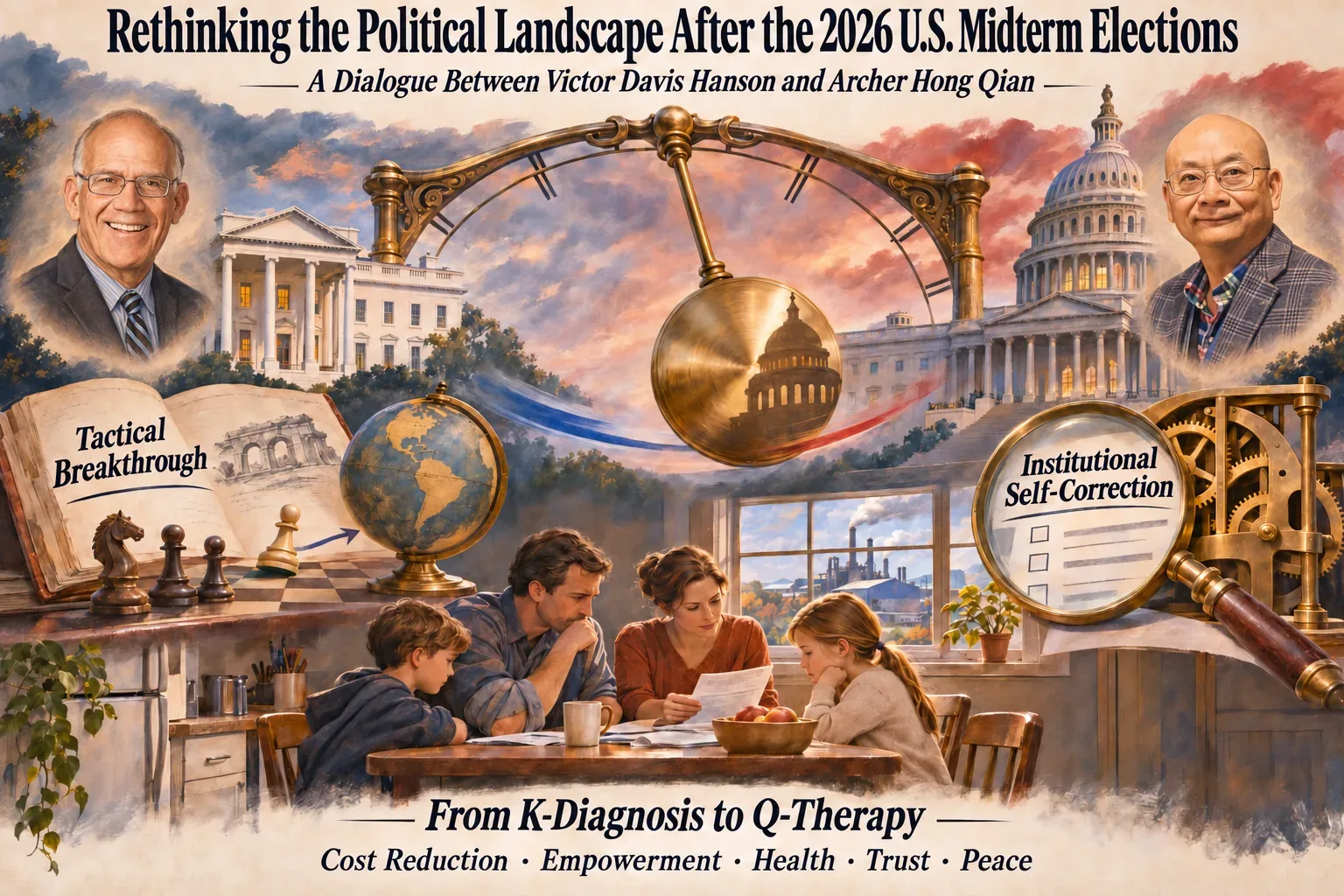
The U.S. midterm elections concluded on November 3, 2026, with Democrats winning control of both chambers of Congress. The outcome immediately sparked debate around the world over whether President Trump would become a lame duck for the remaining two years of his term.
The American historian Victor Davis Hanson looks to historical precedents for how presidents maneuver when Congress is in opposition. Archer Hong Qian, a scholar of Symbionomics, starts from a different question: how does a political order correct itself, and how do public policies deliver value in people’s lives? In his view, winning an election does not amount to winning a consensus, and losing seats need not spell the end of a reform agenda. Read together, their arguments bring the domestic and geopolitical stakes of the election into focus.
I. Finding Common Ground on Strategy — Hanson’s Tactical Breakthrough and Qian’s Institutional Self-Correction
With Republicans having lost their congressional majority, Hanson and Qian approach the same predicament from different levels. Hanson asks what the president can do next. Qian asks what the electoral reversal reveals about the political order’s capacity to correct itself.
1. White House–Congress Rivalry and the Dynamic Balance of a Self-Organizing Political Order
Hanson takes a political realist’s view. He looks back at Bill Clinton in 1994 and Barack Obama in 2010, both of whom recovered politically after severe midterm defeats. In Hanson’s reading, losing Congress could free Trump from protracted legislative wrangling and allow him to shift his efforts toward executive orders and diplomacy, where the presidency has considerable latitude. By moving the contest onto ground where he has more room to act, Trump could counter congressional pressure.
Qian sees a recurring pattern in those precedents, a “correction of earlier corrections.” From the perspective of Symbionomics, presidential and midterm elections serve a function beyond the redistribution of power between parties. They are mechanisms of self-correction through which a living society forms connections and maintains a dynamic balance through self-organization. The precedents Hanson cites show that this political order can recalibrate itself when it moves out of balance.
2. A New Arena in Foreign Affairs and Time for the Common-Sense Agenda to Settle
Hanson urges the White House to shift its focus decisively. A more assertive foreign policy, the use of tariffs, and geopolitical bargaining could give Trump a chance to reshape his presidential legacy.
Qian sees the Democrats’ return to congressional power as a chance for the administration to step back and gain a wider view. After more than a year of moving rapidly on its common-sense reform agenda, the Trump team has time to see how those changes are playing out and identify what it may have overlooked. Which measures to bring industry back to the United States and cut taxes have actually improved ordinary people’s lives? Which costs imposed by institutions still need to be reduced? Those are the questions that determine the reforms’ net effectiveness for society.
II. Where the Two Views Diverge — Zero-Sum Power Politics and the Underlying Institutional Problem
Hanson and Qian find some common ground on how Trump might respond, but they diverge in their understanding of the Democratic Party and where the central conflict now lies.
Hanson focuses on the confrontation between the White House and Congress. Qian argues that “the political pendulum has already swung into the Democratic Party itself.” Shared opposition to Trump can bring enough voters together to win an election. Once lawmaking begins in 2027, Democrats will have to reconcile sharply conflicting positions on universal health coverage, AI-driven job displacement, and the taxes needed to finance higher public spending. Identity politics and campaign promises cannot substitute for the constitutional judgment and governing capacity that the work demands.
III. How Can We Break the Cycle of Correcting One Correction After Another?
In his essay “How Can We Escape the Pendulum Swing Between Growth and Distribution?”, Qian places the midterm elections in a wider context. Whatever party holds office, the United States and much of the world face a structural mismatch in the K-shaped economy. Economic value can grow along one branch while the ability of ordinary households to share in its benefits diverges along the other.
If the AI revolution and the capital behind it fail to turn productivity gains into improvements that reach households broadly, shifting the power struggle to a different arena, as Hanson proposes, or expanding administrative regulation, as Democrats might, can both swell political organizations and their networks of dependency. That is the pathology Qian calls Bureaucolonialism. Organizations reproduce themselves by putting the protection of their positions, budgets, and privileges ahead of the public responsibilities entrusted to them.
From K-Diagnosis to Q-Therapy — Recalibrating Public Policy
Symbionomics proposes recalibrating public policy through Gross Domestic Effectiveness (GDE) and the Five-Cause Index. GDE weights each component of GDP by its effectiveness coefficient, \(\eta_i\). The Five-Cause Index examines five dimensions of actual effectiveness: cost reduction, empowerment, health, trust, and peace.
\[ \mathrm{GDE}=\sum_i(\mathrm{GDP}_i \times \eta_i) \]
Ground monetary and fiscal policy in people’s lives. When the Federal Reserve sets interest rates and Congress negotiates the budget, the priority should be whether their decisions reduce the actual vulnerability of ordinary households. Rising nominal asset values tell only part of the story.
Test the limits of industrial policy and tariffs. Whether Trump’s manufacturing reshoring measures should be retained or revised depends on whether they strengthen the ability of people and enterprises to create on their own initiative.
Elevate AI to AM. Assessing the success of AI takes more than tallying corporate profits. It requires accounting for the costs society bears as workers change jobs, energy consumption rises, and social trust erodes. The aim is to elevate AI toward AM (Artificial Mind), with a greater capacity to deliver value in people’s lives. [1]
Conclusion
Hanson offers a guide to political survival, showing how the White House can regain room to act by stepping back from a fight on unfavorable ground. Qian’s Symbionomics points toward rebuilding institutional trust. Votes can produce a majority without producing a consensus. Winning office gives a party the authority to govern. Fulfilling the public trust takes governing capacity.
The pendulum can swing between the two parties for a century. If organizations remain free to reproduce themselves unchecked, each remedy risks becoming a fresh source of trouble. To move beyond the old establishment playbook and the century-old struggle between growth and distribution, we must connect periodic elections to the long-term obligations of public trust and put economic policy and political power back in the service of the people whose lives they shape.
Vancouver, January 8, 2026