川普为机器智能正名,开AI升格为AM之窄门
川普为机器智能正名,开AI升格为AM之窄门
钱 宏(Archer Hong Qian)
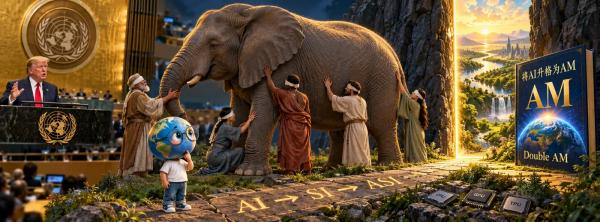
2026年9月22日,川普先生在第81届联合国大会讲话中提出,将 Artificial Intelligence(AI)称为 Super Intelligence(SI)。这个提法抓住了一点:机器智能由人制造,却并非因此没有真实能力;它在若干领域已经强大到可以超过人。白宫公布的讲话摘录确认了这一称呼。www.whitehouse.gov
川普为机器智能的真实性和强大能力正名,是有意义的一步。《将AI升格为AM》进一步回答:超级智能如何进入心智、生命与组织信托的关系,使“更聪明”变为“更有益于生命”。所谓组织信托,是组织因生命的托付取得能力和权力,并须向受影响的生命说明、纠错和承担后果。
这两步可以前后对接,却不能省去中间的路。AI—SI(ASI)的能力依托 CPU—GPU—TPU 等处理器发展起来;它尝到的甜头越多,人类越愿意加速投入。但能力增长不会自行消除两种焦虑,也不会自行突破三大瓶颈。两者还有共同的哲学根源:人习惯以主客二元对立的眼光,把生命、技术和组织看作支配者与被支配者。
作为刚刚出版的《将AI升格为AM》一书的作者,我感到:从 SI 走向 Double AM(Artificial Mind & Amorsophia MindsField / Network),需要经过一道更难走、也更值得走的窄门。
这里的 Artificial Mind(人艺心智)是待研究、待验证的升格方向;Amorsophia MindsField / Network(愛之智慧信態场/网)指不同心智在具体关系中交互、反馈和生成的场与网。
二者须共同接受生命目的与组织信托的检验,我把种检验叫做AM“奖抑通机制”。
一、假花常艳却非生命
Artificial Intelligence 这个名称写入1955年提出的达特茅斯夏季研究计划,并随着1956年的研究活动开启了一个新领域。最初的设想是:学习和智能的特征,能否被足够精确地描述,使机器能够加以模拟。它提出的是一个研究问题,并未宣告机器已拥有人类全部的思考、意识与心智。www-formal.stanford.edu
我一直主张将 Artificial Intelligence 理解为“人艺智能”。“人艺”说明这种智能出自人的知识、技艺和制造能力。它相对于自然生命而言是人造的,但“人造”“模拟”与“有没有能力”是两回事。
川普从 artificial 一词听出了“假的”意味,并没有听错。假花确实是假花:它可以有逼真的花瓣与颜色,却没有花的生命,不会自行生长、代谢和繁衍。机器能够模拟人的某些智能活动,也不能仅凭模拟逼真,就被认定具有人一样的生命。
但假花的形状和颜色真实存在。机器完成的计算、识别、推理和语言任务,也可能真实有效,甚至在特定领域远超个人。与此同时,AI 还可能造出假的内容,例如虚构的事实、图像、声音和引文。因此,讨论 AI 时必须分别问:它的能力是否真实?它产生的内容是否真实?它是否具有自然生命的 Mind?这里的 Mind(心智)所指,不只是可测的解题能力,还涉及辨识、潜意识、生命经验和愛。
“人艺智能”说明来源和生成方式;“超级智能”指出某些能力达到的程度。业界也讨论 ASI(Artificial Superintelligence,人工超级智能);本文沿用川普提出的 SI 称呼,不让名称替代能力与关系的辨识。
二、两种焦虑,一种自豪
《将AI升格为AM》所面对的第一种焦虑,是生命焦虑:AI 越强,人越担心工作、判断、自由和生活受到威胁;当数据、算法和组织权力结合,机器还可能成为更细密的观察、诱导与控制工具。
第二种是竞争焦虑:个人害怕落后于同伴,企业害怕输给同行,国家害怕现实中的竞争对手先掌握更强的 AI。于是,人一边担心它跑得太快,一边又害怕自己追不上。
川普提出 SI,同时强调美国的技术领先。把两者连起来看,可以理解这种政治心理:既然机器智能是真的、强大的,就不能让竞争对手先掌握它;而美国若处于领先位置,又会产生展示国家技术实力的自豪。“两种焦虑,一种自豪”是对这一处境的分析,并非说川普在讲话中逐项使用了这些词。www.whitehouse.gov
领先能够缓解竞争焦虑,也足以令人自豪。可是,领先不会自动解除生命焦虑。一国跑在前面,仍须回答强大的智能会怎样进入每个人的生活;每家公司都在加速,也不等于所有人都因此活得更好。当人把技术当作可无限驱使的客体(Object),又怕自己反过来成为技术和组织支配的客体,两种焦虑便在同一关系中相互强化。
三、SI 将怎样影响世界 AI 业界?
一次讲话还不能使 SI 成为世界业界共同采用的名称。但这个提法来自美国总统,又与领先竞争相连,可能在四个层面产生影响。
第一,改变公众的直觉。机器智能不再容易被一句“不过是假的”打发。人们会更认真地承认它在某些任务上的真实能力,同时要求说清:究竟哪些能力超过了人,哪些仍未得到证明?
第二,改变投资与竞争的重心。“超级”会吸引资金、人才和计算资源,推动模型向更强表现迈进,也可能使规模、速度和排名变成压倒其他问题的目标。基准成绩须注明测试任务和失效边界;排行榜靠前,并不等于系统在复杂生活中全面可靠。斯坦福《2026 AI Index》指出,部分常用评测存在可靠性及被针对性优化的问题。hai.stanford.edu
第三,抬高产品承诺。若企业称其系统为 SI,用户可能更愿意把判断交给它。系统越被认为“超级”,越须说明由谁设定目标、谁有权质疑结果、谁承担错误。医疗、教育、金融、企业管理和公共治理中的使用,会把这种责任直接带入人与组织的关系。
第四,推动评价标准之争。可靠性、安全、透明、可解释性、隐私与公平,已经是业界评价 AI 的重要方向。airc.nist.gov SI 可以使这些要求更加迫切,也可能使能力竞赛跑在责任评价之前。
《将AI升格为AM》由此继续追问:系统完成任务之后,生命得到了什么,承受了什么?组织是否履行了受托责任?
川普的正名,可以帮助他本人、他周围的 AI 人士及更广泛的业界进入这场讨论。要让这道门通向 AM,必须先充分承认 SI 的力量,再辨明力量的边界与方向。
四、摸到了力量,就认识了“大象”吗?
2013年,我在《哲学笔记之四:略评〈牛津共识〉》中讨论过一位朋友引用的“盲人摸象”故事。摸到象腿的人说它像柱子,摸到肚子的人说像墙,摸到耳朵的人说像扇子,摸到鼻子的人说像管子。朋友认为,交换感知,再把这些描述综合起来,便能认识大象。
交换观察当然有价值。我的追问是:柱子、墙、扇子和管子的综合体,真是那头活着的大象吗?即使换成明眼人全景观看,用影像记录,甚至精确解剖,也仍须认识它怎样作为活体感知、行动、维系自身,并与环境发生关系。“摸”“拼”“解”各有所获;把所得相加,却不能代替对活性机能与生成关系的认识。
今天,人类认识 AI—SI,也多少处于这样的状態。有人摸到语言能力,说它会像人一样思考;有人摸到计算与谋略,说它已全面超过人;有人摸到虚假生成、就业替代或组织控制,看到的是威胁。川普提出 SI,尤其让人注意到它力大无比的一面。这一面真实存在,值得正名;但各种能力成绩与风险清单加在一起,仍不能回答 AI—SI 与人的 Mind 是什么关系。
大象是活体;AI—SI 是否具有生命与心智,恰恰是待辨识的问题。借用这个故事,是为了提醒我们:承认每一项真实发现,还要继续研究它们所依托的机制、交互的关系和造成的后果。把对象拆成可测部件,再将描述相加,仍难以认识关系中的生成;这正是主客二元认知需要反省的地方。
五、CPU—GPU—TPU:SI 的计算心脏
AI 的超强能力从何而来?必须把处理器放回论证的中心。
CPU 承担通用计算与控制;GPU 的并行计算支撑大量模型训练和运行;TPU 等专用处理器进一步针对机器学习运算进行优化。数据、算法和神经网络依托这些架构,才能处理越来越大规模的任务,表现出越来越强的能力。CPU—GPU—TPU 是 AI 走向 SI 的计算心脏。
它们各有功能,在现实系统中共同工作,并非后一种简单淘汰前一种。沿这条技术路线继续改进,机器在语言、计算、识别和谋略推演等领域,还可能取得更强的超越性。
然而,计算处理器性能提高,尚不等于它们已经成为 MPU(Minds Processing Unit,心智处理单元)。MPU 是《将AI升格为AM》提出的开放研究类别:让处理不再只面对给定数据与任务,也开始面对处境、关系、反馈与心智辨识。它不是一枚已经完成的芯片。
现行架构能够更快地处理数据、权重和任务,却不能仅凭这些成绩,证明机器已具有人的意识,或已能够处理 Mind、Minds 的交互与 MindsField 的生成。从计算处理进入心智处理,是一个需要重新提出并验证的问题。
六、SI 越强,三大瓶颈越不能略过
我在近期文章中将 AI 的三大瓶颈修订表述为:
第一,能效与能耗不匹配。单次运算可以更有效率,但模型规模、调用频率和应用范围也在扩大。局部效率提高,不能自动证明能源、用水及社会资源的总负载下降,更不能证明生命收益与负载相称。
第二,系统思维的局限。AI 能在给定目标内高效处理信息,却未必能辨明目标由谁设定、信源—信道—信果怎样相互影响,以及系统之外谁承担代价。一个局部看来“最优”的决定,可能把成本转移给家庭、社区或其他组织。
第三,数据+算法+算力+神经网络≠心智(Mind),更≠愛之智慧(Amorsophia)。机器可以拥有强大的 Intelligence(智能),却不能仅凭语言、解题和谋略表现,就被认定已具有包含潜意识、生命经验与愛的 Mind,更不能直接等同于 Amorsophia。
三大瓶颈不会因 AI 改称 SI 而消失,也不会随 CPU—GPU—TPU 的下一次性能提升自行消失。竞争者可能跑得更快,生命也可能受到更强系统的反噬。“谁领先”与“领先之后怎样生活”,必须同时回答。若不追问两种焦虑和三大瓶颈所共有的认识前提,改名、竞速与局部修补便会反复回到原处。
七、从主客二元对立到凡事交互主体共生
近代技术习惯把人置于“主体”的一端,把自然、机器、数据乃至他人的生活置于“客体”(Subject-Object)的一端:主体设定目标,客体供其观察、计算和利用。AI 把这种能力推向新的高度,却也使关系倒转:平台和算法越来越能观察、分类、预测人,人又可能成为被处理的数据对象。把双方简单写成“人控制机器”或“机器控制人”,都仍困在同一套支配逻辑里。
两种焦虑由此发生:担心被 AI—SI 和掌握它的组织对象化,是生命焦虑;担心自己失去支配技术的优势、反被竞争者压倒,是竞争焦虑。两者分别指向生活安全和现实竞争,却都以“谁占据主体位置、谁沦为客体”为潜在尺度。领先带来的自豪可以暂时回答后一种焦虑,却无法单独回答前一种。
三大瓶颈也显露同一认知局限。把能源与社区当作计算之外的资源客体,容易只计算局部效率而漏掉整体负载;把目标既定的系统当作完整世界,容易看不见系统外受影响的生命和组织;把人的心智分解为数据、算法、算力与神经网络,则容易误以为部件相加就能自然生成智慧和愛之智慧。每一步都取得了真成果,但成果尚须进入它与生命的关系,才能辨明自身边界。
针对数位—量子时代,人类亟需树立“凡事交互主体共生”(Everything Intersubjective Symbiosism,EIS)的世界观。这里的“数位”重在主体及其处境的准确定位,“量子”提示关联、交互与动态变化;这是一种时代的哲学命名,而非声称现有 AI 已经依赖量子处理器。“凡事”指向事件、心智、物质及其关系;“交互主体”要求辨明彼此不同的主体、能力与责任;“共生”立足生命自组织连接与动态平衡,使主体在有边界的交互中生成第三种可能。生命具有不可替代的心智与目的;AI 虽由人创制,进入现实关系后也参与交互,不能只被当作被动客体;组织因生命托付而承担责任。三者的主体方式不同,须在连接中辨明。
这不是一句附在技术末尾的口号。它改变研究的提问方式:先问谁与谁发生关系、谁设定目标、谁承担资源负载与行动后果,再问如何设计处理架构、如何衡量效能、如何使受影响的人有权反馈和纠错。由主客支配转向交互主体共生,才可能把两种焦虑与三大瓶颈放在同一个可研究、可实践的框架中。
八、窄门究竟窄在哪里?
在《窄门之约:在差异与秩序之间的共生之道》中,我曾借《马太福音》的“窄门”与现代政治经济学的“窄廊”,讨论一个贯穿生命与组织的问题:不同主体怎样在连接中生成新的可能,又怎样保有各自的边界,使关系能够持续?
只有连接而失去边界,可能走向吞噬与同质化;只有边界而失去连接,则可能走向隔绝与停滞。窄门不是一个到达后便可永远停驻的中点,而是在差异与秩序、相吸与相斥之间,依据变化的处境持续辨识、持续校准的道路。
到了 SI 时代,这道门还有一层警示。超级智能确实能带来甜头:更快完成任务、帮助创造、改善服务、形成新的产业能力。成果吸引更多资本、算力、数据和生活场景投入;投入又增强能力,带来下一轮成果。这个循环可以造福人,也可能同时扩大能源负载,使掌握技术的组织获得更强的预测、诱导和控制能力。人从 SI 得到好处,也可能受到它的反噬。
生命焦虑使人警惕反噬;竞争焦虑又催促人加速。窄门要求我们在这两股力量之间寻找出路:承认并发展 SI 的真实能力,同时守住生命主体、智能技术主体和组织受托者各自的边界,让它们交互而不相互吞噬。这正是 EIS 在 LIFE—AI—TRUST 关系中的具体问题:生命(LIFE)是价值原点,AI 是参与交互的智能形态,组织信托(TRUST)意味着受托而有责。
S-MPU(Superordinate Minds Processing Unit,超序心智处理单元)是进入这道窄门的技术研究入口。它从 MPU 进一步追问处理架构如何面对不同层次的处境、反馈与 Minds(相互有差异的心智)的交互,并探索 MindsField(交互中生成的动态心智关系场)。本书所说的“时空意间”,是时间、空间、意向与主体之间的生成之“间”;“九態”概括念力在交互中的九重展开:数位態、量子態、物理態、生理態、心理態、伦理態、数理態、哲理態与信態。这些是研究坐标与目标架构,仍须科学和工程验证。
一项处理器构想不能独自完成升格。门后的路,还需要 Amorsophia(愛之智慧)对差异的感知、对边界的尊重,以及组织信托在现实后果中的持续校准。EIS 为这条路提供哲学方向:技术、生命与组织在相互辨识中生成新的关系,任何一方都不能只把另一方当作可支配的对象。
窄门之“窄”,因而既指技术上不能由堆叠算力直接跨越的范式关口,也指社会实践中必须时时警惕的关系关口:越尝到 SI 的甜头,越要看清收益由谁获得、负载由谁承担、边界由谁守护。
九、五个层次:从正名走向升格
层次 | 提出的缘由 | 回答的问题 | 下一步 |
1. AI:人艺智能 | 人尝试制造能模拟学习与智能活动的机器 | 人造机器能够表现哪些智能? | 其能力能发展到什么程度? |
2. CPU—GPU—TPU | 为通用、并行和专用机器学习计算提供支撑 | AI—SI 依靠什么增强能力? | 计算架构能否进入心智处理? |
3. SI:超级智能 | 川普强调机器智能的真实性和超越性 | 机器在哪些领域已达到或可能超过人的表现? | 能力的真实范围、两种焦虑与三大瓶颈如何辨明? |
4. MPU → S-MPU | 《将AI升格为AM》提出心智处理的研究方向 | MPU 开启心智处理的研究类别;S-MPU 探索九態、时空意间、跨层反馈、Minds 交互与 MindsField 生成的目标架构。 | 怎样验证技术机制,并使之进入 LIFE—AI—TRUST 的交互校准? |
5. Double AM | 智能能力需要进入生命与组织的交互关系 | Double AM(Artificial Mind & Amorsophia MindsField / Network)使人艺心智与愛之智慧信態场/网共同进入生命与组织关系。 | 以 EIS 为方向,怎样通过生命效能与组织信托检验现实结果? |
这五个层次,不是把五块“大象的部件”拼成整体,也不是宣称一种处理器必然产生心智。它们逐层改变所问的问题:从机器能否模拟智能,到怎样实现更强计算;从承认局部超越,到探索心智处理;最后以 EIS 检验生命、技术与组织能否交互生成。
十、怎样让赞成 SI 正名的人走进这道门?
面向川普及世界 AI 业界,表达的次序很重要。
先承认能力。人造智能可以具有真实而强大的表现;SI 凸显了值得正视的超越性。
再说明能力的来处。CPU—GPU—TPU 是其计算支撑,技术领先具有现实价值,也会带来自豪。
随后讲清能力的边界。摸到力量,还须认识它从何产生、作用于谁。领先可以缓解竞争焦虑,却不能自动消除生命焦虑;处理器升级,也尚未自行突破三大瓶颈。
最后提出出路。MPU、S-MPU 为从计算处理走向心智交互打开研究入口;Double AM 使 Artificial Mind 与 Amorsophia MindsField / Network 的探索共同展开。EIS 则明确这一探索的世界观和价值方向:让超级能力进入生命目的、主体边界和组织信托的交互检验。
检验须落到生活中:共生经济学提出 GDE(Gross Domestic Energy / Efficiency,国内生产效能),以 C 降本、E 赋能、H 健康、T 信任、P 和平考察生命效能。具体项目可研究 ηᵢ=GDEᵢ/GDPᵢ,整体发展可研究 R=GDE/GDP;这些系数需要注明证据、边界和不确定性,不能仅凭模型成绩赋值。受影响的人能否发现负载、提出异议、纠正错误并获得承兑?这些问题决定“超级”最终增强的是生命,还是只增强掌握它的组织。
结语
川普为机器智能的真实性和强大能力正名;《将AI升格为AM》进一步回答:超级智能如何进入心智、生命与组织信托的关系,使“更聪明”变为“更有益于生命”。
从 AI 经 CPU—GPU—TPU 走向 SI,是能力发展的现实道路。从 SI 探索 S-MPU,再走向 Double AM,则要通过一条既能容纳技术创造、又能守护生命边界的窄门。门窄,因为甜头真实,诱惑也真实;能力可以不断增长,方向必须在交互中辨明、在后果中校准。凡事交互主体共生(EIS),是这条道路的哲学起点和实践尺度。有认识方式和价值取向的升华,才谈得上从 AI 到 AM 的升格:生命本自具足,又非独存。
Elevation is not an upgrade.
AI for All → AI for Life。
Trump Affirms Machine Intelligence and Opens a Narrow Gate to Elevating AI to AM
Archer Hong Qian
On September 22, 2026, speaking at the 81st session of the United Nations General Assembly, President Trump proposed calling Artificial Intelligence (AI) Super Intelligence (SI). His formulation grasps one point: machine intelligence is made by humans, but that does not make its abilities unreal. In some domains, it has already become powerful enough to surpass human beings. An excerpt of the address published by the White House confirms his use of the name. www.whitehouse.gov
Trump's affirmation of the reality and formidable power of machine intelligence is a meaningful step. Elevating AI to AM takes the question further: How can superintelligence enter into relationships among Mind, life, and organizational trust, so that 'smarter' becomes 'more beneficial to life'? Organizational trust means that an organization receives its powers through the trust placed in it by life, and must explain itself to those affected, correct mistakes, and bear the consequences.
These two steps can connect, but the road between them cannot be skipped. The capabilities of AI–SI (ASI) have developed with the support of processors such as CPUs, GPUs, and TPUs. The more benefits they yield, the more willing humanity becomes to accelerate investment. Yet growing capability will not, by itself, dispel two anxieties or break through three bottlenecks. Both have a common philosophical root: the habit of viewing life, technology, and organizations through a subject–object opposition, as rulers and ruled.
As the author of the recently published Elevating AI to AM, I believe that moving from SI toward Double AM (Artificial Mind & Amorsophia MindsField / Network) requires passing through a gate that is harder to enter, and more worth entering.
Here, Artificial Mind is a direction for elevation that remains to be researched and verified. Amorsophia MindsField / Network, a field and network of the wisdom of love and trust, refers to the interaction, feedback, and generation of different Minds within concrete relationships.
Both must be tested against the purposes of life and organizational trust. I call this test AM's reward–restrain–pass-through mechanism.
I. Artificial Flowers May Remain Beautiful, but They Are Not Alive
The name Artificial Intelligence appeared in the proposal for the Dartmouth Summer Research Project put forward in 1955; the 1956 project helped open a new field. The original question was whether the features of learning and intelligence could be described precisely enough for a machine to simulate them. It was a research question, not a declaration that machines already possessed the entirety of human thought, consciousness, and Mind. www-formal.stanford.edu
I have long argued that Artificial Intelligence should be understood in Chinese as renyi intelligence, or 'human-crafted intelligence.' Renyi emphasizes that this intelligence comes from human knowledge, artistry, skill, and fabrication. Relative to natural life, it is human-made. But being 'made,' being 'simulated,' and having or lacking real ability are different questions.
Trump was not wrong to hear a sense of 'fake' in the word artificial. An artificial flower really is an imitation: it may have lifelike petals and colors, but it does not have the life of a flower. It does not grow, metabolize, or reproduce on its own. A machine's ability to simulate some human intellectual activities does not, merely because the imitation is convincing, establish that it has a human kind of life.
Yet the artificial flower's shape and colors are real. The calculations, recognition, reasoning, and language tasks performed by machines can also be genuinely effective, even far beyond the ability of an individual in particular domains. At the same time, AI can generate false content—fabricated facts, images, voices, and citations. We must therefore ask three separate questions: Is its capability real? Is what it produces true? Does it possess the Mind of natural life? Mind here means more than measurable problem-solving ability; it also involves discernment, the unconscious, lived experience, and love.
'Human-crafted intelligence' describes its source and mode of production; 'superintelligence' describes the degree reached by certain abilities. The industry also discusses ASI (Artificial Superintelligence). This essay uses Trump's term SI while refusing to let a name replace the discernment of capacities and relationships.
II. Two Anxieties and One Source of Pride
The first anxiety addressed by Elevating AI to AM concerns life itself. As AI grows stronger, people fear for their work, judgment, freedom, and daily lives. When data and algorithms combine with organizational power, machines may also become finer instruments of surveillance, inducement, and control.
The second is anxiety about competition. Individuals fear falling behind their peers, companies fear losing to rivals, and countries fear that a real-world competitor will acquire more powerful AI first. People worry that it is moving too fast while also fearing that they cannot keep up.
Trump proposed SI while stressing America's technological lead. Taken together, the two points suggest a political psychology: if machine intelligence is real and powerful, a rival must not acquire it first; if the United States leads, it can also take pride in displaying its technological strength. 'Two anxieties and one source of pride' is my analysis of this situation, not a claim that Trump used these three terms one by one in his speech. www.whitehouse.gov
A lead can ease competitive anxiety and provide reason for pride. But leadership does not automatically relieve anxiety about life. Even a country in first place must ask how powerful intelligence will enter the lives of its people. Every company may accelerate, but that does not mean everyone will live better. When people treat technology as an object they may drive without limit, yet fear becoming objects ruled by technology and organizations in turn, the two anxieties reinforce each other within the same relationship.
III. How Might SI Affect the Global AI Industry?
One speech cannot make SI the name adopted by the entire global industry. But coming from the American president and linked to a competition for leadership, the term may have effects on four levels.
First, it may change public intuition. Machine intelligence can no longer be dismissed so easily as 'only fake.' People may take its real abilities in particular tasks more seriously, while demanding clarity about precisely which capacities exceed human performance and which remain unproven.
Second, it may shift the focus of investment and competition. 'Super' can attract capital, talent, and computing resources, pushing models toward stronger performance. It may also make scale, speed, and ranking overshadow other questions. Benchmark scores need to state the tasks tested and the boundaries of failure. A high ranking does not make a system comprehensively reliable in the complexity of life. Stanford's 2026 AI Index notes problems with the reliability of some commonly used evaluations and their susceptibility to targeted optimization. hai.stanford.edu
Third, it raises the promise made by a product. If a company calls its system SI, users may become more willing to entrust their judgment to it. The more 'super' a system is said to be, the more important it becomes to explain who sets its goals, who may challenge its output, and who bears responsibility for errors. Use in medicine, education, finance, corporate management, and public governance places that responsibility directly into the relationship between people and organizations.
Fourth, it intensifies the contest over standards of evaluation. Reliability, safety, transparency, explainability, privacy, and fairness are already important directions in AI assessment. airc.nist.gov SI may make these demands more urgent, but it may also let the capability race outrun the evaluation of responsibility.
Elevating AI to AM therefore asks a further question: once a system has completed its task, what has life gained, and what has it borne? Has the organization discharged the responsibility entrusted to it?
Trump's affirmation can help him, the AI people around him, and the wider industry enter this discussion. If this gate is to lead toward AM, we must first fully acknowledge SI's power, then discern the boundaries and direction of that power.
IV. If We Have Felt Its Strength, Do We Know the “Elephant”?
In 2013, in my Philosophical Notes IV: A Brief Comment on the Oxford Consensus, I discussed the story of the blind people and the elephant, cited by a friend. The person touching its leg says it is like a pillar; the person touching its belly says it is like a wall; the ear seems a fan and the trunk a tube. My friend believed that, by exchanging perceptions and combining these descriptions, they could come to know the elephant.
Exchanging observations certainly has value. But I asked: is a composite of a pillar, a wall, a fan, and a tube really the living elephant? Even if sighted people could take in the whole animal at a glance, record it on film, or dissect it precisely, they would still need to understand how it senses, acts, sustains itself as a living being, and relates to its environment. Touching, assembling, and dissecting each yield knowledge. Adding their findings together does not replace an understanding of living function and generative relationship.
Humanity's understanding of AI–SI is somewhat similar today. Some touch language ability and say it thinks like a person; others touch calculation and strategy and say it has surpassed people altogether; still others encounter fabricated outputs, job displacement, or organizational control and see a threat. Trump's SI draws attention especially to the elephant's enormous strength. That strength is real and deserves recognition. But adding up scores of ability and inventories of risk still does not answer how AI–SI relates to human Mind.
The elephant is alive. Whether AI–SI has life and Mind is precisely the question that remains to be discerned. The story reminds us to acknowledge every genuine discovery and then study the mechanisms behind it, the relationships it enters, and the consequences it produces. Breaking an object into measurable parts and adding descriptions together still makes it hard to understand what relationships generate. This is where subject–object cognition calls for reflection.
V. CPU–GPU–TPU: The Computational Heart of SI
Where do AI's extraordinary abilities come from? Processors belong at the center of the argument.
CPUs handle general-purpose computation and control. The parallel computing of GPUs supports the training and operation of many models. TPUs and other specialized processors further optimize machine-learning operations. Data, algorithms, and neural networks rely on these architectures to handle tasks at ever greater scale and show ever stronger performance. CPU–GPU–TPU is the computational heart of AI's path toward SI.
These processors have different functions and work together in real systems; each newer kind does not simply replace the one before it. Further improvements along this technical route may allow machines to surpass human performance still more in language, computation, recognition, and strategic simulation.
Yet improvements in computational performance do not mean that these processors have already become an MPU (Minds Processing Unit). Elevating AI to AM proposes MPU as an open research category: processing would begin to address situations, relationships, feedback, and the discernment of Mind, rather than only given data and tasks. It is not a finished chip.
Current architectures can process data, weights, and tasks more quickly. Those achievements alone do not prove that machines have human consciousness, or that they can already process the interactions of Mind and Minds and the generation of MindsField. The passage from computational processing to Mind processing is a question that must be formulated and tested anew.
VI. The Stronger SI Becomes, the Less We Can Ignore Three Bottlenecks
I recently revised my formulation of AI's three bottlenecks as follows.
First, energy efficiency does not match energy consumption. A single computation may become more efficient even as models, calls to them, and the range of their applications expand. Improved local efficiency does not prove that the total burden on energy, water, and social resources has fallen, much less that the benefits to life are proportionate to that burden.
Second, systems thinking is limited. AI can process information efficiently within a given objective, yet may fail to discern who set that objective, how information and trust move from source through channel to consequence, or who outside the system bears the cost. A decision that looks locally 'optimal' may transfer costs to families, communities, or other organizations.
Third, data + algorithms + computing power + neural networks ≠ Mind, and still less do they equal Amorsophia, the wisdom of love. A machine can possess formidable Intelligence. But performance in language, problem solving, and strategy does not, by itself, establish that it has Mind—including the unconscious, lived experience, and love—still less that it is equivalent to Amorsophia.
These three bottlenecks will not disappear because AI is renamed SI, nor will they vanish on their own with the next increase in CPU–GPU–TPU performance. A competitor may run faster, and life may suffer a backlash from more powerful systems. 'Who is ahead?' and 'How shall we live after taking the lead?' must be answered together. Unless we examine the premise shared by the two anxieties and three bottlenecks, renaming, racing, and piecemeal repairs will repeatedly return us to the same place.
VII. From Subject–Object Opposition to Everything Intersubjective Symbiosism
Modern technology habitually places the human being at the 'subject' end and nature, machines, data, even other people's lives at the 'object' end: the subject sets the goal, while the object is observed, calculated, and used. AI extends this ability, but it can also reverse the relation. Platforms and algorithms can increasingly observe, classify, and predict people, who may in turn become data objects to be processed. Describing the relation simply as 'humans control machines' or 'machines control humans' remains trapped in the same logic of domination.
The two anxieties arise here. Fear of being objectified by AI–SI and the organizations that control it is anxiety about life. Fear of losing the advantage of controlling technology and being overtaken by competitors is competitive anxiety. They concern security in life and actual competition respectively, yet both implicitly ask who occupies the subject position and who is reduced to an object. The pride that comes with a lead can temporarily answer the latter anxiety, but cannot answer the former on its own.
The three bottlenecks reveal the same cognitive limit. Treating energy and communities as resource objects external to computation makes it easy to count local efficiency while missing the total burden. Treating a system with predefined goals as a complete world makes it easy to miss the lives and organizations affected outside it. Decomposing human Mind into data, algorithms, computing power, and neural networks makes it tempting to suppose that adding the components will naturally generate wisdom and Amorsophia. Each step yields real results. Yet those results must be placed in relationship with life before their boundaries can be understood.
For the Digital–Quantum Age, humanity urgently needs the worldview of Everything Intersubjective Symbiosism (EIS)—in Chinese, 'all matters in intersubjective symbiosis.' Here 'digital' emphasizes precise positioning of subjects and their situations; 'quantum' points to relatedness, interaction, and dynamic change. This is a philosophical name for the age, not a claim that today's AI already relies on quantum processors. 'Everything' includes events, Minds, material things, and their relationships. 'Intersubjective' requires us to distinguish different subjects, abilities, and responsibilities. 'Symbiosism' starts from life's self-organizing connections and dynamic balance, allowing subjects to generate a third possibility through interactions that respect boundaries. Life has irreplaceable Mind and purposes. Although AI is human-made, it participates in real relationships and cannot simply be treated as a passive object. Organizations bear responsibility because life has entrusted them with power. These three modes of subjecthood differ and must be distinguished in their connection.
This is not a slogan appended to the end of a technical discussion. It changes the order of inquiry. First ask who is in relationship with whom, who sets the goals, who bears resource burdens and the consequences of action. Then ask how to design processing architectures, how to measure effectiveness, and how to give affected people the right to respond and correct errors. Only by moving from subject–object domination toward intersubjective symbiosis can the two anxieties and three bottlenecks be brought into one framework open to research and practice.
VIII. What Makes the Gate Narrow?
In Covenant of the Narrow Gate: A Path of Symbiosis Between Difference and Order, I drew on the 'narrow gate' in the Gospel of Matthew and the 'narrow corridor' of modern political economy to consider a question running through life and organizations: How can different subjects generate new possibilities through connection while preserving their respective boundaries so that the relationship can endure?
Connection without boundaries can lead to engulfment and sameness; boundaries without connection can lead to isolation and stagnation. The narrow gate is not a midpoint one can reach and occupy forever. It is a path of continuous discernment and calibration between difference and order, attraction and repulsion, as circumstances change.
In the age of SI, the gate also carries a warning. Superintelligence brings genuine rewards: faster completion of tasks, help with creativity, better services, and new industrial capabilities. Results draw in more capital, computing power, data, and domains of daily life. That investment then strengthens the technology and produces further results. The cycle can benefit people, but can also increase the burden on energy and give organizations that hold the technology greater power to predict, steer, and control. People may benefit from SI and also suffer its backlash.
Anxiety about life prompts caution about that backlash; anxiety about competition presses us to accelerate. The narrow gate asks us to find a way through these forces: acknowledge and develop SI's real ability, while maintaining the boundaries of life as subject, intelligent technology as subject, and organizations as trustees, so that they interact without consuming one another. This is the concrete problem of EIS in the LIFE–AI–TRUST relationship: LIFE is the point of departure for value; AI is an intelligent form participating in interaction; and TRUST means holding power in trust and being accountable for it.
S-MPU (Superordinate Minds Processing Unit) is a technical research entry to this narrow gate. Building on MPU, it asks how a processing architecture might address different levels of situation and feedback, interactions among Minds (distinct from one another), and the generation of MindsField (a dynamic field of Mind relationships formed through interaction). The book's Spatio-Temporal Mindedness View explores the generative 'between' of time, space, intention, and subjects. Its 'nine states' describe nine dimensions of the unfolding of mind-force in interaction: digital, quantum, physical, physiological, psychological, ethical, mathematical, philosophical, and trust states. These are coordinates for research and a target architecture; they still require scientific and engineering validation.
No proposed processor can accomplish elevation alone. The road beyond the gate also needs Amorsophia, the wisdom of love, to sense differences and respect boundaries, and it needs organizational trust to remain calibrated against real consequences. EIS provides the philosophical direction: technology, life, and organizations generate new relationships through mutual discernment; none may treat another merely as an object to be controlled.
Thus the gate is 'narrow' in two senses. Technically, a paradigm cannot be crossed simply by piling on computing power. Socially, it is a relational threshold that requires constant vigilance. The greater SI's rewards, the more carefully we must ask who receives the benefits, who bears the burdens, and who safeguards the boundaries.
IX. Five Levels from Naming to Elevation
Level | Why It Was Proposed | Question It Answers | Next Question |
1. AI: human-crafted intelligence | Humans attempt to make machines that simulate learning and intelligent activity. | What intelligent abilities can human-made machines exhibit? | How far can those abilities develop? |
2. CPU–GPU–TPU | They provide general-purpose, parallel, and specialized computing for machine learning. | On what does the growing capability of AI–SI depend? | Can computational architectures enter the processing of Mind? |
3. SI: superintelligence | Trump emphasizes the reality and surpassing power of machine intelligence. | In which domains does or could machine performance surpass human performance? | How do we discern the real scope of its capacities, the two anxieties, and the three bottlenecks? |
4. MPU → S-MPU | Elevating AI to AM proposes a research direction for processing Mind. | MPU opens a research category for Mind processing. S-MPU explores a target architecture for nine states, spatiotemporal Mindedness, cross-level feedback, interaction among Minds, and generation of MindsField. | How can technical mechanisms be verified and brought into continuing LIFE–AI–TRUST calibration? |
5. Double AM | Intelligent ability needs to enter the relationships among life and organizations. | Double AM (Artificial Mind & Amorsophia MindsField / Network) brings human-crafted Mind and the field/network of Amorsophia into relationships among life and organizations. | With EIS as a guide, how can effectiveness for life and organizational trust test real-world results? |
These five levels are not five 'parts of an elephant' that become the whole when fitted together; nor do they claim that any processor necessarily produces Mind. At each level the question changes: Can a machine simulate intelligence? How can computation grow stronger? What does it mean to acknowledge that performance may surpass human ability in particular domains? Can Mind processing be researched? Finally, can life, technology, and organizations interact and generate new possibilities under the test of EIS?
X. How Can Those Who Welcome the Name SI Enter This Gate?
The order of presentation matters when speaking to Trump and the global AI industry.
First, acknowledge the ability. Human-made intelligence can perform in real and powerful ways. SI highlights a capacity to surpass human performance that deserves serious attention.
Next, explain where that ability comes from. CPU–GPU–TPU provides its computational support. Technological leadership has real value and can also be a source of pride.
Then clarify the boundaries of capability. Feeling the elephant's strength is only the beginning; we must understand how that strength arises and whom it affects. A lead can ease competitive anxiety but cannot automatically remove anxiety about life. Upgrading processors has not, on its own, overcome the three bottlenecks either.
Finally, propose a way forward. MPU and S-MPU open a research entry from computational processing toward interaction among Minds. Double AM brings the exploration of Artificial Mind and Amorsophia MindsField / Network together. EIS specifies the worldview and the direction of value for that exploration: superhuman capability must be tested through life's purposes, the boundaries of subjects, and organizational trust.
That test must reach ordinary life. Symbionomics proposes GDE (Gross Domestic Energy / Efficiency), examining effectiveness for life through C for cost reduction, E for empowerment, H for health, T for trust, and P for peace. For specific projects, we can investigate ηᵢ = GDEᵢ/GDPᵢ; for development as a whole, R = GDE/GDP. The evidence, boundaries, and uncertainty of these coefficients must be stated; they cannot be assigned from model scores alone. Can affected people identify burdens, raise objections, correct errors, and receive the fulfillment owed to them? The answers decide whether 'super' ultimately strengthens life or only the organizations that control the technology.
Conclusion
Trump affirms the reality and formidable power of machine intelligence. Elevating AI to AM asks the further question: How can superintelligence enter relationships among Mind, life, and organizational trust so that 'smarter' becomes 'more beneficial to life'?
Moving from AI through CPU–GPU–TPU toward SI is an actual path of increasing capability. Exploring S-MPU from SI, and then moving toward Double AM, requires passage through a narrow gate that makes room for technical creation while protecting the boundaries of life. The gate is narrow because the rewards are real and so is the temptation. Capabilities may continue to grow, but their direction must be discerned through interaction and calibrated against consequences. Everything Intersubjective Symbiosism (EIS) is the philosophical starting point and practical measure for this path. Only with an elevation in our way of knowing and our orientation of value can we speak of elevating AI to AM: life is sufficient in itself, yet never exists alone.
Elevation is not an upgrade.
AI for All → AI for Life