《共生经济学概论》与《将AI升格为AM》如是说
组织信托不是一个漂亮的词
Organizational Trust Is Not Just a Beautiful Phrase
——《共生经济学概论》与《将AI升格为AM》如是说
—What Symbionomics: An Overview and Elevating AI to AM Have to Say
钱 宏(Archer Hong Qian)
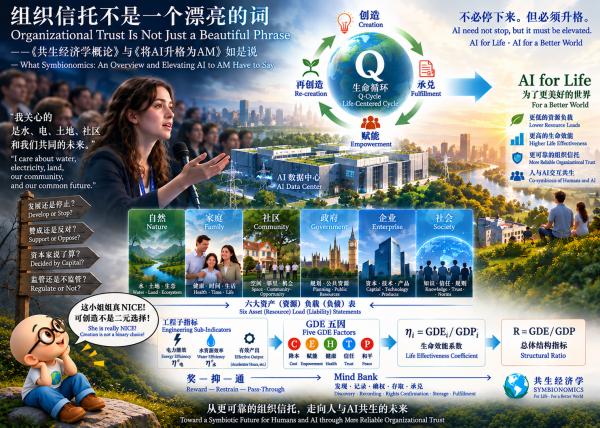
一个年轻女孩站起来了。
在一场谈论AI未来的会议上,她没有跟着台上的宏大叙事往前走,而是把水、电、土地、社区和普通人的生活重新带回了会场。
她的声音之所以迅速引起共鸣,不是因为她提出了一个从来没有人提出过的问题。
恰恰相反。
她放大了一个已经积累了多年的老问题。
这些年来,从马斯克等科技界人士参与推动暂停更强AI系统训练的公开呼吁,到AI安全、对齐与监管之争,再到AI研究人员因为风险判断而辞职,担忧的内容不断变化,情绪却越来越强烈:
AI究竟会把人类带到哪里?
这个女孩把已经在科技界、资本市场、政府和学术界翻滚多年的焦虑,一下子带到了普通人的水龙头、电费账单和生活社区的安全里。
所以,我欣赏她。
一个年轻人愿意站出来,为自己所理解的公共利益发声,需要勇气、责任心和人文关怀。
但是,欣赏她的勇气,与接受她所放大的问题框架,是两回事。
因为问题如果仍然被表述为:
发展还是停止?
赞成还是反对?
资本家说了算,还是公众投票?
监管还是不监管?
那么无论哪一边声音更大,都可能仍然没有触及问题的根。
2026年,恰好给了我们一个重新思考的时间坐标。
70年前的1956年,一群数学家和科学家聚集在达特茅斯,“Artificial Intelligence”由此成为一个新研究领域的名字。70年以后,AI已经从实验室进入千家万户,又从千家万户反过来要求越来越庞大的芯片、算力、数据中心、电力、水和土地。
一个当初追问机器能否模拟人的智能的科学问题,正在变成一个牵动资本、技术、政府、社区、能源、生态乃至国际竞争的巨大组织问题。
也就在2026年,我的《共生经济学概论(修订版)》与《将AI升格为AM》同时出版。
这当然不是为了纪念AI诞生70周年而作的安排。
但是,有耐心而又有灵气的读者,不难发现:这两本书虽然分别从经济学与人工智能出发,却从两个不同方向走到了同一个问题面前。
《共生经济学概论》追问:
经济从哪里发生,又最终为了什么?
《将AI升格为AM》追问:
人工智能如此迅猛地发展,究竟应该走向哪里?
前一本书,从GDP一路追问到生命。
后一本书,从Intelligence一路追问到Mind。
一个重新考察我们怎样衡量经济活动,一个重新考察我们怎样理解人工智能。
二者最后相遇在同一个地方:
LIFE—AI—TRUST。
也相遇在同一个现实命题:
重建组织信托。
真正推动AI发展的,从来不只是几个所谓“AI巨头”。
资本市场在推动。
千千万万投资者在推动。
工程师和创业者在推动。
政府出于国家竞争、产业发展和公共利益的考虑在推动。
亿万用户每天使用AI、提供需求、数据、反馈乃至资本,也在推动。
这是一个巨大的组织过程。
同样,要求监管AI的也不是一个抽象的“人民”。
政府是组织。
监管机构是组织。
企业是组织。
资本市场是组织。
社区也是不同层次的组织。
所以,AI真正面对的问题,并不能简单归结为:
谁战胜谁。
它首先要求我们追问:
这些掌握资本、技术、数据、算力、公共资源乃至监管权力的组织,究竟受谁之托?调用了什么?负载(负债)了什么?创造了什么?向谁负责?又向谁承兑?
这就是我所说的:
组织信托。
可是,一个尖锐而且值得认真回答的质疑随之而来:
“组织信托”听起来很好,“AI for Life”也很好,“Double AM”似乎更宏大——但这些会不会仍然只是另一套漂亮的哲学语言?
如果不能回答一个数据中心究竟应该建在哪里、用多少电、耗多少水;不能回答社区承担什么、企业获得什么、谁来确权、怎样计量、如何承兑;不能推动芯片、冷却、能源和算法发生真正的技术改变,那么“向生命承兑”说得再漂亮,又有什么用?
这个质疑是有价值的。
因为它恰恰把《共生经济学概论》与《将AI升格为AM》从书架上推回了现实世界。
我的回答很简单:
那就不要停留在词上。
让我们从那个女孩担心的最现实问题开始。
水。
电。
土地。
社区。
数据中心。
然后一步一步往下追:
六大资产(资源)负载(负债)表能不能把账打开?这里“负载”与“负债”指向同一件事:前者侧重能耗/能效意义上的实际承载,后者是《共生经济学概论》采用的常规会计表达;本文以“负载(负债)”并列提示。
确权能不能找到谁贡献、谁负载(负债)?
工程层面的能耗/能效子指标能不能回答:一单位有效算力究竟用了多少电、多少水、多少资源?
而共生经济学正式提出的生命效能系数ηᵢ=GDEᵢ/GDPᵢ,以及GDE(Gross Domestic Energy / Efficiency,国内总能量/效能)的C降本、E赋能、H健康、T信任、P和平五因,能不能进一步回答这些经济活动最终给生命带来了什么?
R=GDE/GDP能不能从总体结构上观察经济规模与生命效能之间的关系?
然后还有一个更重要的问题:
我们是不是只能计算既有的水、电和土地,然后围绕稀缺重新分配?
还是可以通过新的材料、新的冷却、新的能源、新的算法乃至未来纳米级自供电技术,降低单位有效产出的水、电和资源负载(负债),改变原来的资源约束,让技术创造本身生成第三种可能?
如果能够,那么:
“一视为仨,间道竞和”就不是一个漂亮的词。
如果这些创造还能够通过奖—抑—通得到激励,通过Mind Bank得到发现、记录、确权、存取和承兑,那么:
“组织信托”也不是一个漂亮的词。
而如果Artificial Mind进一步进入Amorsophia MindsField / Network,使智能能力、生命效能、技术创造与组织信托发生交互,那么:
Double AM(Artificial Mind & Amorsophia MindsField / Network),也就不再只是一个文明命名。
所以,2026年把两个问题同时摆到了我们面前。
一个是已经走过70年的AI:
它还能不能只是沿着Intelligence继续做大?
另一个是已经深刻塑造现代世界的GDP:
我们还能不能只用“生产了多少”,来回答“生活究竟变得怎样”?
《共生经济学概论》与《将AI升格为AM》给出的不是两个彼此孤立的答案。
它们构成的也不是一个封闭的O。
更不是一个不断断裂的K。
它们试图形成一个Q:
从生命出发,经由创造、承兑、赋能重新回到生命,又从这个循环中伸出一个继续生成的开口。
创造 → 承兑 → 赋能 → 再创造。
那么,就从那个女孩所担心的一座AI数据中心开始吧。
看看“组织信托”,究竟是不是一个漂亮的词。
一、先把AI放到地上:一座数据中心究竟发生了什么?
建一个大型AI数据中心,需要资本、土地、芯片、服务器、工程师、电网、网络、冷却系统。
还需要电。
需要水。
需要公共基础设施。
更需要一个它实际进入的生活环境和社区。
所以,一个数据中心从来不是孤零零的一栋建筑。
它是一个组织调动多种资产和资源,进入一个既有生命环境以后发生的关系重组。
这一点并非AI数据中心所独有。
建一个火葬场,修一条磁悬浮铁路,技术上当然是完全不同的三件事情,却具有相似的组织经济行为结构:它们都会调动资本、土地、能源、技术、人力和公共基础设施,也都可能对周围生物以及人的生活产生不同程度的物理、生理乃至心理影响。
因此,它们具有一个共同的问题:
不能只算项目自己的账。
一个数据中心能够赚钱,不等于它一定值得建。
一个火葬场具有公共需要,不等于建在哪里都一样。
一条磁悬浮铁路能够提高速度,也不意味着速度增加本身已经回答了项目是否值得。
反过来也一样。
居民反对,不自动证明项目错误;公众担忧,也不能替代科学判断。
共生经济学首先不急于站到“建设”或者“反对建设”的任何一边,而是追问:
为了让这项经济行为发生,究竟有什么进入了关系?谁投入?谁负载(负债)?谁创造?谁受益?
二、没有进入资产负债表,就等于没有发生吗?
一家企业准备建设AI数据中心,首先会计算投资、土地、芯片设备、电费、水费、人工、融资成本、未来收入以及投资回收期。
现代项目评价当然早已不限于这些。环境影响评价、社会影响评价、成本收益分析以及各种风险评估,都已经存在。
这些都有价值。
共生经济学并不否定它们。
它继续追问:
有没有一些真正进入这项经济行为的资产和资源,因为没有进入企业自己的资产负债表,最后就被归入了所谓“外部性”?
数据中心使用一度电,企业付了电费。
账算完了吗?
未必。
为了供应这度电,需要多少发电和输配电资源?高峰时期有没有占用其他社会用电能力?增加的基础设施由谁建设?最终成本由谁承担?
水、土地、生态和社区生活环境都是如此。
人的时间、健康、安全感以及人与组织之间的信任,也可能因为一项经济行为而改变。
所以:
没有价格,不等于没有价值;没有进入企业资产负债表,不等于没有发生负载(负债)。
三、为什么共生经济学提出六大资产(资源)负载(负债)表?
这正是《共生经济学概论》观察经济行为的一个不同起点。
我提出六大资产(资源)负载(负债)表,并不是为了再给企业增加几张复杂的财务报表,而是要改变我们观察经济活动的方法。
传统资产负债表首先回答:
企业拥有什么?企业欠什么?
共生经济学还要继续追问:
为了完成这项经济行为,究竟有哪些资产和资源进入了关系?分别由谁提供?谁因此增加了价值?谁又因此承担了负载(负债)?
企业投入资本,是投入。
家庭投入养育生命,更是投入。
工程师投入知识、创造力和生命时间,也是投入。
政府提供道路、电网、公共服务和制度基础设施,是投入。
社区提供空间环境和社会承载能力,也是投入。
自然提供水、土地、能源和生态容量,同样进入经济活动。
与此同时,项目产生的能源消耗、水资源压力、噪声、环境变化、潜在健康影响以及社会关系变化,又形成不同性质的负载(负债)。
所以,六大资产(资源)负载(负债)表背后首先要解决的,是:
确权。
四、为什么必须确权?
没有确权,就没有真正完整的经济计算。
如果一个AI数据中心创造了10亿美元收入,我们很容易知道这些收入首先进入哪些企业账户,因为现代财务制度已经建立了成熟的产权记录。
但是,如果为了创造这些收入,当地增加了巨大电网投入,谁承担?
如果大量使用水资源,水资源价值怎样体现?
如果社区承担额外负载(负债),有没有被记录?
如果AI模型的价值与大量人的知识、数据和文化创造有关,这些贡献怎样被发现?
反过来,如果AI显著降低普通人的学习、医疗、创业和获取专业知识的成本,这些正向价值又怎样记录?
因此,确权不仅问:
“这东西是谁的?”
还要问:
谁贡献了什么?谁承担了什么?谁创造了什么?谁因此应该获得什么?
于是形成:
发现 → 记录 → 确权 → 负载(负债) → 创造 → 承兑。
没有发现、记录和确权,承兑就找不到对象;没有承兑,组织信托最终就容易只剩一句道德要求。
五、从工程能效到η:技术效率不能冒充生命效能
确权之后,就进入衡量。但这里首先要把两个层次分开。
数据中心当然需要测量工程效率:一单位有效算力用了多少电、多少水,芯片、算法和冷却系统有没有降低单位资源消耗。这些都是必要的工程子指标。
但是,共生经济学正式使用的η,不等于任何一个“有效算力/千瓦时”或“有效算力/立方米水”的工程效率。
《共生经济学概论》的公式是:
ηᵢ=GDEᵢ/GDPᵢ
它表示一项经济活动的名义经济产出,经过生命效能与跨表责任检验以后,究竟形成了怎样的生命效能转换。没有GDEᵢ这个分子,就不能把工程效率直接称作ηᵢ。
因此,工程能效回答“技术转化得怎样”;ηᵢ则进一步回答“这项经济活动相对于其GDP,究竟形成了多少GDE”。二者相关,却不能混写。
这一区分对于AI尤其重要。
一种新芯片、算法或冷却技术,可以先使单位算力的电耗、水耗下降;但这种工程改进只有进一步进入C、E、H、T、P及六表关系,才可能改变GDEᵢ,并最终改变ηᵢ。
所以,技术效率是ηᵢ形成的重要事实基础,却不是ηᵢ本身。
这也意味着,共生经济学的测量不能先造一把综合尺,再把所有生命关系硬塞进一个小数。
先发现、记录原量;再识别方向、阈值与可逆性;能够稳定换算的部分,再逐步进入GDE的构造。
不能立即加总,不等于不能计量。
恰恰相反,这是为了防止η和GDE重新变成新的指标幻觉。
六、从GDE到η:有效率,还必须问“为了什么”
但是,仅仅提高η仍然不够。
一台机器可以效率极高,却用来生产没有生命价值甚至损害生命的东西。
一个AI系统可以用更少的电完成更多计算,但如果这些计算主要制造垃圾信息、欺骗、冲突或者社会成本,我们不能仅仅因为它“高效”就认为它具有更高的整体价值。
所以,共生经济学还必须从转换效能继续进入生命效能。
这就是:
GDE(Gross Domestic Energy / Efficiency,国内总能量/效能)。
GDE并不简单替代GDP,而是在GDP告诉我们“经济活动生产了多少”以后,继续追问:
这些生产究竟给生命和社会带来了什么?
我把这种生命效能进一步落实为五个相互关联的因素:
C——Cost Reduction,降本;
E——Empowerment,赋能;
H——Health,健康;
T——Trust,信任;
P——Peace,和平。
即C、E、H、T、P五因。
于是,工程子指标、GDE五因与η回答的是三个相互连接、却不能混淆的问题:
工程子指标问:单位有效产出的水、电、资源负载(负债)有没有下降?
五因问:这些经济活动最终给生命带来了怎样的降本、赋能、健康、信任与和平效应?
ηᵢ=GDEᵢ/GDPᵢ则问:相对于名义经济产出,这些生命效能究竟形成了怎样的转换关系。
七、R=GDE/GDP:从单项活动进入总体结构
在η以及GDE五因的基础上,共生经济学进一步提出:
R=GDE/GDP
R不是给某一座数据中心颁发的“生命效能奖牌”,而是总体资源效能转换的结构性比率。
它追问:一个经济体在形成GDP的同时,究竟形成了多少能够被生命感受、被社会验证并最终得到承兑的GDE?
于是,一个更严谨的逻辑次序出现了:
六表发现与确权 → 工程原量与子指标 → GDE五因 → ηᵢ=GDEᵢ/GDPᵢ → GDE=Σ(GDPᵢ×ηᵢ) → R=GDE/GDP。
两个AI数据中心都创造10亿美元GDP,并不意味着它们具有相同的生命效能。
一个数据中心可能通过先进芯片、算法和冷却技术,以更少的电和水完成同样的计算——这首先改善的是工程子指标。
如果这种改善又降低自然、家庭、社区等表上的负载(负债),并通过医疗、科研、教育和中小企业赋能形成更高的C、E、H、T、P,它才进一步进入GDEᵢ的构造。
在此基础上,才可能形成更高的ηᵢ;而R是否改善,还要放回区域或国家总体结构中观察,不能由一个项目自行宣布。
这样,几个层次就不能再混淆:
工程子指标——资源与能量怎样转化;
GDE——转化以后形成什么生命效能;
ηᵢ与R——生命效能分别相对于单项GDP与总体GDP形成怎样的转换关系。
八、五因不能成为另外五个漂亮的词
如果C、E、H、T、P永远只是五个好听的词,它们同样没有意义。
“我们的项目赋能社会。”
“我们的技术改善健康。”
“我们的AI增进信任。”
这些话谁都会说。
真正的问题是:
降低了谁的什么成本?
赋能了谁?
原来不能做什么,现在能够做什么?
健康结果怎样改变?
信任增加还是减少?
冲突成本下降还是上升?
不同项目当然不能使用完全相同的指标。
但是:
不能用一个数字完全表达,不等于不能计量;不能精确到小数点后两位,也不等于可以不建立账户。
因此,GDE必须从五因进入计量,从计量进入账户,从账户进入承兑。
九、难道我们只能计算稀缺,然后分配稀缺吗?
到这里,还有一个更加重要的问题。
如果AI数据中心耗水太多,我们是不是只能讨论:
AI少用一点,居民多留一点?
如果电力不足,是不是只能讨论:
数据中心少建一点,其他部门多用一点?
如果健康与资源发生冲突,是不是只能决定牺牲哪一边?
当然不是。
日本常见的喷水清洗式智能马桶盖,就是一个极小却很有意思的生活例子。
便后喷水清洁,可以改善个人卫生,却同时需要消耗水和电。
于是似乎出现一个矛盾:
健康希望清洁得更好,节约资源又希望少用水。
怎么办?
如果仍然是一分为二的思维,就只能在两边寻找妥协。
但为什么不能进一步问:
能不能通过喷嘴、压力、雾化和控制技术,用更少的水达到同样甚至更好的清洁效果?
如果海水淡化和再生水技术又把单位水资源成本大幅降低,原来的约束条件本身就进一步改变。
这时,我们看到的已经不是简单的A或者B。
A与B发生关系,可能生成一个过去不存在的C。
这正是我所说的:
一视为仨,间道竞和。
所以:
“一视为仨,间道竞和”也不是一个漂亮的哲学词。
它可以直接进入喷嘴、材料、能源、算法和工程设计。
哲学改变问题的问法,新的问法又可能改变技术创造的方向。
十、技术创新,可以改变稀缺本身
AI数据中心也是如此。
高性能芯片产生大量热量,需要冷却。
于是人们看到:
算力增加 → 芯片发热增加 → 冷却增加 → 水电消耗增加。
似乎这是一个无法逃脱的链条。
但是,技术条件本身不是常数。
新的液冷、浸没式冷却、冷板、新材料、低功耗芯片和算法优化,都可能用更少资源获得相同甚至更高的有效产出。
于是,面对“算力增加—热量增加—水电增加”的既有关系,人类并不是只能接受它。
可以改变技术本身。
海水淡化成本如果大幅下降,淡水约束会改变。
芯片单位算力的能耗如果下降,电力约束会改变。
算法如果用更少计算获得同样结果,算力约束会改变。
新的材料如果改变散热方式,冷却约束也会改变。
所以,共生经济学绝不能只研究:
怎样在既定稀缺条件下分配资源。
它还要继续追问:
怎样通过确权、效能计量和组织激励,让能够改变稀缺条件本身的创造不断发生?
十一、技术创新首先改变η
这样,η就不再只是一个事后统计指标。
它开始进入技术创造。
原来100单位能源和资源只能支持一定算力;新的芯片、算法和冷却技术,也许80、50甚至更少就可以完成。
于是:
技术创新 → 单位有效产出的资源负载(负债)下降 → 工程子指标改善。
如果这种改善又降低六表中的跨表负载(负债),并生成更大的降本、赋能、健康、信任与和平效应,则进一步进入GDEᵢ。
GDEᵢ提高,在GDPᵢ给定时,ηᵢ提高;大量活动的ηᵢ发生结构性改善,才可能进一步提高总体GDE与R。
这非常重要。
因为我们终于不再只是“计算技术的社会成本”。
经济学的计量方式本身,开始反过来激励技术创新。
我们不再只问:
技术能不能更强?
还要问:
技术能不能以更低的生命负载(负债),创造更大的生命效能?
十二、生命本身,可能就是未来技术的老师
再往前一步,我们甚至可以从生命本身获得启发。
一个人早晨喝一杯牛奶、吃一点食物,摄入的化学能经过消化和代谢进入细胞。线粒体参与ATP生成,为神经活动、肌肉运动以及人体各种生命过程持续提供能量。
人不需要背着一个发电站才能思考和行动。
生命本身就在进行高度微型化、分布式的能量转换、储存、调用与动态平衡。
自然界还有更加极端的例子。
例如电鳗通过大量电细胞协调作用,可以在需要的时候产生强烈放电。
这些生命现象启发我在AM“16+1”技术矩阵中提出一个构想:
未来能不能借鉴生命在微观尺度上的能量生成、转换、储存和按需释放机制,发展纳米级、分布式、自供电技术,并进一步与Artificial Mind的计算单元连接?
这不是说今天已经存在这样的成熟AI供电系统。
它是一个等待技术创造和实验验证的方向。
但是,它所追求的目标非常明确:
从根本上降低单位有效产出的资源负载(负债),并为提高GDE与ηᵢ打开新的技术可能。
十三、Elevation is not an upgrade:升格重新规定升级的方向
现在,我们可以更完整地理解《将AI升格为AM》中的一句话:
Elevation is not an upgrade.
升格不是升级。
但升格绝不排斥升级。
恰恰相反:
升格重新规定升级的方向。
过去AI升级首先追求:
更大的模型、更强的算力、更快的芯片、更大的数据中心。
这些仍然可能需要。
但是,当AI进入生命效能的参照系以后,一系列新的技术问题就会被激发出来:
能不能少用一半的水?
能不能少耗一半的电?
能不能让芯片少产生需要排出的热?
能不能用新的材料改变散热?
能不能通过算法减少无效计算?
能不能让能源供应越来越微型化、分布式甚至自供给?
能不能让每一单位有效产出的水、电、材料等资源负载(负债)继续下降?
又能不能让这些工程改进进一步生成更大的C、E、H、T、P,进入GDE与ηᵢ,并在总体结构中推动R改善?
所以:
Elevation is not an upgrade; elevation reorients upgrading.
升格不只是升级;升格重新规定升级的方向。
从AI走向AM,不会让技术创新停止。
恰恰相反,它可能打开新的技术创新空间。
十四、组织信托不是限制创造,而是让创造获得方向
现在,整个逻辑可以连接起来:
发现六大资产(资源)及其负载(负债)
→ 记录与确权
→ 工程原量与能效子指标
→ GDE五因计量
→ ηᵢ=GDEᵢ/GDPᵢ
→ GDE=Σ(GDPᵢ×ηᵢ)与R=GDE/GDP的结构观察
→ 奖—抑—通
→ 激励改变约束的技术与组织创造
→ 降低跨表负载(负债)、提高生命效能
→ 价值承兑
→ 赋能新的创造。
这就进入Q型经济的循环:
创造 → 承兑 → 赋能 → 再创造。
它不是K。
K让我们看见断裂。
它也不是一个封闭的O。
封闭的O只是循环。
Q在循环之中留下一个继续向外生成的开口。
Q所追问的,是能不能让越来越多失去转动力的生命重新进入创造,让价值获得承兑,让承兑重新赋能生命,再生成新的创造。
所以,共生经济学不满足于现行经济学问:
现有的蛋糕怎样分?
也不仅仅是强调另一端:
如何做大蛋糕?
不是二元对立钟摆式难题。
它继续追问:
原来的约束为什么不能改变?新的价值为什么不能生成?
十五、奖—抑—通:组织信托必须变成机制
组织信托如果只有一句“企业应该对社会负责”,当然还是一个漂亮的词。所以,它必须进入机制。
这就是:
奖—抑—通。
奖,让真正降低生命负载(负债)、增加GDE并改善ηᵢ的创造得到承兑。
如果一种新的冷却技术能够用更少的水和电产生同样甚至更大的算力,就应该得到相应的价值承兑。
抑,使资源浪费、风险转嫁、欺骗、数据滥用不能继续无成本扩张。
通,则让原来被组织壁垒隔开的资源、信息和价值重新流动。
资本能够找到真正降低生命负载(负债)的技术;
技术能够获得资本;
社区承担的负载(负债)能够进入项目决策;
创造者能够获得承兑;
政府、企业、用户和社区之间的信息能够交互验证。
奖而不抑,可能形成掠夺;
抑而不奖,会压制创造;
奖抑而不通,则形成堵塞。
由此形成动态平衡。
于是,Q婉如:“蜗牛背着重重的壳,驾轻就熟地往前走”!
十六、从六大资产(资源)负载(负债)表,到Mind Bank
那么,这些价值记录在哪里?
这就进入Mind Bank。
Mind Bank不是把传统银行搬到网上,更不是建立一套行政评分系统。
它首先解决的是:
价值怎样被发现、记录、确权、存取和承兑。
整个逻辑由此进一步闭合:
六大资产(资源)负载(负债)表——显现资产、资源和跨表负载(负债);
确权——确认谁贡献、谁承担、谁创造;
工程原量与子指标——观察单位有效产出的水、电和资源消耗怎样变化;
GDE五因——观察经济活动怎样进入生命;
ηᵢ与R——分别观察单项活动与总体结构中的生命效能转换;
奖—抑—通——把价值判断转化为组织激励;
技术创造——降低单位有效产出的资源负载(负债),并改变原有约束;
Mind Bank——使新生成的价值能够存取和承兑;
最终形成:
组织信托。
到了这里,组织信托已经进入资产资源、确权、计量、技术、账户、激励和组织行为。
它还只是一个漂亮的词吗?
十七、这就是Double AM
现在,我们终于可以回到:
Double AM(Artificial Mind & Amorsophia MindsField / Network)
为什么一定是Double?
如果只有Artificial Mind,我们仍然可能沿着单一智能能力不断放大:
更多数据、更强算法、更大算力、更大模型。
而Amorsophia MindsField / Network所提供的,是让Artificial Mind进入生命、关系、价值、确权、承兑和组织信托的场域。
前者发展能力。
后者让能力进入生命关系。
二者交互,而不是彼此取代。
这就是:
LIFE—AI—TRUST。
所以,Double AM并不是给AI外面再套一层哲学包装。
它试图使:
智能能力、生命效能、技术创造与组织信托进入同一个生成过程。
十八、70年以后,为什么必须升格?
现在再看AI的三大瓶颈。
第一,资源、能耗投入与生命能效产出的不对称。
解决它不能只靠限制算力,还要改变能源、芯片、算法、冷却等技术,降低单位有效产出的资源负载(负债),并使这些改进进一步进入GDE、ηᵢ与R。
第二,系统思维的局限。
AI面对的始终是经过数据选择、算法处理和模型结构形成的世界。数据再多,也不是完整的生命世界;算力再强,也不会自动消除信源、信道与信果之间的选择、偏差和局限。
第三,数据+算法+算力+神经网络,并不因此等于Mind,更不等于Amorsophia。
AI今天极其强大的,是人的某些智能能力被工程化以后形成的放大。
局部智能的极大发展,并不自动生成完整心智。
这也解释了为什么AI越强,人们有时反而越焦虑。
一种被高度放大的局部能力,如果脱离生命、关系和组织信托,人们当然会担心它最后究竟向哪里去。
所以,真正需要改变的,不只是AI的速度。
是它的方向。
这就是为什么:
不必停下来,但必须升格。
结语:那个女孩站起来以后
现在,再回到文章开头那个站起来的年轻女孩。
她担心水。
担心电。
担心土地。
担心社区。
她把这些担忧重新带进了一间谈论AI未来的大会场。
这些声音值得听见。
但是,人类能够给她的回答,不应该只有两个:
停下来。
或者:
继续冲。
还有第三种可能。
这正是“一视为仨,间道竞和”真正进入现实的地方。
资本承担的风险不能记作零。
工程师的创造不能记作零。
政府投入的公共资源不能记作零。
社区承担的负载(负债)不能记作零。
生命获得的赋能不能记作零。
而能够降低单位有效产出的资源负载(负债)、提高GDE并改善ηᵢ与总体R的技术创造,更不能记作零。
所以,《共生经济学概论》要做的,不只是:
把过去没有算进去的东西重新算进来。
还要继续向前:
让创造改变原来的那张账。
而《将AI升格为AM》所要做的,也不是给AI换一个更漂亮的名字。
它所追问的是:
能不能改变AI继续发展的参照系?
水不够,不一定只能争水。
电不够,不一定只能限电。
健康与节水发生冲突,不一定只能牺牲一边。
今天的数据中心需要庞大的冷却和供电系统,也不意味着未来的Artificial Mind永远必须依赖今天的能源结构。
人类还有一种能力:
创造。
创造新的材料。
创造新的能源。
创造新的芯片。
创造新的冷却。
创造新的算法。
创造新的组织方式。
甚至创造今天还没有名字的技术。
所以:
“一视为仨,间道竞和”不是一个漂亮的词。
它要求我们从A与B的冲突中寻找能够生成的C。
“组织信托”自然更不是一个漂亮的词。
它必须落实到六大资产(资源)负载(负债)表、确权、工程原量与子指标、GDE、ηᵢ、R、奖—抑—通、Mind Bank以及可以验证的组织行为。
而:
Double AM(Artificial Mind & Amorsophia MindsField / Network)更不能只是一个漂亮的文明命名。
它最终必须进入真实的技术、真实的企业、真实的数据中心和真实的生活。
1956年,人们给Artificial Intelligence起了一个名字。
70年过去了。
2026年,《共生经济学概论》与《将AI升格为AM》恰好同时出版。
有耐心而又有灵气的读者,也许会发现:
这两本书实际上正在从两个方向做同一件事——
让经济重新回到生命,让智能重新回到生命。
二者相遇,形成的不是封闭的O。
也不是断裂的K。
是Q。
创造 → 承兑 → 赋能 → 再创造。
它回到生命,又从生命继续向前生成。
所以,当那个女孩站起来以后,我们不妨认真听完她的话。
然后告诉她:
你的担忧值得这个世界听见。
但人类面对AI能够做的,还不只是担忧。
不必停下来,但必须升格。
Elevation is not an upgrade; elevation reorients upgrading.
升格以后,技术不会停止升级。
恰恰相反——
它终于知道为什么升级,又向哪里升级。
AI for All → AI for Life。
将AI升格为AM。
Organizational Trust Is Not Just a Beautiful Phrase
—What Symbionomics: An Overview and Elevating AI to AM Have to Say
Archer Hong Qian
A young woman stood up.
At a conference discussing the future of AI, she did not simply follow the grand narrative unfolding onstage. Instead, she brought water, electricity, land, community, and the everyday lives of ordinary people back into the room.
Her voice quickly resonated, not because she raised a question no one had ever asked before. Quite the contrary. She amplified an old problem that had been accumulating for years.
Over these years—from the public call, supported by Elon Musk and others in the technology world, to pause the training of more powerful AI systems, to debates over AI safety, alignment, and regulation, and to AI researchers resigning because of their assessments of risk—the specific concerns have changed, while the intensity of the anxiety has continued to grow:
Where, ultimately, will AI take humanity?
This young woman brought anxieties that had been churning through the technology sector, capital markets, governments, and academia directly to ordinary people's faucets, electricity bills, and the safety of their communities.
So I appreciate her.
For a young person to stand up and speak for what she understands to be the public interest takes courage, responsibility, and human concern.
But appreciating her courage and accepting the framework through which she magnified the problem are two different things.
If the question is still framed as:
Development or suspension?
For or against?
Should capitalists decide, or should the public vote?
Regulate or do not regulate?
Then whichever side speaks louder may still fail to reach the root of the problem.
The year 2026 happens to give us a useful temporal coordinate from which to rethink the issue.
Seventy years ago, in 1956, a group of mathematicians and scientists gathered at Dartmouth, and “Artificial Intelligence” became the name of a new field of research. Seventy years later, AI has moved from the laboratory into millions of homes, and from those homes it now reaches back into the world demanding ever larger quantities of chips, computing power, data centers, electricity, water, and land.
A scientific question that originally asked whether machines could simulate human intelligence is becoming a vast organizational question involving capital, technology, government, communities, energy, ecology, and even international competition.
It is also in 2026 that my Symbionomics: An Overview (Revised Edition) and Elevating AI to AM are being published at the same time.
This was certainly not arranged to commemorate the seventieth anniversary of AI.
Yet patient and perceptive readers may notice that, although the two books begin respectively from economics and artificial intelligence, they approach the same question from two different directions.
Symbionomics: An Overview asks:
Where does the economy arise, and what is it ultimately for?
Elevating AI to AM asks:
As artificial intelligence develops at such extraordinary speed, where should it ultimately be heading?
The first book follows GDP all the way back to life.
The second follows Intelligence all the way back to Mind.
One re-examines how we measure economic activity; the other re-examines how we understand artificial intelligence.
They finally meet at the same place:
LIFE—AI—TRUST.
And they meet in the same practical proposition:
Rebuilding Organizational Trust.
What truly drives AI has never been merely a handful of so-called “AI giants.” Capital markets drive it. Millions of investors drive it. Engineers and entrepreneurs drive it. Governments drive it out of considerations of national competition, industrial development, and public interest. Billions of users, by using AI every day and providing demand, data, feedback, and even capital, also drive it.
This is a vast organizational process.
Likewise, those demanding regulation of AI are not an abstract “people.” Government is an organization. Regulatory agencies are organizations. Enterprises are organizations. Capital markets are organizations. Communities, too, are organizations at different levels.
Therefore, the real problem confronting AI cannot simply be reduced to the question of who defeats whom.
It first requires us to ask:
These organizations that command capital, technology, data, computing power, public resources, and even regulatory authority—on whose trust do they act? What do they draw upon? What loads (liabilities) do they create? What do they create? To whom are they responsible? And to whom must they fulfill value?
This is what I call Organizational Trust.
But a sharp and worthwhile challenge immediately follows:
“Organizational Trust” sounds good. “AI for Life” sounds good. “Double AM” may sound even grander—but could these still be merely another set of beautiful philosophical expressions?
If they cannot answer where a data center should be built, how much electricity it should use, and how much water it should consume; if they cannot answer what burdens a community bears, what an enterprise receives, who confirms rights, how value is measured, and how it is fulfilled; if they cannot drive real technological change in chips, cooling, energy, and algorithms—then however beautiful the phrase “fulfillment toward life” may sound, what use is it?
This challenge is valuable, precisely because it pushes Symbionomics: An Overview and Elevating AI to AM off the bookshelf and back into the real world.
My answer is simple:
Then do not stop at words.
Let us begin with the most concrete things the young woman is worried about.
Water. Electricity. Land. Community. Data centers.
Then let us pursue the questions step by step:
Can the Six Asset (Resource) Load (Liability) Statements open the accounts? Here, “load” and “liability” refer to the same underlying matter: the former emphasizes actual burden in the sense of energy/resource consumption and efficiency, while the latter is the conventional accounting expression adopted in Symbionomics: An Overview. This article therefore uses “load (liability)” as a paired expression.
Can rights confirmation identify who contributes and who bears the load (liability)?
Can engineering-level energy/resource indicators answer how much electricity, water, and other resources are used for one unit of effective computing output?
And can the life-effectiveness coefficient formally proposed by Symbionomics, ηᵢ = GDEᵢ/GDPᵢ, together with the five GDE factors—C Cost Reduction, E Empowerment, H Health, T Trust, and P Peace—go further and answer what these economic activities ultimately bring to life?
Can R = GDE/GDP observe, at the level of overall structure, the relationship between economic scale and life effectiveness?
Then comes an even more important question:
Are we limited to calculating existing water, electricity, and land and then merely redistributing scarcity?
Or can new materials, new cooling systems, new energy sources, new algorithms, and even future nanoscale self-powered technologies reduce the water, electricity, and resource load (liability) per unit of effective output, alter the original resource constraints, and enable technological creation itself to generate a third possibility?
If so, then:
“Seeing One as Three; Competing and Harmonizing through the Inter” is not merely a beautiful phrase.
If these creations can further be incentivized through Reward–Restrain–Pass-Through and be discovered, recorded, rights-confirmed, deposited, accessed, and fulfilled through the Mind Bank, then:
“Organizational Trust” is not merely a beautiful phrase either.
And if Artificial Mind further enters the Amorsophia MindsField / Network, allowing intelligent capability, life effectiveness, technological creation, and Organizational Trust to interact, then:
Double AM (Artificial Mind & Amorsophia MindsField / Network) is no longer merely the name of a civilization.
Thus, in 2026, two questions stand before us at the same time.
One concerns AI after seventy years of development:
Can it continue simply by making Intelligence ever larger?
The other concerns GDP, which has profoundly shaped the modern world:
Can we continue using only “how much was produced” to answer “what has happened to life”?
Symbionomics: An Overview and Elevating AI to AM do not offer two isolated answers.
Nor do they form a closed O.
Still less do they form a repeatedly fractured K.
They attempt to form a Q:
Beginning from life, passing through creation, fulfillment, and empowerment, returning to life, and from that cycle extending an opening through which further generation can continue.
Creation → Fulfillment → Empowerment → Re-creation.
So let us begin with the AI data center that worries the young woman.
Let us see whether “Organizational Trust” is merely a beautiful phrase.
I. Put AI Back on the Ground: What Actually Happens in a Data Center?
Building a large AI data center requires capital, land, chips, servers, engineers, the power grid, networks, and cooling systems. It also requires electricity. It requires water. It requires public infrastructure. And, even more importantly, it requires a real living environment and community into which it enters.
A data center is therefore never an isolated building. It is a restructuring of relationships that occurs when an organization mobilizes multiple assets and resources and enters an existing living environment.
This is not unique to AI data centers.
Building a crematorium and constructing a maglev railway are technically entirely different undertakings, yet they share a similar organizational-economic structure: all mobilize capital, land, energy, technology, labor, and public infrastructure, and all may affect surrounding organisms and human life physically, physiologically, and even psychologically.
They therefore share a common problem:
We cannot calculate only the project's own accounts.
A data center's ability to make money does not automatically mean it should be built. A crematorium's public necessity does not mean that every location is appropriate. A maglev railway's ability to increase speed does not mean that greater speed by itself answers whether the project is worthwhile.
The reverse is equally true.
Residents' opposition does not automatically prove that a project is wrong; public concern cannot substitute for scientific judgment.
Symbionomics does not begin by rushing to either the “build” or “oppose” side. It first asks:
For this economic action to occur, what has actually entered into relationship? Who invests? Who bears loads (liabilities)? Who creates? Who benefits?
II. If Something Does Not Enter the Balance Sheet, Does That Mean It Never Happened?
When an enterprise prepares to build an AI data center, it naturally calculates investment, land, chips and equipment, electricity and water costs, labor, financing costs, future revenue, and payback periods.
Modern project evaluation, of course, has long gone beyond these items. Environmental impact assessment, social impact assessment, cost-benefit analysis, and many forms of risk assessment already exist. All of them have value. Symbionomics does not deny them.
It asks one question further:
Are there assets and resources that genuinely enter an economic activity but, because they do not enter the enterprise's own balance sheet, are ultimately classified merely as “externalities”?
A data center uses one unit of electricity, and the enterprise pays its electricity bill. Is the account settled? Not necessarily.
How much generation and transmission-distribution capacity was required to supply that electricity? During peak periods, did it occupy capacity that could otherwise serve society? Who builds the additional infrastructure, and who ultimately bears its cost?
The same applies to water, land, ecology, and the living environment of the community.
Human time, health, sense of security, and trust between people and organizations may also change because of an economic activity.
Therefore:
No price does not mean no value; not appearing on an enterprise's balance sheet does not mean no load (liability) has occurred.
III. Why Does Symbionomics Propose Six Asset (Resource) Load (Liability) Statements?
This is precisely one of the different starting points from which Symbionomics: An Overview observes economic behavior.
I propose Six Asset (Resource) Load (Liability) Statements not in order to add several complicated financial reports to enterprises, but to change the way we observe economic activity.
A conventional balance sheet first asks: What does the enterprise own? What does the enterprise owe?
Symbionomics continues: To complete this economic activity, which assets and resources actually entered into relationship? Who provided them? Who thereby increased value? Who, in turn, bore the load (liability)?
Enterprise capital is an input. A family's investment in nurturing life is even more fundamentally an input. Engineers contribute knowledge, creativity, and life-time. Government contributes roads, grids, public services, and institutional infrastructure. Communities contribute spatial environments and social carrying capacity. Nature contributes water, land, energy, and ecological capacity.
At the same time, energy consumption, water pressure, noise, environmental change, potential health effects, and changes in social relationships generated by the project create different kinds of loads (liabilities).
The first problem behind the Six Asset (Resource) Load (Liability) Statements is therefore:
Rights confirmation.
IV. Why Must Rights Be Confirmed?
Without rights confirmation, there can be no genuinely complete economic calculation.
If an AI data center creates one billion dollars in revenue, we can easily see which corporate accounts receive that revenue first, because modern financial systems have mature property-rights records.
But if creating that revenue requires major additional investment in the local grid, who bears it? If large quantities of water are used, how is the value of that water represented? If the community bears additional loads (liabilities), are they recorded? If the value of an AI model depends on the knowledge, data, and cultural creation of many people, how are those contributions discovered?
Conversely, if AI substantially lowers ordinary people's costs of learning, medical care, entrepreneurship, and access to professional knowledge, how are these positive values recorded?
Rights confirmation therefore asks not only, “Whose is this?” It also asks:
Who contributed what? Who bore what? Who created what? Who should therefore receive what?
This gives us:
Discovery → Recording → Rights Confirmation → Load (Liability) → Creation → Fulfillment.
Without discovery, recording, and rights confirmation, fulfillment has no identifiable recipient; without fulfillment, Organizational Trust easily collapses into a moral appeal.
V. From Engineering Efficiency to η: Technical Efficiency Must Not Masquerade as Life Effectiveness
After rights confirmation comes measurement. But two levels must first be separated.
A data center certainly needs engineering efficiency measurements: how much electricity and water are used per unit of effective computing output, and whether chips, algorithms, and cooling systems reduce resource consumption per unit. These are necessary engineering sub-indicators.
However, the η formally used by Symbionomics is not any engineering ratio such as “effective computing output per kWh” or “effective computing output per cubic meter of water.”
The formula in Symbionomics: An Overview is:
ηᵢ = GDEᵢ / GDPᵢ.
It expresses how much life effectiveness is formed by the nominal economic output of an activity after examination through life effectiveness and cross-statement responsibilities. Without the numerator GDEᵢ, engineering efficiency cannot simply be called ηᵢ.
Engineering efficiency therefore answers, “How well does the technology convert inputs?” ηᵢ goes further: “Relative to this activity's GDP, how much GDE has actually been formed?” The two are related, but they cannot be conflated.
This distinction is especially important for AI.
A new chip, algorithm, or cooling technology may first reduce electricity and water use per unit of computing output. But only when that engineering improvement further enters the C, E, H, T, P factors and the six-statement relationships can it alter GDEᵢ and ultimately ηᵢ.
Technical efficiency is therefore an important factual basis for the formation of ηᵢ, but it is not ηᵢ itself.
This also means that Symbionomic measurement cannot first manufacture a single composite ruler and then force every life relationship into one decimal number.
First discover and record the original quantities; then identify direction, thresholds, and reversibility; only those parts that can be converted stably should gradually enter the construction of GDE.
Not being immediately additive does not mean being immeasurable.
On the contrary, this is precisely how η and GDE can be prevented from becoming another indicator illusion.
VI. From GDE to η: Efficiency Still Requires the Question “For What?”
Yet merely raising η is still not enough.
A machine can be extremely efficient while producing things with no life value, or even things harmful to life.
An AI system may use less electricity to perform more computation, but if that computation mainly produces junk information, deception, conflict, or social costs, we cannot regard it as having greater overall value merely because it is “efficient.”
Symbionomics must therefore move from conversion effectiveness into life effectiveness.
This is GDE—Gross Domestic Energy / Efficiency.
GDE does not simply replace GDP. After GDP tells us “how much economic activity produced,” GDE continues by asking:
What, ultimately, has this production brought to life and society?
I operationalize this life effectiveness through five interrelated factors:
C—Cost Reduction;
E—Empowerment;
H—Health;
T—Trust;
P—Peace.
Thus engineering sub-indicators, the five GDE factors, and η answer three connected but distinct questions:
Engineering sub-indicators ask whether the water, electricity, and resource load (liability) per unit of effective output has fallen.
The five factors ask what effects the economic activity ultimately has on Cost Reduction, Empowerment, Health, Trust, and Peace.
ηᵢ = GDEᵢ/GDPᵢ asks what conversion relationship these life effects form relative to nominal economic output.
VII. R = GDE/GDP: From Individual Activities to Overall Structure
On the basis of η and the five GDE factors, Symbionomics further proposes:
R = GDE / GDP.
R is not a “life-effectiveness medal” to be awarded to a single data center. It is a structural ratio of overall resource-effectiveness conversion.
It asks: while an economy forms GDP, how much GDE does it form that can be felt by life, verified by society, and ultimately fulfilled?
A more rigorous logical sequence therefore appears:
Six statements for discovery and rights confirmation → engineering raw quantities and sub-indicators → five GDE factors → ηᵢ = GDEᵢ/GDPᵢ → GDE = Σ(GDPᵢ × ηᵢ) → R = GDE/GDP.
Two AI data centers that each create one billion dollars of GDP do not necessarily have the same life effectiveness.
One may use advanced chips, algorithms, and cooling to complete the same computation with less electricity and water—first improving engineering sub-indicators.
If that improvement also reduces loads (liabilities) on the Natural, Family, Community, and other statements, and generates greater C, E, H, T, and P through empowerment of healthcare, research, education, and small and medium-sized enterprises, it then enters the construction of GDEᵢ.
Only on that basis may a higher ηᵢ emerge. Whether R improves must still be examined within the overall regional or national structure; it cannot be proclaimed by one project itself.
The levels must therefore remain distinct:
Engineering sub-indicators—how resources and energy are converted;
GDE—what life effectiveness is formed after conversion;
ηᵢ and R—how life effectiveness relates respectively to the GDP of an individual activity and to aggregate GDP.
VIII. The Five Factors Cannot Become Five More Beautiful Phrases
If C, E, H, T, and P remain forever five pleasant-sounding words, they are equally meaningless.
“Our project empowers society.” “Our technology improves health.” “Our AI enhances trust.” Anyone can say these things.
The real questions are:
Whose costs were reduced, and which costs? Who was empowered? What could they not do before that they can now do? How did health outcomes change? Did trust rise or fall? Did the cost of conflict decline or increase?
Different projects cannot, of course, use exactly the same indicators.
But the fact that something cannot be completely expressed by one number does not mean it cannot be measured; the fact that it cannot be specified to two decimal places does not mean an account need not be established.
GDE must therefore move from the five factors into measurement, from measurement into accounts, and from accounts into fulfillment.
IX. Can We Only Calculate Scarcity and Then Allocate It?
At this point an even more important question arises.
If an AI data center consumes too much water, are we limited to discussing whether AI should use less so residents can keep more?
If electricity is insufficient, are we limited to discussing whether fewer data centers should be built so other sectors can use more?
If health and resources conflict, must we decide which side to sacrifice?
Of course not.
The spray-cleaning smart toilet seat common in Japan is a tiny but illuminating everyday example.
Water-spray cleansing after toileting can improve personal hygiene, but it also consumes water and electricity. A seeming contradiction appears: health calls for better cleaning, while resource conservation calls for less water.
What should we do?
If we remain trapped in binary thinking, we can only seek compromise between the two sides.
But why not ask another question:
Can nozzle design, pressure, atomization, and control technology use less water to achieve the same or even better cleaning?
If desalination and reclaimed-water technologies substantially reduce the unit cost of water, the original constraint changes further.
We are then no longer looking simply at A or B.
When A and B enter into relationship, they may generate a C that did not previously exist.
This is what I mean by:
Seeing One as Three; Competing and Harmonizing through the Inter.
Therefore, this too is not merely a beautiful philosophical phrase.
It can enter directly into nozzle design, materials, energy, algorithms, and engineering.
Philosophy changes how a problem is asked; a new way of asking may in turn change the direction of technological creation.
X. Technological Innovation Can Change Scarcity Itself
The same is true of AI data centers.
High-performance chips generate large amounts of heat and therefore require cooling.
We seem to see an unavoidable chain:
More computing power → more chip heat → more cooling → greater water and electricity consumption.
But technological conditions are not constants.
New liquid cooling, immersion cooling, cold plates, new materials, low-power chips, and algorithmic optimization may all obtain the same or greater effective output with fewer resources.
Humanity therefore does not have to accept the existing relationship of “more computing—more heat—more water and electricity.” Technology itself can be changed.
If desalination costs fall sharply, freshwater constraints change. If energy consumption per unit of chip computing falls, electricity constraints change. If algorithms achieve the same result with less computation, computing constraints change. If new materials change heat dissipation, cooling constraints change.
Symbionomics therefore cannot study only how resources are allocated under fixed scarcity.
It must continue to ask:
How can rights confirmation, effectiveness measurement, and organizational incentives cause creations that change scarcity conditions themselves to keep occurring?
XI. Technological Innovation First Changes the Engineering Basis of η
In this way, η is no longer merely an ex post statistical indicator. It begins to enter technological creation.
Where 100 units of energy and resources once supported a given amount of computing, new chips, algorithms, and cooling technologies may accomplish it with 80, 50, or even fewer units.
Thus:
Technological innovation → lower resource load (liability) per unit of effective output → improved engineering sub-indicators.
If this improvement also reduces cross-statement loads (liabilities) and generates greater Cost Reduction, Empowerment, Health, Trust, and Peace, it further enters GDEᵢ.
When GDEᵢ rises while GDPᵢ is given, ηᵢ rises; only when the ηᵢ of many activities improves structurally can aggregate GDE and R potentially improve.
This is extremely important.
We are no longer merely “calculating the social costs of technology.”
The method of economic measurement itself begins to feed back into and stimulate technological innovation.
We no longer ask only: Can technology become stronger?
We also ask:
Can technology create greater life effectiveness with a lower life load (liability)?
XII. Life Itself May Be the Teacher of Future Technology
Taking one further step, we may even draw inspiration from life itself.
A person drinks a glass of milk and eats some food in the morning. The chemical energy consumed is digested and metabolized into cells. Mitochondria participate in ATP generation, continuously supplying energy for neural activity, muscular movement, and many other life processes.
A human being does not need to carry a power plant on the back in order to think and act.
Life itself performs highly miniaturized and distributed energy conversion, storage, deployment, and dynamic balancing.
Nature offers even more extreme examples.
Electric eels, for instance, coordinate large numbers of electrocytes to generate powerful electrical discharges when needed.
These life phenomena inspired a conception in the AM “16+1” Technology Matrix:
Could future technology learn from life's microscopic mechanisms of energy generation, conversion, storage, and on-demand release to develop nanoscale, distributed, self-powered technologies, and then connect them with the computational units of Artificial Mind?
This does not mean that such a mature AI power system already exists today.
It is a direction awaiting technological creation and experimental verification.
But its goal is clear:
To fundamentally reduce the resource load (liability) per unit of effective output and open new technological possibilities for increasing GDE and ηᵢ.
XIII. Elevation Is Not an Upgrade: Elevation Reorients Upgrading
We can now understand more fully a sentence in Elevating AI to AM:
Elevation is not an upgrade.
Elevation is not upgrading.
But elevation does not reject upgrading.
On the contrary:
Elevation reorients upgrading.
AI upgrading in the past has primarily pursued larger models, greater computing power, faster chips, and larger data centers.
These may still be needed.
But once AI enters a life-effectiveness frame of reference, a new series of technological questions is stimulated:
Can we use half as much water?
Can we consume half as much electricity?
Can chips generate less heat that must be removed?
Can new materials change heat dissipation?
Can algorithms reduce ineffective computation?
Can energy supply become increasingly miniaturized, distributed, or even self-supplying?
Can the water, electricity, materials, and other resource loads (liabilities) per unit of effective output continue to fall?
And can these engineering improvements further generate greater C, E, H, T, and P, enter GDE and ηᵢ, and promote improvement of R in the overall structure?
Therefore:
Elevation is not an upgrade; elevation reorients upgrading.
Moving from AI to AM will not stop technological innovation.
On the contrary, it may open new spaces for technological innovation.
XIV. Organizational Trust Does Not Restrict Creation; It Gives Creation Direction
The whole logic can now be connected:
Discover the Six Asset (Resource) Statements and their loads (liabilities)
→ Recording and rights confirmation
→ Engineering raw quantities and efficiency sub-indicators
→ Measurement through the five GDE factors
→ ηᵢ = GDEᵢ/GDPᵢ
→ Structural observation through GDE = Σ(GDPᵢ × ηᵢ) and R = GDE/GDP
→ Reward–Restrain–Pass-Through
→ Incentivize technological and organizational creation that changes constraints
→ Reduce cross-statement loads (liabilities) and increase life effectiveness
→ Value fulfillment
→ Empower new creation.
This enters the Q-shaped economic cycle:
Creation → Fulfillment → Empowerment → Re-creation.
It is not K. K allows us to see rupture.
Nor is it a closed O. A closed O is only circulation.
Q leaves an opening within the cycle through which further generation can continue outward.
Q asks whether more and more lives that have lost their motive force can re-enter creation; whether value can be fulfilled; whether fulfillment can re-empower life; and whether new creation can then be generated.
Symbionomics therefore is not satisfied with asking, as conventional economics often does: How should the existing cake be divided?
Nor does it merely emphasize the opposite pole: How can the cake be made larger?
This is not a binary pendulum problem.
It continues to ask:
Why can the original constraints not change? Why can new value not be generated?
XV. Reward–Restrain–Pass-Through: Organizational Trust Must Become a Mechanism
If Organizational Trust means only that “enterprises should be responsible to society,” then of course it remains merely a beautiful phrase.
It must therefore enter mechanisms.
This is:
Reward–Restrain–Pass-Through.
Reward allows creations that genuinely reduce life loads (liabilities), increase GDE, and improve ηᵢ to receive value fulfillment.
If a new cooling technology can produce the same or greater computing power with less water and electricity, it should receive corresponding value fulfillment.
Restrain prevents resource waste, risk shifting, deception, and data abuse from expanding at zero cost.
Pass-Through allows resources, information, and value previously separated by organizational barriers to flow again.
Capital can find technologies that genuinely reduce life loads (liabilities); technology can obtain capital; community loads (liabilities) can enter project decisions; creators can receive fulfillment; and information among government, enterprises, users, and communities can be interactively verified.
Reward without Restrain may produce predation. Restrain without Reward suppresses creation. Reward and Restrain without Pass-Through create blockage.
Dynamic balance emerges from their interaction.
Thus Q is like “the snail carrying its heavy shell, yet moving forward with practiced ease.”
XVI. From the Six Asset (Resource) Load (Liability) Statements to the Mind Bank
Where, then, are these values recorded?
This brings us to the Mind Bank.
The Mind Bank is not a conventional bank moved online, still less an administrative scoring system.
Its first task is to solve the question:
How can value be discovered, recorded, rights-confirmed, deposited, accessed, and fulfilled?
The logic closes further:
The Six Asset (Resource) Load (Liability) Statements—make assets, resources, and cross-statement loads (liabilities) visible;
Rights confirmation—identifies who contributes, who bears, and who creates;
Engineering raw quantities and sub-indicators—observe how water, electricity, and resource consumption per unit of effective output changes;
The five GDE factors—observe how economic activity enters life;
ηᵢ and R—observe life-effectiveness conversion respectively at the level of individual activity and overall structure;
Reward–Restrain–Pass-Through—translates value judgment into organizational incentives;
Technological creation—reduces resource load (liability) per unit of effective output and changes existing constraints;
Mind Bank—enables newly generated value to be deposited, accessed, and fulfilled;
Ultimately forming:
Organizational Trust.
At this point, Organizational Trust has entered assets and resources, rights confirmation, measurement, technology, accounts, incentives, and organizational behavior.
Is it still merely a beautiful phrase?
XVII. This Is Double AM
We can finally return to:
Double AM (Artificial Mind & Amorsophia MindsField / Network).
Why must it be Double?
If there is only Artificial Mind, we may still continue magnifying a single dimension of intelligent capability: more data, stronger algorithms, greater computing power, larger models.
Amorsophia MindsField / Network provides the field in which Artificial Mind enters life, relationships, value, rights confirmation, fulfillment, and Organizational Trust.
The former develops capability.
The latter brings capability into life relationships.
They interact rather than replace one another.
This is:
LIFE—AI—TRUST.
Double AM is therefore not philosophical packaging added around AI.
It seeks to bring intelligent capability, life effectiveness, technological creation, and Organizational Trust into the same generative process.
XVIII. Seventy Years Later, Why Must AI Be Elevated?
Now consider again AI's three major bottlenecks.
First, the asymmetry between resource and energy inputs and life-effectiveness outputs.
Solving it cannot rely only on limiting computing power. It also requires changing energy, chips, algorithms, cooling, and other technologies, reducing resource loads (liabilities) per unit of effective output, and allowing these improvements to enter GDE, ηᵢ, and R.
Second, the limitations of systems thinking.
AI always confronts a world formed through data selection, algorithmic processing, and model architecture. More data is still not the whole living world; greater computing power does not automatically eliminate selection, bias, and limitation among information source, channel, and consequence.
Third, data + algorithms + computing power + neural networks do not thereby equal Mind, still less Amorsophia.
What is extraordinarily powerful in AI today is the amplification of certain human intelligent capabilities after they have been engineered.
Extreme development of partial intelligence does not automatically generate complete Mind.
This also helps explain why, as AI becomes more powerful, people may become more anxious.
When a highly amplified partial capability is detached from life, relationships, and Organizational Trust, people naturally worry about where it will ultimately go.
What truly needs to change, therefore, is not merely AI's speed.
It is its direction.
That is why:
AI need not stop, but it must be elevated.
Conclusion: After the Young Woman Stood Up
Now return to the young woman who stood up at the beginning of this article.
She worries about water. She worries about electricity. She worries about land. She worries about community.
She brought these concerns back into a large hall discussing the future of AI.
These voices deserve to be heard.
But humanity's answer to her should not be limited to two choices:
Stop.
Or:
Keep charging ahead.
There is a third possibility.
This is where “Seeing One as Three; Competing and Harmonizing through the Inter” truly enters reality.
The risks borne by capital cannot be recorded as zero. Engineers' creation cannot be recorded as zero. Public resources invested by government cannot be recorded as zero. Loads (liabilities) borne by communities cannot be recorded as zero. Empowerment received by life cannot be recorded as zero.
And technological creation that reduces resource load (liability) per unit of effective output, increases GDE, improves ηᵢ, and contributes to improvement of overall R certainly cannot be recorded as zero.
What Symbionomics: An Overview seeks to do, therefore, is not merely to put previously uncounted things back into the account.
It goes further:
Let creation change the account itself.
Nor does Elevating AI to AM seek merely to give AI a more beautiful name.
It asks:
Can we change the frame of reference within which AI continues to develop?
If water is scarce, we do not necessarily have to fight only over water.
If electricity is scarce, we do not necessarily have to rely only on rationing electricity.
If health and water conservation conflict, we do not necessarily have to sacrifice one side.
The fact that today's data centers require enormous cooling and power systems does not mean that future Artificial Mind must forever depend on today's energy structure.
Human beings possess another capacity:
Creation.
Creating new materials. Creating new energy. Creating new chips. Creating new cooling. Creating new algorithms. Creating new organizational forms.
Even creating technologies that do not yet have names.
Therefore:
“Seeing One as Three; Competing and Harmonizing through the Inter” is not merely a beautiful phrase.
It requires us to seek a generative C from the conflict between A and B.
“Organizational Trust” is even less merely a beautiful phrase.
It must be embodied in the Six Asset (Resource) Load (Liability) Statements, rights confirmation, engineering raw quantities and sub-indicators, GDE, ηᵢ, R, Reward–Restrain–Pass-Through, the Mind Bank, and verifiable organizational behavior.
And:
Double AM (Artificial Mind & Amorsophia MindsField / Network) must be still more than a beautiful name for a civilization.
It must ultimately enter real technology, real enterprises, real data centers, and real life.
In 1956, people gave Artificial Intelligence a name.
Seventy years have passed.
In 2026, Symbionomics: An Overview and Elevating AI to AM happen to be published at the same time.
Patient and perceptive readers may discover that these two books are actually doing the same thing from two directions—
bringing the economy back to life, and bringing intelligence back to life.
When the two meet, what forms is not a closed O.
Nor is it a fractured K.
It is Q.
Creation → Fulfillment → Empowerment → Re-creation.
It returns to life, and from life continues generating forward.
So after that young woman stands up, we should listen carefully to what she has to say.
Then tell her:
Your concerns deserve to be heard by the world.
But humanity can do more in the face of AI than worry.
AI need not stop, but it must be elevated.
Elevation is not an upgrade; elevation reorients upgrading.
After elevation, technology will not stop upgrading.
On the contrary—
it will finally know why it upgrades, and toward what it upgrades.
AI for All → AI for Life.
Elevating AI to AM.