从一位年轻女士的激情发言,看生命、智能与组织信托
AI的问题,不是发展还是停止
The Real Question of AI Is Not Whether to
Develop or Stop
——
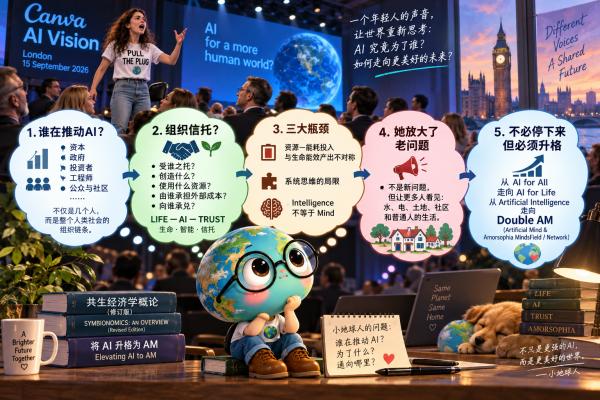
2026 年 9 月 15 日伦敦 Canva“AI Vision”会上,Pull The Plug 一位年轻女性站上座位发言,随后被安保带离。她讲的核心不是抽象的“AI 会不会灭绝人类”,而是更落地的一层:地方社区最先承受数据中心对电、水、土地和住房的挤压,却几乎没有表决权。
这段伦敦AI前景会议上的视频传开,不是因为她发明了新问题,而是她把已经存在多年的张力压进了一个具体房间:台上在谈“愿景”,台下在谈“谁先付账”。面对台上的AI产业人士,激动地谈到AI给普通人和地方社区带来的影响。
她年轻、勇敢,声音富有感染力,对普通人的生活怀有强烈关切。我很欣赏这样的年轻人。一个社会如果还有年轻人愿意站起来,对正在改变人类生活的巨大力量公开表达自己的忧虑,这本身就是一种可贵的责任心、愛心和公共精神。
视频下面的评论很快形成了截然不同的声音。
有人赞扬她是“清醒者”,有人认为她是在反对AI;有人把问题归结为资本利用AI剥削普通人;也有人反驳:AI研发的巨额投入和失败风险主要由资本承担,投资者当然应该拥有相应的经营决策权。还有人认为AI已经不可阻挡,人类真正需要做的是适应,而不是恐惧。
这些评论让我想到:我们可能首先需要改变讨论AI的方式。
AI真正的问题,并不是赞成还是反对、发展还是停止,也不是让公众通过一次民主表决来决定AI究竟应该向前还是向后。
因为AI首先是一件必须通过一定组织形式才能完成的事情。
那么,真正值得追问的就是:
做AI的组织,究竟是不是一个忠于信托的组织?
一、究竟是谁在推动AI?
表面上看,推动AI的是科技巨头、企业家、资本家和工程师。
但再往后看一步,就没有这么简单。
今天许多重要AI企业背后连接着复杂的资本市场。股东、基金、养老金、机构投资者以及无数普通投资者,通过不同渠道把自己的资源投入这些企业。
一个普通人买进一家科技公司的股票,当然不能解释成他对这家公司每一项AI决策都投了一张赞成票。但是,他愿意把自己的钱交给这个组织,本身就是一种经济意义上的选择和托付:
我把自己的资源交给你,希望你运用这些资源创造价值。
因此,所谓“资本推动AI”,并不准确,因为其背后实际上连接着千千万万普通人的储蓄、投资和未来预期。
政府也是如此。
当AI已经关系到产业竞争、生产效率、医疗、教育、国家安全以及一个国家未来的科技能力时,政府不可能简单地干预说:“因为存在风险,所以停止发展。”
政府本身也是受托组织。
它既要防范风险,也必须考虑:怎样使自己的人民不因为技术变化而失去未来的发展机会?怎样避免自己的国家在新的生产力竞争中陷入被动?
而普通公众更不是AI的局外人。
我们使用互联网,贡献数据,购买产品,投资企业,缴纳税收,同时又生活在AI正在改变的社区、就业市场、教育体系和社会环境之中。
所以,AI背后真正站着的,并不只是几个亿万富翁。
资本、技术人员、政府、投资者、消费者、社区与普通人的生活,实际上已经连接在同一条巨大的组织链条之中。
二、AI争议的深处,是组织信托
如果我们把AI问题简单变成“资本家与人民”“科技巨头与普通人”“技术进步与人类安全”的二选一,很容易再次掉进熟悉的二元对立。
资本承担投资风险,当然应该获得相应的产权和创造回报;但是,投入资本并不意味着同时取得处置全部社会外部性的无限权利。
公众受到AI影响,当然应该拥有与自己生命和生活相关的权利;但是,公众的焦虑也不能自动成为判断复杂技术未来的充分依据。
政府应该监管;但监管者本身同样需要接受信托检验。
科技企业需要创新;但创新者也必须回答:你所使用的资本、能源、水、土地、数据以及组织权力,最终创造了什么,又向谁承兑?
所以问题逐渐清楚了:
谁受托发展AI?
受谁之托?
使用什么资源?
创造什么价值?
由谁承担外部成本?
最终又向谁承兑?
这些已经不只是技术监管问题。
这是组织信托问题。
也因此,我们真正需要建立的,不是简单的“支持AI联盟”或者“反对AI联盟”,而是让生命、人工智能与组织信托——LIFE—AI—TRUST——发生交互契合。
三、AI的第一个瓶颈,不只是耗电
这位年轻女士的发言以及由此引起的讨论,还提醒了我们过去容易被低估的问题。
AI消耗的不只是电。
它需要数据中心、芯片、土地、水资源、矿产、网络,需要大量工程师和其他专业人员,需要巨额资本,也需要越来越庞大的能源和基础设施体系。
因此,我过去概括的AI第一个瓶颈——能耗与能效不对称——还可以进一步展开为:
资源—能耗投入与生命能效产出的不对称。
我们不能只问:
模型扩大了多少?
算力增加了多少?
运行速度提高了多少?
AI产业又创造了多少GDP?
我们还应该问:
它为生命降低了多少成本?
赋予普通人多少新的创造能力?
改善了多少健康?
增加了多少人与组织之间的信任?
减少了多少冲突?
这也正是为什么我一直主张,在GDP之外还需要看GDE:
C——降本,E——赋能,H——健康,T——信任,P——和平。
如果越来越多的电、水、土地、矿产、资本和人的创造力,只是为了把某一种局部能力不断推向极致,那么即使技术指标一次又一次刷新纪录,我们仍然应该问一句:
生命究竟得到了什么?
四、AI最容易被忽略的问题:片面智能的极大发展
这可能是今天AI讨论中一个更加根本、却很少被真正说清楚的问题。
我们习惯说“人工智能越来越接近人的智能”,甚至不断追问:
AI什么时候超过人类?
可是,今天所谓Artificial Intelligence,并不是把一个完整的“人”复制进机器。
它实际上是把人的某些能够数据化、形式化、计算化、模式化的智能能力抽取出来,再通过数据、算法、算力和神经网络,把这些能力放大到过去难以想象的程度。
所以,今天发生的首先不是“完整人的智能”被整体人工化。
更准确地说,是:
人的某些智能被人工化,并获得了极其强大的片面发展。
这一点,与现代社会的专业分工和现代知识体系的学科分割有一种惊人的相似。
经济学研究经济,医学研究身体,政治学研究权力,工程学研究效率,计算机科学研究计算。每一个格子都可以越来越精细,每一种专业能力都可以越来越强大。
可是,人并不生活在任何一个格子里面。
生命是整体发生的。
AI也面临同样的问题。
当某些局部智能越来越强,而生命的整体性没有同步进入时,片面发展的力量越强,它与真实生命世界之间的不匹配反而可能越明显。
于是,第一个瓶颈与更深层的问题连接起来了:
为什么AI需要越来越巨大的资源投入?我们究竟是在用越来越多的生命资源,把什么样的智能推向极致?
五、第二个瓶颈:AI面对的,本来就不是完整世界
AI的信息从哪里来?
来自人类已经生产、记录和保存的数据。
但是,这些数据在进入AI以前,就已经经过人的观察、认知、分类、选择和价值判断。
世界上无数没有被记录的经验,无法被量化的感受,没有进入数据库的生命活动,在AI开始训练之前,就已经不在它的“世界”之中了。
然后,AI再对这些已经经过选择的信息进行训练、计算、组合和生成。
因此,从信源—信道—信果来看,AI面对的从来就不是未经选择的完整世界。
这就是我所说的第二个瓶颈:
系统思维的局限。
局部的、经过筛选的信息,即使经过再强大的计算,也不会仅仅因为算力增加,就自动变成完整的生命世界。
于是,我们不能只问AI的答案聪明不聪明。
还应该继续问:
它从哪里得到这个“真”?
它怎样理解“善”?
它怎样感受“美”?
它又凭什么生成“慧”与“信”?
当我们一路从真、善、美追问到慧与信,问题已经越出了单纯的Artificial Intelligence。
它开始进入Mind。
六、第三个瓶颈:Intelligence不等于Mind
今天围绕AI最大的焦虑之一,是它会不会有一天反过来控制人类。
这样的风险当然可以研究,也应该研究。
但是,从“AI某些智能能力超过人类”,直接跳到“AI将成为一个完整的、独立于人的新统治主体”,中间其实存在一个巨大的认识鸿沟。
因为:
数据+算法+算力+神经网络,并不因此就等于Mind,更不等于Amorsophia。
Intelligence可以被工程化,可以被训练,可以被复制,可以在某些任务上不断放大,甚至远远超过任何一个人的能力。
可是Mind究竟是什么?
人的意识、生命体验、愛、价值感、意义感,以及主体与主体之间的交互与生成究竟怎样发生?
这些问题,人类自己都还远远没有完全弄清楚。
因此,我们尤其需要警惕一种认知错位:
AI真正值得警惕的,不只是人工智能越来越强,而是人类把越来越强的局部智能,误认为越来越完整的Mind。
一旦发生这种错位,就可能同时产生两种看起来完全相反的情绪:
一种是无限崇拜AI。
另一种是无限恐惧AI。
一个认为AI无所不能,一个担心AI终将成为人类无法控制的新主体。
方向完全相反,却可能来自同一个认识前提:
把局部智能能力的极大发展,等同于完整Mind的生成。
在这个意义上,对不起,我不能不说,连AI领军人物及诺奖得主辛顿先生也未能免俗。
七、她并未提出新问题,但放大了老问题
现在再回到那位年轻女士。
我仍然欣赏她。
但我们需要准确地说,她并未提出一个新的问题,这些担忧早已存在。但她以年轻人的激情、鲜明的表达和对普通人及社区生活的关切,把一个已经持续多年的老问题重新放大了。从早期关于AI失控风险的警告,到要求暂停更强大模型训练的公开呼吁,再到近年来围绕AI安全、对齐与监管不断出现的争论,这些问题早已由AI科学家、企业家和研究人员自己提了出来。今天真正值得思考的,已经不是再把“AI危险不危险”“应该发展还是停止”变成一次大众的赞成与反对,而是怎样把已经被反复提出、不断放大的问题重新定义准确,并进一步寻找可以解决它的路径。
从生成式AI迅速发展的早期开始,AI企业家、科学家和研究人员内部就不断有人公开讨论模型风险、安全、对齐、就业冲击以及监管。此后,来自AI企业内部的安全争论、公开分歧乃至研究人员辞职,又不断把这种忧虑推到社会面前。
但是,这里恰恰出现了一个更需要我们警惕的问题:
问题被放大,并不等于问题被准确地定义。
如果一个复杂问题被不断放大,最后却被压缩成:
你支持AI还是反对AI?
你站科技企业还是站普通人?
发展还是停止?
资本还是人民?
自由创新还是政府监管?
那么,一个原本需要深入认识和解决的问题,就可能变成要求所有人立即选择立场的问题。
社会情绪越强烈,问题本身反而可能越来越模糊。
这也是为什么,我认为今天真正需要做的,已经不是继续增加“AI很危险”或者“AI不可阻挡”的音量。
我们需要重新定义问题。
AI并不是一个通过一次民主表决就可以决定前进或者停止的东西,也不是一个只靠几个科学家、企业家或者政府官员就可以完成的工程。
它已经成为由资本、科研、工程、能源、水资源、土地、数据、政府、企业、投资者、消费者和社区共同参与的巨大组织活动。
因此,真正的问题不是:谁对,谁错?
甚至首先也不是:谁赞成,谁反对?
而是:怎样解决?
八、不必停下来,但必须升格
到了这里,我们才可能重新理解这些年来不断出现的AI焦虑。
真正需要解决的,是两组相互连接的问题。
第一组,是AI自身的三大瓶颈:
资源—能耗投入与生命能效产出的不对称;
系统思维的局限;
Artificial Intelligence与Mind之间尚未跨越的鸿沟。
第二组,则是发展AI的组织信托问题:
谁受托?
受谁之托?
怎样使用资源?
怎样创造价值?
怎样承担风险和外部成本?
怎样让创造出来的价值重新赋能生命?
最终向谁承兑?
这样一来,“监管还是不监管”也不再是问题的终点。
监管当然需要。
但是谁监管?监管什么?依据什么价值尺度?监管者向谁负责?如果监管本身成为新的高成本组织,谁又来检验监管者?
于是问题再次回到:组织信托。
这也就是为什么,我越来越认为,面对AI,我们既没有必要因为恐惧而停下来,也不能因为竞争而闭着眼睛向前冲。
不必停下来,但必须升格。
从 AI for All 走向 AI for Life。
从单纯追求Artificial Intelligence的能力扩张,走向尊重Mind、服务生命的AM(Artificial Mind & Amorsophia MindsField / Network)。
从“谁控制AI”的权力争夺,走向 LIFE—AI—TRUST 的交互契合共生。
从数据、算法、算力和神经网络构成的技术系统,进一步追问生命、Mind、Amorsophia以及人与人之间怎样建立可信的受托关系。
这不是要消灭Artificial Intelligence。
恰恰相反,是要让它找到自己在生命世界中更加准确的位置。
结语:把被放大的焦虑,变成可以解决的问题
所以,我感谢那个年轻人。
不是因为她告诉了我们AI究竟应该发展还是停止,也不是因为她给出了AI问题的答案。
她让我们再次看见了一个已经存在、却仍然没有得到很好解决的社会焦虑。她把问题放大了!
接下来真正重要的工作,是不要继续放大情绪,而要把被放大的问题重新放回准确的问题域。
AI当然需要发展,也当然需要面对风险。
但比“支持还是反对”更重要的是认识它;比“乐观还是悲观”更重要的是解决它;比简单地增加监管更重要的,是建立能够承担责任、接受验证并持续向生命承兑的组织信托。
因为真正的问题最终不是:
AI会不会成为人类的敌人?
而是:
我们正在用什么认识、什么价值、什么资源和什么样的组织形式,把AI带进人类生活?
如果只是把人的某些智能不断人工化、无限放大,我们得到的可能只是越来越强大的Artificial Intelligence。
如果让智能重新回到生命,让技术接受组织信托,让 LIFE—AI—TRUST 交互契合,我们才有可能从 AI for All 进一步走向 AI for Life。
AI真正需要跨越的,不只是下一代模型(https:// amorsophia.com,ai-am.org)。
人类真正需要完成的,也不是下一场关于AI的赞成与反对。
需要发生的,是从片面智能走向生命整体,从AI焦虑走向组织信托,从Artificial Intelligence走向:
Double AM ——Artificial Mind & Amorsophia MindsField / Network.
AI老问题被提出 → 女孩把它放大 → 大众情绪进一步放大 → 发现原来的问题域本身有局限 → 重新定义AI三大瓶颈 → 从监管进入组织信托 → 从AI for All进入AI for Life → 将AI升格为AM。
Elevation is not an upgrade.
这才是《将AI升格为AM》真正要解决的问题。
The Real Question of AI Is Not Whether to Develop or Stop
—From a Young Person’s Passionate Speech to Life, Intelligence, and Organizational Trust
Archer Hong QIAN
Vancouver, Morning of September 18, 2026
At Canva’s “AI Vision” event in London on September 15, 2026, a young woman from Pull The Plug stood on a chair to speak and was subsequently escorted out by security. The core of her message was not the abstract question of whether “AI will destroy humanity,” but something much closer to everyday life: local communities are often the first to bear the pressure that data centres place on electricity, water, land, and housing, yet they have little say in the decisions.
The video spread widely not because she had invented a new problem, but because she compressed years of accumulated tension into one physical room: onstage, people were talking about “vision”; offstage, someone was asking, “Who pays first?”
Facing AI industry participants onstage, she spoke passionately about the effects of AI on ordinary people and local communities.
She was young and courageous. Her voice was compelling, and she showed strong concern for ordinary people’s lives. I appreciate young people like her. A society in which young people are still willing to stand up and publicly express their concerns about forces transforming human life possesses something precious in itself: responsibility, 愛, and a public spirit.
The comments beneath the video quickly divided into sharply different camps.
Some praised her as someone who was “awake.” Some interpreted her speech as opposition to AI. Some reduced the issue to capital using AI to exploit ordinary people. Others responded that the enormous investments and risks of failure in AI development are borne largely by capital, and that investors should therefore possess corresponding decision-making rights. Still others argued that AI is already unstoppable and that humanity should adapt rather than fear it.
These reactions made me think that perhaps the first thing we need to change is the way we discuss AI.
The real question of AI is not whether we support or oppose it, whether it should develop or stop, nor whether the public should decide through a single democratic vote whether AI should move forward or backward.
AI, first of all, is something that can only be accomplished through particular forms of organization.
The question truly worth asking, therefore, is:
Are the organizations developing AI organizations that remain faithful to trust?
I. Who Is Actually Driving AI?
On the surface, AI is being driven by technology giants, entrepreneurs, capitalists, and engineers.
Look one step further, however, and the picture becomes much more complicated.
Behind many of today’s major AI companies lies a complex capital market. Shareholders, funds, pension funds, institutional investors, and countless ordinary investors channel their resources into these companies through different mechanisms.
When an ordinary person buys shares in a technology company, this certainly cannot be interpreted as casting a vote in favour of every AI decision made by that company. Yet the willingness to entrust one’s money to an organization is itself an economic choice and a form of entrustment:
I entrust my resources to you in the expectation that you will use them to create value.
It is therefore not entirely accurate to say simply that “capital is driving AI.” Behind capital are the savings, investments, and future expectations of millions of ordinary people.
The same applies to governments.
Once AI affects industrial competition, productivity, healthcare, education, national security, and a country’s future technological capabilities, a government cannot simply intervene by saying: “There are risks, therefore development must stop.”
Government itself is an entrusted organization.
It must guard against risks, but it must also ask: How can it prevent its people from losing future opportunities because of technological change? How can it keep the country from falling into a disadvantaged position in the competition surrounding new productive capabilities?
Nor is the general public standing outside AI.
We use the internet, contribute data, purchase products, invest in companies, and pay taxes. At the same time, we live within the communities, labour markets, educational systems, and social environments that AI is transforming.
So the forces behind AI are not merely a handful of billionaires.
Capital, technical professionals, governments, investors, consumers, communities, and ordinary people’s lives have already become connected through one enormous organizational chain.
II. Beneath the AI Controversy Lies Organizational Trust
If we reduce the AI question to binary oppositions—“capitalists versus the people,” “technology giants versus ordinary citizens,” or “technological progress versus human safety”—we easily fall back into familiar dualistic thinking.
Capital bears investment risk and should therefore receive corresponding property rights and returns from creation. But investing capital does not confer an unlimited right to dispose of all social externalities.
The public is affected by AI and therefore should possess rights concerning its own life and livelihood. But public anxiety cannot automatically become sufficient grounds for judging the future of complex technologies.
Government should regulate. Yet regulators themselves must also be tested against trust.
Technology companies need to innovate. But innovators must also answer: What do the capital, energy, water, land, data, and organizational power you use ultimately create—and to whom are those values fulfilled?
The questions gradually become clearer:
Who is entrusted to develop AI?
Entrusted by whom?
What resources are being used?
What value is being created?
Who bears the external costs?
And to whom is that value ultimately fulfilled?
These are no longer merely questions of technological regulation.
They are questions of organizational trust.
What we truly need, therefore, is neither a simple “pro-AI alliance” nor an “anti-AI alliance,” but an interactive congruence among Life, Artificial Intelligence, and Organizational Trust—LIFE—AI—TRUST.
III. AI’s First Bottleneck Is Not Merely Electricity Consumption
The young woman’s speech and the discussion surrounding it also remind us of something that has often been underestimated.
AI consumes far more than electricity.
It requires data centres, chips, land, water, minerals, networks, large numbers of engineers and other professionals, enormous amounts of capital, and an increasingly vast system of energy and infrastructure.
The first bottleneck of AI that I have previously identified—the asymmetry between energy consumption and energy efficiency—can therefore be further expressed as:
the asymmetry between resource-energy inputs and life-efficiency outputs.
We cannot ask only:
How much larger has the model become?
How much computing power has been added?
How much faster does it run?
How much GDP has the AI industry created?
We must also ask:
How much has it reduced the cost of life?
How much new creative capacity has it given ordinary people?
How much health has it improved?
How much trust between people and organizations has it generated?
How much conflict has it reduced?
This is precisely why I have long argued that, beyond GDP, we also need to consider GDE:
C—Cost Reduction; E—Empowerment; H—Health; T—Trust; P—Peace.
If increasing amounts of electricity, water, land, minerals, capital, and human creativity are devoted merely to pushing one localized capability toward its extreme, then even if technical benchmarks repeatedly break records, we must still ask:
What has life actually gained?
IV. AI’s Most Easily Overlooked Problem: The Extreme Development of Partial Intelligence
This may be an even more fundamental problem in today’s AI debate, yet one that is rarely articulated clearly.
We routinely say that “artificial intelligence is getting closer to human intelligence,” and repeatedly ask:
When will AI surpass humanity?
But today’s Artificial Intelligence does not place a complete human being inside a machine.
What it actually does is extract certain human capabilities that can be datafied, formalized, computed, and patterned, and then amplify them through data, algorithms, computing power, and neural networks to levels previously unimaginable.
What is happening, therefore, is not primarily the artificial reproduction of complete human intelligence.
More precisely:
Certain human intelligences have been artificialized and developed to extraordinary extremes in partial form.
There is a striking similarity here to modern specialization and the disciplinary fragmentation of knowledge.
Economics studies the economy. Medicine studies the body. Political science studies power. Engineering studies efficiency. Computer science studies computation. Every box can become increasingly refined, and every specialized capability increasingly powerful.
But human beings do not live inside any one of those boxes.
Life happens as a whole.
AI faces the same problem.
When particular forms of intelligence grow ever more powerful while the wholeness of life does not enter the process correspondingly, the stronger these partial capabilities become, the more visible their mismatch with the real world of life may become.
The first bottleneck therefore connects with a deeper question:
Why does AI require ever greater resource inputs? What kind of intelligence are we using ever more life resources to push toward its extreme?
V. The Second Bottleneck: AI Never Faces the Complete World
Where does AI obtain its information?
From data already produced, recorded, and preserved by human beings.
But before these data ever reach AI, they have already passed through human observation, cognition, classification, selection, and value judgment.
Countless experiences that were never recorded, feelings that cannot be quantified, and life activities that never entered databases have already disappeared from AI’s “world” before training even begins.
AI then trains, calculates, combines, and generates from information that has already undergone selection.
Therefore, viewed through the relationship among information source—information channel—information outcome, AI never confronts an unselected and complete world.
This is what I call the second bottleneck:
the limitations of systemic thinking.
Partial and filtered information does not automatically become the complete world of life simply because more computing power is applied to it.
So we cannot ask only whether AI’s answers are intelligent.
We must continue asking:
Where does its “truth” come from?
How does it understand “goodness”?
How does it experience “beauty”?
And on what basis could it generate “wisdom” and “trust”?
Once we move from truth, goodness, and beauty toward wisdom and trust, we have already moved beyond Artificial Intelligence alone.
We have entered the domain of Mind.
VI. The Third Bottleneck: Intelligence Is Not Mind
One of the greatest anxieties surrounding AI today is whether it might eventually turn around and control humanity.
Such risks can and should be studied.
But there is an enormous conceptual gap between saying that “some AI capabilities exceed those of human beings” and saying that “AI will become a complete new ruling subject independent of humanity.”
Because:
Data + Algorithms + Computing Power + Neural Networks ≠ Mind, much less Amorsophia.
Intelligence can be engineered. It can be trained and copied. It can be amplified continuously in particular tasks and can far exceed the capability of any single human being.
But what exactly is Mind?
How do human consciousness, lived experience, 愛, values, meaning, and the interaction and generation between subjects actually occur?
Human beings themselves are still far from fully understanding these questions.
We therefore need to be particularly alert to a cognitive misalignment:
What deserves vigilance is not merely that Artificial Intelligence is becoming stronger, but that human beings may mistake increasingly powerful partial intelligence for an increasingly complete Mind.
Once this misalignment occurs, it can simultaneously produce two apparently opposite emotions:
One is unlimited worship of AI.
The other is unlimited fear of AI.
One assumes that AI can do everything; the other fears that AI will inevitably become a new subject beyond human control.
The directions are completely opposite, yet both may arise from the same cognitive premise:
equating the extreme development of partial intelligent capability with the generation of a complete Mind.
In this sense, I am sorry to say that even AI pioneer and Nobel laureate Geoffrey Hinton has not entirely escaped this assumption.
VII. She Raised No New Problem, but She Amplified an Old One
Now let us return to the young woman.
I still appreciate her.
But we should describe what happened accurately. She did not raise a new problem. These concerns had existed for years. What she did—with youthful passion, vivid expression, and concern for ordinary people and community life—was to amplify an old problem that had already persisted for a long time.
From early warnings about the risk of AI losing control, to public calls for pauses in the training of more powerful models, and then to continuing debates over AI safety, alignment, and regulation, these questions had already been raised by AI scientists, entrepreneurs, and researchers themselves.
What deserves serious thought today is no longer how to turn “Is AI dangerous?” or “Should AI develop or stop?” into a mass vote of approval or opposition. It is how to redefine repeatedly raised and amplified problems accurately, and then find pathways capable of addressing them.
Since the rapid rise of generative AI, entrepreneurs, scientists, and researchers within the AI industry have repeatedly discussed model risk, safety, alignment, employment disruption, and regulation. Internal safety disputes, public disagreements, and even resignations by researchers have subsequently pushed these anxieties further into public view.
But here lies something that requires even greater vigilance:
Amplifying a problem does not mean defining it accurately.
If a complex problem is amplified again and again, only to be compressed into:
Do you support AI or oppose it?
Do you stand with technology companies or ordinary people?
Development or cessation?
Capital or the people?
Free innovation or government regulation?
then a problem that originally required deeper understanding and resolution may become a demand that everyone immediately choose a side.
The stronger the social emotion becomes, the less clear the problem itself may become.
This is why I believe what we need today is no longer simply to increase the volume of either “AI is dangerous” or “AI is unstoppable.”
We need to redefine the problem.
AI is not something whose advance or cessation can be decided by a single democratic vote. Nor is it an undertaking that can be accomplished solely by a few scientists, entrepreneurs, or government officials.
It has become an enormous organizational activity involving capital, research, engineering, energy, water, land, data, governments, businesses, investors, consumers, and communities.
The real question, therefore, is not:
Who is right and who is wrong?
Nor, first of all:
Who supports it and who opposes it?
It is:
How do we solve the problem?
VIII. No Need to Stop—but We Must Elevate
Only now can we begin to understand the AI anxieties that have repeatedly surfaced over recent years.
What truly needs to be addressed consists of two interconnected sets of problems.
The first is AI’s three intrinsic bottlenecks:
the asymmetry between resource-energy inputs and life-efficiency outputs;
the limitations of systemic thinking;
the still-unbridged gap between Artificial Intelligence and Mind.
The second is the question of organizational trust in developing AI:
Who is entrusted?
Entrusted by whom?
How are resources used?
How is value created?
How are risks and external costs borne?
How can created value empower life again?
And to whom is it ultimately fulfilled?
Seen this way, “regulation or no regulation” is no longer the endpoint of the question.
Regulation is of course necessary.
But who regulates? What is regulated? According to what scale of value? To whom are regulators accountable? And if regulation itself becomes another high-cost organization, who examines the regulators?
Once again, the question returns to:
organizational trust.
This is why I increasingly believe that, in confronting AI, we neither need to stop because of fear nor should we rush blindly forward because of competition.
No need to stop—but we must elevate.
From AI for All toward AI for Life.
From the mere expansion of Artificial Intelligence capabilities toward AM—respecting Mind and serving life:
Double AM—Artificial Mind & Amorsophia MindsField / Network.
From struggles over “who controls AI” toward the interactive congruence and symbiosis of:
LIFE—AI—TRUST.
From technical systems composed of data, algorithms, computing power, and neural networks toward deeper questions of life, Mind, Amorsophia, and how trustworthy entrusted relationships can be established among human beings.
This does not mean eliminating Artificial Intelligence.
Quite the contrary.
It means helping AI find its more accurate place within the world of life.
Conclusion: Turn Amplified Anxiety into a Solvable Problem
So I thank that young person.
Not because she told us whether AI should develop or stop, and not because she gave us the answer to the AI problem.
She enabled us to see once again a social anxiety that has existed for years but has still not been adequately resolved.
She amplified the problem.
What matters next is not to amplify the emotion further, but to return the amplified problem to its proper problem domain.
AI certainly needs to develop, and it certainly needs to confront risk.
But understanding it matters more than “supporting or opposing” it. Solving it matters more than being “optimistic or pessimistic.” And more important than simply adding regulation is building organizational trust capable of bearing responsibility, accepting verification, and continuously fulfilling its trust toward life.
Because ultimately the real question is not:
Will AI become humanity’s enemy?
It is:
With what understanding, what values, what resources, and what forms of organization are we bringing AI into human life?
If all we do is continuously artificialize and infinitely amplify certain human intelligences, what we may obtain is simply ever more powerful Artificial Intelligence.
If we bring intelligence back to life, place technology within organizational trust, and enable LIFE—AI—TRUST to interact and achieve congruence, then we may be able to move from AI for All toward AI for Life.
What AI truly needs to cross is not merely the threshold to the next generation of models.
What humanity needs to accomplish is not another contest between approval and opposition to AI.
What needs to happen is a movement:
from partial intelligence toward the wholeness of life;
from AI anxiety toward organizational trust;
from Artificial Intelligence toward:
Double AM—Artificial Mind & Amorsophia MindsField / Network.
The old AI problem is raised → the young woman amplifies it → public emotion amplifies it further → we discover the limitations of the original problem domain → redefine AI’s three bottlenecks → move from regulation toward organizational trust → move from AI for All toward AI for Life → elevate AI to AM.
Elevation is not an upgrade.
This is precisely the problem that Elevating AI to AM seeks to address.