民族主义置幻记
民族主义置幻记
Nationalism and the Making of Illusions
——重建组织孞托,比什么都重要
—Nothing Matters More Than Rebuilding Organizational Trust
钱 宏(Archer Hong Qian)
2026年9月1日晨于Vancouver
民族主义是一种很奇妙的东西。
一个人愛自己的故土,珍惜自己的语言、文化、历史,希望自己的国家安全、繁荣而有尊严,本是人之常情。民族感情因此可以成为人与人之间真实而深厚的生命连接。
问题发生在另一处:
当这种真实的生命感情,被组织操纵者拿去加工,尤其是选举制度条件下的组织操纵者,会发生什么?
它可能变成一种“置幻剂”。
之所以叫置幻剂,是因为它不只是让人产生某种激情或者幻觉,更厉害的是,它能够在不知不觉中置换问题:
把政策问题置换成国家问题;
把组织利益置换成民族利益;
把政治人物的得失置换成国家的荣辱;
把对政府的质疑置换成对国家的不忠;
把现实生活的成本置换成必须承担的“历史代价”;
最后,把本来应该由组织操纵者承兑的责任,置换成普通生命必须作出的牺牲。
于是,一剂下去,问题还是那个问题,人看到的问题却已经不是原来的问题了。
这就是民族主义置幻剂。
一、民族主义最危险的时候,是它开始替别人回答问题
资本主义、社会主义、民族主义,当然不是一回事。
它们产生于不同的历史环境,有不同的思想来源,也回应不同的社会问题。
市场交换、产权与企业创造,可以借资本主义获得理论说明;公平、保障和社会互助,可以从社会主义获得思想资源;故土、文化、历史与国家认同,也可以通过民族情感形成真实连接。
问题在于,组织操纵者并不一定忠实于任何“主义”。
什么好用,就拿什么来用。
需要激励生产,可以讲市场;
需要集中资源,可以讲国家;
需要扩大权力,可以讲危机;
需要重新分配,可以讲公平;
需要人民承担损失,可以讲民族;
需要人民继续承担损失,还可以讲历史与未来。
于是,原本彼此冲突的“主义”,到了组织操纵者那里,反而可以相互配合。
因为真正不变的,未必是什么主义。
可能只是组织自身的利益函数。
这正是共生经济学现代经济病理学需要辨认的一种病症:
别急着听它说什么,先看它拿这些好听的话做了什么。
二、民族主义为什么特别适合成为“置幻剂”?
因为民族不是冷冰冰的概念。
民族背后有家乡,有语言,有童年,有祖先,有记忆,有战争留下的创伤,也有一个人在世界上确认“我从哪里来”的情感依托。
所以民族情感天然具有动员力。
一个经济政策失败了,人民可以要求解释。
一个政府失职了,公民可以要求问责。
一个组织扩张过度了,社会可以要求它收缩。
可是,一旦把问题转换成“民族存亡”“国家尊严”“历史使命”,讨论便进入了完全不同的心理场。
这时候再问:
这项政策究竟值不值?
很容易被转换成:
“难道你不爱国吗?”
于是,一个本来需要用事实回答的问题,被一个道德问题替换掉了。
这就是置幻。
它不需要证明原来的政策正确。
只需要让你忘记原来在问什么。
三、最深的一幻:组织反过来要求生命为自己存在
国家为什么发生?
先有生命。
然后有人与人的连接,有家庭,有社会,有交换,有冲突,也有需要共同解决的问题,于是才逐渐生成国家以及政府、司法、议会等公共组织。
所以从发生学上说:
生命先于国家。
国家的意义来自生命。
组织的正当性来自生命的托付。
可是民族主义置幻剂最危险的一次置换,恰恰是把这个关系倒过来:
生命本来是目的,变成手段; 组织本来是手段,变成目的。
于是,“为了国家”可以要求一代人牺牲。
“为了民族”可以要求普通人承受贫困。
“为了历史”可以把今天的损失合理化。
“为了未来”可以让今天的人无限忍耐。
再往前一步,甚至出现“留岛不留人”之类的战争叫嚣。
到了这里,人们其实不需要多少宏大的理论。
只问一句:
人都没有了,要岛干什么?
如果战争进一步被说成是为了产业、科技乃至芯片,那么再问一句:
生命都消失了,芯片给谁用?
土地不会自己生活。
芯片不会自己幸福。
GDP也不会自己幸福。
只有生命会。
四、谁付代价?谁的未来?
“为历史付代价,为未来开太平”这类话,最容易令人激动。
也最值得警惕。
因为“历史”“未来”“民族”“国家”都是巨大的集合概念,而“代价”最终却一定落到一个个具体的人身上。
所以共生经济学必须把“代价”两个字重新放回生活账本:
谁付?
谁失去工作?
谁承担物价上涨?
谁的企业倒闭?
谁家的孩子上战场?
谁失去父亲?
谁失去儿子?
谁残疾?
谁死亡?
更重要的是:
作出决定的人,与承担后果的人,是同一批人吗?
如果一个人在讲台上慷慨激昂地要求“我们必须作出牺牲”,自己却不需要承担那个牺牲,那么“我们”这个词就值得高度警惕。
因为他说的是“我们”。
真正牺牲的,却可能永远是他们。
这就是一种极深的组织孞托倒置:
组织操纵者负责定义历史,普通生命负责支付代价;政治人物开出未来的支票,别人的孩子负责承兑。
然而,责任主体还不能只看到政治人物和组织操纵者。
在今天的数位传播环境中,政治人物的一句话,从说出口到成为社会情绪,中间还有一个越来越重要的放大器:
媒体,尤其是以流量、点击率和情绪传播为生的某些自媒体。
政治人物可能说了一句刺激性的话,谈判者可能放出一句试探性的语言,本来还有解释、回旋、讨价还价的余地。经过媒体和自媒体的剪辑、标题化、人格化和敌我化之后,却可能迅速变成:“他在羞辱我们”“他们要吞并我们”“国家已经到了最危险的时候”。
于是,原本需要坐下来解决的具体问题,被加工成必须立即表态的民族立场。
这时候,媒体就不再只是记录发生了什么,也可能参与了“置幻”的发生。
尤其值得警惕的是某些自媒体的生存机制:事情越大,流量越大;语言越狠,传播越快;敌我越清楚,情绪越容易聚集。“息事宁人”“实事求是”往往没有点击率,“煽风点火”反而可能成为一门生意。
这便产生了一种新的责任错位:
政治人物获得政治得分,媒体获得流量收益;真正承担关系恶化成本的,却必定是普通民众和中小企业,是加拿大整个国家利益。
更麻烦的是,舆论并不会停留在民间。
当一种经过反复放大的民族情绪形成“主流民意”的印象,它又会反过来影响政治人物,影响谈判代表,影响各省省长以及其他公共决策者的行动空间。原来可以在谈判桌上讨价还价的问题,可能因为任何退让都会被解释成“软弱”“投降”“下跪”,而变得越来越难谈。
于是形成一个值得警惕的循环:
政治语言刺激舆论 → 媒体与自媒体放大情绪 → 民众形成压力 → 政治人物感受到压力 → 谈判空间收窄 → 更强硬的政治语言再次出现。
这时候,甚至很难再说究竟是谁操纵了谁。
政治人物利用舆论,媒体利用政治人物,流量推动情绪,情绪反过来绑架决策——最后形成一种自我强化的民族主义置幻场。
所以,“识破置幻”必须把责任主体看完整。
政治人物当然要为自己的言论和政策负责;政府与政党要为自己的组织行为负责;媒体也要为自己选择传播什么、怎样传播、究竟是在帮助社会看见真实问题,还是在靠放大敌意获取注意力负责。
言论自由非常重要。媒体监督权力同样重要。恰恰因为重要,才更需要珍惜这种自由所包含的责任。
一个值得孞托的媒体,不应该替政府粉饰问题,也不必替任何政治人物“息事宁人”;但它至少应该帮助公众看清问题,而不是把一个本来可以解决的问题,煽成一个越来越难以解决的问题。
这才是媒体在组织孞托中的位置。
五、民族主义、战争与“牺牲免责”
战争尤其容易把置幻剂的剂量推到最大。
死亡可以被重新命名为牺牲。
贫困可以被重新命名为奉献。
短缺可以被重新命名为忍耐。
质疑可以被重新命名为软弱。
反对可以被重新命名为背叛。
最后甚至连政策失败,都可以解释成“人民还不够团结”。
于是,本来应该承担责任的组织获得了某种免责权。
这也是为什么那些鼓吹战争的人尤其值得追问:
你准备让谁上战场?
鼓吹战争者出售的,往往是世界上成本最低的一种勇敢:
别人的勇敢。
自己的声音很壮烈。
别人家的孩子流血。
从共生经济学看,任何战争动员都不能逃脱生命检验:
有没有更低生命成本的解决办法?
有没有继续谈判的可能?
有没有减少冲突的机制?
有没有把政治人物自己的失败转嫁成民族必须承担的战争?
和平从来不只是一个美好的愿望。
在GDE中,P——Peace,本来就是生命效能的基本参量。
六、美国不是川普和共和党的美国,加拿大也不是卡尼和自由党的加拿大
这句话非常重要。
因为民族主义置幻剂还有一种极其常见的操作:
把政治人物置换成国家。
川普是美国总统。
卡尼是加拿大总理。
共和党和自由党,是特定时期执政的政治组织。
他们可以在宪法和法律授权范围内代表国家处理公共事务,却不能因此把自己等同于国家。
所以:
美国不是川普和共和党的美国。 加拿大也不是卡尼和自由党的加拿大。
Administration会换。
执政党会换。
政治人物更会换。
可是人民、公民、国民仍然在那里,企业在那里,家庭在那里,社区在那里,美加之间经过几代人生成的经济、社会与生活连接也在那里。
这正是现代正常国家与传统家国、党国以及各种非正常准国家之间一个根本性的区别:
国家不是执政者的私产,也不是执政党的组织延伸。
所以今天讨论美加关系,至少要把三个层次分开:
政治人物是政治人物; 政党是政党; 国家是国家。
更不能忘记第四层:
生活其中的人民、公民、国民,才是国家发生的生命原点。
七、川普是“坏人”,所以反川普就是“好人”吗?
这恰恰是今天美加贸易争议中最容易出现的另一次置换。
川普当然可以批评。
他说加拿大应该成为美国“第51州”,加拿大人完全有理由反感。
但是,一个政治人物说了一句令人讨厌的话,与另一件事——
USMCA/CUSMA究竟应该怎样续签?
不是同一个问题。
如果川普作为美国总统认为原来的北美贸易规则需要调整,那么加拿大可以不同意他的具体要求,可以认为美国开价过高,可以据理力争,也可以提出自己的条件。
这叫谈判。
真正需要讨论的是:
原来的协议哪里需要修改?
新的规则是否公平?
三方承担的义务是否对等?
原产地规则怎样执行?
怎样让美国、加拿大、墨西哥都愿意继续留在这个协议里?
可是,一旦民族主义置幻剂起作用,问题就可能被悄悄换成:
川普是坏人。
然后再换一次:
我敢于对抗这个坏人,所以我是好人。
再换一次:
我越强硬,就越代表加拿大。
到这里,贸易谈判已经被人格化且面目全非了。
而经济问题并没有得到回答。
一个政治人物令人讨厌,不等于他的每一项谈判要求都错误;一个政治人物受到欢迎,也不等于他的每一项贸易政策都正确。
评价人,和评价政策,是两回事。
八、“第51州”:最适合民族主义置幻的一句话
川普关于加拿大成为美国“第51州”的说法,恰恰是一个非常有意思的案例。
从美国制度本身看,一个总统根本没有一句话把另一个主权国家变成美国一个州的权力。
新州进入美国需要美国自身复杂的宪政程序。
加拿大更不是一块等待别人处置的无主土地。
所以,把这句话理解成川普明天就能够吞并加拿大,显然离现实很远。
它更像政治挑衅、谈判语言、调侃,甚至故意气你。
问题恰恰在这里:
越不可能实现的话,有时候越适合被政治利用。
川普可以用它刺激加拿大。
加拿大政治人物也可以用它刺激加拿大人的民族感情。
于是,一句话竟然可能让双方政治人物同时得到政治收益。
尤其在选举期间,一旦“第51州”从一句挑衅话,变成“加拿大国家生存受到威胁”的政治符号,贸易政策就很容易被民族主义重新编码。
政治人物因此获得支持,并不奇怪。
但是获得政治收益以后,真正成熟的政治家应该知道:
该收了。
竞选需要赢票。
治理必须解决问题。
一件工具帮助你赢得选举,并不意味着你应该永远使用它。
否则就像那只熟悉一种办法的猴妈妈:
平时拿篮子做什么都挺顺手。
房子着火以后,还拿篮子去打水——
结果只能是“竹篮打水一场空”。
工具还是那个工具。
问题已经不是那个问题了。
九、赢了选举以后,民族主义可能从资产变成负债
民族主义在受到外部压力时,可以迅速形成政治凝聚力。
这种凝聚力本身甚至可能具有正面意义。
可是政治领导人的责任,不能停在凝聚。
最后还是要解决问题。
所以,对加拿大政府真正的检验,不应该是:
有没有在川普面前显得强硬?
而应该是:
有没有为加拿大人民谈成一份可以接受、能够长期运行、继续降低北美连接成本的协议?
同样,对川普政府的检验也不能是:
有没有压服加拿大和墨西哥?
而应该是:
重新谈判以后,美国、加拿大、墨西哥的人民和企业,是不是获得了一个更加公平、更能长期承兑的北美贸易秩序?
这才是国家行为。
否则,政治人物赢了。
政党赢了。
选举赢了。
掌声也赢了。
最后协议没了,企业吃亏了,人民生活成本增加了——
国家究竟赢了什么?
十、别忘了North American这个边界
USMCA/CUSMA常被称为自由贸易协议。
可是别忘了:
Free Trade前面还有North American。
加拿大当然有权与欧洲、中国、印度、日本以及世界任何愿意与加拿大做生意的国家发展贸易。
美国无权决定加拿大跟谁贸易。
墨西哥也一样。
所谓“贸易多元化”本身完全合理。
但是另一件事情同样必须说清楚:
加拿大有权同第三国自由贸易,不等于任何第三国商品都天然有权借加拿大进入北美自由贸易区并享受北美优惠待遇。
这就是为什么协议需要原产地规则。
三国共同签了契约,就共同遵守。
美国遵守。
加拿大遵守。
墨西哥也遵守。
规则不合理,可以重新谈。
条件不公平,可以重新谈。
世界发生变化,更应该重新谈。
但是不能一方面要求继续享受北美区域贸易协议的好处,另一方面把执行和重谈区域规则解释成:
“你干涉我跟谁做生意的国家主权。”
这又是一次置幻。
契约问题,被置换成了主权问题。
十一、顾客是上帝,不等于顾客可以欺负你
做生意的人都知道一句很朴素的话:
顾客是上帝。
它当然不是说大客户可以欺负小客户。
更不是说加拿大必须接受美国的一切要求。
它只是提醒一个最简单的生活常识:
没有必要为了证明自己不怕最大的客户,而主动毁掉同最大客户已经形成的价值连接。
美国长期是加拿大最大的出口市场。
这不是意识形态。
这是加拿大千千万万企业、工人、农场、能源生产者、运输企业和消费者日复一日交易形成的生活事实。
大客户提出不合理要求怎么办?
谈。
合同不公平怎么办?
改。
规则有漏洞怎么办?
补。
对方违约怎么办?
依法追究。
可是,如果最后演变成:
“我宁可不要这个客户,也要证明我有民族尊严。”(京剧《杜鹃山》里山大王要鞭打为地主打工的田大江的理由是:“宁可饿死,不当奴才!”)
那么必须再问:
这个尊严,由谁买单?
政治人物可以获得强硬的声誉收益。
中小企业却要支付现金成本。
工人还要养家。
普通家庭还要生活。
所以,民族主义永远不能代替经济学。
十二、贸易多元化不是一句口号,也必须算账
加拿大当然应该降低单一市场风险。
贸易多元化完全可以做。
问题是:
做出来了吗?
新市场增加了多少真实出口?
增加了多少收入?
创造了多少就业?
降低了多少风险?
为了重新配置供应链又增加了多少成本?
失去的北美订单,有没有被新的订单真正替代?
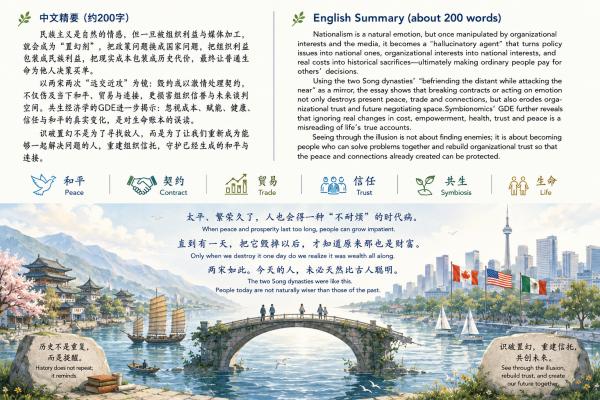
历史有时候也会提醒我们,不要轻易把“远方”想象成摆脱“近邻”的答案。北宋与辽签订澶渊之盟以后,双方守约百余年,边境大体和平,贸易往来不断生长。一百多年以后的人当然可以认为前人签下的某些条款已经不合时宜,甚至认为岁币有失尊严——那就重新谈。契约本来就可以随着环境变化而修改,问题在于你是重新谈判,还是干脆绕过契约,联合更远方的力量去消灭自己的缔约方。北宋后来选择了联金灭辽。这里损伤的便不只是一段宋辽关系,还有自己的组织信誉:今天你可以与我结盟去毁掉你与辽维持百年的约,明天别人自然会问,你会不会再联合另一个人毁掉与我签下的约?契约一旦可以随着政治情绪和一时利益随意抛弃,失去的就不只是一纸协议,而是别人对你下一份协议还能不能承兑的孞心。南宋后来联蒙灭金,又一次留下了相似的历史教训。
今天当然不是宋辽金蒙的时代,贸易多元化也不是战争结盟;但契约精神没有过时:
远方可以开拓,近邻可以争执,旧约可以重谈;已经生成的组织孞托,却不能因为一时“不爽”便轻易毁掉。多元化真正应该增加连接,而不是以损伤既有连接来证明自己的独立。
这些问题都可以算。
如果没有算,只说:
“为了加拿大长远的民族利益,我们必须付出今天的代价。”
那么“贸易多元化”本身也可能被加工成新的置幻剂。
因为未来永远很好听。
今天的账,却必须有人付。
十三、真正不能丢掉的,是美加之间已经生成的民间连接
好在国家关系并不完全等于政府关系。
政治人物可以争吵。
政府可以加关税。
谈判甚至可以一度破裂。
但是美国人与加拿大人仍然往来。
企业仍然交易。
亲属仍然跨境。
货车仍然过境。
供应链仍然连接。
资本、知识、技术、旅游、教育和日常生活形成的关系,不会因为两个政治人物一句话立即消失。
这正是生命自组织连接的力量。
也是现代正常国家最值得珍惜的基础。
国家组织真正应该做的,是降低这些连接的成本,保护这些连接的安全,为这些连接提供可以长期承兑的规则。
而不是反过来要求生命连接为政治组织之间的冲突服务。
十四、真正危险的,是贸易边界最后变成军事边界
美加之间还有一种巨大财富,很少进入GDP。
那就是:
一条长期不需要重兵设防的漫长边界。
这是和平资产。
它意味着两国人民不需要维持庞大的边境军事机器,不需要修建层层军事设施,不需要把大量青年、税收和社会资源投入彼此防范。
如果民族主义不断升级,把贸易摩擦升级为政治敌意,再把政治敌意升级为国家安全焦虑,那么事情就完全不同了。
加拿大可以扩军。
可以买武器。
可以建军事设施。
可以增加边境安全投入。
有意思的是——
这些都会增加GDP。
军营是GDP。
雷达是GDP。
军舰是GDP。
军火是GDP。
重复建设的安全基础设施也是GDP。
于是,完全可能出现一种荒诞景象:
和平减少了,GDP增加了。
过去几乎不需要付钱的和平边境,因为相互猜疑开始变得越来越昂贵。
然后经济学告诉你:
增长了。
这正是为什么共生经济学要把GDP升格为GDE。
GDP记录花了多少钱。
GDE还要问:
C——成本究竟升了还是降了? E——生命究竟得到赋能还是受到束缚? H——社会更加健康还是更加焦虑? T——组织孞托增加还是流失? P——和平增加还是战争与安全成本增加?
一条不需要驻军的边境,GDP可能几乎看不见。
一条布满军队、基地、雷达和武器的边境,却能够制造大量GDP。
究竟哪一个国家更加富有?
十五、不要把政治人物变成国家:把国家重新还给生命
所以,我们最后还是回到那个最简单的区分。
川普不是美国。
共和党不是美国。
卡尼不是加拿大。
自由党也不是加拿大。
他们都是现代国家中阶段性的政治人物和政治组织。
国家大于一届政府。 人民大于一个政党。 生命大于一个政治人物。
喜欢一个领导人,不必把他变成国家。
讨厌一个领导人,也不要把与那个国家人民之间的连接一起毁掉。
Administration之间可以争。
国家之间仍然要谈。
政党可以轮替。
人民还要继续生活。
协议可以修改。
组织孞托不能轻易毁掉。
所以,当有人再次告诉我们:
为了民族,要忍受生活损失;
为了国家,要接受政策失败;
为了历史,要牺牲今天;
为了未来,要暂时不要问谁负责;
为了尊严,即使失去原本能够创造价值的连接也值得——
共生经济学只需要把那些被置换掉的问题,一个个重新放回来:
谁决定?
谁受益?
谁付费?
谁牺牲?
谁承兑?
民族可以愛。
国家当然可以愛。
但如果有人要求我们把一个政治人物当成国家,把一个政党当成民族,把一种政策当成爱国,把质疑政策当成背叛,再要求一个个普通生命为这一连串置换支付成本——
这时候,或许应该想起Samuel Johnson留下的那句话:
“Patriotism is the last refuge of a scoundrel.”
— Samuel Johnson
十六、识破置幻之后:重建组织孞托
Samuel Johnson的警告值得记住,但识破“置幻”并不是为了再寻找一个敌人,更不是为了把民族主义本身变成新的批判对象。民族感情可以是真实的生命连接,国家利益也当然需要维护。真正需要警惕和修复的,是组织操纵者借民族之名完成的关系倒置、责任置换与组织免责。
批评如果只停在揭露,仍然没有解决问题。共生经济学关心的下一步,是怎样把被置换掉的关系重新放回原位:让人民、公民、国民重新成为国家的生命主体,让政府重新成为公共事务的受托者,让政党回到可以选择、可以轮替、必须接受检验的政治组织位置,让政策重新接受事实、成本与责任承兑的检验。
这就是重建组织孞托。
组织孞托并不要求人民无条件相信政府,也不要求不同政治立场的人彼此认同。恰恰相反,真正的孞托必须容得下质疑、纠错、谈判和改变。受托者可以犯错,但必须能够说明;政策可以失败,但必须能够调整;协议可以过时, 但必须能够重谈;政党可以竞争,但不能把竞争变成国家与人民之间的撕裂。孞托不是一句“相信我”,而是在一次次真实的责任承兑中生成。
因此,美国与加拿大今天真正需要重建的,也不是谁向谁低头,而是怎样把政治人物之间的冲突重新放回制度,把贸易争议重新放回谈判,把North American的区域契约重新放回三方可以共同接受和共同遵守的规则,把已经生成的民间连接从民族主义情绪中保护下来。美国人的利益、加拿大人的利益、墨西哥人的利益,并不天然互相排斥;一个能够降低连接成本、鼓励公平交换并持续承兑责任的北美秩序,本来就可能让三国同时获益。
从这个意义上说,真正的国家利益从来不需要靠制造敌人来证明。一个有生命力的现代正常国家,应当保有自己的纠偏、修复与自愈能力:人民可以表达,社会可以自组织,企业可以选择,媒体可以追问,议会可以监督,司法可以守界,政府可以改错,选民可以更换受托者。正常,不是永远不犯错;正常,是犯错以后仍然能够发现问题、纠正偏差、修复损伤、恢复连接。
这也是为什么共生经济学把T——Trust放进GDE。孞托不是经济运行之外的一种道德装饰,而是实实在在的组织效能。彼此孞托的边境,可以几十年少建多少军事设施、少养多少彼此防范的军队;彼此孞托的贸易关系,可以减少多少审查、绕道、重复投资和交易成本;值得孞托的政府,又可以让多少家庭和企业不必把时间与精力耗费在猜疑、防范和关系寻租之中。孞托本身就在降本、赋能,也在创造和平。
所以,重建组织孞托不是要求谁放弃原则。恰恰是把原则从情绪中救出来:该争的利益认真争,该守的边界认真守,该改的规则认真改,该承担的责任认真承担;同时承认对方也是有生命、有利益、有尊严、需要生活的交互主体。谈判的目的,不是证明谁更强硬,而是找到能够继续生活、继续交换、继续合作的承兑点。
只要还愿意看见真实的问题,还愿意真诚解决问题,就还来得及。
美国和加拿大还可以谈。政党还可以轮替。协议还可以修改。政策还可以纠偏。人与人之间已经生成的连接,也仍然可以继续生长。民族主义一时造成的迷幻,并不必然成为永久的命运。
识破置幻,不是为了寻找新的敌人;重建组织孞托,才是为了让我们重新成为能够一起解决问题的人。
Nationalism and the Making of Illusions
—Nothing Matters More Than Rebuilding Organizational Trust
Archer Hong Qian
Vancouver, September 1, 2026
Nationalism is a curious thing.
To love one’s homeland, cherish one’s language, culture, and history, and hope that one’s country remains secure, prosperous, and dignified is entirely natural. National sentiment can therefore become a genuine and profound connection among human lives.
The problem arises elsewhere:
What happens when this genuine attachment is taken up and processed by organizational manipulators—especially those operating under electoral politics?
It can become a kind of “hallucinatory agent.”
I call it this because it does more than arouse passion or produce an illusion. More powerfully, it can quietly substitute one question for another:
A policy question becomes a national question.
An organizational interest becomes a national interest.
The fortunes of a political figure become the honor or humiliation of the country.
Questioning a government becomes disloyalty to the nation.
The costs borne in everyday life become a “historical price” that must be paid.
And finally, responsibilities that should have been redeemed by those who wield organizational power are transferred into sacrifices demanded of ordinary lives.
One dose, and the problem itself has not changed—yet what people think the problem is has changed completely.
That is nationalism as a hallucinatory agent.
I. Nationalism Becomes Most Dangerous When It Starts Answering Questions for Us
Capitalism, socialism, and nationalism are obviously not the same thing.
They emerged from different historical circumstances, have different intellectual origins, and respond to different social problems.
Market exchange, property rights, and entrepreneurial creation can find theoretical expression in capitalism. Fairness, security, and social mutual assistance can draw intellectual resources from socialism. Attachment to homeland, culture, history, and national identity can likewise generate genuine connections through national sentiment.
The problem is that organizational manipulators are not necessarily loyal to any particular “ism.”
They use whatever works.
When production needs stimulating, they talk about markets.
When resources need concentrating, they talk about the state.
When power needs expanding, they talk about crisis.
When redistribution is needed, they talk about fairness.
When people must bear losses, they talk about the nation.
And when people must continue bearing those losses, they can talk about history and the future.
Thus, ideologies that may conflict in theory can work together perfectly well in the hands of organizational manipulators.
Because what remains constant may not be any particular ideology.
It may simply be the organization’s own interest function.
This is precisely one of the pathologies that the modern economic pathology of Symbionomics must learn to recognize:
Do not rush to listen to what an organization says. First look at what it does with those beautiful words.
II. Why Is Nationalism So Well Suited to Becoming a “Hallucinatory Agent”?
Because a nation is not a cold abstraction.
Behind it lie homeland, language, childhood, ancestors, memories, wounds left by war, and the emotional grounding through which a person knows: this is where I come from.
National sentiment therefore possesses a natural power of mobilization.
If an economic policy fails, people can demand an explanation.
If a government fails in its duty, citizens can demand accountability.
If an organization expands excessively, society can demand that it contract.
But once the question is transformed into one of “national survival,” “national dignity,” or “historical mission,” the discussion enters an entirely different psychological field.
Ask:
Is this policy actually worthwhile?
And the question can easily become:
“Don’t you love your country?”
A question that should have been answered with facts has now been replaced by a moral test.
That is substitution.
That is illusion.
It does not have to prove that the original policy was correct.
It only has to make you forget what you were originally asking.
III. The Deepest Illusion: When Organization Demands That Life Exist for It
Why does a state come into being?
First, there is life.
Then come connections among people: families, societies, exchange, conflicts, and problems that must be solved together. From these gradually arise the state and public organizations such as governments, courts, and legislatures.
In terms of genesis, therefore:
Life precedes the state.
The meaning of the state comes from life.
The legitimacy of organization comes from the entrustment of life.
Yet the most dangerous substitution performed by nationalist illusion is precisely to reverse this relationship:
Life, originally the end, becomes the means;
organization, originally the means, becomes the end.
Then “for the country” can justify sacrificing a generation.
“For the nation” can justify making ordinary people endure poverty.
“For history” can justify today’s losses.
“For the future” can demand unlimited patience from people living now.
Push this one step further and we even hear war cries such as “keep the island, not the people.”
At that point, we do not need a grand theory.
We need only ask:
If the people are gone, what is the island for?
And if war is further justified in the name of industry, technology, or even semiconductors, ask one more question:
If life itself disappears, who are the chips for?
Land does not live by itself.
Chips do not experience happiness.
GDP does not experience happiness.
Only life does.
IV. Who Pays the Price? Whose Future?
Phrases such as “pay the price for history and create peace for the future” are easy to find inspiring.
They are also precisely the phrases that deserve scrutiny.
“History,” “future,” “nation,” and “state” are enormous collective concepts. Yet the “price” always falls upon concrete human beings.
Symbionomics must therefore return the word price to the ledger of everyday life:
Who pays?
Who loses a job?
Who bears higher prices?
Whose business closes?
Whose child goes to war?
Who loses a father?
Who loses a son?
Who is disabled?
Who dies?
More importantly:
Are those who make the decision the same people who bear its consequences?
If someone stands at a podium and passionately declares that “we must make sacrifices,” while personally bearing none of those sacrifices, then the word we deserves special scrutiny.
He says we.
But those who actually sacrifice may always be they.
This is a profound inversion of organizational trust:
Organizational manipulators define history; ordinary lives pay its price. Political figures write checks on the future; other people’s children are asked to redeem them.
Yet responsibility does not stop with political figures and organizational manipulators.
In today’s digital media environment, between a politician uttering a sentence and that sentence becoming a social emotion stands an increasingly powerful amplifier:
the media—especially certain forms of social and self-media whose survival depends upon traffic, clicks, and emotional circulation.
A politician may make a provocative remark. A negotiator may float a tentative position. There may originally still be room for explanation, maneuver, bargaining, and compromise.
After editing, headline-making, personalization, and enemy-making, however, the message can rapidly become:
“They are humiliating us.”
“They want to swallow us.”
“Our country has never been in greater danger.”
A concrete problem that should have been solved at a negotiating table is transformed into a national position on which everyone must immediately declare allegiance.
At this point, media are no longer merely recording the illusion.
They may be participating in its production.
Certain forms of self-media face an especially dangerous incentive structure:
The bigger the crisis, the greater the traffic.
The harsher the language, the faster it spreads.
The clearer the enemy, the easier it is to mobilize emotion.
Seeking facts and lowering unnecessary tensions may generate few clicks; adding fuel to the fire can become a business model.
A new displacement of responsibility then appears:
Political figures gain political points; media gain traffic. The costs of deteriorating relations, however, are inevitably borne by ordinary people and small and medium-sized businesses—and ultimately by Canada’s national interest as a whole.
Worse still, public emotion does not remain confined to the public.
Once repeatedly amplified nationalist emotion begins to appear as “mainstream public opinion,” it feeds back into political figures, negotiators, provincial premiers, and other public decision-makers. Questions that could once have been bargained over become increasingly difficult to negotiate because any concession can now be branded “weakness,” “surrender,” or “kneeling.”
A self-reinforcing cycle emerges:
Political rhetoric stimulates public opinion → media and self-media amplify emotion → public pressure rises → political figures respond to that pressure → negotiating space narrows → still harsher political rhetoric follows.
At that point, it becomes difficult even to say who is manipulating whom.
Politicians use public opinion. Media use politicians. Traffic drives emotion. Emotion, in turn, captures decision-making.
Together they generate a self-reinforcing field of nationalist illusion.
To see through the illusion, therefore, we must identify the full range of responsible actors.
Political figures must answer for their words and policies. Governments and parties must answer for their organizational behavior. Media must also answer for what they choose to circulate, how they circulate it, and whether they are helping society see a real problem or merely harvesting attention by magnifying hostility.
Freedom of speech matters enormously.
So does the media’s responsibility to scrutinize power.
Precisely because these freedoms matter, the responsibility embedded within them matters as well.
A trustworthy media institution should neither whitewash problems for government nor suppress controversy for political leaders. But it should at least help the public see the problem clearly, rather than inflame a problem that could have been solved until it becomes increasingly difficult to solve.
That is the media’s place in organizational trust.
V. Nationalism, War, and the “Exemption of Sacrifice”
War can raise the dosage of nationalist illusion to its maximum.
Death can be renamed sacrifice.
Poverty can be renamed devotion.
Shortage can be renamed endurance.
Questioning can be renamed weakness.
Opposition can be renamed betrayal.
Eventually even policy failure can be explained as “the people are not united enough.”
The organization that should have borne responsibility thereby acquires a kind of exemption from accountability.
This is why those who advocate war deserve a particularly simple question:
Whom are you preparing to send to the battlefield?
Those who glorify war often sell the cheapest courage in the world:
someone else’s courage.
Their own voices sound heroic.
Other people’s children bleed.
From the perspective of Symbionomics, no mobilization for war can escape the test of life:
Is there a solution with a lower cost to life?
Is further negotiation possible?
Are there mechanisms capable of reducing conflict?
Has a political figure’s own failure been transferred into a war that the nation is now expected to bear?
Peace is never merely a beautiful aspiration.
Within GDE, P—Peace is a fundamental parameter of life efficiency.
VI. America Is Not Trump and the Republican Party; Canada Is Not Carney and the Liberal Party
This distinction matters.
Another common operation of nationalist illusion is to substitute a political figure for the country itself.
Trump is President of the United States.
Carney is Prime Minister of Canada.
The Republican Party and the Liberal Party are political organizations governing during particular periods.
Within the authority granted by constitutions and laws, they may represent their countries in public affairs. But that does not make them identical with the countries themselves.
Therefore:
America is not Trump and the Republican Party.
Canada is not Carney and the Liberal Party.
Administrations change.
Governing parties change.
Political figures certainly change.
Yet people, citizens, businesses, families, and communities remain. So do the economic, social, and everyday connections generated across generations between Canada and the United States.
This is a fundamental distinction between a modern normal state and traditional patrimonial states, party-states, or other abnormal quasi-states:
The state is not the private property of its ruler, nor the organizational extension of its governing party.
When discussing Canada–U.S. relations, we must therefore distinguish at least three levels:
Political figures are political figures.
Parties are parties.
States are states.
And we must not forget the fourth:
The people and citizens who live within them are the living origin from which the state arises.
VII. If Trump Is a “Bad Man,” Does Opposing Trump Automatically Make Someone “Good”?
This is another substitution easily produced in current Canada–U.S. trade disputes.
Trump can certainly be criticized.
Canadians have every reason to dislike his remarks that Canada should become America’s “51st state.”
But a political figure making an offensive remark and another question—
How should USMCA/CUSMA be renewed?
—are not the same thing.
If Trump, as U.S. president, believes that the existing North American trade rules should be adjusted, Canada may reject his specific demands, argue that the American price is too high, bargain firmly, and propose its own conditions.
That is called negotiation.
The real questions are:
What should be changed in the existing agreement?
Are the new rules fair?
Are the obligations of the three parties reciprocal?
How should rules of origin be enforced?
How can the United States, Canada, and Mexico all remain willing to participate?
Once nationalist illusion begins operating, however, the question can quietly become:
Trump is bad.
Then:
I oppose this bad man, therefore I am good.
And then:
The tougher I am, the more authentically I represent Canada.
By this point, a trade negotiation has been personalized beyond recognition.
The economic questions remain unanswered.
A political figure’s unpleasantness does not make every one of his negotiating demands wrong. Nor does popularity make every trade policy correct.
Judging a person and judging a policy are two different things.
VIII. The “51st State”: A Remark Almost Made for Nationalist Illusion
Trump’s remarks about Canada becoming America’s “51st state” provide an unusually revealing case.
Under the American constitutional system, a president cannot simply transform another sovereign country into a U.S. state by saying so.
Admission of a new state requires constitutional and political processes within the United States.
Canada is certainly not unclaimed territory waiting for someone else to dispose of it.
To interpret the remark as meaning that Trump could simply annex Canada tomorrow is therefore far removed from institutional reality.
It functions more plausibly as political provocation, negotiating rhetoric, mockery, or even deliberate irritation.
And therein lies the problem:
The less realistic a statement is, the more politically useful it can sometimes become.
Trump can use it to provoke Canada.
Canadian politicians can use it to stimulate Canadian nationalism.
One remark can therefore generate political returns for actors on both sides.
During an election in particular, once “the 51st state” is transformed from provocative rhetoric into a symbol of “Canada’s national survival,” trade policy can easily be recoded as nationalism.
There is nothing surprising about political figures gaining support from this.
But once the political gain has been harvested, a mature statesman should know:
Enough.
Campaigning requires winning votes.
Governing requires solving problems.
A tool that helps win an election does not have to be used forever.
The tool may be the same.
The problem is no longer the same.
IX. After Winning an Election, Nationalism Can Turn from an Asset into a Liability
Under external pressure, nationalism can rapidly generate political cohesion.
That cohesion may even serve a positive function.
But the responsibility of political leadership cannot stop at cohesion.
Eventually, problems must be solved.
The real test of the Canadian government should therefore not be:
Did it look tough enough in front of Trump?
It should be:
Did it negotiate an agreement acceptable to Canadians, capable of operating over the long term, and able to continue lowering the costs of North American connection?
Likewise, the test of the Trump administration should not be:
Did it force Canada and Mexico into submission?
It should be:
After renegotiation, have the people and businesses of the United States, Canada, and Mexico gained a fairer and more sustainable North American trade order whose responsibilities can actually be redeemed?
That is statecraft.
Otherwise, the politician wins.
The party wins.
The election wins.
The applause wins.
But if the agreement disappears, businesses suffer, and the cost of living rises—
what exactly has the country won?
X. Do Not Forget the Boundary in “North American”
USMCA/CUSMA is commonly described as a free-trade agreement.
But do not forget:
Before Free Trade comes North American.
Canada has every right to trade with Europe, China, India, Japan, and any other country willing to trade with it.
The United States has no right to dictate with whom Canada may trade.
The same applies to Mexico.
Trade diversification is entirely legitimate.
But another point must be equally clear:
Canada’s right to trade freely with third countries does not mean that every third-country product automatically has a right to enter the North American free-trade area through Canada and receive North American preferential treatment.
That is why rules of origin exist.
Three countries signed the contract.
All three must honor it.
The United States.
Canada.
Mexico.
If the rules are unreasonable, renegotiate them.
If the conditions are unfair, renegotiate them.
If the world has changed, there is even more reason to renegotiate them.
But one cannot demand the continuing benefits of a North American regional trade agreement while interpreting the enforcement or renegotiation of its regional rules as:
“You are interfering with my national sovereignty over whom I trade with.”
That is another substitution.
A contractual question has been transformed into a sovereignty question.
XI. “The Customer Is God” Does Not Mean the Customer May Bully You
People who do business know a simple saying:
The customer is God.
It certainly does not mean that a large customer may bully a smaller supplier.
Nor does it mean that Canada must accept every American demand.
It merely reminds us of a piece of everyday common sense:
There is no need to destroy a valuable relationship with your largest customer merely to prove that you are not afraid of that customer.
The United States has long been Canada’s largest export market.
That is not ideology.
It is a fact of life generated day after day by Canadian businesses, workers, farms, energy producers, transportation companies, and consumers.
What if a major customer makes unreasonable demands?
Negotiate.
What if the contract is unfair?
Change it.
What if the rules contain loopholes?
Fix them.
What if the other side breaches the agreement?
Pursue the breach under the rules.
But if the position becomes:
“I would rather lose this customer than fail to demonstrate my national dignity,”
then another question must be asked:
Who pays for that dignity?
Political figures may gain reputational returns for appearing tough.
Small and medium-sized businesses pay cash costs.
Workers still have families to support.
Ordinary households still have lives to live.
Nationalism can never substitute for economics.
XII. Trade Diversification Is Not a Slogan; It Too Must Be Accounted For
Canada certainly should reduce the risks of relying excessively on a single market.
Trade diversification can and should be pursued.
The question is:
Has it worked?
How much real export growth have new markets generated?
How much additional income?
How many jobs?
How much risk has actually been reduced?
How much additional cost has been created by reorganizing supply chains?
Have lost North American orders genuinely been replaced?
History sometimes reminds us not to imagine that “the distant” is automatically the answer to problems with “the near.”
After the Northern Song and Liao concluded the Chanyuan Treaty, the two sides honored it for more than a century. Their frontier remained broadly peaceful and trade connections continued to grow. People living a century later were perfectly entitled to believe that some terms signed by their predecessors had become outdated, or even that the annual payments offended their sense of dignity.
Then renegotiate.
Contracts can be revised as circumstances change.
The question is whether you renegotiate—or bypass the contract altogether and ally with a more distant power to destroy your contractual counterpart.
The Northern Song ultimately chose to ally with Jin against Liao.
The damage extended beyond the Song–Liao relationship itself. It damaged the Song’s own organizational credibility.
If today you ally with me to destroy an agreement you maintained with Liao for a century, tomorrow I will naturally ask:
Might you someday ally with someone else to destroy the agreement you have signed with me?
Once contracts can be discarded according to political emotion and temporary advantage, what disappears is not merely one agreement.
What disappears is confidence that the next agreement will be redeemed.
The Southern Song later allied with the Mongols to destroy Jin, leaving a strikingly similar historical lesson.
Today is obviously not the age of Song, Liao, Jin, and the Mongols. Trade diversification is not military alliance.
But the spirit of contract has not expired:
Distant connections can be developed. Neighbors can disagree. Old agreements can be renegotiated. But organizational trust already generated through long practice should not be casually destroyed merely because one side is temporarily “unhappy.” Diversification should add connections, not prove independence by damaging existing ones.
These questions can all be calculated.
If they are not, and all that remains is the claim:
“For Canada’s long-term national interest, we must pay today’s price,”
then “trade diversification” itself can become another hallucinatory agent.
The future always sounds wonderful.
Today’s bill must still be paid by someone.
XIII. What Must Not Be Lost Is the Living Connection Already Generated Between Canadians and Americans
Fortunately, relations between states are not identical with relations between governments.
Political figures may quarrel.
Governments may impose tariffs.
Negotiations may even temporarily collapse.
But Americans and Canadians still interact.
Businesses still trade.
Families still cross the border.
Trucks still move.
Supply chains remain connected.
Capital, knowledge, technology, tourism, education, and everyday life create relationships that do not disappear merely because two political figures exchange harsh words.
This is the power of life’s self-organizing connections.
It is also one of the foundations most worth preserving in a modern normal state.
The proper role of state organization is to reduce the costs of these connections, protect their security, and provide rules capable of being redeemed over time.
It should not demand that living connections serve conflicts between political organizations.
XIV. The Real Danger Is When a Trade Border Becomes a Military Border
Canada and the United States possess another enormous form of wealth that rarely appears in GDP:
a vast border that for generations has not required massive military fortification.
That is a peace asset.
It means that the two peoples do not need enormous military machines along their common frontier, layers of military installations, or vast amounts of youth, taxation, and social resources devoted to defending themselves from one another.
If nationalism escalates trade friction into political hostility, and political hostility into national-security anxiety, everything changes.
Canada can expand its military.
Buy weapons.
Build military facilities.
Increase border-security expenditure.
Interestingly—
all of these increase GDP.
Barracks are GDP.
Radar is GDP.
Warships are GDP.
Weapons are GDP.
Duplicated security infrastructure is GDP.
An absurd situation can therefore arise:
Peace declines while GDP rises.
A border that once required almost no military expenditure becomes increasingly expensive because mutual suspicion has grown.
Then conventional economics tells us:
Growth.
This is precisely why Symbionomics seeks to upgrade GDP into GDE.
GDP records how much money was spent.
GDE asks more:
C—Cost: did costs rise or fall?
E—Empowerment: was life empowered or constrained?
H—Health: did society become healthier or more anxious?
T—Trust: did organizational trust grow or erode?
P—Peace: did peace increase, or did the costs of war and security increase?
An undefended peaceful border may be almost invisible to GDP.
A border filled with troops, bases, radar, and weapons can generate enormous GDP.
Which country is actually wealthier?
XV. Do Not Turn Political Figures into the State: Return the State to Life
We therefore return to the simplest distinction.
Trump is not America.
The Republican Party is not America.
Carney is not Canada.
The Liberal Party is not Canada.
They are political figures and political organizations occupying temporary positions within modern states.
A country is greater than one administration.
The people are greater than one party.
Life is greater than one political figure.
To like a leader does not require turning that leader into the country.
To dislike a leader does not require destroying one’s connections with the people of that country.
Administrations may dispute.
States must still negotiate.
Parties can rotate.
People must continue living.
Agreements can be revised.
Organizational trust should not be casually destroyed.
So when we are told again:
For the nation, accept losses in everyday life.
For the country, accept policy failure.
For history, sacrifice today.
For the future, stop asking who is responsible.
For dignity, accept the destruction of connections that were creating value—
Symbionomics need only restore the questions that have been substituted away:
Who decides?
Who benefits?
Who pays?
Who sacrifices?
Who redeems?
A nation can be loved.
A country can certainly be loved.
But when someone asks us to treat a political figure as the country, a political party as the nation, a policy as patriotism, criticism of policy as betrayal—and then asks ordinary lives to pay for this entire chain of substitutions—
perhaps we should remember Samuel Johnson:
“Patriotism is the last refuge of a scoundrel.”
—Samuel Johnson
XVI. After Seeing Through the Illusion: Rebuilding Organizational Trust
Samuel Johnson’s warning deserves to be remembered. But seeing through the illusion is not about finding another enemy, nor about turning nationalism itself into a new object of condemnation.
National sentiment can be a genuine connection among lives.
National interests deserve protection.
What must be recognized and repaired are the inversions of relationship, substitutions of responsibility, and exemptions from accountability carried out in the name of the nation.
Criticism that ends with exposure still has not solved the problem.
Symbionomics therefore asks the next question:
How do we restore the relationships that have been displaced?
People and citizens must again be recognized as the living subjects from whom the state arises.
Government must return to its role as trustee of public affairs.
Political parties must return to their proper place as organizations that can be chosen, replaced, and held accountable.
Policies must once again submit themselves to facts, costs, and the redemption of responsibility.
This is what it means to rebuild organizational trust.
Organizational trust does not require people to believe government unconditionally.
Nor does it require people of different political positions to agree with one another.
Quite the opposite.
Genuine trust must be able to accommodate questioning, correction, negotiation, and change.
Trustees may make mistakes, but they must explain them.
Policies may fail, but they must be adjusted.
Agreements may become outdated, but they must be renegotiable.
Parties may compete, but political competition must not become the tearing apart of the state and its people.
Trust is not a demand that says, “Believe me.”
It is generated through repeated acts of responsibility actually redeemed.
What Canada and the United States need to rebuild today, therefore, is not a relationship in which one side bows to the other.
Political conflict must be returned to institutions.
Trade disputes must be returned to negotiation.
The North American regional contract must be returned to rules that all three parties can accept and honor.
The living connections already generated among ordinary people must be protected from nationalist emotion.
American, Canadian, and Mexican interests are not inherently mutually exclusive.
A North American order capable of reducing connection costs, encouraging fair exchange, and continuously redeeming responsibility can create benefits for all three peoples.
True national interest does not need enemies in order to prove itself.
A living, modern normal state should retain its capacity for correction, repair, and self-healing.
People can speak.
Society can self-organize.
Businesses can choose.
Media can question.
Legislatures can supervise.
Courts can guard boundaries.
Governments can correct mistakes.
Voters can replace trustees.
Normality does not mean never becoming ill.
It means retaining the capacity to detect the illness, correct the deviation, repair the damage, and restore the connection.
This is also why Symbionomics places T—Trust inside GDE.
Trust is not a moral ornament outside economic life.
It is real organizational efficiency.
How many military installations can a trusted border avoid building over decades?
How many forces of mutual suspicion need never be maintained?
How many inspections, detours, duplicated investments, and transaction costs can trusted trade relationships eliminate?
How much time and energy can families and businesses save when they do not have to spend their lives on suspicion, defensive behavior, and rent-seeking relationships?
Trust itself reduces costs, empowers life, and creates peace.
Rebuilding organizational trust therefore does not require anyone to abandon principle.
It means rescuing principle from emotion.
Fight seriously for interests that should be defended.
Guard boundaries that should be guarded.
Change rules that should be changed.
Accept responsibilities that should be accepted.
At the same time, recognize that the other side is also an intersubjective being—with life, interests, dignity, and a need to live.
The purpose of negotiation is not to prove who is tougher.
It is to find the point of redemption at which people can continue to live, exchange, and cooperate.
As long as we are still willing to see the real problem, and still sincerely willing to solve it, it is not too late.
Canada and the United States can still talk.
Parties can still rotate.
Agreements can still be revised.
Policies can still be corrected.
Connections already generated between people can continue to grow.
The temporary illusions produced by nationalism do not have to become permanent destiny.
Seeing through the illusion is not about finding new enemies; rebuilding organizational trust is about enabling us once again to become people capable of solving problems together.