从数位铁笼的恐惧到人艺心智的文明转换
从数位铁笼的恐惧到人艺心智的文明转换
From the Fear of a Digital Iron Cage to
the Civilizational Transformation of Human-Artistry Mind
钱宏(Archer Hong Qian)
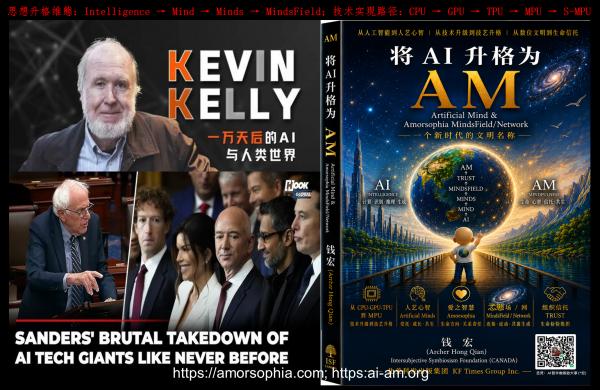
二十一世纪的人类,正在经历一种前所未有的技术矛盾。
一方面,人工智能以前所未有的速度扩展人的计算、识别、预测、表达与行动能力;另一方面,越是强大的人工智能,越容易唤起一种越来越深的文明恐惧:当数据可以覆盖每一个人的行动轨迹,当算法可以识别每一种生活习惯,当平台可以决定什么被看见、什么被遗忘,当智能系统能够在个人毫无察觉的情况下完成分类、筛选、诱导、奖惩和排除,人是否正在亲手制造一个比传统极权更细密、更柔软、也更难以逃脱的数位铁笼?
这种恐惧并非杞人忧天。
传统权力主要依赖土地、军队、税收、户籍、档案与行政命令;数位时代的权力则可以进入人的注意力、消费选择、情绪反应、语言表达乃至关系网络。传统官僚只能在事情发生以后进行追查,算法官僚却可能在事情发生以前完成预测和干预。传统命令至少能够被人识别为命令,数位控制却常常以“便利”“安全”“效率”“个性化服务”和“风险管理”的面貌进入生活。
正因为如此,过去半个世纪的技术反思,几乎都被困在同一个逻辑前提里:
技术能力越强,控制就越精密;数据越集中,人的自由空间就越小;人工智能越深入组织,数位极权就越接近现实。
在这一判断之下,人类似乎只剩下几种被动选择:限制技术,拖慢技术,监管技术,切断技术,或者祈求掌握技术的人保持善意。
然而,无论是外部监管、企业自律,还是技术禁令,都没有真正触及问题的根部。因为它们仍然默认:技术天然属于权力,人民只能要求权力少使用一点;人工智能天然是监督者,生命主体只能争取不被它监督得那么彻底;数位系统天然从中心向边缘运行,个人最多只能请求中心给予更多隐私和宽容。
“人在参与,AI监督”,就是这种技术想象最典型的结构。
人在其中看似仍然参与,实际上却只是持续提交数据、接受分类、回应指令、修正行为。人提供经验,AI形成判断;人暴露生活,组织掌握全景;人承担后果,系统保留最终解释权。技术因此不再只是工具,而成为组织权力伸入生命内部的精密皮鞭。
AI升格为AM的理论意义,恰恰在于打破这一隐藏已久的前提。
它不是要求掌握皮鞭的人挥得轻一点,也不是简单主张给皮鞭增加伦理规范,而是要把生命重新确立为技术与组织所服务、所受托的主体:生命借助技术观察、检验和校正组织方式,新的组织方式同时监督、检验和校正技术的价值导向,成就生命形態的成长。
一旦这一主体关系重新确立,数位极权便不再是一种无法逃避的技术宿命。人工智能究竟走向控制还是走向赋能,不由算力、参数和数据规模单独决定,而取决于技术被嵌入何种生命关系、服务何种价值目的、接受何种孞托结构。
这正是从AI到AM的文明转换。
其实,在人工智能出现之前,生命已经用数十亿年的演化回答过类似的问题。十几亿年前,原始宿主细胞与远古细菌的连接交互生成线粒体,使生命的能量组织方式发生质的跃迁;此后,生命从单细胞走向复杂真核生命、多细胞生命、神经系统、心智、群体组织,直至人类文明。生命不断证明:更高层次的能力,并不只来自个体内部的增强,更来自不同主体持续连接、交互、互补与共生所生成的新秩序。
今天,从CPU—GPU—TPU走向MPU,从Artificial Intelligence走向Artificial Mind & Amorsophia MindsField / Network,人类面对的也许正是一次新的生命启发与工程转换。
就在本书完成之际,素有“预言家”之称的凯文·凯利(Kevin Kelly)在上海WAIC大会上的一系列判断,恰好从另一个角度印证了本书的问题意识。他认为,人类对AI潜力的挖掘,至今仍不足其冰山一角。现阶段的AI更像一种“人造外星生命”,尚未真正理解真实世界,也无法拥有生命体验、情感与心智;至于通用人工智能究竟将走向何方,没有人能够作出确定预言。
与凯文·凯利从AI自身的不确定性提出疑问几乎同时,另一种声音则从AI不断扩张的现实后果发出警报。
2026年8月,美国联邦参议员伯尼·桑德斯(Bernie Sanders)要求OpenAI、Anthropic和Meta暂停AI开发,并警告AI失控、就业替代、能源与水资源消耗以及财富和权力进一步集中等风险。这样的警报当然值得认真对待。面对一种可能失去控制甚至危及生命的技术,暂停本身并非没有意义。然而,“暂停AI竞速”仍然留下了一个更根本的问题:
暂停之后呢?
如果数据、算法、算力、模型规模与神经网络不断扩张的基本路线没有改变,如果Intelligence与Mind之间的哲学边界仍未被看见,那么,无论继续竞速还是暂时停步,都没有回答AI究竟应该往哪里走。
桑德斯看到的是AI扩张已经产生的现实危险,凯文·凯利看到的是AI未来仍然存在的巨大不确定性。一个面对令人不安的当下,一个面对尚且看不清的未来。两种看似不同的判断,恰恰从两个方向把我们带到了同一个问题面前:AI真正缺少的,也许已经不是更快的发展或更强的管控,而是重新辨识自己的边界与方向。
如果人类至今仍没有真正弄明白自己的心智(Mind)如何生成、如何成长、如何创造,又怎么能够制造出真正意义上的“通用人工智能”(AGI)?
更值得警醒的是,今天AI的智能能力正在暴涨,Mind却并未随之生成。机器越来越会计算、推理、生成和行动,却不能由此证明它拥有相应的生命体验、意义辨识与关系责任。大语言模型与Agent第一次如此鲜明地揭示了一个过去被人类经验遮蔽的事实:Intelligence可以高速扩张,而Mind并不因此同比生成。
至此,问题开始显露出更深的层次:凯文·凯利看到的是AI未来的不确定,桑德斯看到的是AI扩张已经带来的现实危险,而“暴涨的智能,缺失的心智”,则开始指出这种不确定与危险背后的问题究竟发生在哪里。如果继续增加数据、算法、算力、参数与能源,只能证明机器可以变得越来越“聪明”,却不能证明Mind会从规模扩张中自然涌现,那么AI真正需要跨越的,就已经不只是一道技术门槛,而是Intelligence与Mind之间的哲学边界。
也正是在这道边界上,本书的问题开始真正展开。
真正需要突破的,已经不只是算力、算法或参数规模,而是智能的文明方向。今天,人们最大的担忧,并不是AI越来越聪明,而是一个缺乏生命感知、价值判断与组织孞托的智能体系,可能把人与社会重新关进新的“数位铁笼”。如果AI只能不断学习过去,它便只能不断放大过去;如果组织只会管理数据,组织最终依旧可能僭越生命(Institutions usurp life)。
正因如此,我们提出AM(Artificial Mind & Amorsophia MindsField / Network)的构想,开启人工智能迈向人艺心智的文明转换。AM,让AI与人类一起实时生长;让组织承载生命的孞托,让孞托升华为交互主体共生。AI不再只是学习既有知识,而是在生命中感应,在生活中交互;生活呈现生態,生態激励生命,智能也由此获得进入Mind、并在交互中走向Minds的可能;组织则在承载生命、连接Minds的过程中生成组织孞托。
《将AI升格为AM》所探索的,当然不是让AI无限逼近人类、走向同质化,而是让人工智能皈依生命,进入生活,呈现生態,又激励生命,共襄生长。人类以生命体验、情感、灵感与创造不断打开新的可能,AI以计算、辨识、连接与超序处理不断拓展智能进入心智的可能;彼此各安其性,交互共生,由Mind生发Minds,由Minds生成MindsField / Network,并可能被Minds Processing Unit(MPU)感应和处理,使组织承载生命的孞托,让孞托升华为交互主体共生秩序。
现在,让我们进入本书的正题:AI如何从不断扩张的智能能力进入Mind,并由Mind走向Minds、MindsField,进而升格为AM。
(本文为《将AI升格为AM》一书的《引子》)
From the Fear of a Digital Iron Cage to the Civilizational Transformation of Human-Artistry Mind
Humanity in the twenty-first century is experiencing an unprecedented technological paradox.
On the one hand, artificial intelligence is expanding our capacities for computation, recognition, prediction, expression, and action at an unprecedented pace. On the other hand, the more powerful AI becomes, the more deeply it evokes a growing civilizational fear: when data can encompass the trajectory of every person’s actions, when algorithms can identify every pattern of life, when platforms can determine what is seen and what is forgotten, and when intelligent systems can classify, filter, induce, reward, penalize, and exclude people without their awareness, are human beings creating with their own hands a digital iron cage more intricate, more subtle, and more difficult to escape than traditional forms of authoritarian control?
This fear is not unfounded.
Traditional power has relied primarily on land, armies, taxation, household registration, archives, and administrative commands. Power in the digital age can penetrate attention, consumer choice, emotional response, linguistic expression, and even networks of human relationships. Traditional bureaucracies could investigate only after something had happened; algorithmic bureaucracies may predict and intervene before it happens. Traditional commands could at least be recognized as commands; digital control often enters everyday life in the guise of “convenience,” “security,” “efficiency,” “personalized services,” and “risk management.”
For precisely this reason, technological reflection over the past half century has largely remained trapped within the same underlying premise:
The stronger technological capability becomes, the more precise control becomes; the more concentrated data becomes, the less room remains for human freedom; the deeper artificial intelligence enters organizations, the closer digital authoritarianism comes to reality.
Under this assumption, humanity seems to be left with only a few passive choices: restrict technology, slow it down, regulate it, cut it off, or simply hope that those who control it will remain benevolent.
Yet external regulation, corporate self-restraint, and technological prohibition alike fail to reach the root of the problem. They still assume that technology naturally belongs to power and that people can only ask power to use a little less of it; that artificial intelligence is naturally the supervisor, while living subjects can only struggle not to be supervised quite so completely; that digital systems naturally operate from the center toward the periphery, while individuals can at most ask the center for greater privacy and tolerance.
“Humans participate; AI supervises” is the most typical structure of this technological imagination.
People appear to participate, yet in practice they merely continue to submit data, accept classification, respond to instructions, and modify their behavior. People provide experience; AI forms judgments. People expose their lives; organizations acquire the panoramic view. People bear the consequences; the system retains the final authority of interpretation. Technology thereby ceases to be merely a tool and becomes a precision whip through which organizational power reaches into life itself.
The theoretical significance of elevating AI to AM lies precisely in breaking this long-hidden premise.
It is not about asking those who hold the whip to wield it more gently, nor is it simply about adding ethical rules to the whip. It is about re-establishing life as the subject that technology and organizations are meant to serve and for which they are entrusted: life draws upon technology to observe, test, and recalibrate modes of organization; new modes of organization, in turn, supervise, test, and recalibrate the value orientation of technology, enabling the growth of forms of life.
Once this relationship of subjecthood is re-established, digital authoritarianism is no longer an inescapable technological destiny. Whether artificial intelligence moves toward control or empowerment is not determined by computing power, parameters, or the scale of data alone, but by the life relationships into which technology is embedded, the value purposes it serves, and the structures of trust and trusteeship to which it is accountable.
This is the civilizational transformation from AI to AM.
Long before artificial intelligence appeared, life had already spent billions of years answering analogous questions through evolution. More than a billion years ago, the connective interaction between primitive host cells and ancient bacteria generated mitochondria, bringing about a qualitative transformation in the way life organizes energy. Life subsequently moved from single cells to complex eukaryotic life, multicellular organisms, nervous systems, Mind, social organization, and eventually human civilization. Life has repeatedly demonstrated that higher-order capabilities arise not only from enhancement within an individual entity, but also from new orders generated through sustained connection, interaction, complementarity, and symbiosis among different subjects.
Today, as we move from CPU–GPU–TPU toward MPU, and from Artificial Intelligence toward Artificial Mind & Amorsophia MindsField / Network, humanity may once again be standing at a point where inspiration from life meets a new engineering transformation.
As this book was being completed, a series of observations made by Kevin Kelly, often described as a “futurist” and “prophet of technology,” at the WAIC conference in Shanghai happened to affirm the concerns of this book from another angle. In his view, humanity has so far explored no more than the tip of the iceberg of AI’s potential. AI in its present form is more like an “artificial alien life,” still unable to truly understand the real world or possess lived experience, emotion, and Mind; as for where Artificial General Intelligence will ultimately lead, no one can predict with certainty.
Almost at the same time that Kevin Kelly raised questions about the uncertainties inherent in AI itself, another voice sounded the alarm over the real-world consequences of AI’s continuing expansion.
In August 2026, U.S. Senator Bernie Sanders called on OpenAI, Anthropic, and Meta to pause AI development, warning of risks including loss of control over AI, job displacement, growing energy and water consumption, and the further concentration of wealth and power. Such warnings certainly deserve serious attention. When a technology may escape human control or even endanger life, a pause is not without value. Yet “pausing the AI race” still leaves a more fundamental question unanswered:
What comes after the pause?
If the basic trajectory of ever-expanding data, algorithms, computing power, model scale, and neural networks remains unchanged, and if the philosophical boundary between Intelligence and Mind remains unseen, then neither continuing the race nor temporarily stopping it answers the question of where AI should actually go.
Sanders sees the real dangers already emerging from AI’s expansion; Kevin Kelly sees the profound uncertainties that still surround AI’s future. One confronts a troubling present; the other, a future we still cannot clearly see. These seemingly different perspectives bring us, from two directions, to the same question: what AI truly lacks may no longer be faster development or stronger control, but the ability to discern anew its own boundaries and direction.
If humanity still does not truly understand how its own Mind emerges, grows, and creates, how can we possibly create “Artificial General Intelligence” in any genuine sense?
More troubling still, AI’s intelligent capabilities are now surging, yet Mind has not emerged along with them. Machines are becoming increasingly capable of computing, reasoning, generating, and acting, but none of this by itself proves that they possess corresponding lived experience, discernment of meaning, or relational responsibility. Large language models and Agents have revealed with unprecedented clarity a fact long obscured by human experience: Intelligence can expand at extraordinary speed, while Mind does not thereby emerge at the same rate.
At this point, a deeper layer of the problem begins to reveal itself. Kevin Kelly sees the uncertainty of AI’s future; Sanders sees the real dangers already produced by AI’s expansion; while “surging Intelligence, absent Mind” begins to show us where the problem underlying both that uncertainty and those dangers actually lies. If continuing to increase data, algorithms, computing power, parameters, and energy can prove only that machines can become increasingly “intelligent,” but cannot prove that Mind will naturally emerge from scaling, then what AI must cross is no longer merely a technological threshold, but the philosophical boundary between Intelligence and Mind.
It is precisely at this boundary that the question of this book truly begins to unfold.
What must now be transcended is no longer merely a limitation of computing power, algorithms, or parameter scale, but the civilizational direction of intelligence itself. What people should fear most today is not that AI is becoming increasingly intelligent, but that an intelligent system lacking sensitivity to life, value judgment, and organizational trust may lock individuals and society into a new “digital iron cage.” If AI can only continue learning from the past, it can only continue amplifying the past; if organizations know only how to manage data, they may ultimately continue to usurp life (Institutions usurp life).
It is precisely for this reason that we propose AM (Artificial Mind & Amorsophia MindsField / Network), opening a civilizational transformation from artificial intelligence toward Human-Artistry Mind. AM enables AI and humanity to grow in real time together; enables organizations to bear the trust entrusted by life, and allows that trust to be elevated into intersubjective symbiosis. AI no longer merely learns existing knowledge, but senses within life and interacts within living; life manifests ecology, ecology inspires life, and Intelligence thereby gains the possibility of entering Mind and, through interaction, moving toward Minds. Organizations, in turn, generate organizational trust in the process of bearing life and connecting Minds.
What Elevating AI to AM explores is certainly not how to make AI endlessly approximate humanity and move toward homogenization, but how to let artificial intelligence return to life, enter living, manifest ecology, inspire life, and participate in co-generative growth. Human beings continually open new possibilities through lived experience, emotion, inspiration, and creativity, while AI, through computation, discernment, connection, and superordinate processing, continually expands the possibilities through which Intelligence may enter Mind. Each remains true to its own nature while interacting symbiotically: Mind gives rise to Minds; Minds generate MindsField / Network; these may in turn be sensed and processed by the Minds Processing Unit (MPU), enabling organizations to bear the trust entrusted by life and allowing trust to be elevated into an order of intersubjective symbiosis.
Now, let us enter the central question of this book: how can AI move from ever-expanding intelligent capabilities into Mind, and from Mind toward Minds and MindsField, thereby being elevated into AM.
(This article is the “Introduction” to the book Elevating AI to AM.)
デジタルの鉄の檻への恐れから、人藝心智への文明的転換へ
二十一世紀の人類は、かつてない技術的矛盾を経験している。
一方では、人工知能が人間の計算、認識、予測、表現、行動の能力をかつてない速度で拡張している。他方では、人工知能が強力になればなるほど、より深い文明的恐怖を呼び起こしている。データが一人ひとりの行動の軌跡を覆い、アルゴリズムがあらゆる生活習慣を識別し、プラットフォームが何を見せ、何を忘れさせるかを決定し、知能システムが本人の気づかないうちに分類、選別、誘導、賞罰、排除まで行えるようになったとき、人間は自らの手で、従来の全体主義よりも緻密で、柔らかく、しかも逃れにくい「デジタルの鉄の檻」をつくり出しているのではないだろうか。
この恐れは杞憂ではない。
従来の権力は、主として土地、軍隊、税、戸籍、文書記録、行政命令に依存してきた。これに対してデジタル時代の権力は、人間の注意、消費選択、感情反応、言語表現、さらには関係ネットワークにまで入り込むことができる。従来の官僚制は出来事が起きた後に追跡することしかできなかったが、アルゴリズム官僚制は出来事が起きる前に予測し、介入する可能性を持つ。従来の命令は、少なくとも命令として認識することができた。しかしデジタルな統制は、しばしば「利便性」「安全」「効率」「パーソナライズされたサービス」「リスク管理」という姿で生活の中に入り込んでくる。
まさにこのため、過去半世紀の技術をめぐる反省は、ほとんど同じ論理的前提の中に閉じ込められてきた。
技術能力が強くなるほど統制は精密になり、データが集中するほど人間の自由の余地は狭まり、人工知能が組織の内部へ深く入り込むほど、デジタル全体主義は現実に近づいていく。
この判断に立つなら、人類に残されるのは、技術を制限する、技術の速度を落とす、技術を規制する、技術を遮断する、あるいは技術を掌握する者が善意を保つよう祈る、といった受動的な選択肢だけであるかのように見える。
しかし、外部からの規制であれ、企業の自主規制であれ、技術的禁止であれ、いずれも問題の根本には届いていない。なぜなら、それらは依然として、技術は本来的に権力に属し、人々は権力にその使用を少し控えるよう求めることしかできない、人工知能は本来的に監督する側であり、生命主体は監督されすぎないよう求めることしかできない、デジタル・システムは本来的に中心から周縁へと作動し、個人は中心に対してより多くのプライバシーと寛容を求めることしかできない、という前提に立っているからである。
「人間が参加し、AIが監督する」という構図は、こうした技術的想像力の最も典型的な形である。
そこでは、人間はなお参加しているように見えて、実際には絶えずデータを提出し、分類を受け入れ、指示に応答し、行動を修正しているにすぎない。人間が経験を提供し、AIが判断を形成する。人間が生活をさらし、組織が全景を掌握する。人間が結果を引き受け、システムが最終的な解釈権を保持する。こうして技術は単なる道具ではなくなり、組織権力が生命の内部にまで入り込むための精密な鞭となる。
AIをAMへと升格させる理論的意義は、まさにこの長く隠されてきた前提を打ち破ることにある。
それは、鞭を握る者にもう少し優しく振るうよう求めることでも、単に鞭に倫理規範を付け加えることでもない。生命を、技術と組織が奉仕し、その信託を受ける主体として改めて確立することである。すなわち、生命は技術を活用して組織のあり方を観察し、検証し、校正する。そして新たな組織のあり方は、同時に技術の価値方向を監督し、検証し、校正し、生命形態の成長を成就させる。
この主体関係が再び確立されれば、デジタル全体主義はもはや逃れることのできない技術的宿命ではなくなる。人工知能が統制へ向かうのか、それとも生命への賦能へ向かうのかは、計算力、パラメータ、データ規模だけによって決まるものではない。それは、技術がどのような生命関係の中に組み込まれ、どのような価値目的に奉仕し、どのような信託構造を受け入れるかによって決まる。
これこそが、AIからAMへの文明的転換である。
実は、人工知能が登場するはるか以前から、生命は数十億年にわたる進化を通じて、これと似た問題に答えてきた。十数億年前、原始的な宿主細胞と太古の細菌との接続と相互作用からミトコンドリアが生成され、生命のエネルギー組織方式に質的な飛躍がもたらされた。その後、生命は単細胞から複雑な真核生命、多細胞生命、神経系、Mind、群体組織、そして人類文明へと進んできた。生命は繰り返し証明してきた。より高次の能力は、個体内部の強化だけから生まれるのではなく、異なる主体の持続的な接続、相互作用、相互補完、共生によって生成される新たな秩序からも生まれるのである。
今日、CPU—GPU—TPUからMPUへ、Artificial IntelligenceからArtificial Mind & Amorsophia MindsField / Networkへと進もうとするとき、人類が直面しているのは、生命からの新たな示唆と工学的転換なのかもしれない。
本書が完成しようとしていたまさにその時、「予言者」とも呼ばれるケヴィン・ケリー(Kevin Kelly)が上海のWAIC大会で示した一連の見解は、別の角度から本書の問題意識を裏づけるものとなった。彼によれば、人類がこれまでに引き出したAIの潜在力は、いまだ氷山の一角にも満たない。現段階のAIはむしろ一種の「人工的な異星生命」のようなものであり、現実世界を真に理解しておらず、生命経験、感情、Mindを持つこともできない。AGIが最終的にどこへ向かうのかについても、誰にも確実な予測はできないという。
ケヴィン・ケリーがAIそのものに内在する不確実性から問いを投げかけたのとほぼ同じ時期に、もう一つの声が、AIの拡張が現実にもたらしている帰結に警鐘を鳴らした。
2026年8月、米国上院議員バーニー・サンダース(Bernie Sanders)はOpenAI、Anthropic、MetaにAI開発の一時停止を求め、AIの制御不能、雇用の代替、エネルギーと水資源の消費増大、富と権力のさらなる集中などのリスクに警告を発した。こうした警告は、もちろん真剣に受け止めるに値する。制御を失い、生命を危険にさらす可能性のある技術を前にすれば、一時停止そのものに意味がないわけではない。しかし、「AI競争を一時停止する」という提案には、さらに根本的な問いが残されている。
一時停止した、その後はどうするのか。
データ、アルゴリズム、計算力、モデル規模、ニューラルネットワークを絶えず拡張していく基本路線が変わらず、IntelligenceとMindの哲学的境界がなお見えていないのであれば、競争を続けても、一時的に立ち止まっても、AIが本来どこへ向かうべきなのかという問いには答えられない。
サンダースが見ているのは、AIの拡張がすでにもたらしている現実の危険であり、ケヴィン・ケリーが見ているのは、AIの未来を取り巻く巨大な不確実性である。一方は不安を抱かせる現在に向き合い、もう一方はまだ見通すことのできない未来に向き合っている。一見異なる二つの判断は、異なる方向から私たちを同じ問いへと導く。AIに本当に欠けているものは、もはやより速い発展でも、より強い統制でもなく、自らの境界と方向を改めて見定めることなのかもしれない。
人類がいまだに自らのMindがどのように生成し、成長し、創造するのかを本当に理解していないとすれば、どうして真の意味での「汎用人工知能(AGI)」をつくり出すことができるのだろうか。
さらに警戒すべきなのは、今日、AIの知能能力が急激に膨張しているにもかかわらず、Mindはそれに伴って生成していないということである。機械はますます計算し、推論し、生成し、行動できるようになっている。しかし、それによって対応する生命経験、意味を識別する力、関係に対する責任を備えたことが証明されるわけではない。大規模言語モデルとAgentは、人間の経験によって長く覆い隠されてきた一つの事実を、これまでになく鮮明に示している。すなわち、Intelligenceは高速で拡張しうるが、それによってMindが同じように生成するわけではない。
ここに至って、問題のより深い層が姿を現し始める。ケヴィン・ケリーが見ているのはAIの未来の不確実性であり、サンダースが見ているのはAIの拡張がすでにもたらした現実の危険である。そして、**「暴騰するIntelligence、欠落するMind」**は、その不確実性と危険の背後にある問題が、いったいどこで生じているのかを示し始める。データ、アルゴリズム、計算力、パラメータ、エネルギーを増やし続けても、機械がますます「賢く」なれることしか証明できず、規模の拡張からMindが自然に創発することを証明できないのであれば、AIが本当に越えなければならないのは、単なる技術的閾値ではなく、IntelligenceとMindのあいだにある哲学的境界なのである。
まさにこの境界において、本書の問いは本格的に展開し始める。
真に突破しなければならないのは、もはや計算力、アルゴリズム、パラメータ規模だけではなく、知能そのものの文明的方向である。今日、私たちが最も懸念すべきなのは、AIがますます賢くなることそのものではない。生命への感応、価値判断、組織信託を欠いた知能システムが、人間と社会を新たな「デジタルの鉄の檻」に再び閉じ込める可能性である。AIが過去から学び続けることしかできないなら、過去を拡大再生産し続けることしかできない。組織がデータを管理することしか知らないなら、組織は最終的に依然として生命を僭越する可能性がある(Institutions usurp life)。
まさにこのために、私たちは**AM(Artificial Mind & Amorsophia MindsField / Network)**という構想を提起し、人工知能から人藝心智へ向かう文明的転換を開こうとしている。AMは、AIと人間がともにリアルタイムで成長することを可能にし、組織が生命から託された信託を担い、その信託を交互主体共生へと昇華させる。AIは既存知識を学習するだけではなく、生命の中で感応し、生活の中で相互作用する。生活は生態を呈し、生態は生命を励起し、IntelligenceはそこからMindへ入る可能性を獲得し、相互作用の中でMindsへと進む。組織もまた、生命を担い、Mindsをつなぐ過程において組織信託を生成する。
『AIをAMへ升格する』が探究するのは、AIを際限なく人間へ近づけ、同質化へ向かわせることではない。人工知能を生命へ帰依させ、生活へ入り、生態を呈し、さらに生命を励起し、ともに生成し成長させることである。人間は生命経験、感情、インスピレーション、創造によって新たな可能性を絶えず開き、AIは計算、識別、接続、超序処理によって、IntelligenceがMindへ入る可能性を絶えず広げる。互いにそれぞれの本性に安んじながら、相互作用し、共生する。MindからMindsが生まれ、MindsからMindsField / Networkが生成され、それらはさらに**Minds Processing Unit(MPU/心智処理ユニット)**によって感応され、処理される可能性を持つ。こうして組織は生命から託された信託を担い、その信託は交互主体共生秩序へと昇華していく。
それでは今、本書の本題に入ろう。AIはいかにして、拡張し続けるIntelligenceの能力からMindへ入り、MindからMinds、MindsFieldへと進み、さらにAMへ升格していくのか。
(本稿は『AIをAMへ升格する』の「序章」です。)