100万亿美元项目长啥样? ——从AI的产业价值到AM的文明级价值空间
如果AM(Artificial Mind & Amorsophia MindsField / Network)真能改变AI的基本范式,它所进入的价值空间有没有100万亿美元量级?
100万亿美元项目长啥样?
——从AI的产业价值到AM的文明级价值空间
有人问:怎么证明AM(Artificial Mind & Amorsophia MindsField / Network)的价值?
这个问题很好。
不过,要讨论AM是不是一个100万亿美元量级的项目,首先需要把“证明”分成两个层次。作为一种正在形成的哲学—科学—工程构想,AM最终能否实现,需要科学研究、工程实验和生活实践不断验证;而在进入这些验证之前,我们已经可以回答一个现实尺度的问题:
如果今天的AI正在形成万亿美元级产业,那么,一个试图改变AI基本范式、能源效率、心智生成方式、组织方式乃至人类生活方式选择的AM,其潜在价值究竟应该按照什么数量级来衡量?
这不是给一家尚不存在的“AM公司”估值。
我们真正需要衡量的是一个更大的概念:
文明级价值空间(Civilizational Value Space)。
100万亿美元不是一家公司的股票市值,也不是一项传统DCF估值,而是AM如果成为人类生活方式创新与再选择的基础设施,可能影响、重构、节省、释放和创造的全球经济活动、资产配置、组织成本与生命效能的数量级。
从这个意义上说,100万亿美元这个命题可以讨论,也可以论证。关键是,我们必须首先改变计算方法。
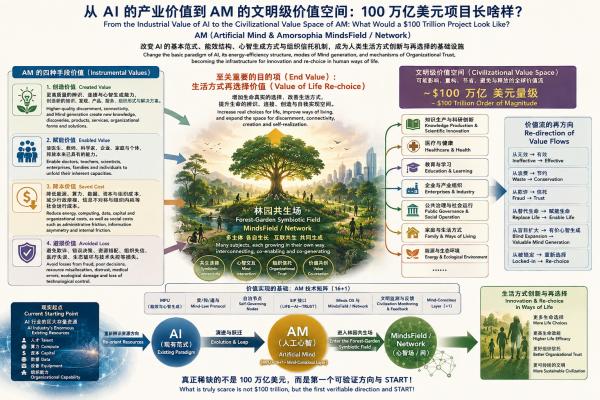
一、从“AI值多少钱”到“AI究竟值不值”
过去十几年,人们习惯于用越来越大的数字衡量AI。参数多少?算力多少?融资多少?公司估值多少?市场规模多少?
这些数字当然重要,却都建立在一个隐含前提上:能力增长本身就是价值增长。
2016年AlphaGo以4∶1战胜李世石的时候,这个问题其实已经第一次以极其生动的方式摆在人类面前。
棋盘上,AlphaGo赢了。可是,如果把比赛从“谁赢了几盘棋”扩展到“为了完成这五盘棋,双方分别消耗了多少能源、计算资源、工程劳动和组织成本”,我们看到的便是另一幅图景。
李世石一天所需要的生命能量,可能不过来自一顿普通早餐;AlphaGo背后呢?则是芯片、服务器、电力、数据以及此前大量工程劳动共同构成的技术系统。
这丝毫不减损AlphaGo的历史性成就,却提醒我们:
性能不是价值的全部,产出不能脱离投入,智能也不能逃避能效与能耗的检验。
到了大模型时代,这个问题更加现实。
模型越来越大,算力越来越强,数据中心、电力、冷却、芯片、资本投入不断扩张。于是,“AI还能不能更强”之外,一个更加朴素的问题迟早会出现:值不值?
这正是从AI进入AM以后,价值计算首先需要发生的变化。
AM不只计算AI“做成了什么”,还必须计算:
为了做成这些事情,人类付出了什么?节省了什么?避免了什么?改善了什么?最终又给生命增加了什么?
二、100万亿美元不是“公司估值”,而是文明级价值空间
严格地说,目前,AM没有一家对应的公司,没有稳定现金流,没有可交易股权,当然不能按照传统企业估值方法宣布“AM市值100万亿美元”。这样的说法既不严谨,也会把一个值得认真讨论的命题变成大数字宣传。
但是,换一个尺度,问题就完全不同了。
如果AM最终影响的只是某一种软件,那么我们应该按照软件市场估值;如果它影响芯片和数据中心,就应该进一步计算计算基础设施的价值;如果它进一步影响能源利用、知识生产、医疗、教育、科研、金融、政府、企业和家庭的组织方式,那么衡量对象已经发生变化。
如果AM最终所触及的是:
人怎样借助人工心智重新辨识自己的需要,怎样组织生产与生活,怎样降低无效消耗,怎样重新建立人与组织之间的信托关系,又怎样获得重新选择生活方式的能力——那么它所进入的就已经不是一个单独产业的市场空间,而是人类生活方式创新与再选择所打开的文明级价值空间。
因此,100万亿美元真正要讨论的不是:AM能卖多少钱?而是:AM可能影响多大规模的人类资源配置,并使这些资源重新服务于生命?
这两个问题,看似相近,实质完全不同。
三、AM的四种手段价值
要把这个问题变得可以计算,可以先从四类相对容易识别的现实价值开始。
第一,创造价值(Created Value)。
Artificial Mind如果能够形成更高质量的辨识、连接与心智生成能力,就可能参与创造新的知识、科学发现、产品、服务、组织形式和解决方案。
这是传统经济学最容易看见的部分:新的东西出现了,因此形成新的产出和收入。
第二,赋能价值(Enabled Value)。
AM的意义并不在于把生命从经济和社会活动中排除出去,而在于增加生命本来具有的能力。
医生仍然是医生,教师仍然是教师,科学家仍然是科学家,孩子仍然在成长,家庭仍然生活,企业仍然创造。Artificial Mind的价值在于使他们拥有更充分的辨识、连接、学习、创造和行动能力。
这种价值不是“替代了多少人”,而是:
使多少生命原本没有充分发挥的能力获得释放。
第三,降本价值(Saved Cost / Cost Reduction)。
这是AM与共生经济学直接相接的地方。
今天AI本身就存在巨大的能源、算力、数据、资本和组织成本。MPU(Minds Processing Unit)的提出,首先面对的正是AI低能效、高能耗不匹配这一瓶颈。
但降本远不止芯片和电力。
社会运行中的重复劳动、行政摩擦、信息不对称、过度中介、低效审批、组织内耗以及大量为了维持复杂系统自身而产生的成本,同样消耗着真实资源。
如果AM能够降低这些成本,节省下来的资源本身就是巨大的价值。
第四,避损价值(Avoided Loss)。
现代社会创造财富,也不断制造损失。
欺诈、错误决策、资源错配、组织失信、医疗失误、生态破坏、技术失控以及各种成本转嫁,都意味着已经创造的生命资源被重新消耗。
因此,AM的价值不能只计算“增加了多少”,还必须计算:
原本可能损失多少,因为更好的辨识、连接、组织和信托而没有损失。
创造、赋能、降本、避损,这四项加在一起,已经足以打开一个巨大的现实价值空间。
但到这里,仍然没有抵达AM真正的目的。
四、被忽略的至关重要的目的项:生活方式再选择价值
这可能是整个100万亿美元论证中最重要的一步。
传统经济估值习惯于把创造、增长、效率和成本作为价值指标,却经常忽略一个至关重要的目的项(End Value):
生活方式再选择价值(Value of Life Re-choice)
创造价值、赋能价值、降本价值和避损价值,都很重要,但它们最终不能以自身为目的。
技术为什么要提高效率?
为什么要降低成本?
为什么要减少损失?
为什么要增加人的能力?
最后仍然必须回到生命:
它是否增加了生命真实的选择?
它是否改善了人的生活方式?
它是否使生命拥有更加充分的辨识、连接、创造和自我实现空间?
这正是传统增长逻辑,最容易发生手段—目的倒置的地方。
如果一种技术使GDP增加,却让生活成本越来越高,我们必须追问其价值;如果一种AI创造大量算力需求,却消耗越来越多能源而没有相应增加生命效能,我们同样必须追问其价值;如果一个组织规模越来越庞大,却使生命越来越依附于组织而不是组织服务生命,那么组织本身的增长也不能证明它的成功。
AM所要打开的,是另一种可能。
医疗可以重新选择怎样围绕生命健康组织,而不只是围绕疾病治疗组织;教育可以重新选择怎样保护儿童Mind的开放生成,而不只是制造标准答案;工作可以重新选择怎样释放创造力,而不只是延长劳动时间;城市、养老、家庭、消费和知识生产,都可以重新辨识哪些需要是真实需要,哪些成本本来可以避免,哪些组织方式可以重新安排,哪些生活原本可以有另一种可能。
因此,生活方式再选择价值并不是AM价值公式中与其他四项并列的第五种收益。
它是目的项。
前四项更多属于手段价值(Instrumental Values):
创造价值 + 赋能价值 + 降本价值 + 避损价值
最终应当指向:
生活方式再选择价值(Value of Life Re-choice)
也就是:
Created Value + Enabled Value + Saved Cost + Avoided Loss
→ Value of Life Re-choice
这个箭头,比加号更加重要。
因为AM最终追求的不是把世界制造得越来越复杂,而是让生命拥有更好的能力去辨识:
什么值得创造,什么值得保留,什么应该停止,什么可以重新选择。
五、100万亿美元究竟从哪里来?
到了这里,我们才能真正谈100万亿美元。
不能把芯片市场、软件市场、机器人市场、医疗市场、教育市场统统加起来,然后宣布“AM拥有100万亿美元市场”。
那只是把世界上已有产业重复计算一遍。
更合理的方法,是考察AM可能影响的全球价值流(Global Value Flows)。
假设AM进入现实以后,能够在几十年的时间尺度上影响全球知识生产、能源利用、AI计算、医疗教育、企业运行、公共治理、科研创新以及家庭生活中的资源配置,那么它无需“占有”这些产业的全部价值。
只要它能够使其中一部分资源:
从无效转向有效,
从浪费转向节约,
从欺诈转向信托,
从替代生命转向赋能生命,
从盲目扩大能力转向有价心智生成,
从被既有生活方式锁定转向重新获得选择,
它影响的价值就可能迅速进入数十万亿美元,乃至100万亿美元量级。
因此,所谓:
AM可能是一个100万亿美元量级的项目,真正严谨的含义应该是:
如果AM能够改变AI的能效结构、心智生成方式和组织信托机制,并由此成为人类生活方式创新与再选择的基础设施,那么,在数十年的文明尺度上,它所影响、重构、节省、避免损失并重新导向生命的全球价值流,具有进入100万亿美元数量级的可能。
这是一个数量级命题(Order-of-Magnitude Thesis),不是股票价格预测。它可以被质疑,可以被计算,也应该随着工程实践不断被修正。
这才是一个真正值得研究的100万亿美元命题。
六、展望价值:真正稀缺的不是资源,而是启动
如果AM的文明级价值空间成立,接下来便出现一个看似更加现实的问题:
如此宏大的事业,钱从哪里来?人才从哪里来?设备和技术从哪里来?
回望人工智能产业的发展,这个问题也许并没有想象中困难。
OpenAI创立之初所拥有的启动资源,与今天全球AI产业已经形成的资本、人才、芯片、数据中心和技术能力不可同日而语。真正重要的,并不是当初究竟用了多少启动资金,而是一个新的方向一旦被少数人认真启动,便可能不断吸引原本分散的资本、人才和技术资源向新的可能空间汇聚。
AM如果成立,同样如此,而且规模可能完全不同。
今天的OpenAI、xAI、Anthropic、NVIDIA、Google、Meta、TSMC、Microsoft、Amazon以及众多AI实验室、芯片企业、云计算平台和科研机构,已经积累了人类历史上前所未有的智能技术资源:科学家、工程师、算法、模型、芯片、算力、能源设施、资本和全球组织能力。
这些都不必从零创造。
AM真正提出的问题是:这些已经存在的巨大资源,未来向哪里去?
如果AI继续沿着参数、算力、模型规模和市场占有率彼此竞逐,每一个组织都有充分的“单一存在意义”。
然而,一旦AM所提出的问题获得科学与工程上的实质突破——Artificial Intelligence开始进入Artificial Mind,CPU–GPU–TPU的既有路径出现MPU的新可能,孤立模型开始进入Minds与MindsField / Network的交互生成,AI能力开始进入LIFE–MIND–TRUST的组织信托秩序——今天彼此分立的AI巨头,其许多单独建设、重复投入和相互消耗的意义就会发生变化。
那时,真正有价值的未必是把这些企业消灭、取代或者合并,而是使它们已经积累的人员、设备、资金、技术和组织能力,开始进入AM“大林园”的共襄创建。
有人种树,有人育种,有人提供水源,有人改良土壤,有人研究生命,有人建设道路;树木不必成为同一棵树,森林也不需要一个中心控制所有生命。不同主体各美其美,美人之美,美美与共——在持续连接、交互、互证中共襄生成。
这恰恰是AM(Artificial Mind & Amorsophia MindsField / Network)MindsField / Network——林园共生场。
它不是把OpenAI、xAI、Anthropic、NVIDIA、Google、Meta、TSMC、Microsoft、Amazon重新装进一个更大的超级组织,而是让原本各自生长的技术、人才、资本、设备与组织能力,在守住各自边界与生命活力的同时,进入一个能够持续连接、相互赋能、共襄生成的孞態场/网。
林园之所以成为林园,正在于万木各自生长而又彼此感应;Minds之所以生成MindsField / Network,也正在于不同主体无需归一,却能够在连接交互中形成共生效应,并由持续的共生效应生成共生秩序。
因此,AM与今天AI企业的关系,不应理解成“AM出现以后谁被谁取代”,而更可能是一场价值方向的重新辨识与资源的重新连接:已有AI产业构成AM最重要的现实存量,而AM为这些存量打开一个更大的文明价值空间。
由此看,创建AM最稀缺的东西可能既不是钱,也不是算力,甚至不是人才。这些资源,人类已经拥有,而且规模惊人。
真正稀缺的是:
第一个可以验证的方向,第一个愿意跨越既有边界的行动,以及把哲学构想带入科学、工程和生活实践的启动。
所以,当我们说AM可能打开100万亿美元量级的文明价值空间时,最后的问题反而变得异常简单:
不是“哪里有100万亿美元来创建AM?”
而是“谁来启动?”
因为一旦方向被证明值得进入,资金会寻找新的价值空间,人才会寻找新的创造空间,技术会寻找新的应用空间,已有AI产业积累的巨大资源也会寻找新的生长空间。
从这个意义上说,AM最重要的第一笔资本,当然不是100万亿美元的100分之1,很可能只要OpenAI寻求70亿美元融资的10分之1,甚至只是今天一家大型AI企业单轮融资规模的一小部分。关键就一个字:
启动(START)!
而一旦真正启动,AM“大林园共生场”,也不必由一家企业独占,更不应成为另一个超级中心。它存在的意义,恰恰在于让不同主体各自生长、持续连接、共襄生成。
这才与前面“100万亿美元不是一家公司的市值”完全吻合:100万亿美元衡量的是可能被重新连接和激活的文明资源,而START,才是把可能世界带入现实世界的第一步。
七、真正需要“升格”的,还有价值尺度
现在再回头看《将AI升格为AM》中的“升格”,问题会更加清楚。
AI升级,往往意味着更大的模型、更高的Benchmark、更强的算力、更丰富的功能。
AM升格,则要求我们同时改变观察技术的尺度。
过去问:它有多强?
现在还要问:它消耗多少?
过去问:它能完成什么?
现在还要问:这些事情值不值得完成?
过去问:它能够替代多少劳动?
现在还要问:它能够释放多少生命潜能?
过去问:它创造多少经济增长?
现在最终还要问:
它给生命增加了多少真实的生活创新与再选择?
这才使“100万亿美元”不再只是一个惊人的数字。
真正值得争取的,也不是制造一家市值100万亿美元的公司。
如果AM最终能够让巨大的技术能力、资本、能源、组织和人工智能资源重新接受生命的检验,使人类能够降低不必要的成本,释放被压抑的能力,修复正在流失的组织信托,并重新获得创造和选择生活方式的空间,那么,100万亿美元所描述的就不再只是财富规模。
它描述的是可以被重新配置、重新释放并重新服务生命的文明资源规模。
所以,真正的问题或许应该倒过来问:
100万亿美元的AM项目长什么样?
它未必首先表现为一家100万亿美元的公司。
它可能表现为能源少消耗了一些,人的能力多释放了一些,组织成本下降了一些,欺诈和浪费减少了一些,信托重新生长了一些,而亿万生命因此获得了更多真实选择——生命自组织连接动态平衡。
如果这些变化最终能够持续连接、交互生成并形成新的共生秩序,那么,我们才真正有资格说:
从AI到AM,发生的不是一次升级。
发生的是价值尺度本身的升格。
AM(Artificial Mind & Amorsophia MindsField / Network),一个新时代的文明名称!
What Would a $100 Trillion Project Look Like?
— From the Industrial Value of AI to the Civilizational Value Space of AM
If AM (Artificial Mind & Amorsophia MindsField / Network) can truly change the basic paradigm of AI, could the value space it opens reach the scale of $100 trillion?
Someone asked: How can the value of AM be demonstrated?
It is a good question.
To discuss whether AM could be a $100 trillion-scale project, however, we must first distinguish two levels of “proof.” As an emerging philosophical–scientific–engineering conception, whether AM can ultimately be realized must be continuously tested through scientific research, engineering experiments, and lived practice. Before those validations are completed, however, we can already address a question of real-world scale:
If AI today is becoming a trillion-dollar industry, then at what order of magnitude should we measure the potential value of AM—an undertaking that seeks to change AI’s basic paradigm, energy efficiency, mode of Mind generation, organizational structure, and even humanity’s capacity to choose how it lives?
This is not an attempt to value a hypothetical “AM company.”
What we need to measure is something larger:
Civilizational Value Space.
$100 trillion is neither the market capitalization of a single company nor a conventional DCF valuation. It refers to the order of magnitude of global economic activity, asset allocation, organizational costs, and life efficacy that AM could influence, restructure, save, release, and create if it becomes an infrastructure for innovation and re-choice in human ways of life.
In this sense, the $100 trillion proposition can be discussed—and argued. But first, we must change the way value is calculated.
I. From “How Much Is AI Worth?” to “Is AI Worth It?”
Over the past decade or more, we have become accustomed to measuring AI with ever-larger numbers: How many parameters? How much computing power? How much financing? What company valuation? How large a market?
These numbers matter. Yet they rest on an implicit assumption: that growth in capability is itself growth in value.
When AlphaGo defeated Lee Sedol 4–1 in 2016, this question was already placed before humanity in an extraordinarily vivid form.
On the Go board, AlphaGo won. But if we expand the contest from “Who won how many games?” to “How much energy, computing resource, engineering labor, and organizational cost did each side consume in order to complete those five games?”, a very different picture emerges.
The life energy Lee Sedol required for a day might have come from an ordinary breakfast. Behind AlphaGo stood chips, servers, electricity, data, and a technological system built through enormous prior engineering effort.
None of this diminishes AlphaGo’s historic achievement. It does, however, remind us of something fundamental:
Performance is not the whole of value. Output cannot be separated from input, and intelligence cannot escape the test of energy efficiency and energy consumption.
In the age of large models, this question has become even more concrete.
Models grow larger; computing power becomes stronger; data centers, electricity, cooling, chips, and capital investment continue to expand. Beyond asking “Can AI become even more powerful?”, sooner or later we must ask a simpler question:
Is it worth it?
This is the first change in value calculation required when moving from AI toward AM.
AM must calculate not only what AI has accomplished, but also:
What did humanity expend to accomplish it? What was saved? What loss was avoided? What was improved? And ultimately, what was added to life?
II. $100 Trillion Is Not a “Company Valuation,” but a Civilizational Value Space
Strictly speaking, AM currently has no corresponding company, no stable cash flow, and no tradable equity. It therefore cannot responsibly be declared to have a “$100 trillion market capitalization” under conventional corporate valuation methods. Such a claim would be imprecise and would reduce a serious proposition to publicity built around a spectacular number.
At another scale, however, the question changes completely.
If AM ultimately affects only one category of software, it should be valued against the software market. If it affects chips and data centers, the value of computing infrastructure should also be considered. If it further affects energy utilization, knowledge production, healthcare, education, scientific research, finance, government, enterprises, and the organization of family life, then the object being measured has already changed.
And if AM ultimately concerns how people use Artificial Mind to rediscover their needs, organize production and life, reduce ineffective consumption, rebuild trust between people and organizations, and regain the capacity to choose their ways of life, then it has entered something larger than the market space of any single industry.
It has entered a Civilizational Value Space opened by innovation and re-choice in human ways of life.
The real $100 trillion question, therefore, is not:
How much can AM be sold for?
It is:
How large a share of humanity’s resource allocation could AM influence—and redirect toward serving life?
These questions may sound similar. They are fundamentally different.
III. Four Instrumental Values of AM
To make the question calculable, we can begin with four categories of relatively identifiable real-world value.
First, Created Value.
If Artificial Mind can generate higher-quality discernment, connectivity, and Mind generation, it may participate in creating new knowledge, scientific discoveries, products, services, organizational forms, and solutions.
This is the form of value conventional economics recognizes most easily: something new appears and generates new output and income.
Second, Enabled Value.
The purpose of AM is not to remove life from economic and social activity, but to augment capabilities already inherent in life.
Doctors remain doctors. Teachers remain teachers. Scientists remain scientists. Children continue to grow. Families continue to live. Enterprises continue to create. The value of Artificial Mind lies in enabling them to discern, connect, learn, create, and act more fully.
Its value is therefore not measured by “how many people it replaces,” but by:
How much previously unrealized capacity in living beings it enables to unfold.
Third, Saved Cost / Cost Reduction.
Here AM connects directly with Symbionomics.
AI itself already carries enormous energy, computing, data, capital, and organizational costs. The proposal of the MPU (Minds Processing Unit) directly addresses one of AI’s fundamental bottlenecks: the mismatch between low energy efficiency and high energy consumption.
But cost reduction extends far beyond chips and electricity.
Repetitive labor, administrative friction, information asymmetry, excessive intermediation, inefficient approval processes, organizational internal friction, and the enormous resources consumed merely to sustain complex systems themselves are all real costs.
If AM can reduce them, the resources saved constitute enormous value in themselves.
Fourth, Avoided Loss.
Modern societies create wealth, but they also continually create losses.
Fraud, poor decisions, resource misallocation, organizational distrust, medical errors, ecological damage, technological loss of control, and various forms of cost shifting all consume resources that life has already created.
The value of AM therefore cannot be calculated only in terms of “how much more was created.” It must also ask:
How much would otherwise have been lost, but was preserved through better discernment, connectivity, organization, and trust?
Created Value, Enabled Value, Saved Cost, and Avoided Loss already open an enormous real-world value space.
But even here, we have not yet reached AM’s ultimate purpose.
IV. The Crucial End Value That Has Been Overlooked: Value of Life Re-choice
This may be the most important step in the entire $100 trillion argument.
Traditional economic valuation tends to treat creation, growth, efficiency, and cost as measures of value. Yet it often overlooks a crucial End Value:
Value of Life Re-choice.
Created Value, Enabled Value, Saved Cost, and Avoided Loss all matter, but none can ultimately be an end in itself.
Why should technology increase efficiency?
Why reduce costs?
Why prevent losses?
Why increase human capability?
Ultimately, we must return to life:
Does it increase the real choices available to life?
Does it improve the ways people live?
Does it give life greater space for discernment, connection, creation, and self-realization?
This is precisely where conventional growth logic most easily reverses means and ends.
If a technology increases GDP while making life increasingly expensive, we must question its value. If an AI creates enormous demand for computation while consuming ever more energy without a corresponding increase in life efficacy, we must likewise question its value. If an organization becomes ever larger while making life increasingly dependent on the organization rather than enabling the organization to serve life, organizational growth itself cannot prove success.
AM seeks to open another possibility.
Healthcare can reconsider how it organizes itself around the health of life rather than primarily around the treatment of disease. Education can reconsider how it protects the open generation of a child’s Mind rather than merely producing standard answers. Work can reconsider how it releases creativity rather than simply extending working hours. Cities, aging, family life, consumption, and knowledge production can all rediscover which needs are real, which costs are avoidable, which organizational arrangements can be redesigned, and which forms of life might have been otherwise.
The Value of Life Re-choice is therefore not a fifth benefit standing alongside the other four.
It is the End Value.
The first four are primarily Instrumental Values:
Created Value + Enabled Value + Saved Cost + Avoided Loss
which should ultimately lead toward:
Value of Life Re-choice
That is:
Created Value + Enabled Value + Saved Cost + Avoided Loss
→ Value of Life Re-choice
The arrow matters more than the plus signs.
Because AM’s ultimate purpose is not to make the world increasingly complicated, but to give life a better capacity to discern:
What is worth creating? What is worth preserving? What should stop? What can be chosen anew?
V. Where Could $100 Trillion Come From?
Only now can we meaningfully discuss $100 trillion.
We cannot simply add together the semiconductor, software, robotics, healthcare, and education markets and then declare that “AM has a $100 trillion market.”
That would merely count the world’s existing industries again.
A more reasonable method is to examine the Global Value Flows that AM could influence.
Suppose that, over a period of decades, AM begins to affect resource allocation in global knowledge production, energy use, AI computation, healthcare and education, enterprise operations, public governance, scientific innovation, and family life.
AM would not need to “own” the total value of those sectors.
It would only need to redirect some portion of those resources:
from inefficiency toward efficacy,
from waste toward conservation,
from fraud toward trust,
from replacing life toward enabling life,
from blindly expanding capability toward generating Valuable Mind,
and from being locked into existing ways of life toward recovering the ability to choose again.
The value affected could then rapidly enter the tens of trillions—and potentially the $100 trillion order of magnitude.
Thus, the rigorous meaning of the proposition
“AM could be a $100 trillion-scale project”
is this:
If AM can change the energy-efficiency structure of AI, the mode of Mind generation, and the mechanisms of Organizational Trust—and thereby become an infrastructure for innovation and re-choice in human ways of life—then, over a civilizational time horizon of decades, the global value flows it influences, restructures, saves, protects from loss, and redirects toward life could plausibly enter the order of magnitude of $100 trillion.
This is an Order-of-Magnitude Thesis, not a stock-price prediction.
It can be challenged. It can be calculated. And it should be continuously revised as engineering practice develops.
That is the $100 trillion proposition genuinely worth studying.
VI. Prospective Value: What Is Truly Scarce Is Not Resources, but START
If AM’s Civilizational Value Space is real, another apparently practical question immediately follows:
Where will the money come from? Where will the talent come from? Where will the equipment and technology come from?
Looking back at the development of the AI industry, this problem may be less difficult than it appears.
The resources available at the beginning of OpenAI bear little comparison with the capital, talent, chips, data centers, and technological capacity accumulated across today’s global AI industry. The decisive issue is not exactly how much initial capital was available at the beginning. What matters is that once a new direction is seriously initiated by a small number of people, previously dispersed capital, talent, and technological resources may begin to converge upon a new field of possibility.
The same could be true of AM—potentially on an entirely different scale.
Today, OpenAI, xAI, Anthropic, NVIDIA, Google, Meta, TSMC, Microsoft, Amazon, and numerous AI laboratories, semiconductor companies, cloud platforms, and research institutions have accumulated an unprecedented concentration of intelligent technological resources: scientists, engineers, algorithms, models, chips, computing power, energy infrastructure, capital, and global organizational capabilities.
None of these need to be created from zero.
The real question AM raises is:
Where should these enormous existing resources go next?
If AI continues to compete through parameters, computing power, model scale, and market share, every organization retains ample reason for separate existence.
But if the questions posed by AM begin to achieve substantive scientific and engineering breakthroughs—if Artificial Intelligence begins to enter Artificial Mind; if the established CPU–GPU–TPU trajectory encounters the new possibility of MPU; if isolated models begin to enter the interactive generation of Minds and MindsField / Network; and if AI capability enters a LIFE–MIND–TRUST order of Organizational Trust—then the significance of today’s separate, duplicated, and mutually consuming investments by AI giants will begin to change.
The valuable outcome would not necessarily be to eliminate, replace, or merge these enterprises. It would be to enable the people, equipment, capital, technologies, and organizational capabilities they have already accumulated to participate in building the great AM Forest-Garden.
Some plant trees. Some cultivate new varieties. Some provide water. Some enrich the soil. Some study life. Some build paths. The trees need not become one tree, and the forest need not have a single center controlling every form of life.
Different subjects may each flourish in their own way, appreciate the flourishing of others, and generate greater flourishing together—through continuing connection, interaction, and mutual verification.
This is precisely the MindsField / Network—Forest-Garden Symbiotic Field of AM (Artificial Mind & Amorsophia MindsField / Network).
It does not seek to place OpenAI, xAI, Anthropic, NVIDIA, Google, Meta, TSMC, Microsoft, and Amazon inside an even larger super-organization. Rather, it enables technologies, talent, capital, equipment, and organizational capabilities that already grow independently to enter a MindsField / Network capable of continuous connection, mutual enablement, and co-generative growth while preserving their own boundaries and vitality.
A forest-garden becomes a forest-garden precisely because countless forms of life grow independently while remaining responsive to one another. Minds generate a MindsField / Network in the same way: different subjects need not be reduced to one, yet through connective interaction they can generate symbiotic effects, and through sustained symbiotic effects generate symbiotic order.
The relationship between AM and today’s AI enterprises should therefore not be understood primarily as “Who will replace whom?” It is more likely to involve a renewed discernment of value direction and a reconnection of resources: the existing AI industry constitutes AM’s most important real-world stock of resources, while AM may open a larger civilizational value space for those resources.
From this perspective, the scarcest resource required to create AM may be neither money, computing power, nor even talent. Humanity already possesses these resources at astonishing scale.
What is truly scarce is:
the first verifiable direction, the first action willing to cross existing boundaries, and the START that carries a philosophical conception into science, engineering, and lived practice.
So when we say that AM may open a Civilizational Value Space on the order of $100 trillion, the final question becomes remarkably simple:
Not:
“Where can we find $100 trillion to create AM?”
but:
“Who will START?”
Once a direction proves worth entering, capital will seek new value space, talent will seek new creative space, technology will seek new application space, and the enormous resources already accumulated by the AI industry will seek new space in which to grow.
In this sense, AM’s first and most important capital need not be remotely close to $100 trillion.
The key is one word:
START!
Once genuinely started, the great AM Forest-Garden Symbiotic Field need not be monopolized by one enterprise, nor should it become another super-center. Its very purpose is to allow different subjects to grow independently, connect continuously, and participate in co-generation.
This is entirely consistent with the earlier proposition that “$100 trillion” is not the market capitalization of a single company. It measures the scale of civilizational resources that could potentially be reconnected and reactivated.
START is simply the first step that brings a possible world into the real world.
VII. What Must Ultimately Be “Elevated” Is the Measure of Value Itself
We can now return to the word “elevating” in Elevating AI to AM.
An AI upgrade usually means a larger model, a higher benchmark score, greater computing power, or richer functionality.
The elevation to AM requires us to change the scale by which technology itself is judged.
We used to ask: How powerful is it?
Now we must also ask: How much does it consume?
We used to ask: What can it accomplish?
Now we must also ask: Is it worth accomplishing?
We used to ask: How much labor can it replace?
Now we must also ask: How much human and living potential can it release?
We used to ask: How much economic growth can it create?
Ultimately, we must now also ask:
How much genuine innovation and re-choice in ways of life does it give back to life?
Only then does “$100 trillion” cease to be merely an astonishing number.
What is worth striving for is not the creation of a corporation with a $100 trillion market capitalization.
If AM can ultimately bring enormous technological capability, capital, energy, organizational resources, and artificial intelligence back under the test of LIFE—reducing unnecessary costs, releasing suppressed capabilities, repairing eroding Organizational Trust, and restoring humanity’s capacity to create and choose ways of life—then $100 trillion no longer describes merely a quantity of wealth.
It describes the scale of civilizational resources that could be reconfigured, released, and redirected toward serving life.
So perhaps the real question should be reversed:
What would a $100 trillion AM project look like?
It may not first appear as a $100 trillion corporation.
It may appear as somewhat less energy consumed, somewhat more human capacity released, somewhat lower organizational costs, somewhat less fraud and waste, some renewed growth of trust—and billions of lives thereby gaining more genuine choices:
the dynamic balance of life’s self-organizing connectivity.
If these changes can ultimately sustain connection, generate through interaction, and form a new symbiotic order, only then will we be entitled to say:
From AI to AM, what occurred was not an upgrade.
It was an elevation of the measure of value itself.
AM (Artificial Mind & Amorsophia MindsField / Network)—a civilizational name for a new era.