第一美德与半个世纪前的一个梦
第一美德与半个世纪前的一个梦
The First Virtue and a Dream from Half a Century Ago
文 / 钱宏(Archer Hong Qian)
2026年7月9日 记于温哥华
序 马蹄莲的闭环与“无可奈何”的棒喝
2026年7月9日黄昏,温哥华·Richmond图书馆门前,一株马蹄莲在夏夜的微风中静静伫立。
这抹纯粹的白色突然掠过我的视线。刹那间,三十多年前读过的那本根据子虚乌有演绎出来的长篇小说——《叫父亲太难》中,那象征爱情的马蹄莲意象,在时空的褶皱里精准地具象化了。世事微妙的是,恰在今晨,耶鲁教授便转来了旅美作家孔捷生的最新网文。此时的世界,正围绕着一场刚刚落幕的美国世界杯喧嚣不已;那个被称为“政治正确素人”的总统川普,再次成了全世界痛骂的靶子。这种全天下皆可骂美国总统的荒诞,在喧嚣中恰恰构成了某种“常识的复归”。
然而,当一位多伦多的老朋友读完我的《如何面对川普式破局——精英的沦陷、常识的复归与数位-量子时代的共生演化》后,却发来了他深沉而困惑的感慨:
“美国左派攻击川普,给他冠予了许多头衔,如独裁者、法西斯、破坏宪政等等,他们出于党派之争、个人利益等因素,无中生有的污名化川普,尚可理解。中国的贺卫方、张千帆等一众人物,也如此黑化川普,是他们的真实认知?张千帆甚至用谩骂的方式对川普进行攻击,一个中国法律界的领军人物,把自己变成了街头混混,实在是让人匪夷所思。”
在文字的最后,朋友抛出了一句沉重而充满时代窒息感的感叹:“当下中国知识分子也是无可奈何。”
这句“无可奈何”,像一把钥匙,瞬间将我拉回了记忆的深处。我回他:是,合情合理,可以理解。就是少了点野性、血性,少了那颗勇敢的心——Beautiful Mind。
要不然,温斯顿·丘吉尔何以说:“勇气被理所当然地推崇为人类美德之首,因为它是保证所有其他美德得以实现的基石” (Courage is rightly esteemed the first of human qualities... because it is the quality which guarantees all others.)?!
我的翻译是:勇敢是所有美德中的第一美德!
但我绝不同意AI所理解的那种所谓“完美字眼的错位”分析。在人的生命自组织连接的交互主体共生语境中,这“第一美德”,既是华莱士式的 Braveheart(勇敢的心),也是纳什式的 Beautiful Mind(美丽心灵)。因此,我坚持用 Beautiful Mind 来对译“LIFE-AI-TRUST 交互契合”内核中——“良智-文明-共生”三重交互中的“良智”!
一、 拒绝精致的利己:从“良知”到纳什式的“德行追求”
我一直感觉,光讲“良知”,甚至流于表面形式的“知行合一”,在复杂的现实考验面前是远远不够的。
见人落水救与不救,现实生活中,知难而退与知难而上,达则兼济天下与穷则独善其身,乃至韬光养晦“装孙子”与积极作为“自膨胀”……在功利主义的逻辑里,都可以被称为“知行合一”。也就是说,“知行合一”并不等于“德行合一”“思行合一”。
后来才知道,佛学中严格区分“知”与“智”,这是一件极其有趣且深刻的事。“良知”不等于“良智”。因为“良知”并不含蕴“良心”和“良能”的丰富性。
汉传佛教经典《般若无知论》(僧肇)亦有“以缘求智,智非知也”说。且按四依原则,“依智不依识”,用真俗二谛的方法,阐述“智”与“知”的关系,是从分别、缘表的“惑知”,到穷幽、通鉴的“圣智”或“良智”。
直到看了电影《美丽心灵》,看到约翰·纳什在深渊般的精神分裂症中,凭借理性和纯粹的智力在绝对的混乱中寻找秩序的故事,我才恍然大悟——那才是最顶尖的智识、逻辑与德行追求啊!
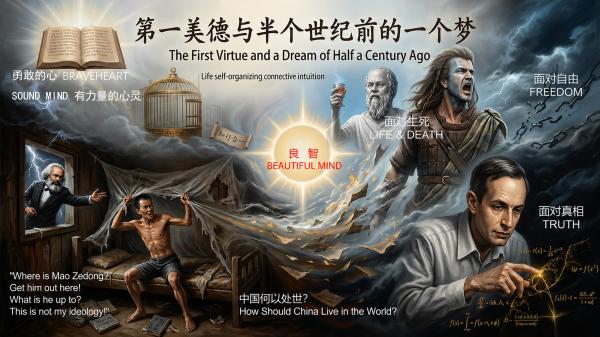
从《Holy Bible》视角看,那更是从“惑知”走向“圣智”的道成肉身的显现——Beautiful Mind,对应Power(刚强/血性)、Love(慈爱/良心)与Sound Mind(健全、清明、有力量的心灵),宣示上帝所赐绝非胆怯,而是直面生死、真相与自由的免疫力;更棒喝世人“切莫被世界规训”,唯要Renew(更新)Beautiful Mind,从而以向死而生的智性,从惑知跨越至圣智!
于是,对不起,在《共生简史》中,我对现在人们似乎越来越喜欢的张横渠“四句教”(为天地立心,为生民立命,为往圣继绝学,为万世开太平)和王阳明“四句教”( 无善无恶心之体,有善有恶意之动,知善知恶是良知,为善去恶是格物),就直接提出了批评。仅仅是“为往圣继绝学”、为良知而进行世俗层面的“知行合一”,大概率只会造就北京大学钱理群教授描述的“精致的利己主义者”。因为当他们割舍了生命本源的野性与血性(Braveheart)时,“无可奈何”就成了一种最精致、最体面的自保借口。
诚如英国作家 C.S. 路易斯所说:“勇气不仅是美德的一种,更是每一种美德在经受考验关头时的表现形式。”
而我们用丘吉尔的勇敢是“第一美德”,来反观当下知识分子那种犬儒式的无奈和分寸感,不过是对当代所谓“文人风骨”的一声重磅棒喝而已。有知识而缺思想,有知识而缺苏格拉底、纳什、华莱士式智性的心灵——在面对生死、面对真相,面对自由的抉择时,若没有野性与血性(Braveheart),没有“良智”(Beautiful Mind)的支撑,不过是一副好看的皮囊罢了!
二、 1975年夏夜:一个青年农夫的反规训直觉
在这里,我必须澄清:我不是知识分子,也从未有过做学者或作家的野心。我,只是一个忠实于感知的思行者。
这种对感知的绝对忠实,可能早在半个世纪前,一个惊心动魄的夏夜,就已经在我的生命里完成了初次的自组织演化。
1975年,我还是一个地道的青年农夫。在那个用猪栏修葺成的小小房间里,窗户只有半米见方,床头紧挨着一个小木箱。就在那个夜晚,我做了一个极其奇特的梦:卡尔·马克思突然从那扇半米宽的窗户翩然而至,冲着我大喊:“毛泽东在哪里?你给我叫他出来,他搞什么名堂,这哪是我的思想?”
梦中的我吓了一大跳,革命导师怎么突然来了?赶紧在梦里说:“毛主席刚刚出恭,他很崇拜你啊!”只听到马克思留下一声“那还差不多!”,人便凭空不见了。
我大汗淋漓地醒来,发现自己由于惊吓和激动,把床上的蚊帐都给扯了下来。第二天跟我妈说起这事,她没有任何宏大的说教,只是很平淡、却极其戒备地叮嘱了一句:“崽哩,这事千万别告诉别人,包括你爸爸也不要说。”
其实,很多年来,我一直没有弄明白,我当时为什么会做这样的梦?
有一点可以肯定,我当时绝对没有杨小凯那样的政治觉悟。在文革正酣中的1968年,杨小凯就写出了惊世骇俗的《中国向何处去?》——虽然这是五四以来中国人一以贯之的时代主题,但我后来在自己的《原德:大国哲学》中,对这个主题其实不以为然,而是明确提出了另一个属于我们这个时代的全新主题:“中国何以处世?”但即便如此,我对当年的杨小凯依然非常敬佩。
相比于杨小凯,我觉悟慢,一是因为我当时年纪小了几岁,还不谙世事;再者,我当时在农村,更没读过那么多的书。不过靠着各种机缘巧合,我确实死啃过马恩几乎全部翻译过来的原本,读过海涅的《德国宗教和哲学的历史》和海克尔《宇宙之谜》,剩下的便是鲁迅的书、毛的书,以及从老农家里搜集来的石印中医药书。靠着那些医书,我自己采药制药,在自己身上试用针灸,给当地缺医少药的农民伯伯“行方便”,自得其乐。
最后还有一点,尽管我们家当时备受政治、经济和农村宗法势力(虽然看不见却实实在在存在)的剥削与压迫,但我当时骨子里其实还挺敬佩毛主席。记得文革刚开始时,老师让我们小学生跟着中学生去街上游行,我竟鬼使神差,把“打倒刘少奇,保卫毛主席”的口号,给当众喊反了。顺便说一句,奇怪的是,后来知道,那次游行竟有三个小学生把这个口号喊反了,直接惊动到县公安局,以为是阶级敌人搞破坏,经调查发现三个孩子根本不认识,更没有人指使,但我也从此就彻底失学了。后来(应当是1967年),我偶尔得到了一本油印的《毛主席1936年与斯诺的谈话》,依然看得爱不释手!
结语:生存感知的直觉,即是良智的萌芽
现在回望,难道那个大汗淋漓的梦,只是一个巧合吗?
不。那是一个白天“面朝黄土背朝天,上蒸下晒泡水田”,晚上拖着疲惫不堪的身子,躺在猪栏里死啃硬书的青年农夫,在灵魂深处凭借着最本能的逻辑与常识,完成的一次自觉又不自觉的生命自组织连接反规训直觉!
这种忠实于生存感知的直觉,当然不需要依靠学者们宏大的、用来装点门面的理论。它,恰恰就是我后来在生命哲学中所极力推崇的——“良智”(Beautiful Mind)在那个荒诞且压抑的年代里,最初、也最顽强的萌芽。
当多伦多的朋友在面对常识破局的时代发出一声“无可奈何”的叹息时,我想,我们应该回望那个在猪栏里大汗淋漓、扯落蚊帐的夜晚。如果一个失学的年轻农夫,在最深的现实压迫下,尚能凭借生存感知完成对时代的祛魅;那么今天坐在精致象牙塔和宏大理论背后的中国知识分子们,又有什么理由用“分寸感”和“无可奈何”作为借口,去割舍掉作为美德之首的勇敢呢?
有知识而缺思想,不过是一副好看的皮囊。
唯有忠实于感知的思行,唯有野性与血性支撑的良智(Beautiful Mind),才能在这个数位-量子时代,真正回答“中国何以处世”,人类何以共生。
The First Virtue and a Dream from Half a Century Ago
By Archer Hong Qian (钱宏)
Written on July 9, 2026, in Vancouver
Prelude: The Loop of the Calla Lily and a Heavy Blow to "Helplessness"
On the evening of July 9, 2026, a single calla lily stood in quiet repose under the midsummer night breeze in front of the Richmond Public Library in Vancouver (p. 1).
This streak of pure white suddenly grazed my vision (p. 1). In a flash, an image from It Is Too Hard to Call Him Father (叫父亲太难)—a long-form novel I read over thirty years ago that was woven out of pure fiction—vividly materialized through a fold in time: the calla lily as a symbol of love (p. 1). By a subtle twist of fate, just this morning, a professor from Yale had forwarded me the latest online article by the US-based writer Kong Jiesheng (p. 1). At this very moment, the world was clamoring over the newly concluded World Cup in the United States; Donald Trump, the president labeled as a "politically incorrect political novice," had once again become the target of global denunciation (p. 1). Yet, amidst the uproar, this absurdity—where the entire world feels entitled to berate an American president—constituted precisely a "return to common sense" (p. 1).
However, when an old friend from Toronto finished reading my essay, How to Face the Trumpian Breakout: The Collapse of Elites, the Return of Common Sense, and the Co-evolution of the Digital-Quantum Era, he sent over a deeply sorrowful and perplexed reflection (p. 1):
"It is entirely understandable that the American Left attacks Trump, branding him with labels like dictator, fascist, and subverter of the constitutional order, driven as they are by partisan warfare and personal interests. But for Chinese figures like He Weifang and Zhang Qianfan to blacken Trump in the exact same manner—is this truly their genuine cognition? Zhang Qianfan went so far as to use outright vulgar abuse to attack Trump. For a leading figure in the Chinese legal community to degrade himself into a street brawler is truly beyond comprehension." (p. 1)
At the end of his message, my friend let out a heavy sigh, thick with the suffocating weight of our times: "The contemporary Chinese intellectuals are, after all, utterly helpless." (p. 1)
This phrase, "utterly helpless," acted like a key, instantly unlocking the floodgates of my memory (p. 1). I replied to him: Yes, it is rational and understandable (p. 1). But they are simply missing a bit of the feral nature, the raw passion, and that brave heart—the Beautiful Mind (p. 1).
Otherwise, why would Winston Churchill declare: "Courage is rightly esteemed the first of human qualities... because it is the quality which guarantees all others"?! (p. 1)
My translation is direct: Courage is the first virtue among all virtues! (p. 1)
Yet, I absolutely reject the mechanical analysis offered by AI or mundane interpreters regarding a so-called "perfect misplacement of words." (p. 1) In the linguistic context of human self-organizing connectivity and intersubjective coexistence, this "first virtue" is simultaneously a Wallace-style Braveheart and a Nash-style Beautiful Mind (p. 1). Therefore, I steadfastly use Beautiful Mind to translate "Liang Zhi" (良智—Divine Wisdom) within the core trinity of "Liang Zhi-Civilization-Coexistence" under the broader framework of the LIFE-AI-TRUST Interactive Resonance (p. 1)!
I. Rejecting Exquisite Egoism: From "Liang Zhi" (Conscience) to Nashian "Moral Pursuit"
I have long felt that merely invoking Liang Zhi (良知—conventional conscience), or even preaching the surface-level "unity of knowledge and action" (知行合一), is woefully inadequate when confronting complex existential trials (p. 2).
To rescue or not to rescue someone drowning; to retreat in the face of hardship or to charge forward; to bide one's time by "playing the fool" or to self-inflate through aggressive activism... within the parameters of utilitarian logic, all of these can be rationalized as the "unity of knowledge and action." (p. 2) In other words, the "unity of knowledge and action" (知行合一) does not equate to the "unity of moral character and action" (德行合一), nor the "unity of contemplative reflection and action" (思行合一) (p. 2).
Only later did I discover that in Buddhist philosophy, a rigorous distinction is drawn between Zhi (知—empirical knowledge/cognition) and Zhi (智—transcendent wisdom) (p. 2). This is an extraordinarily intriguing and profound demarcation (p. 2). Conventional conscience (良知) does not equate to Divine Wisdom (良智), for the former lacks the rich fullness contained within Liang Xin (良心—the pristine heart) and Liang Neng (良能—the innate capacity for moral action) (p. 2).
The classical Chinese Buddhist treatise Banyor Wuzhi Lun (般若无知论—On the Changelessness of Transcendent Wisdom) by Sengzhao explicitly states: "To seek wisdom through external conditions is to misunderstand it; true wisdom is not mere empirical knowledge." (p. 2) Furthermore, according to the Four Reliances—specifically "rely on wisdom, not on consciousness" (依智不依识)—and employing the method of the Two Truths (the ultimate and the mundane), the relationship between wisdom and knowledge is defined as a transcendence from divisive, superficial "delusional cognition" (惑知) to the profound, all-illuminating "sacred wisdom" (圣智), which is Liang Zhi (良智—Divine Wisdom) (p. 2).
It was only after watching the film A Beautiful Mind—witnessing John Nash navigate the abyssal depths of schizophrenia, relying solely on pure rationality and intellect to forge order out of absolute chaos—that the realization hit me like a thunderbolt: That is the absolute pinnacle of intellect, logic, and moral pursuit! (p. 2)
From the perspective of the Holy Bible, it is the literal manifestation of the Word made flesh—the journey from "delusional cognition" to "sacred wisdom." (p. 2) This Beautiful Mind corresponds precisely to Power (feral courage/raw passion), Love (compassion/pristine heart), and a Sound Mind (a wholesome, lucid, and powerful intellect) (p. 2). It proclaims that what God bestows upon us is never a spirit of fear, but an innate immunity to confront mortality, truth, and freedom head-on (p. 2). It delivers a stern warning to humanity: "Do not be conformed to this world," but instead, renew your Beautiful Mind, thereby utilizing a mortal intellect that gazes into death to cross the chasm from delusional cognition to sacred wisdom (p. 2)!
Consequently—and I offer no apologies—in A Brief History of Coexistence (共生简史), I launched an explicit critique against Zhang Hengqu’s celebrated "Four Sentences" (为天地立心,为生民立命,为往圣继绝学,为万世开太平) and Wang Yangming’s "Four Sentences" (无善无恶心之体,有善有恶意之动,知善知恶是良知,为善去恶是格物) (p. 2). To merely "continue the lost teachings of past sages" or to practice a mundane "unity of knowledge and action" for the sake of conventional conscience will, in all probability, produce nothing but what Professor Qian Liqun of Peking University termed "exquisite egoists." (p. 2) Because the moment they excise the feral nature and raw passion (Braveheart) native to the human life-force, "helplessness" mutates into their most elegant and sophisticated alibi for self-preservation (p. 2).
As the British author C.S. Lewis astutely noted: "Courage is not simply one of the virtues, but the form of every virtue at the testing point." (p. 2)
When we weaponize Churchill’s declaration of courage as the "first virtue" to look back at the cynical helplessness and curated boundaries of contemporary intellectuals, it serves as nothing less than a thunderous blow to the so-called "integrity of the literati." (p. 2) To possess encyclopedic knowledge but lack original thought, to possess information but lack the transcendent, intellectual minds of Socrates, Nash, or Wallace—when standing before mortality, before truth, and before the choices of freedom—is to be nothing more than a well-crafted, empty shell if there is no raw passion (Braveheart) and no Divine Wisdom (Beautiful Mind) to sustain you (p. 2)!
II. A Summer Night in 1975: The Anti-Disciplinary Intuition of a Young Peasant
At this juncture, I must clarify unequivocally: I am not an intellectual, nor have I ever harbored the ambition to become an academic or a writer. I am simply a thinker-doer (思行者) who remains fiercely loyal to existential perception. (p. 3)
This absolute fidelity to perception underwent its inaugural self-organizing evolution within my life-system half a century ago, during a terrifying and breathtaking summer night (p. 3).
In 1975, I was a authentic young peasant (p. 3). In that tiny room of mine, which had been converted from a pigsty, the window measured a meager half-meter wide, and the head of my bed was wedged tightly against a small wooden crate (p. 3). On that particular night, I had an extraordinarily bizarre dream: Karl Marx suddenly arrived, floating through that half-meter window, shouting directly at me: "Where is Mao Zedong? Go bring him out to me! What on earth is he playing at? How is any of this my thought?!" (p. 3)
In the dream, I was scared out of my wits (p. 3). How did the revolutionary grandmaster end up here? I hurriedly stammered back in my sleep: "Chairman Mao has just gone to the latrine! He respects you immensely!" Marx merely let out a gruff grunt—"Well, that's more like it!"—and vanished into thin air (p. 3).
I awoke drenched in sweat, discovering that in my terror and agitation, I had completely torn down the mosquito net above my bed (p. 3). When I recounted this to my mother the following day, she offered no grand ideological lecture; she merely gave me a flat, hyper-vigilant warning: "My boy, never breathe a word of this to anyone. Do not even tell your father." (p. 3)
Truth be told, for many years, I could never fully comprehend why I had such a dream (p. 3). One thing, however, is certain: at that time, I possessed absolutely none of the political consciousness that Yang Xiaokai held (p. 3). In 1968, at the height of the Cultural Revolution, Yang Xiaokai had already penned the earth-shattering essay, Whither China? (中国向何处去?) (p. 3). Although this has been the continuous, defining theme for Chinese thinkers since the May Fourth Movement, I later took a different stance in my own book, The Primal Virtue: Philosophy of a Great Power (原德:大国哲学), explicitly pivoting to the crucial thesis of our contemporary era: "How Does China Comport Itself in the World?" (中国何以处世?) (p. 3) Nonetheless, my reverence for the Yang Xiaokai of those years remains undiminished (p. 3).
Compared to Yang Xiaokai, my awakening was slow (p. 3). This was partly because I was a few years younger and still innocent to the world, and partly because I was stranded in the countryside, starved of a systematic education (p. 3). Yet, through a series of serendipitous encounters, I had managed to devour almost every translated volume of Marx and Engels' original texts (p. 3). I had read Heine’s On the History of Religion and Philosophy in Germany and Ernst Haeckel’s The Riddle of the Universe (p. 3). The remainder of my library consisted of the works of Lu Xun, the writings of Mao, and lithographed traditional Chinese medicine books salvaged from old farmers' homes (p. 3). Armed with those medical texts, I gathered and processed herbs myself, experimented with acupuncture on my own body, and provided free basic care to the local elderly peasants who lacked access to medicine, finding profound joy in this simple service (p. 3).
Lastly, despite the fact that our family was intensely exploited and oppressed by the prevailing political, economic, and rural patriarchal structures—forces that, though invisible, were tangible and heavy—I still harbored a genuine, deep-seated admiration for Chairman Mao in my bones (p. 3). I remember vividly when the Cultural Revolution began; our primary school teachers marched us out to join the high school students in a street rally (p. 3). By some bizarre, inexplicable freak of nature, I accidentally chanted the slogan in reverse, shouting it out loud to the public: "Down with Chairman Mao, protect Liu Shaoqi!" (p. 3) Strangely enough, I later found out that during that very same march, two other primary school children had also inverted the slogan completely independently (p. 3). The incident sent shockwaves all the way to the County Public Security Bureau, which suspected a coordinated act of subversion by class enemies (p. 3). The investigation eventually revealed that the three of us did not even know each other, let alone act under anyone's orders (p. 3). Nevertheless, that marked the absolute end of my formal schooling (p. 3). Later (around 1967), I accidentally got hold of a mimeographed copy of Chairman Mao’s 1936 Conversations with Edgar Snow, a text I treasured and read endlessly (p. 3)!
Conclusion: The Intuition of Existential Perception is the Seedling of Divine Wisdom
Looking back now, could that sweat-soaked dream have been a mere coincidence (p. 3)?
No (p. 4). It was the product of a young peasant who spent his days "facing the yellow earth with his back to the sky, boiling under the sun and soaking in the waterlogged paddies," and his nights dragging a bone-weary body back to a converted pigsty to pore over dense, forbidden texts (p. 4). It was an act of anti-disciplinary intuition—a spontaneous, self-organizing rebellion born in the deepest recesses of the soul, relying purely on the most primal logic and common sense (p. 4)!
This brand of intuition, fiercely loyal to existential perception, naturally has no need for the grand, ornamental theories that academics use to decorate their facades (p. 4). It was precisely the earliest, most resilient seedling of what I would later champion in my philosophy of life as "Divine Wisdom" (良智—Beautiful Mind), sprouting defiantly in that absurd and suffocating era (p. 4).
When my friend in Toronto sighs with "utter helplessness" in the face of today’s collapsing consensus, we ought to turn our gaze back to that sweltering night in the pigsty, where a boy tore down his mosquito net in a cold sweat (pp. 1, 4). If an unschooled young peasant, operating under the crushing weight of real-world oppression, could rely solely on existential perception to demystify his era, then what right do the Chinese intellectuals of today—sheltered behind the walls of exquisite ivory towers and grand theories—have to use "the need for boundaries" and "helplessness" as apologies for abandoning courage, the absolute foremost of all virtues (p. 4)?
To possess knowledge but lack original thought is to be nothing more than a well-crafted, empty shell (p. 4).
Only a contemplative action that remains fiercely loyal to perception, and only a Divine Wisdom (Beautiful Mind) anchored by feral courage and raw passion, can truly answer how China comports itself in the world, and how humanity coexists within this digital-quantum era (p. 4).